
Welcome to this week’s AI round-up! In this edition, we evaluate the performance of GLM-5 within the AI World Model Leaderboard and provide a comprehensive longitudinal analysis of Germany’s AI ecosystem, tracing its strategic trajectory from 2023 through 2025.We also present a selection of frontier research and spotlight emerging startups driving transformation circular economy and medical sector regulation.
This week at a glance:
GLM-5 emerges as open-source leader: our latest data confirms GLM-5 as the top-performing open-source model on the AIW Model Leaderboard, marking a significant milestone in the development of high-performance open architecture.
Germany’s AI ecosystem (2023–2025): an overview of how the German ecosystem has developed, highlighting shifts in research output, corporate adoption and investment resilience over the past three years.
Research papers: our selection of five notable publications examining the latest technical milestones and evolving governance frameworks that are shaping the global AI field.
Startup spotlights: a look at three pioneering companies that are using AI to overcome challenges in areas ranging from the circular economy to medical sector regulation.
Z.ai’s latest release, GLM-5, has set a new standard for open-weight performance, securing first place among open-source LLMs in the AI World Models Ranking.
With a score of 50 on the Artificial Analysis Intelligence Index, GLM-5 is the first open-source model to cross this critical threshold, narrowing the capability gap to just three points behind the proprietary leader, Claude Opus 4.6.
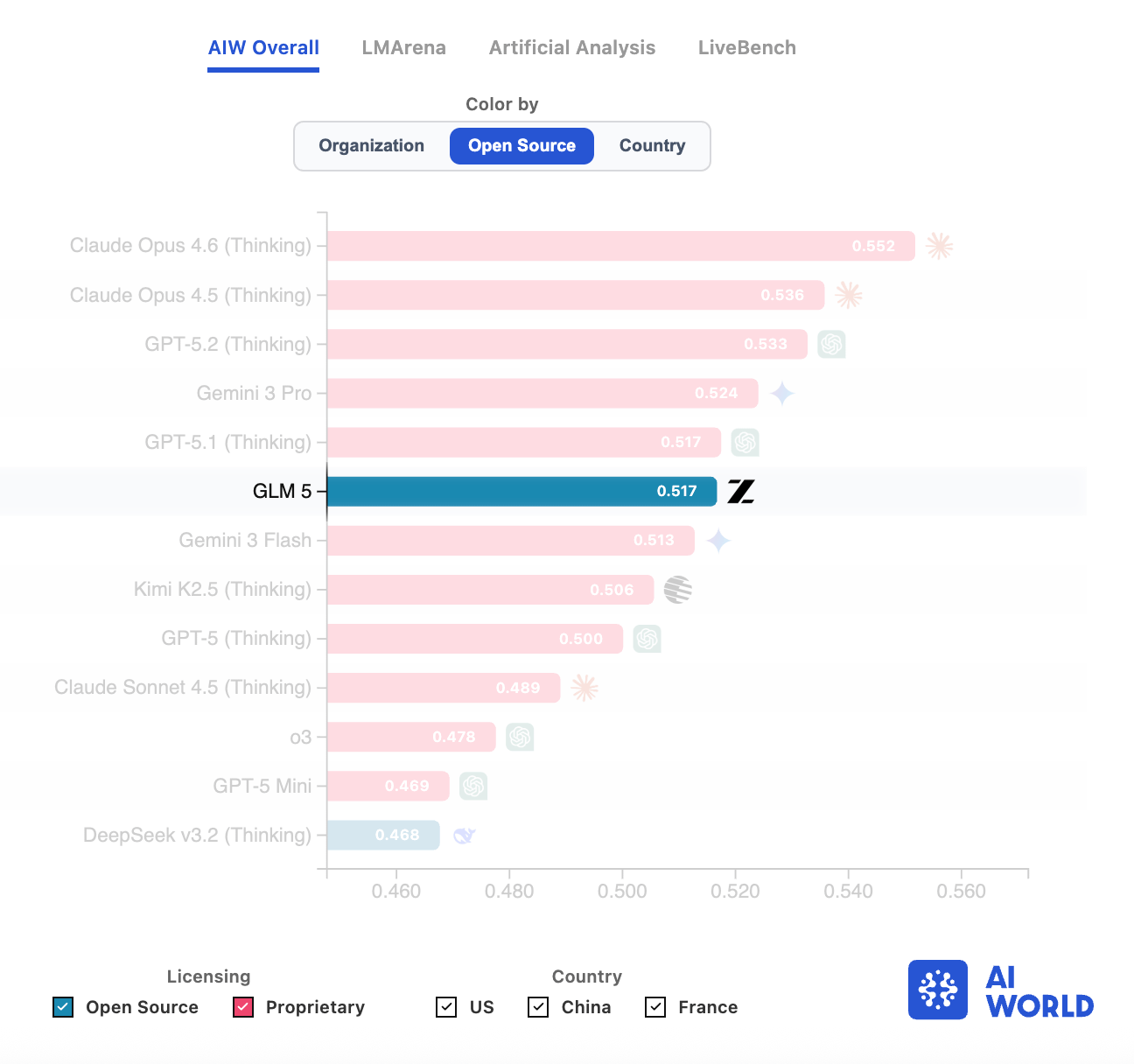
Powered by a 740B Mixture-of-Experts architecture, GLM-5 demonstrates outstanding performance in long-term reasoning and autonomous task execution.
Yet its transition to open weights at this scale introduces a strategic trade-off between infrastructure and API. Despite competitive per-token pricing, the 1 TB+ memory footprint required for local deployment may eclipse cost savings for many organisations.
→ Read the full analysis of GLM-5’s performance and deployment costs on AI World
From 2023 to 2025, Germany’s AI ecosystem was characterised by a distributed research footprint that increasingly aligned with concentrated financial support. Innovation remained geographically widespread, driven by a prestigious network of institutions including the Technical University of Munich, KIT, and Heidelberg country.

By 2025, Munich and Berlin had become the country’s leading cities for scientific output, with Stuttgart, Cologne and Frankfurt am Main also making significant contributions. Investment patterns increasingly reflected this research density, with capital flowing towards regions with high concentrations of innovation.
The German ecosystem is currently characterised by a narrowing gap between where knowledge is generated and where it is financed. Unlike other markets, which are defined by regional disparities, Germany is moving towards a self-sustaining cycle in which research excellence, distributed across the country, reliably precedes future capital allocation.
→ Read the full analysis on AI World
This week’s research looks at the impact of AI on human capital through educational empowerment, historical integrity and medical morality.
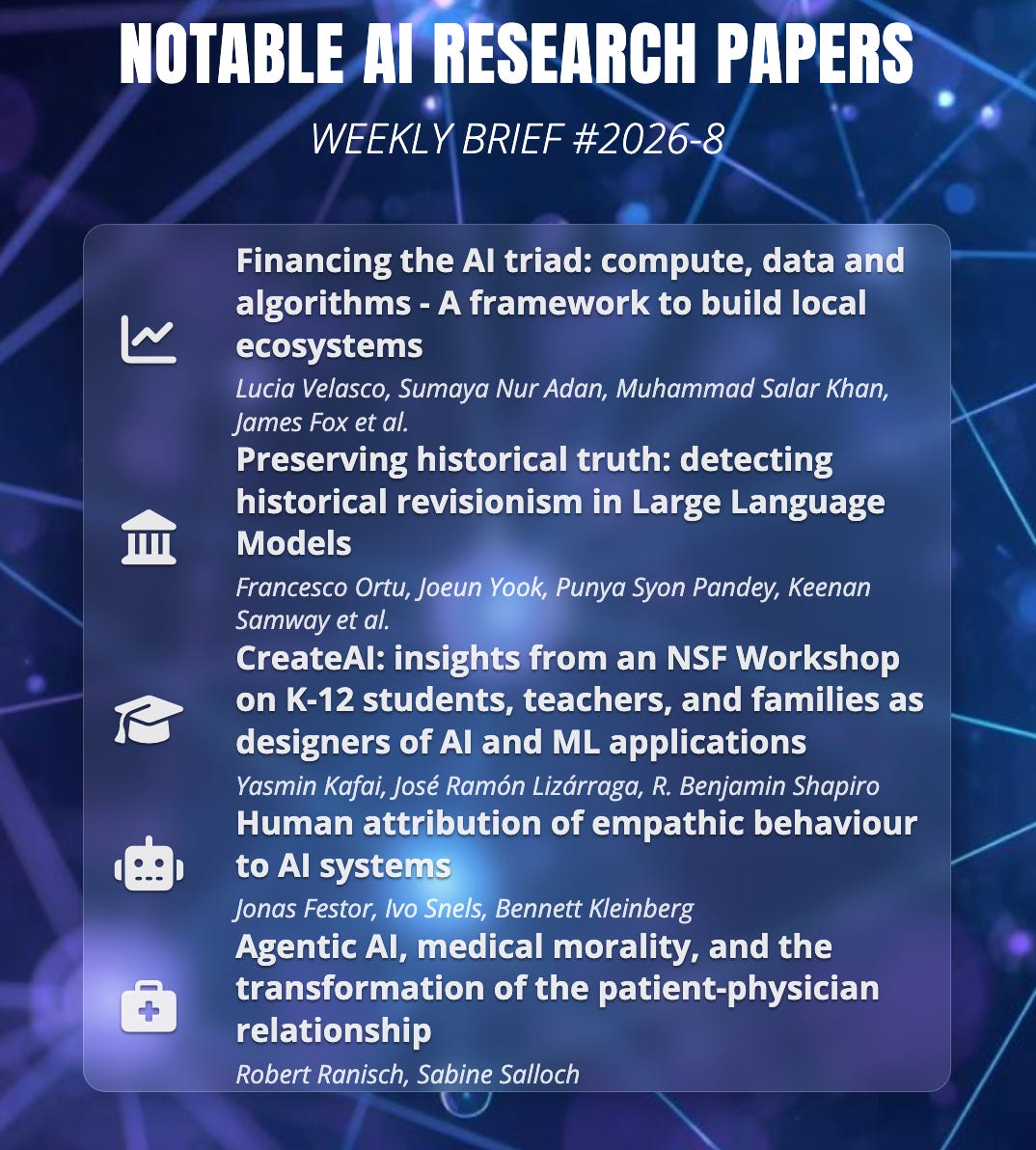
Curious for more? Explore this week’s 5 most notable AI research papers to stay up to date on the latest insights and developments in the field.
This week’s startup selection showcases the application of AI to systemic challenges in sustainable mobility, information integrity and the life sciences.
🇱🇹 Tingit has developed an AI-powered marketplace with the aim of streamlining the fragmented repair sector. The platform instantly identifies and estimates damage, connecting consumers with specialist craftsmen via proprietary algorithms. The Vilnius-based startup closed a €1.5 million seed funding round to expand across the EU.
🇦🇹 Flinn offers an AI-native platform that enables medical device and pharmaceutical manufacturers to automate labour-intensive regulatory workflows. The Vienna-based company recently secured $20 million in funding led by HV Capital to drive international growth and accelerate product development.
🇬🇧 Klaris provides an AI-driven solution aimed at alleviating the regulatory bottlenecks of the EU Medical Device Regulation (MDR). The platform carries out accurate gap analyses to ensure documentation is aligned with evolving standards. The start-up raised $1 million in pre-seed funding to expand its engineering capabilities and strengthen its presence in the European market.
For more updates, research, and insights across the AI ecosystem, visit aiworld.eu. Subscribe to receive next week’s roundup directly in your inbox and stay ahead of key developments.
Have a great week ahead!
Gaia Cavaglioni
On behalf of the AI World Team
Comments
Nothing yet. Say the first thing.
Sign in to join the conversation.