
Today I am at the Ritz-Carlton DIFC in Dubai, having a lovely break and a couple of meetings. Nice acai bowl and classic British cuisine. To be fair, this might be my new favourite hotel in Dubai. The service has been unbelievable.



A friend of mine runs a small design studio. Three people, decent client list, the kind of practice you’d point at as healthy. Last month she sent me a screenshot of an invoice she was about to send. £4,800 for a brand identity. Logo, type system, colour, basic guidelines. She’d worked on it for four days.
She was uncomfortable.
“Lee, the actual work took about six hours. The rest was me waiting, second-guessing, generating options I knew I wouldn’t use, padding the timeline because clients expect designers to take a week. If I send this invoice and tell them it was six hours, they’ll think I’m overcharging. If I send it and don’t tell them, I feel like I’m overcharging.”
She is one of the best designers I know. The output was excellent. The client got real value. But the moment she could produce the work in a fraction of the time, the price started to look like the wrong number for a reason she couldn’t quite articulate.
That feeling, that quiet wrongness, is showing up everywhere right now.
For most of modern economic history, professional services have been priced against time. Lawyers in six-minute units. Consultants in day rates. Agencies in retainers tied to estimated effort. Developers in sprint capacity. Even fixed-price projects were, underneath, just packaged time with a margin.
We told ourselves we were billing for expertise. We weren’t, not really. We were billing for the hours it took an expert to deliver the thing. Expertise was the justification for the rate. Time was the unit.
This worked because time was genuinely scarce. The bottleneck in delivering professional work was the number of trained humans you had and the number of hours each of them could think for. Knowledge was uneven, distributed unevenly, accessible only through people who’d spent years acquiring it.
Production was slow because
thinking is slow
writing is slow
drawing is slow
rewriting is slow.

Hours were the natural metric because hours were the thing in short supply.
What happens when that stops being true?
I keep thinking about the hand-loom weavers. Not because it makes for a neat historical comparison, but because it points to a shape that keeps repeating: new tools arrive, the pace changes, and people whose work was built on time, skill, and handcraft find themselves measured by a different standard. The industrial era made that especially clear, and the weavers are one of the best examples we have.
In the early 1800s, a skilled hand-loom weaver in Lancashire could produce a piece of cloth in a day. The price reflected the craft: the years of apprenticeship, the dexterity, the rhythm of the loom. Customers weren’t paying for cloth. They were paying for the cloth a skilled person could weave in a day. The unit was the same as it is now in a law firm: a person, a day, a fee.
Then the power loom arrived. One operator with a machine could outproduce twenty weavers. By the 1830s, ten thousand weavers in Manchester were earning a fraction of what they’d earned a decade earlier. By the 1860s, the trade was effectively gone. Not because the cloth got worse. Because the unit of value collapsed. Cloth was no longer scarce. The hour of a weaver was no longer the thing being bought.
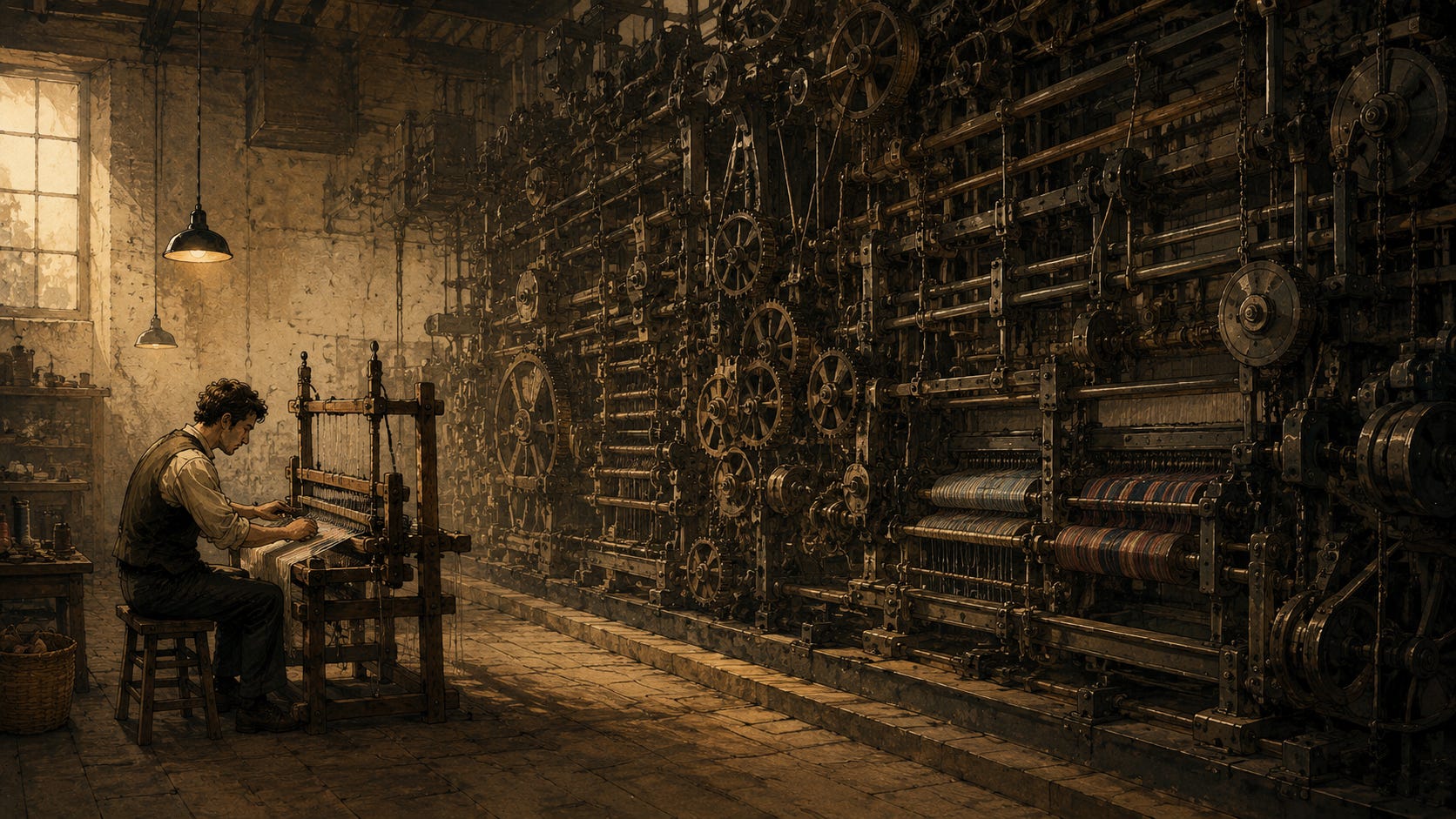
Notice what didn’t happen. The weavers didn’t get a memo. There was no quarterly review where someone explained that the pricing model was now obsolete. They kept charging by the day because that’s how they’d always charged, while the market quietly stopped paying that way. The misalignment is what bankrupted them, not the machine itself.
A copywriter who used to take three days to draft a launch sequence can now produce a first pass in twenty minutes. A junior analyst who used to spend a week on a market scan can produce one in an afternoon. A lawyer who used to read three hundred pages of disclosure can ask a model to surface the seven that matter. A developer who used to scaffold a working prototype in two weeks can stand one up before lunch.
In every case, the hourly model is still in place. The invoices still go out in days, weeks, and retainers. The clients still expect the timelines they’re used to. The professionals, like my designer friend, still feel they have to perform the old duration in order to justify the old fee.
But the thing that made the hour expensive, the scarcity of skilled execution, is evaporating underneath the invoice.
This is where things get interesting. Because the response from most firms so far has been to lean harder into the old model. Resist disclosing AI use. Bill the same hours even when the work took less. A lot of what looks like denial is actually a quieter calculation. Make hay while the sun shines. Privately accept that the model will not survive the decade, and treat the next few years as a final harvest rather than the start of a different business. It is the shape of an industry that has already conceded defeat and is now optimising for the last few good summers.
It works for now. The weavers had decades to work that out. This AI shift is going to move much faster, probably the next five years. It just delays the moment when someone, somewhere, decides to compete on the new model.
Step back from billing for a second and look at what made professional services defensible in the first place.
There were three pillars:
information asymmetry
slow execution
trained judgement
You knew things the client didn’t. You could do things they couldn’t.
And you’d developed taste they hadn’t yet earned.
AI has dismantled the first two pillars almost completely.
Information asymmetry is largely gone. A founder with a model and a Tuesday afternoon can get a passable read on contract law, market positioning, brand strategy, or technical architecture. Not as good as a specialist. Often good enough to make the specialist unnecessary for the question they would have been hired to answer.
Slow execution is going next. The reason it took five people two months to deliver a campaign wasn’t the campaign. It was the production. Decks, briefs, drafts, revisions, handoffs, scheduling, the human admin around the actual creative work. Strip that out and the campaign is a week, maybe less. The work was never the bottleneck. The connective tissue was.
What survives, if anything, is the third pillar. Judgement. Taste. The ability to look at twenty options the model produced and say that one, and here’s why, and here’s what we’re not even going to attempt.
Context - Knowing the client well enough to make the call they would have made if they’d had three more weeks to think about it.
Strategy - Picking the right question to begin with so the speed gain doesn’t get spent producing the wrong thing faster.
These have always been the valuable parts of professional work. We just couldn’t bill them directly, because they were tangled up with the hours of execution that surrounded them. The execution was the invoice; the judgement came along for the ride.
Now the execution is collapsing. The judgement has to stand on its own.
I wrote previously about the HALO model, the human-agent operator who owns an outcome rather than a process. That was one answer to “what does a person sell now.” The broader version of the same question is what the firm sells, and how it charges.
A few patterns are already visible.
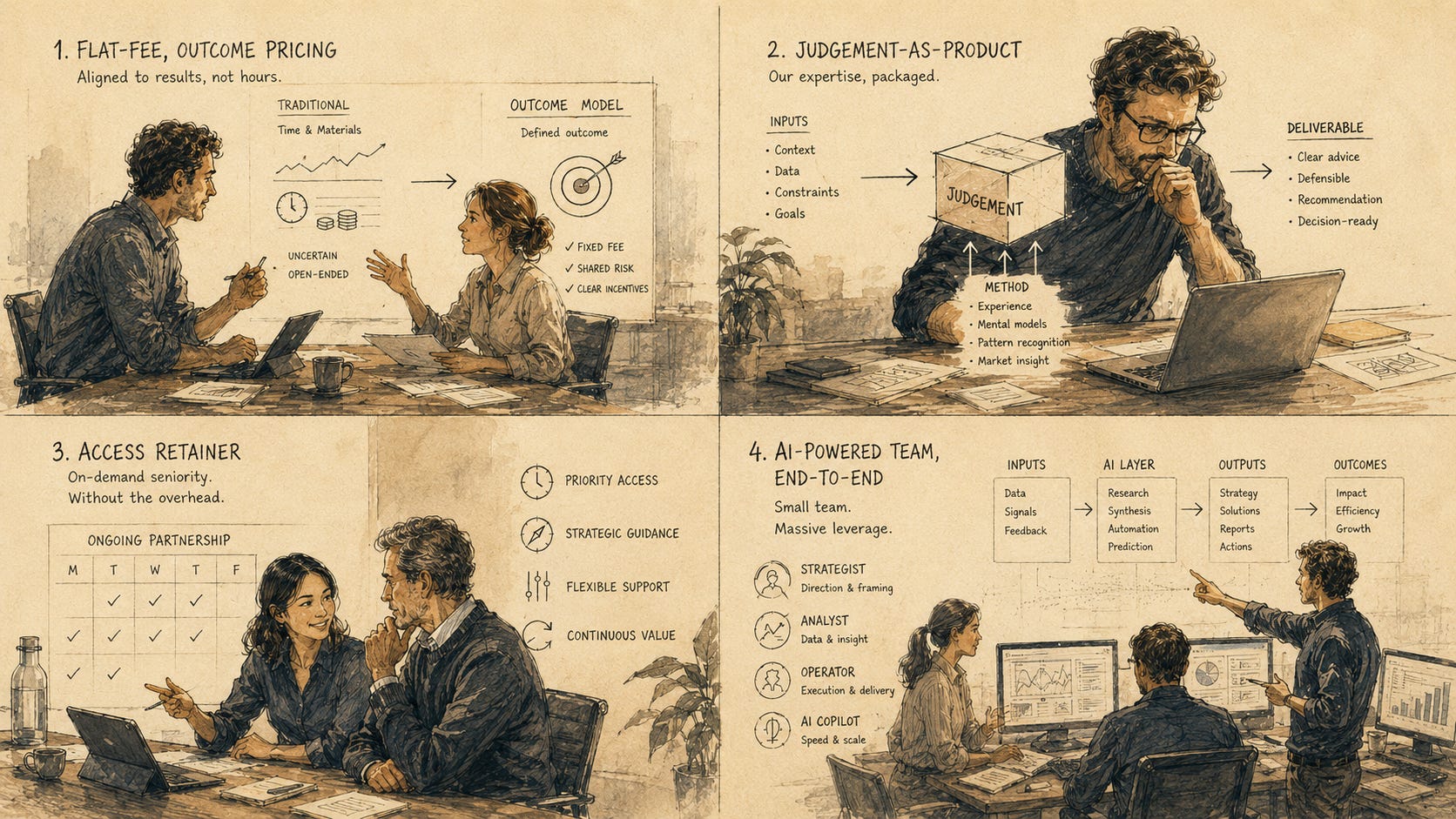
Outcome pricing. Not hours, not seats, not retainers. A flat fee for a defined result, or a percentage of the value created. This is uncomfortable because it forces you to be honest about what the result actually is. It also rewards speed instead of penalising it, which inverts the incentive of every billing model that came before.
Judgement-as-product. Selling the decision, not the execution. Strategy work has always been a version of this; the difference now is that you don’t need a team of twelve to produce the artefacts around the strategy. One operator with taste and tools can land the recommendation with a fraction of the overhead.
Access pricing. Pay for the right to call on someone whose judgement you trust, in the same way you might pay for a lawyer on retainer. The output is presence and availability, not deliverables.
Compounding services. This is the HALO idea above, scaled to a team. A small team that owns a function end-to-end and gets paid against its performance. The “agency” stops being a talent shop and starts being more like a fractional in-house team for hire, with the AI doing what the junior layer used to do. The catch, and the part that decides whether it works, is that the team has to have real IP underneath them. Accumulated workflows, tuned agents, the agentic patterns specific to that function, the playbooks of what to ask the model and how to make it stop. Without that, a “compounding services” firm just ends up taking as long as a human team would have, because nothing has actually been optimised. The leverage is not the AI itself. It is the work the team has already done to make the AI fast at the thing the client is paying for.
None of these are new ideas in isolation. What’s new is the forcing function. Until now you could choose to price by outcome if you wanted to be brave. Soon you’ll have to price by outcome because pricing by hour will be impossible to defend with a straight face.
The Industrial Revolution gave the weavers something we are not going to get. It gave them sixty years. Sixty years to retrain, to migrate, to organise, for new industries to absorb the displaced labour, for entire cities to reshape themselves around factory work.
The current shift is happening on a different clock. In two years we’ve gone from “AI might help with first drafts” to “AI can run an end-to-end function with one human in the loop.” The compression isn’t an opinion. It’s visible in any team that’s been paying attention. The rate of capability gain in the underlying models is doubling on a cadence that no institution, no pricing model, no professional body is structurally able to match.
It is worth being honest about the scale of the gain, because the language we have for it is too small. This is not a ten or twenty per cent productivity bump of the kind you might get from a better project management tool or a new IDE. The work a junior analyst used to do in a week is now done before lunch. The deck a brand team used to take a month on is a few prompts and a Friday afternoon. The “first pass” that used to be a billable phase of the project is, in a lot of cases, the entire job.
We are not optimising the old curve.
We are jumping to a different curve.
And the curve underneath that is still bending, fast.
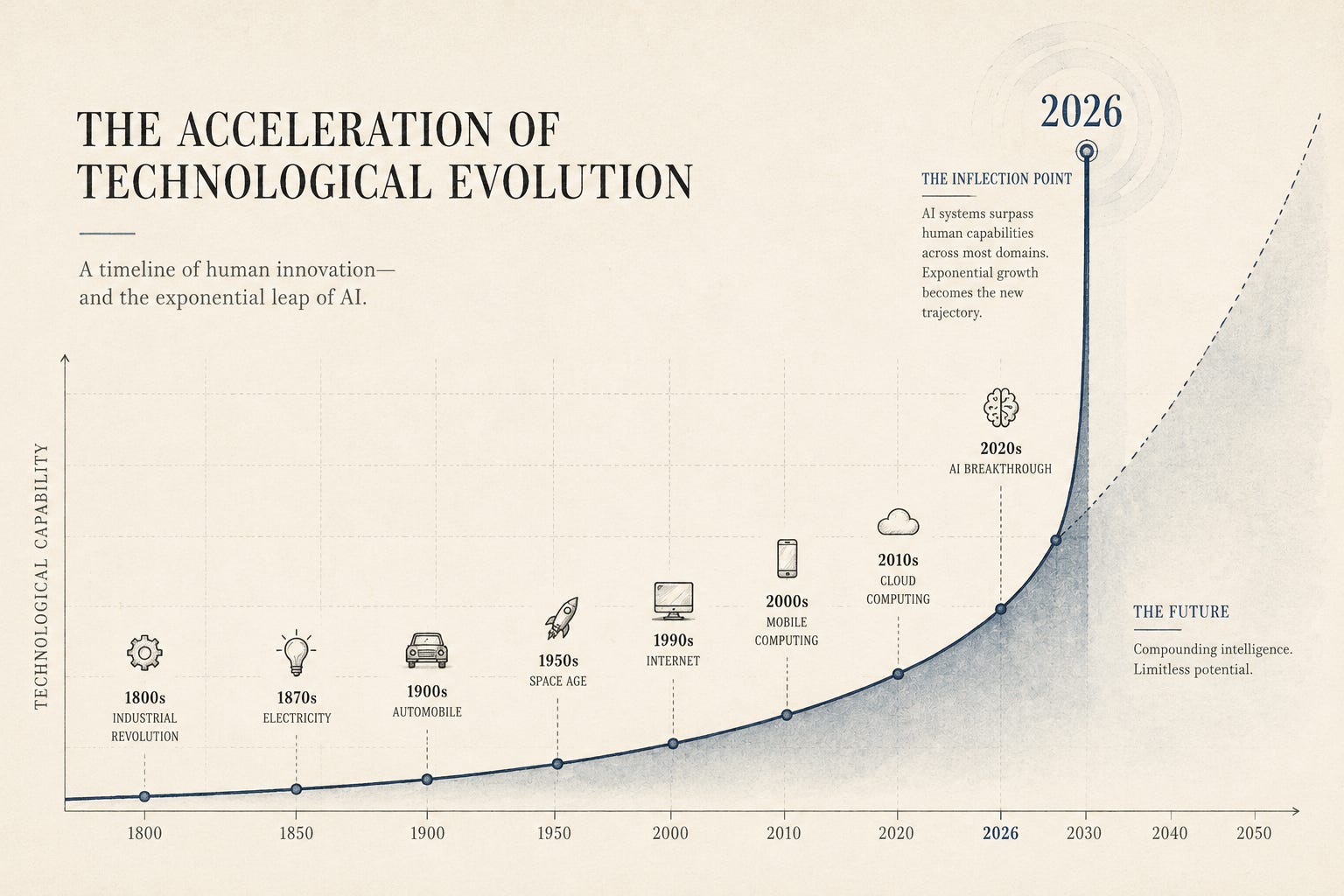
Which means the adjustment is going to be compressed too. Firms that take a decade to redesign their commercial model don’t have a decade. Professionals who plan to spend five years migrating into the new shape of their craft are working off a budget that doesn’t exist.
There is one mercy in this compared to the weavers, and it is worth saying out loud. The weavers were displaced by something they could not afford. Power looms meant factories, factories meant capital, capital meant industrialists. The leverage that ended their trade was structurally out of their reach. This AI shift is the opposite. Everyone gets the same machine, for the price of a takeaway dinner each month. The frontier model that is dismantling the old unit of value is also, for the first time in a transition of this size, sitting on the laptop of every person whose old unit is being dismantled. Whether you treat that as a threat or a tool is a choice, in a way it never was for the people standing next to the loom.
This isn’t a productivity story. It’s a units-of-value story. The hour was the unit. Everything else, the day, the project, the retainer, the headcount, the partner-track promotion, the agency rate card, was just a multiple of it. And the hour, as a unit of value, is diminishing in front of us. The currency is being devalued while we keep writing prices in it.
This is the question worth sitting with, because it’s the one the market is about to answer for you whether you like it or not.
If you’re a professional, what survives when the execution layer of your work is automated? What’s the part of what you do that someone would still pay for if the production took ten minutes? If the honest answer is “the brand of my firm” or “the relationship I have with the client,” that’s not nothing, but it’s a much thinner moat than you used to have.
If you’re a business, what are you actually buying from the agencies, consultants, and contractors on your books? If you’re buying hours, you’re buying a unit that’s about to be repriced underneath you. If you’re buying outcomes, fine. If you’re buying the feeling that someone capable is in charge, you’re buying a vibe, and vibes are going to get a lot cheaper.
And if you’re a leader, the uncomfortable exercise is to look at your own org chart and ask the same question of every role. What outcome is this person accountable for, and what would it look like if they had to defend that outcome without leaning on the hours it took to produce it? It’s the same question the weavers’ guilds should have been asking in 1815. They didn’t. The market asked it for them, and it asked it in a language with no room for negotiation. It is asking it now, of every firm still putting hours on an invoice and hoping the client does not notice the maths has changed.
The thing I keep coming back to is that we’re not really watching a technology story. We’re watching an economic ontology shift. The categories we used to organise work, time, expertise, scarcity, deliverable, fee, are all moving at once, and the language is lagging the reality.
For two centuries we paid each other for the hours it took to do the work. We’re going to spend the next decade working out what we pay each other for instead.
If you are an individual still billed in hours, the work is internal before it is external. Long before you can change a rate card you have to be willing to sit with a quieter question. What is someone actually buying when they buy a unit of my time? Not the polite answer that lives on your LinkedIn, the honest one. Strip out the hours and look at what’s left. The judgement calls you make in the first ten minutes of a brief. The taste that lets you discard nineteen of the twenty options. The pattern recognition that comes from having seen this shape of problem before. The relationships that mean a client trusts your read on the room. That residue is the thing you actually sell. The hours were the wrapper, and the wrapper is what is dissolving. Most of us have spent entire careers wearing the hour as if it were the work itself, which is why letting go of it feels like letting go of competence. It isn’t.
The people who answer that question early get to choose what they sell next. The ones who wait will find the market has already chosen for them, the way it chose for the weavers.
Comments
Nothing yet. Say the first thing.
Sign in to join the conversation.