
This week is the last week AI for Breakfast doesn’t come from a new breakfast spot in Abu Dhabi. As life somewhat returns to normal so shall trying out all the amazing places to eat and have breakfast in this great city.
Right, let’s get into it.
The manager role was invented to solve a coordination problem between humans - different contexts, different skills, different motivations all needing to point in the same direction. AI is dissolving that problem at the root. As individuals become dramatically more capable, the upstream need for coordinators, decomposers, and capacity-managers shrinks with them. What replaces the manager isn’t another manager. It’s an operator with deep craft and an army of agents - the HALO.
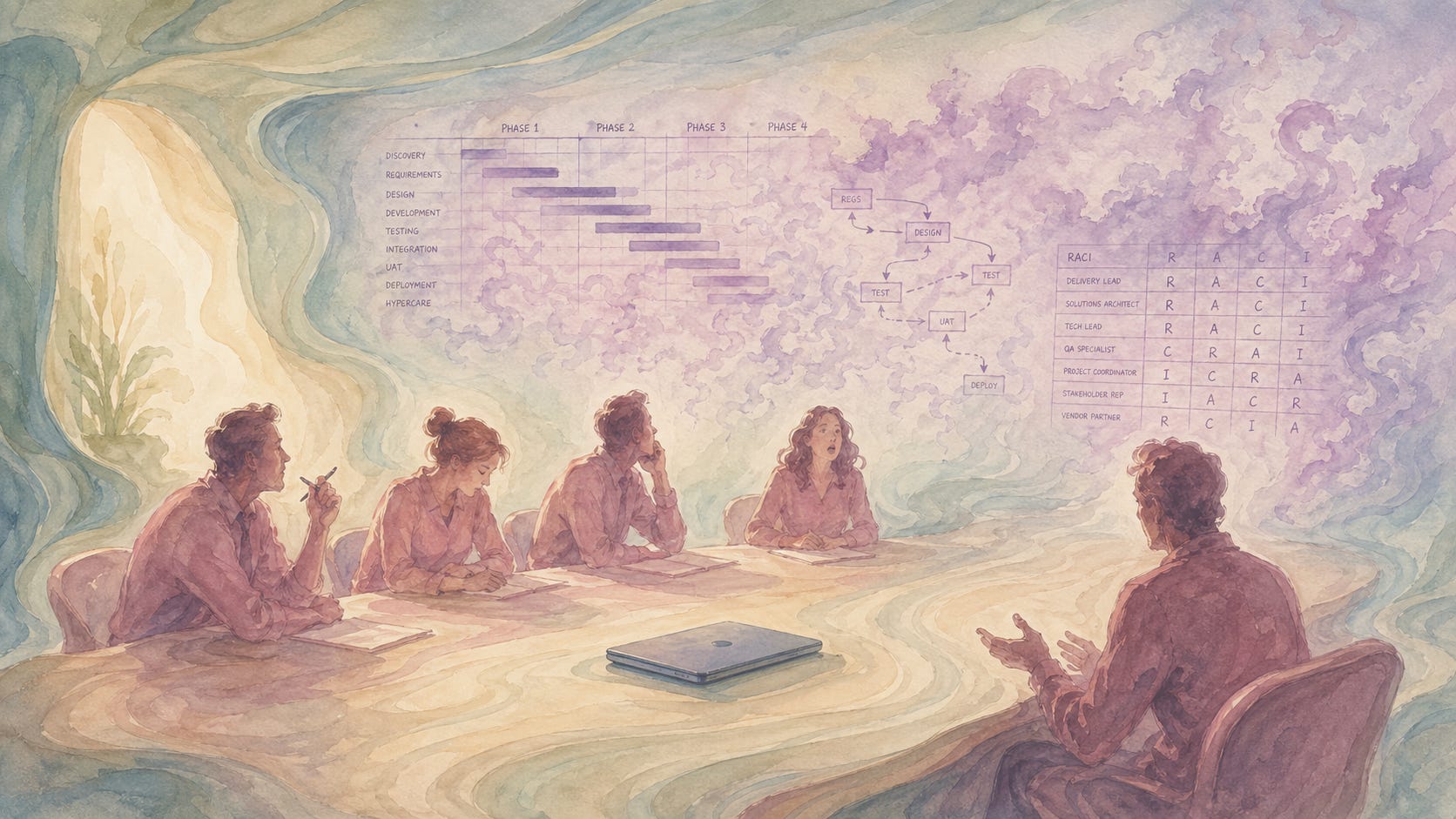
Step back for a moment and ask why managers exist in the first place.
Not the romantic version - vision, leadership, mentorship, all the things we put on LinkedIn. The actual mechanical reason. The reason organisations grew middle layers.
The answer is coordination and, just underneath it, trust.
Humans have different contexts. Different skills. Different motivations. Different working hours. Different definitions of “done.” When you put four of them on a project, you need someone to hold the thread - to translate between them, to decide who does what, to chase the slow ones, to unblock the stuck ones, to decide when the work is finished.
That’s the coordination half. The trust half is quieter, but it’s just as load-bearing.
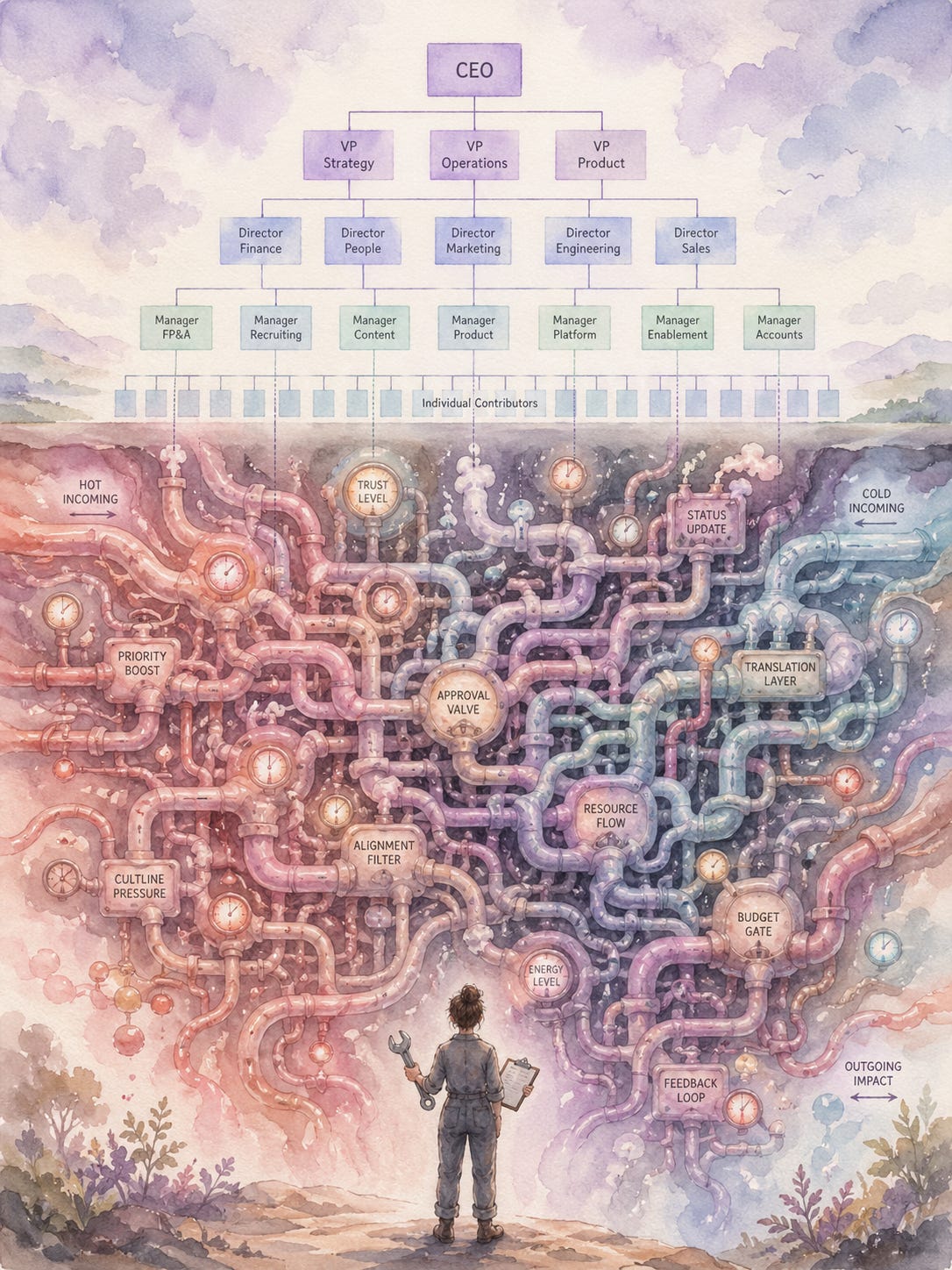
Organisations don’t actually trust their people at scale. They can’t. Once you go past a certain headcount, the founder or the leadership team can no longer personally vouch for whether each person is doing the right thing, to the right standard, at the right pace. So they invent a mechanism to compensate: a layer of humans whose job is to watch the other humans. To check the work. To approve the spend. To sign off on the leave. To confirm the timesheet. To re-promise, on behalf of the team, that the thing will land on time.
We dressed all of this up as leadership because “watching people because we don’t quite trust them” doesn’t sound great on a job title, and because the people doing it did genuinely learn to inspire and motivate and develop others along the way. But strip the role back to its origin and you find the same two things every time: work has to be split across humans, and humans at scale can’t be trusted by default. The manager is the workaround for both.
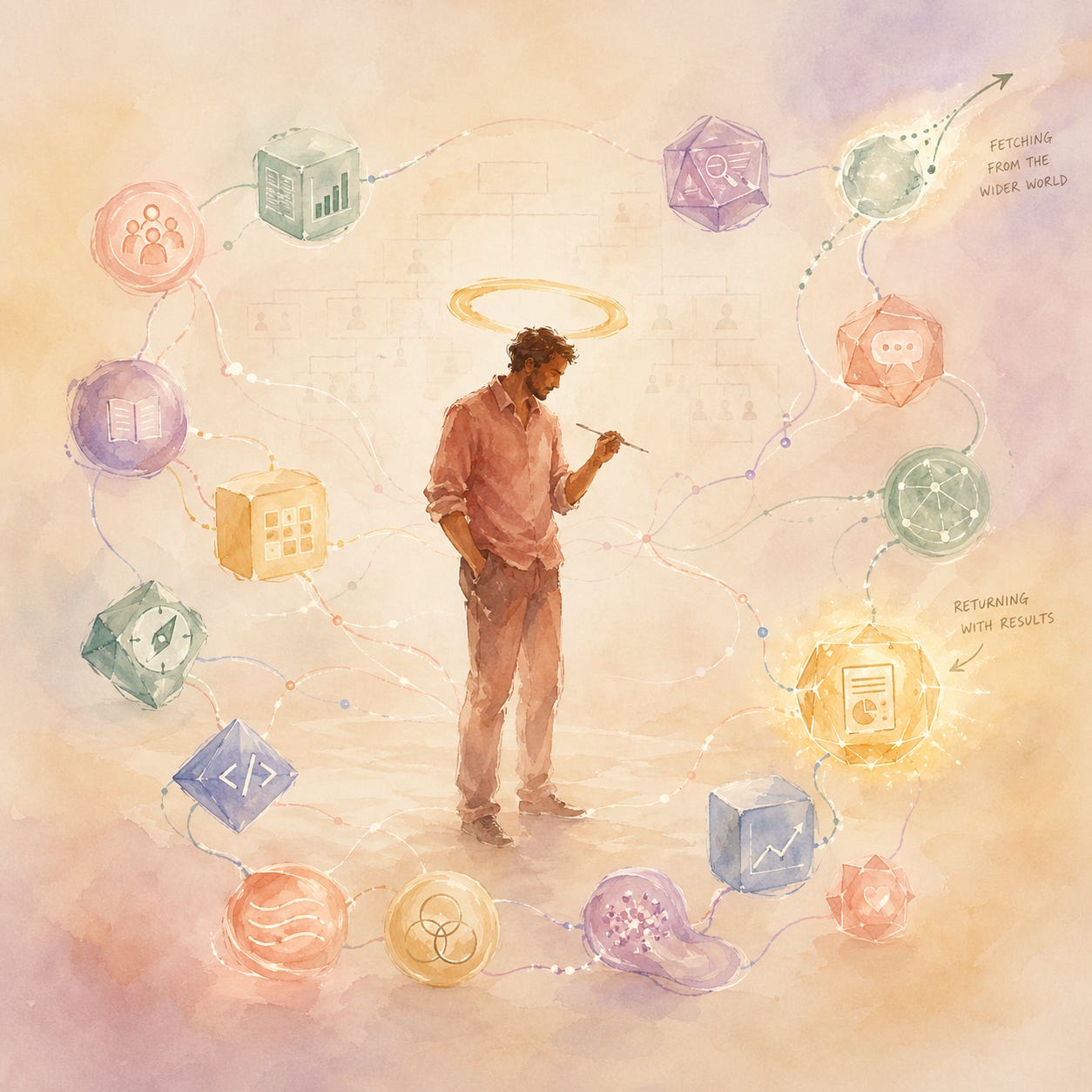
Now ask yourself what happens when work no longer has to be split across humans - and when the entity doing the work is one you actually can observe directly.
Let me explain why this is different from previous waves.
When software automated tasks in the past, it automated execution. Spreadsheets replaced hand-calculated ledgers. CRMs replaced index cards. CAD replaced drafting tables. The tools got better at doing the thing - but you still needed humans to decide what thing to do, when to do it, and how to coordinate it with everyone else’s thing.
The coordination layer was untouched. In fact, it grew. The more tools, the more integration points, the more handoffs, the more coordinators you needed.
What’s different now is that AI doesn’t just execute. It decomposes. It can take a fuzzy outcome and break it into steps. It can sequence those steps. It can hand the right piece to the right tool, watch the result, and decide what to do next. It can ask a clarifying question if the brief is ambiguous, and it can revise the plan when something changes.
That’s not a faster spreadsheet. That’s the manager’s job description.
When one person plus a stack of agents can do what a team of four used to do, you don’t just shrink the team. You shrink the upstream need for someone to manage the team. The coordination work doesn’t move sideways onto fewer humans. A lot of it just stops existing.
There’s a name worth giving to what replaces the manager, because the language we already have doesn’t quite fit.
I’ve been calling it the HALO - the Human-Agent Led Operator. A domain expert backed by an army of agents, accountable for an outcome rather than a team.
The clearest prototype we already have is the Forward Deployed Engineer - Palantir’s invention, now copied everywhere. An FDE is one person who shows up at a customer, understands the problem deeply, and builds the solution end to end. They don’t manage anyone. They do the work, with whatever tools the situation needs. They are evaluated on whether the customer’s problem got solved.
The HALO is what the FDE becomes when the agents are actually good. Same accountability model. Same direct line from problem to outcome. But now the “team” is a constellation of AI systems doing the legwork, and the human is the one with the taste, the context, and the final call.
You don’t have direct reports. You have direct outputs.
There’s a soft version of this argument floating around - “AI will let people work more autonomously.” That undersells what’s actually happening.
People aren’t just becoming more autonomous. They’re becoming dramatically more capable.
Think about what gets absorbed by machines. The boring middle of every job. The boilerplate. The first draft. The data wrangling. The status update. The meeting summary. The competitive scan. The first-pass code. The translation. The format conversion. The “can you put this into a deck” of it all.
What’s left, when that gets stripped out, is the part that actually requires a human: judgement, architecture, creative leaps, taste, and the willingness to stake your name on a decision.
That residue is what one person now brings to the table. And it’s far more concentrated than what any one person used to contribute when half their day was admin and coordination. The bottleneck used to be capacity - there were only so many hours, only so many hands. The new bottleneck is judgement at the top of the funnel. And judgement doesn’t scale by adding bodies. It scales by giving the best people more leverage.
So the team of four collapses to a team of one - but the team of one is doing the work of more than four, because they’re spending all their time on the part that actually matters.
Here’s a pattern most of us have lived through, and almost nobody is honest about.
The career ladder, in most organisations, has historically had a single shape. You start as a doer. You get good at the craft. You get promoted to manage other doers. You stop doing the craft. Eventually, if you’re successful, you spend most of your time in meetings, slide decks, and 1:1s - and the actual thing you got hired for, the thing you were good at, slowly atrophies.
We told people this was growth. It wasn’t, really. It was the org chart’s only escape velocity.
And there’s always been a quiet group of people who refused. The senior engineer who turned down the engineering manager job three times. The senior designer who didn’t want to be a design director. The brilliant analyst who said “no thanks” to running the team. We labelled them career-limited. We worried about them. We invented “individual contributor tracks” to give them somewhere to go that wasn’t quite as prestigious as the management track but at least kept them in the building.
Here’s the awkward bit. They might have been right the whole time. I’d put myself in that camp too - I’ve spent most of my career resisting the gravitational pull of pure management roles because the day I stop touching the work is the day I stop being useful at it.
The people who clung to the craft are the ones who, today, can pick up a stack of agents and immediately know what good output looks like. They have the taste. They have the pattern recognition. They know where the work tends to break. They are HALOs in waiting - they just need the agents.
Meanwhile, the ones who got promoted out of the craft a decade ago, and have been managing managers ever since? They have the people skills. But they may no longer have the thing the people were doing. And in a world where the people themselves are shrinking in number, the skill of organising them shrinks with them.
This is going to be one of the more uncomfortable reframes of the next few years. “Stop promoting people out of their competence” is going to stop being a slogan and start being a survival strategy.
This sounds obvious until you think about what it actually changes.
People management is, at its heart, an emotional and political craft. You’re managing morale, ambition, insecurity, ego, energy, fairness, careers, relationships. The actual work is almost the side dish. A huge part of being “a good manager” is being good at the human stuff - making people feel heard, navigating conflict, building trust, knowing when to push and when to back off.
Agents need none of that. They have no ego. They have no career. They don’t get demotivated when you give them tough feedback, and they don’t gossip in the kitchen when you don’t. They don’t need their manager to believe in them.
What they need is precision. Direction. A clear definition of done. Honest, specific feedback when the output is wrong. Standards that don’t move. Someone who can spot a half-truth in a paragraph and call it out.
Now, here’s the bit that should make a few people sit up.
The skills that make someone a bad people manager - directness to the point of bluntness, impatience with mediocrity, low tolerance for fluff, an obsession with the craft over the comfort of the team - are exactly the skills that make someone a brilliant agent operator. The brilliant-but-prickly engineer who never quite worked out as a team lead might turn out to have been built for this moment all along. Their toolset finally fits the job.
Conversely, the warm, supportive, motivational manager - the one who was beloved by their team but couldn’t tell you what good code looked like - is in a much harder spot. There’s no one to motivate. The kindness has nowhere to land.
This isn’t a celebration of being unpleasant. It’s an observation that the raw materials of good agent operation look very different from the raw materials of good people management. We’ve been hiring and promoting for one and now we need the other.
If I sketch out the managers I’ve worked with over the years, they fall into three rough buckets. Each one faces a very different version of the next decade.
The Builders - These are the managers who never really stopped doing the craft. They still write the code, still touch the model, still draft the deck, still sit with the customer. Management was something they tolerated, not something that defined them. They are going to be fine. Probably more than fine. They become HALOs almost overnight, because they already have the taste, and now they have the leverage.
The Enablers - Genuine systems-thinkers. Process-builders. The people who made teams work without necessarily being the deepest experts in the room. They have a real future too - but as orchestrators of systems, not coordinators of people. Their skill at designing how work flows translates well to designing how agentic work flows. They have to retool, but the underlying instinct still sells.
The Title-Holders - Managers in name, managers by tenure, managers because the org chart had a slot. No deep craft. No genuine systems-thinking. Mostly meetings, mostly approvals, mostly being the person you have to “loop in.” They are in the most trouble. Not because they’ve done anything wrong - many of them are decent, hard-working people who played the game that was put in front of them - but because the game is changing under their feet.
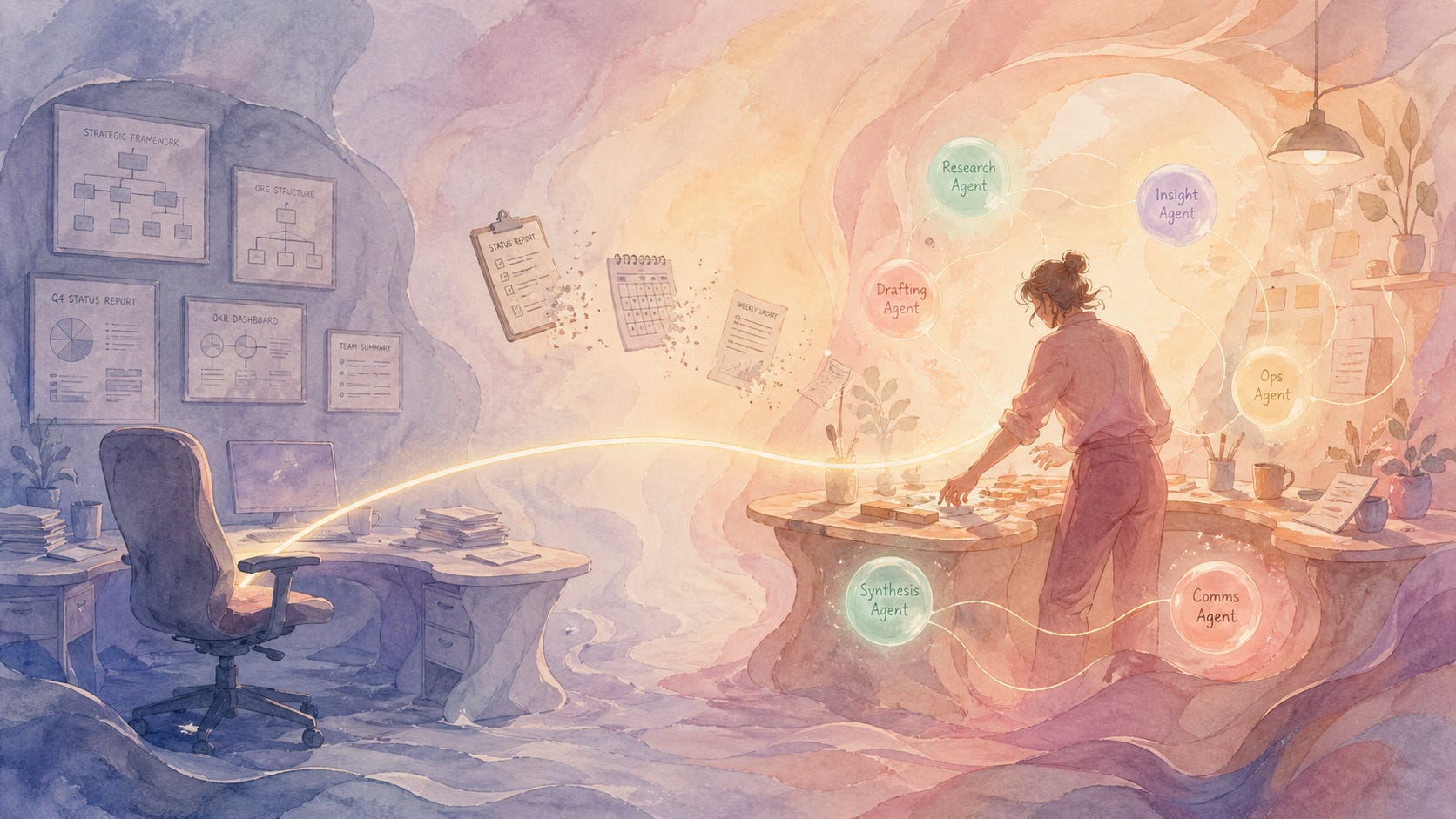
If you’re in that third group, the path forward isn’t to dig deeper into management. It’s to dig back into the work. Whatever your function is, go and learn what good actually looks like in it again. Get your hands dirty. Re-earn the taste. Otherwise you risk becoming an empty chair at a table that’s quietly been replaced by an interface.
And there’s one more thing the winning managers in this space share, regardless of which bucket they came from: a technology mindset. Not the ability to code - that’s not the point. The instinct to reach for a system when a problem appears. A working sense of what AI is genuinely good at, what it’s quietly bad at, where it hallucinates, where it shines, and how fast the ground underneath it is moving. The willingness to actually use these tools every day, not just talk about them in offsites.
This is the thing most current managers are missing. Not because they’re incurious - many of them aren’t - but because the previous generation of management never required it. You could run a successful function for thirty years without understanding the stack underneath it. That option is closing. If you can’t intuitively feel where the technology helps and where it lies to you, you can’t direct it. And if you can’t direct it, you can’t lead anyone who does.
If you run a business, this raises a few practical questions worth sitting with.
Stop promoting people out of their competence. The reflex to “reward” your best practitioners by making them manage other practitioners has always been a tax on the craft. It’s now also a tax on your future capability. If your best engineer wants to keep engineering, let them. Pay them well. Give them agents. Give them an outcome to own. Don’t make them manage three juniors as the price of seniority.
Only keep managers who can evaluate the output. This sounds harsh and it is, but it’s no longer optional. If a manager can’t tell good work from bad in their own function, their authority is borrowed - and the loan is being called in. Either help them re-acquire the craft or move them into a role where their actual strength (people, process, politics) is the headline, not a fig leaf for absent expertise.
Invest in depth over span. The 20th-century instinct was wide spans of control - flatter org charts, more direct reports, more leverage per manager. The 21st-century version of leverage is depth. One person who knows their craft cold and runs ten agents will outperform one person who knows ten people and trusts them to know the craft. Reward going deep. Make it a promotion path, not a consolation prize.
None of this requires firing anyone next quarter. It requires being honest, internally, about what management is actually for in your organisation - and being willing to redesign roles around the new shape of capability rather than the old shape of headcount.
So where does this all land?
Every layer of every org chart is, right now, being quietly evaluated against one question. What does this role actually produce, and could it produce it without the layer beneath it?
For a long time, the answer was “yes, but someone has to coordinate the layer beneath.” That someone was the manager. Take that layer away - replace it with one HALO and a stack of agents - and the manager above is suddenly sitting in mid-air. Still on the org chart. Still in the meetings. Still copied on the emails. But there’s no plumbing left to maintain.
The manager isn’t the villain here. Most of the ones I’ve known were doing their best inside a system that asked them to coordinate because the work needed coordinating. The role was real because the problem was real.
But the problem is being solved by something else now.
And the things we used to measure managers by - headcount, span, seats reporting in - are going to be replaced by something closer to taste. How many outcomes have you personally owned? How many agents can you confidently direct? Whose judgement do you actually trust? It starts to look less like a corporate ladder and more like a craft guild.
So the last manager isn’t really being made redundant. They’re being asked to take their hands out of their pockets, get back into the work, and become the first of something else.
The rest of us get to decide which side of that line we want to stand on.
No pressure :)
Comments
Nothing yet. Say the first thing.
Sign in to join the conversation.