
If you live in certain parts of Abu Dhabi, you start to know the planes by sound. Different engines. Different sizes. Different angles of climb. After a while you can tell the heavy long-haul rumble from the short-hop whine without looking up.
Which naturally leads to a small, slightly silly question. When I hear one go over, can I glance at the TV in the corner of the room and see where it is going?
“Ah, Cairo. Nice.”
That was the brief.
One morning, before breakfast, I built it.
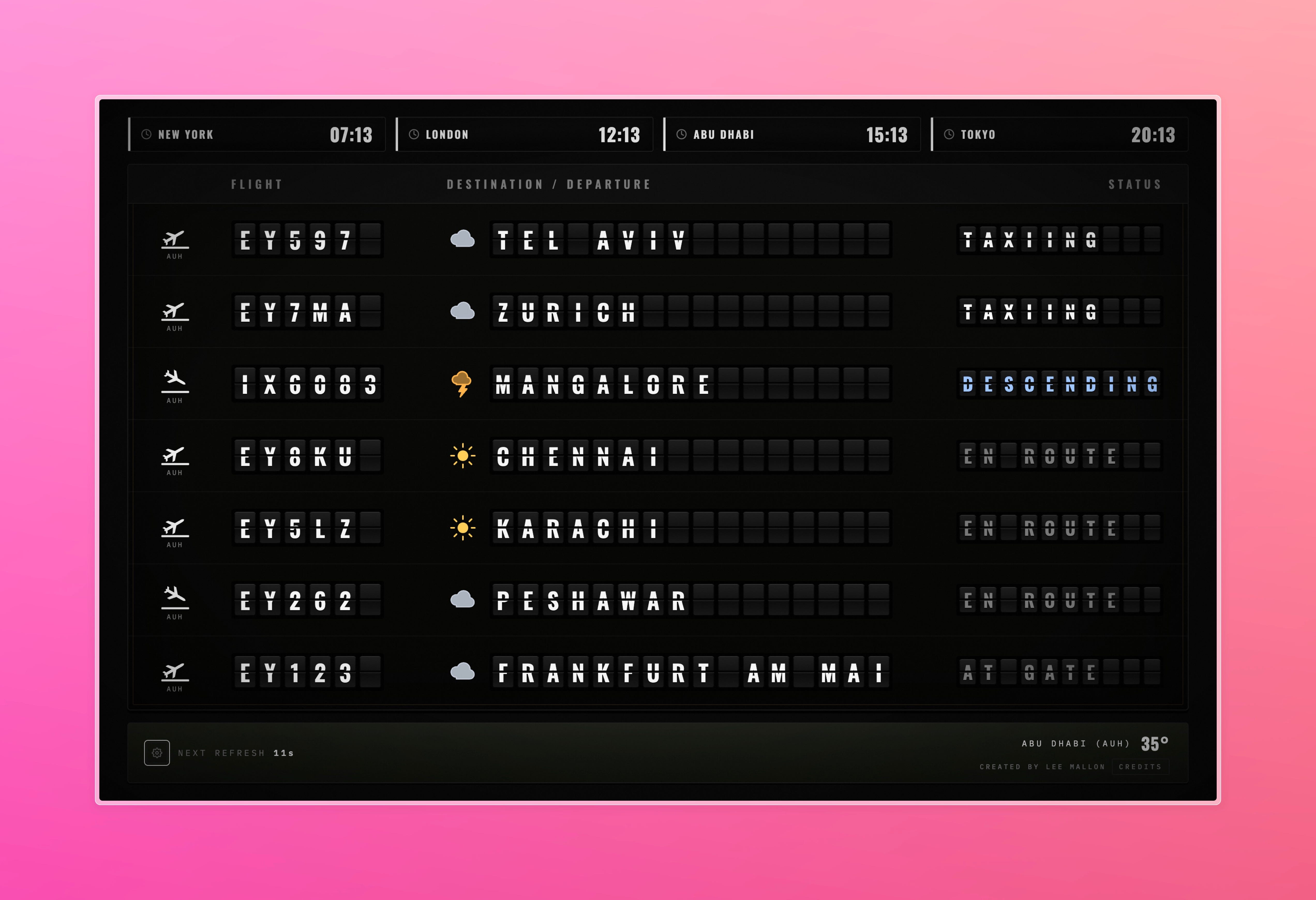
Check it out here https://airportboard.leemallon.com or watch the video at the end.
Last week’s project was a scoreboard for the games room. It works beautifully when the kids are playing. The rest of the time it is a 32-inch black rectangle on a wall.
That bothered me more than it should.
Any screen in the house that is dark for 22 hours a day is a screen waiting for a second job. A photo frame. A clock. A weather panel. Or, if you are me and you live under a flight path, a live departures and arrivals board for the airport down the road.
So this morning’s two-hour sprint had a target: a beautiful live airport board for a TV, using public data, no API keys, no accounts, no monthly bill.
Flight data is one of those things that looks public until you actually try to use it.
There are plenty of aviation APIs. Most of the polished ones either charge serious money, throttle you to almost nothing, or quietly remove the useful fields on the free tier. I wanted the board refreshing every fifteen seconds. On most of those plans I would have burned through a month’s quota in a long afternoon.
The route in turned out to be nearby aircraft data based on GPS positions. Live planes in a radius around a point. Promising, but messy. “Nearby” in this part of the world includes flights landing in Dubai, aircraft heading toward Doha, and a constant stream of overflights that have nothing to do with Abu Dhabi at all.
So the real engineering work was filtering. Keep only flights to or from AUH. Drop the repositioning flights - aircraft moving between stands or off to maintenance, where the departure and arrival airports are the same and the board would just say Abu Dhabi → Abu Dhabi like a confused goldfish. Then a small but important piece of logic: if the plane is leaving, show where it is going; if it is arriving, show where it came from.
That last bit sounds obvious. It is also the moment a list of aircraft turned into something that felt like a real board.
Raw data is never the product. The product is how it feels.
I keep seeing adverts for Vestaboard - that lovely modern take on the old split-flap railway boards. So the question wrote itself. Can the home airport board animate like that?
Yes. And it looks brilliant.
I even wired up the clatter sound effect when letters flipped. That lasted about ten minutes. A busy airport means constant clicking. Browser autoplay rules make audio awkward in the first place. And charming becomes irritating faster than you would think.
The sound came back out. The animation stayed. Correct call.
Abu Dhabi is not Heathrow. Flights come in waves, and between waves the board can look a bit thin.
So I added a backup airport. When the home feed is quiet, the board borrows from somewhere busier and keeps six flights on screen at all times. Visually it stays alive. The eye never lands on a half-empty grid and registers something is broken.
Product design isn’t always about truth. Sometimes it’s about not leaving a gap where something should be.
Once the feed was clean, the hidden gem turned out to be the status field.
Not just where a plane is going - what it is actually doing right this second. At gate. Taxiing. Taking off. Climbing. Cruising. Descending. On approach.
That single field changed the whole feeling of the thing. A normal departures board is a static promise about the future. This one is a live picture of the sky above the house. You hear engines outside, glance up at the TV, and read:
Climbing - Cairo.
Very satisfying. Almost embarrassingly so.
Then the obvious next thoughts. If I already know the destination city and its GPS coordinates, why not show the local weather there too? So each route now gets a little weather icon for what it is like at the other end. Cairo in sun. London in cloud. Delhi in haze.
And to fill the space around the flights, four world clocks across the top. Suddenly it stopped looking like a hobby dashboard and started looking like the kind of screen you might see in the lobby of a small boutique hotel. Same data. Different posture.
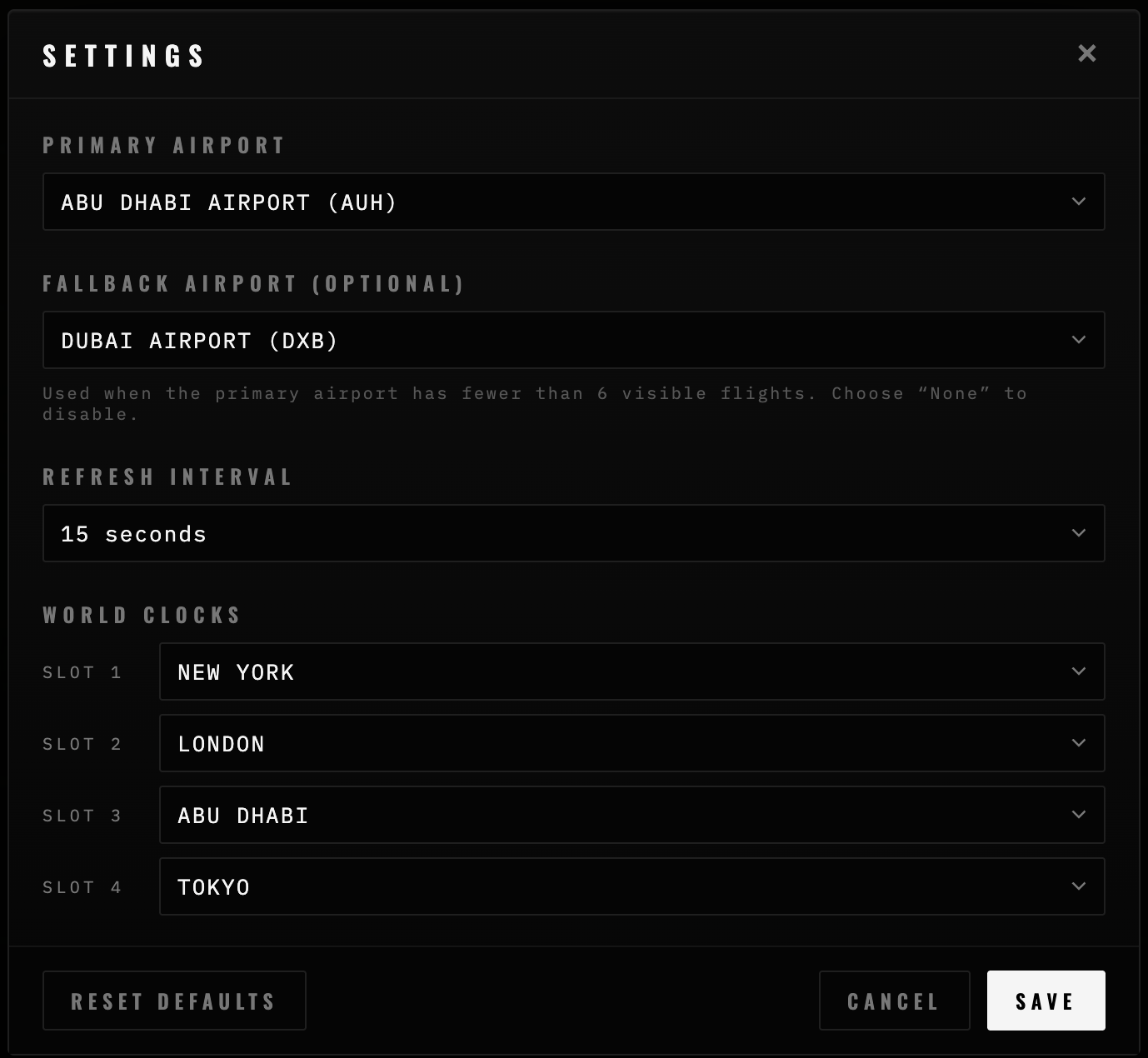
There is a settings panel tucked into the bottom-left corner. Change your local airport. Change the backup. Change the four cities on the clocks. Everything saves in the browser, so a refresh keeps it all intact. No accounts. No setup pain. No API keys. Open the page, walk away.
The interesting products do not come from spotting a billion-pound market. They come from a slightly odd personal annoyance, a spare screen, and a couple of free hours. I hear planes. I like data. I have a TV that was doing nothing. Can this be fun?
That used to be a project. Plans. Estimates. A meeting about whether it was worth it. Now it is a morning with no breakfast.
Every house in the world has a flight path, or a tide, or a train line, or a school run, or a shop opening time, or some quiet local rhythm that a screen on a wall could quietly track. Almost none of those will ever justify being a real product. All of them can now exist anyway.
So the question I keep coming back to is this. When building a small piece of software for the place you actually live becomes a morning’s work, what do our homes start to look like?
Don’t forget to check it out at https://airportboard.leemallon.com
No posts
Comments
Nothing yet. Say the first thing.
Sign in to join the conversation.