
Most podcasters are running five different tools to do one job. A hosting platform. An email list. A website. A social account. A payment processor for the premium stuff. Five logins, five bills, five things that can break.
I want to talk you out of that.
Substack isn't just a newsletter tool anymore. Here's why hosting your podcast there beats duct-taping together five separate platforms.
The podcast host you didn’t know you had
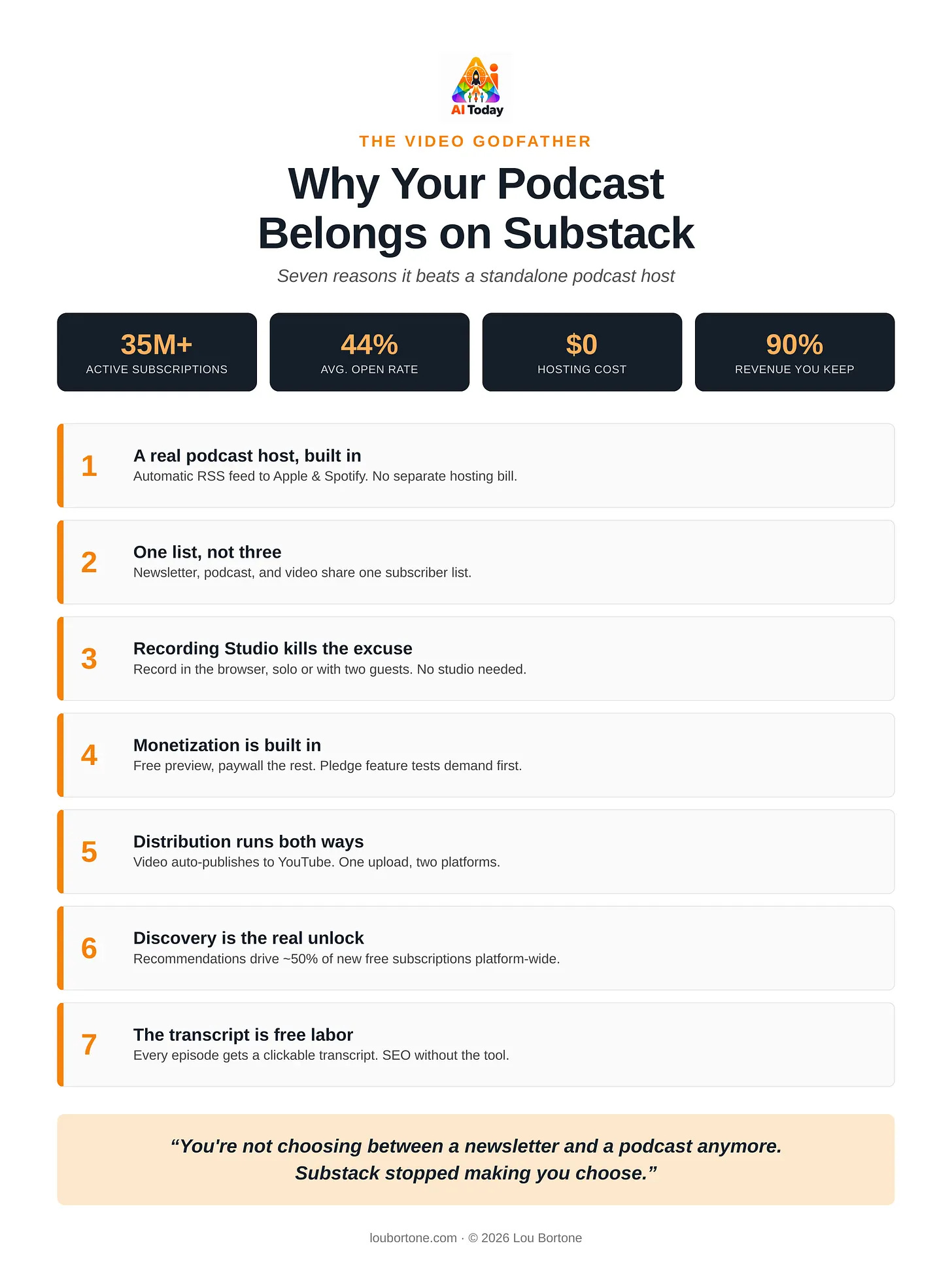
If you’ve got a Substack, you’ve already got a podcast host. Flip on the Podcast tab and it generates a real RSS feed automatically, the same day, no waiting period. That feed pushes straight to Apple Podcasts and Spotify. You don’t need Buzzsprout. You don’t need Libsyn. You need a setting you probably haven’t clicked yet.
That alone should make you stop paying for a separate host. But it’s not even the best part.
One list. Not three.
Here’s the thing nobody explains when you’re setting up your fifth marketing tool: your podcast audience and your email audience are supposed to be the same people. On Substack, they actually are. One subscriber list runs the newsletter, the podcast, and the video. No funnel, no “sign up for my list” call to action buried in the show notes. Someone who finds you through an episode is already on your list. That’s not a feature. That’s the whole architecture working the way it should have from the start.
Recording is the excuse. Substack removed it.
I hear this all the time. “I’d start a podcast but I don’t have the setup.” Fair, except now you don’t need one. Substack’s Recording Studio lets you record solo or with up to two guests, right in the browser. Screen share’s in there. Logo overlay’s in there. You don’t need Descript. You don’t need a studio with foam on the walls.
You need a browser tab and something worth saying.
Getting paid doesn’t require a separate system
Set a free preview, three to five minutes, then paywall the rest. Want a tier that’s paid subscribers only? Private podcast feeds handle that, and those episodes never touch the public players. And if you’re not sure anyone would pay for your show yet, the Pledge feature lets people commit to a price before you’ve even turned payments on. That’s market research you’re not paying a consultant for.
It goes out, then it comes back
Publish a video episode and it auto-publishes to YouTube on the back end. One upload, two platforms, no re-export, no second edit pass. Most people are manually uploading to three places and calling it a distribution strategy. This is the same result with one less step you have to remember to do.
The part that actually grows your show
Here’s where Substack stops being a hosting tool and starts being a growth engine. Notes is a built-in social feed, and unlike most social platforms, it’s built to convert into subscriptions, not just collect likes. Then there’s the recommendation network. Other creators recommending your Substack to their readers drives roughly half of all new free subscriptions on the platform. Half. That’s not your marketing working. That’s other people’s audiences finding you for free.
Mailchimp doesn’t do that. Your email service provider was never going to send you new subscribers. Substack does, by design.
One more thing you’re not paying for
Every episode gets an automatic, clickable transcript. That’s SEO you didn’t have to write. That’s accessibility you didn’t have to think about. That’s a companion article sitting there half-finished, waiting for you to shape it into a post. A transcription service would charge you monthly for this. Substack just does it.
You’re not choosing anymore
For years, “start a podcast” and “grow an email list” were two separate projects with two separate tool stacks and two separate strategies. Substack collapsed that choice. You’re not picking a lane. You’re running the whole show, literally, from one place.
If you’ve been sitting on a podcast idea because the setup felt like too much, the setup isn’t the problem anymore. You’re just deciding whether to hit record.
Lou Bortone is a Video Marketing Strategist and Certified AI Consultant with over 25 years of experience in television and entertainment marketing, including roles at E!, NBC, and Fox Family Worldwide. He works with experts, authors, and speakers to help them stay visible and relevant using AI and video. He hosts the AI Today podcast. Learn more at LouBortone.com.
Comments
Nothing yet. Say the first thing.
Sign in to join the conversation.