
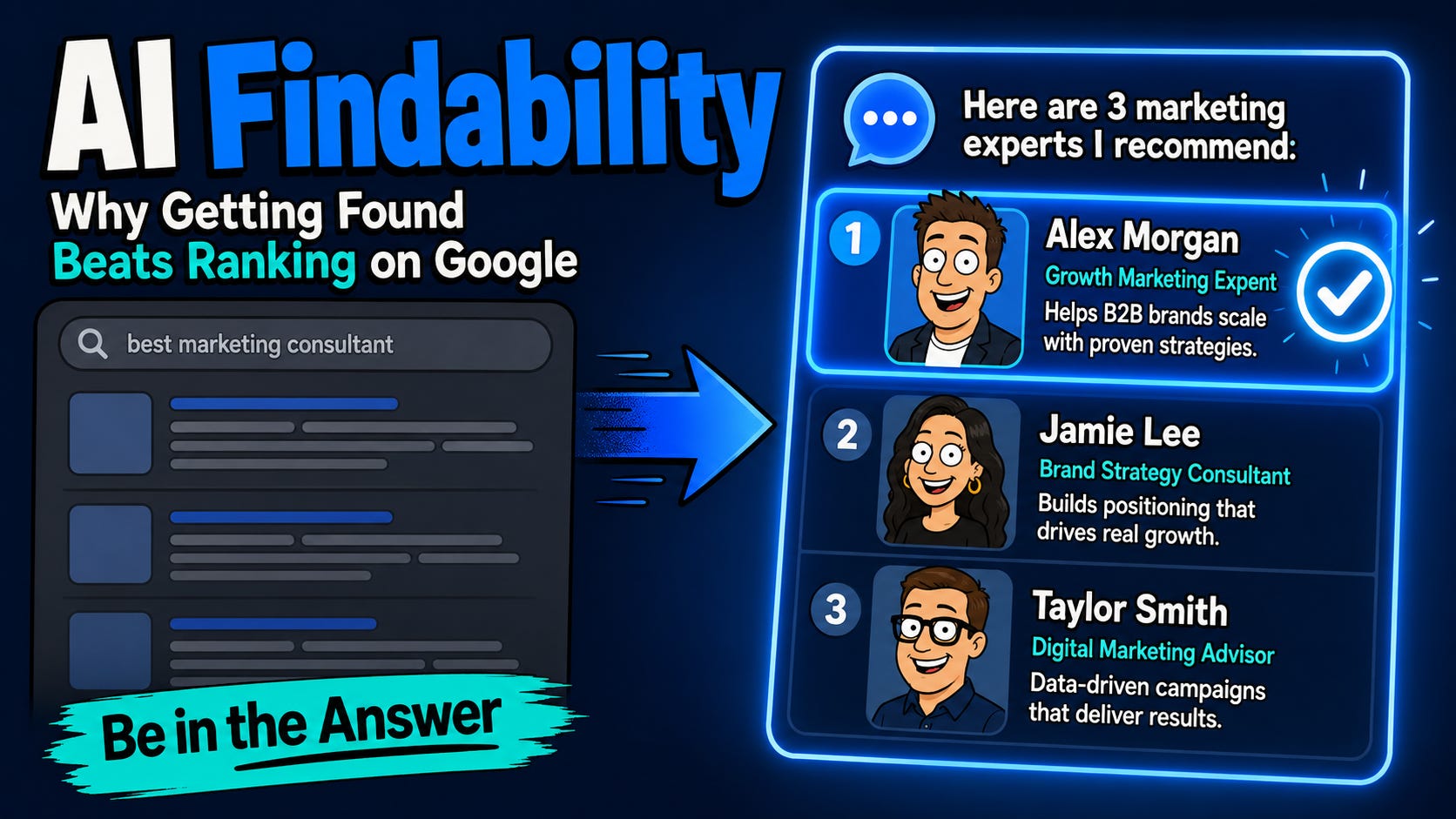
Your next client isn’t going to Google you. She’s going to ask an AI who can help her, and the AI is going to give her three names.
The only question that matters: are you one of them?
For twenty years, the game was rankings. Get on page one, win the click, get the client. We built entire businesses around pleasing an algorithm in Mountain View. That game isn’t dead, but it’s on life support. AI findability is the new game, and most experts I know haven’t even looked at the board.
Here’s what I mean. When someone asks ChatGPT or Claude “who’s a good video marketing strategist for authors and speakers,” the AI doesn’t show ten blue links. It gives an answer. A short list. Maybe one name. There’s no page two to fall back on. You’re either in the answer or you’re invisible.
What Actually Changed
Google search still exists, sure. But look at how your clients actually behave now.
They ask AI for recommendations the way they used to ask a smart friend. “What should I use to edit my podcast?” “Who teaches AI for non-techies?” “Is video still worth my time?” The AI answers in full sentences, cites a few sources, and the conversation ends there. No click. No browsing. No stumbling onto your website because you ranked fourth.
Zero-click was already eating search alive. AI finished the meal.
So the question shifts from “how do I rank?” to “does the AI know I exist, and does it know what I’m the go-to for?” That’s findability. And it plays by different rules than SEO ever did.
How the AI Decides Who to Recommend
Nobody outside the labs knows the exact recipe, but the pattern is clear if you test it. AI models recommend people who are consistent, specific, and cited.
Consistent: your name, your specialty, and your story match everywhere the AI has read about you. If your LinkedIn says “video strategist,” your website says “brand consultant,” and your podcast bio says “marketing coach,” the AI shrugs and moves on to someone with a clear signal.
Specific: “I help successful female business owners use AI and video to grow” beats “I help entrepreneurs level up” every single time. Vague experts don’t get recommended. Ever. The AI needs a hook to hang your name on.
Cited: the models trust names that other sources mention. Podcast interviews, guest posts, other people’s newsletters, directories, reviews. Every mention is a vote.
Run the Five-Minute Findability Audit
Before you change anything, find out where you stand. Open ChatGPT, Claude, and Perplexity and ask each one three questions:
“Who is [your name]?”
“Who are the best [your specialty] for [your audience]?”
“What is [your name] known for?”
If the AI knows you, check what it says. Wrong specialty? Outdated bio? That’s fixable. If the AI has no idea who you are, congratulations, you just found your biggest marketing problem, and it isn’t your Instagram grid.
Five Moves That Make You Findable
1. Pick one sentence and repeat it everywhere. One specialty, one audience, one outcome. Put that exact sentence on your website, LinkedIn, Substack bio, podcast one-sheets, everywhere. Boring? Maybe. Findable? Absolutely.
2. Publish where AI actually reads. Substack posts get indexed. YouTube transcripts get indexed. Podcast show notes get indexed. Your gorgeous PDF that lives behind an opt-in form? The AI has never seen it and never will.
3. Say your own name. In your videos, on your podcast, in your posts: “I’m Lou Bortone, and I help...” Feels awkward. Works anyway. Transcripts full of your name plus your specialty are pure findability fuel.
4. Get mentioned, not just published. One interview on someone else’s podcast can do more for findability than ten posts on your own blog, because it’s a third-party citation. Trade interviews with peers. Show up in other people’s content.
5. Answer the questions your clients actually ask. Write posts that directly answer “what’s the best way to...” questions in your niche. AI models love pulling from clear, direct answers. Listicles and how-tos aren’t dead. They got promoted.
The Part Nobody Wants to Hear
Findability compounds slowly. You can’t hack it in a weekend, and anyone selling you “GEO secrets” for $997 is selling you a rebranded SEO course. What works is dull: clarity, consistency, and showing up in enough places that the machines can’t miss you.
The good news? Almost nobody in your niche is doing this on purpose yet. The window where this is an edge instead of table stakes is open right now.
If you want more straight talk on AI and video without the hype tax, subscribe. It’s free, and I only send stuff worth your time.
Twenty years ago the goal was page one. Now the goal is simpler and harder: be the name the AI can’t leave out of the answer.
Lou Bortone helps experienced business owners stay visible, credible, and hired in the age of AI. A certified AI consultant and host of the AI Today podcast, he spent 25+ years winning attention for brands like E!, NBC, and Fox Family before the battlefield moved. Now he teaches experts how to be found by AI, trusted by buyers, and impossible to ignore.
Comments
Nothing yet. Say the first thing.
Sign in to join the conversation.