
This interview with Sundar Pichai offers a smart glimpse of what the web is becoming. Even if it doesn’t offer a miracle solution to “the end of traffic as we knew it,” it nevertheless introduces key concepts like “click quality” and paints a picture of the new digital landscape.
A must-read!
🎁 But I’m breaking it all down for you in this post because honestly, it’s dense to read and listen to.
1️⃣ The web, as the world’s largest media platform, is living its final hours. It’s transitioning from a passive information platform to an active, transactional ecosystem composed of a multitude of specialized and individualized applications.
2️⃣ Web 2.0 allowed everyone to become a content creator. The AI-powered web is now set to transform the next generation (our children) into programmers of super-personalized applications. Yesterday’s content creators become tomorrow’s Vibe Coders (or... today’s?).
3️⃣ What is AI search? Very soon, we won’t even be scrolling through content anymore (let alone clicking). Tomorrow’s search will focus on data visualization—data generated and made accessible by this new wave of applications. The web becomes a series of databases that AI agents and apps will query.
4️⃣ Google is profoundly transforming traffic dynamics—and this is huge. The scope of the web has exploded: +45% in two years on Google! And it’s not just “noise” generated by AI. It’s related to the fact that content consumption has become deeply multi-platform and multi-format, with AI smoothing transitions (much less friction).
Google claims it will continue to send traffic, but with two major changes:
Traffic dilution: Traffic is now distributed across a much wider variety of sites and creators. This explains why many notice a traffic drop—the pie is bigger, but so are the slices.
Emergence of the “Click Quality” concept: This is the real paradigm shift. Google now measures the quality of traffic it sends. The key criterion? Time spent by the user on the page. As Google becomes a response platform more than a search engine, its objective is to reduce unqualified traffic and favor targeted and engaging visits.
🧨 Honestly, this is huge.
We’re witnessing a complete overhaul of our relationship with digital. Attention no longer focuses on raw quantity, but on real engagement, perceived utility, and extreme personalization.
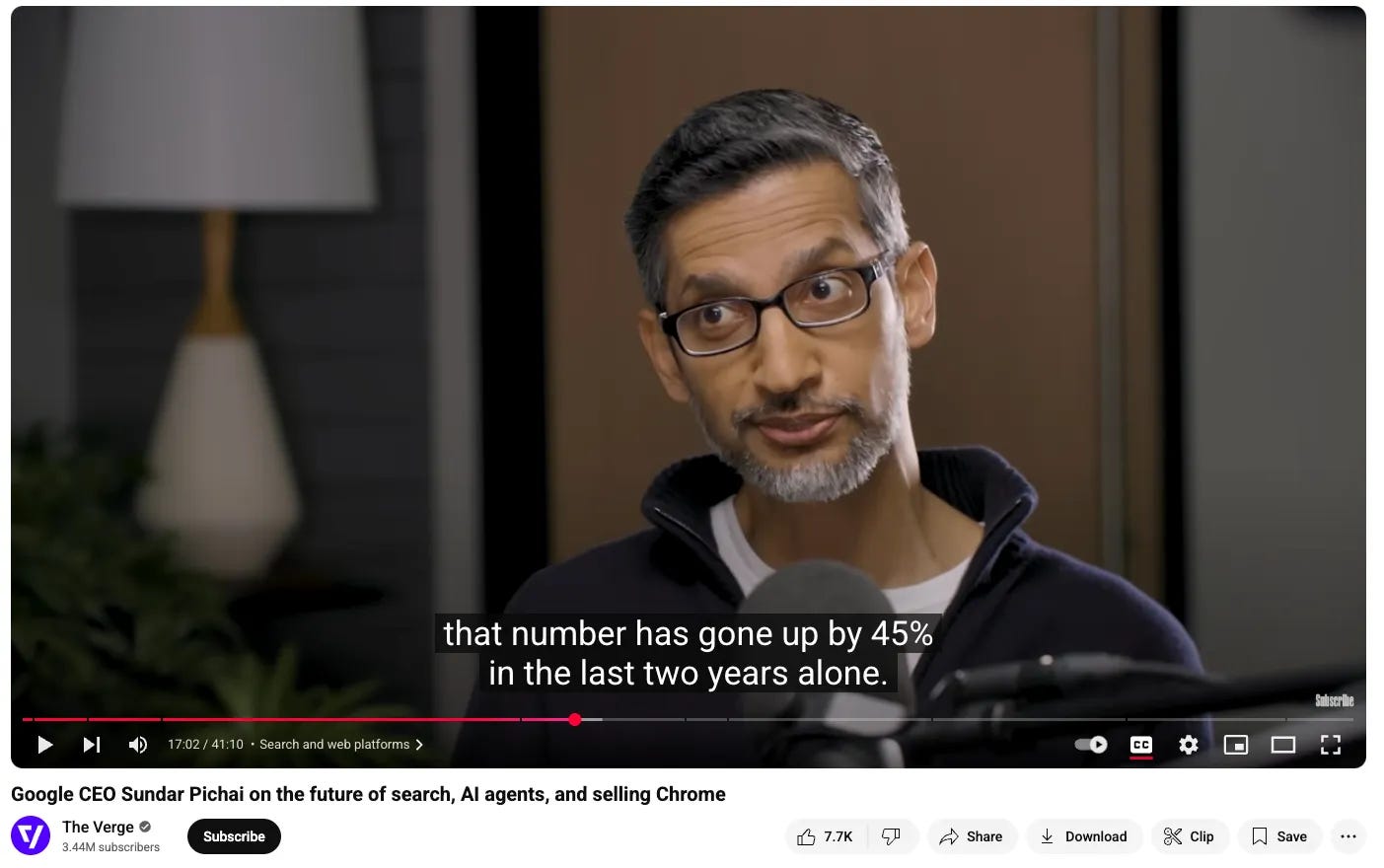
Sundar Pichai addresses the web’s evolution by drawing parallels with previous major technological changes.
He notes that the arrival of the Internet enabled new forms of creation and expression, like blogs, which allowed many to share their thoughts with the world.
Pichai recalls joining Google at a time when AJAX was the “revolution” that made the web dynamic, leading to the emergence of applications like Google Maps, Flickr, and Gmail.
Despite past predictions like the 2015 meme “The web is dead,” Pichai affirms that the web continues to grow. He particularly highlights a “stunning” phenomenon where the number of available web pages has increased by 45% in just the last two years. He mentions that Google’s search techniques evaluate page quality, including whether content is machine-generated, and that this doesn’t explain the overall growth trend they observe.
Pichai suggests that creators must now operate cross-platform and cross-format, noting the sophistication of content formats like video.
He believes AI will make the transition between different content formats “frictionless” because AI models are natively multimodal. He gives the example of NotebookLLM enabling document transformation into something resembling a podcast.
This suggests that content production is moving away from static, format-specific creation.
Pichai concludes that people consume and produce much more content in general, and he sees this as a moment of expansion—contrary to what many marketers and content creators (including journalists) observe and deplore.
The interview addresses the tension between Google’s changes and content publishers’ concerns, particularly regarding traffic.
The News Media Alliance, representing publishers like The New York Times and The Verge’s parent company Vox Media, issued an “angry” statement calling AI mode “theft” for using content without economic return.
The News/Media Alliance organization, which represents major American publishers like Condé Nast and Vox Media, has strongly criticized Google’s AI mode expansion, outright calling it “theft.” Its president, Danielle Coffey, claims Google “forcibly takes content and uses it without any compensation,” thus depriving publishers of both traffic and revenue. The conflict concerns the issue of publisher consent. Internal documents from the antitrust lawsuit against Google revealed that the company deliberately chose not to ask publishers’ permission to include their content in its AI features. Instead, publishers must completely opt out of search results if they don’t want their content used in AI. Publishers consider Google’s response a form of blackmail: either you accept that your content is exploited to feed Google’s AI; or you completely disappear from the web as Google presents it—without any visibility in results. A binary choice without compromise, justified by Liz Reid, head of Google Search, who believes more nuanced opt-outs would generate “enormous complexity.”
The Alliance claims that links (and resulting traffic) were the only redeeming quality of search that gave publishers traffic and revenue.
In response, Pichai:
Affirms that the web continues to grow and that Google sends more traffic to more websites than ever (this is vigorously contested - I’m preparing a detailed post on the subject)
Affirms that AI mode will include sources and that more than ever Google commits to letting users experience the breadth of the web and go where they want, with Google providing “more context”
States that the breadth of domains to which Google sends users is increasing and expects this to be true with AI mode as well. However, he acknowledges there will always be vigorous debates about value exchange on platforms
Affirms that Google, more than any other company, prioritizes sending traffic to the web and will continue to do so in five years
Regarding data on traffic quality, Pichai responds that:
Google sends traffic to a wider range of sources and publishers. He claims this referral traffic is of “higher quality” because Google measures time spent on page and other metrics, and this quality is increasing.
The fact of transforming Google from a search engine into an answer engine (via Featured Snippets, etc.) allows keeping people longer on the platform, this time being an indicator of better quality traffic.
Pichai confirms that Google sees overall query growth in Search, including on Apple devices and platforms. He quantified query growth from AI overviews. He considers the situation “very far from a zero-sum game.”
Generally, he especially reminds that although more people may be highlighted, potentially leading to individuals seeing less traffic, Google reflects what users want. This has always been their position as I remind in this post: sending traffic was one of the elements that was part of the “package” in the intermediation and tripartite relationship between Google, the end user, and in the middle, the site publisher/content creator. Today this balance is evolving, certainly. But Pichai reminds that it’s the result of what users want. Pichai even concludes by saying that “if Google made the wrong choice, users would go elsewhere - but data shows the opposite.”
The interview covers how Google Search evolves with AI integration.
This year’s I/O marked the beginning of what appears to be a “new era” for search and the web.
Google’s vision for Search goes beyond links to web pages, evolving toward something that much more resembles developing personalized applications.
Google’s new AI mode builds a personalized search results page with interactive graphics and potentially other types of applications, in real-time.
Google plans to “evolve” AI mode features into the main search experience over time.
Pichai recalls that the functioning of Search, particularly ranking, is “sacred” at Google and that “no person at Google can influence the ranking algorithm.”
Google uses many ranking signals, far more complex than PageRank today. A page’s authority is determined by these signals (how other pages link to it, like an academic citation), Google doesn’t individually evaluate a page’s authority.
Pichai states that AI mode is no different in this regard. In particular (and one might say “obviously”...) Google will not adjust AI mode responses in response to political pressure. If broad user feedback indicates something isn’t working, Google systematically examines changes, but they don’t look at individual cases or change rankings based on pressure.
Regarding information synthesis and potential misinformation, Pichai clarifies that Google’s signals determine authority, not individual evaluation. He believes Google has always operated at a high level of responsibility and constantly works to earn users’ trust. AI overviews had a low error rate even under adversarial questioning.
Pichai discusses a fundamental change in the web’s purpose and structure, driven by AI and agents.
According to him, the current phase means people will be able to “create AI applications.” He sees this as a “multiplicative” phase where more people than ever before can build products. He highlights that the web is becoming a space where applications are “added.”
Examples include Figma, TikTok, Substack/Ghost, and communities.
“Vibe Coding” is considered a bridge for this trend, suggesting future generations will easily program and create everything they imagine.
Pichai agrees with the idea that the web, as a media platform, is “living its final hours” since AI’s advent. While the web as an application platform is at an “all-time high,” he notes that the web as a media or information platform “seems to be at its lowest level.”
The web is shifting from a media platform (information) to a transaction platform.
He also highlights that some of Google’s most interesting search results now involve generating “personalized web applications” for data visualization.
He agrees with the concept developed by the interviewing journalist that the web is fundamentally a “series of databases,” on which user interfaces are built. Envisioning an “agent-driven web” in 10 years, he believes this web might not resemble the current web. It could be optimized for agents to query these databases.
For companies like Uber, DoorDash, or Airbnb, participating in this agent-driven world means considering value exchange. They might see their overall business increase, or feel disintermediated and choose not to participate, just as a restaurant might choose not to do delivery.
He acknowledges companies could charge fees to agents for accessing their services, comparing this to retailers providing value to brands or merchants paying credit card fees. He thinks the system will find balance. There are many possible models (subscription, revenue sharing).
He suggests the transition to agents might happen faster in enterprise because CIOs can mandate interoperability. In the consumer space, users will decide which experience they prefer.
The conclusion of this massive interview is quite promising:
He emphasizes that the power developers will have to create on the web thanks to tools like “vibe coding” hasn’t been seen in 25 years. And already projects into the next phase after this one could be when AI translates into the physical world via robotics, creating a “magical” moment with more versatile robots.
The complete S. Pichai interview: Google CEO Sundar Pichai on the future of Search, AI Agents, and selling Chrome
For a summary: This LinkedIn post
For an overview of News on this topic and periphery: My AI Marketing Curation
🟣 I’m Karine. I help you adapt your content strategy to AI Search and GEO through a masterclass and a community focused on AI marketing. The next session of my GEO masterclass in english will be in May. Want to join?

No posts
Comments
Nothing yet. Say the first thing.
Sign in to join the conversation.