
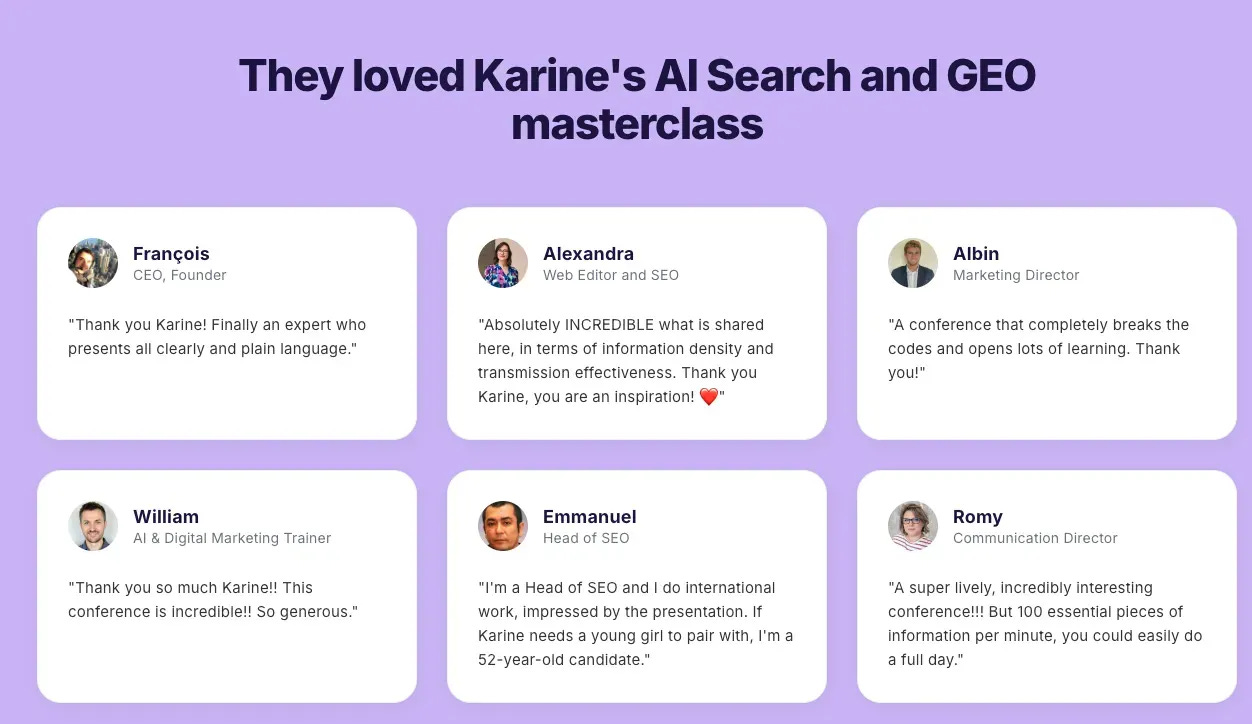
I've spent the past few weeks — a good chunk of my summer, actually — updating my AI Search & GEO masterclass so it fully covers the impact of AI Overviews and AI Mode on your content strategy. It's launching sometime in September. Sign up if you'd like to be the first to know.
🟣 Top searches & data – The AI search stats you need to shape your strategy
🟣 The AI Search tech corner – One scary technical term, explained in plain English
🟣 Search Everywhere Optimization – Because search doesn't stop at Googl
🟣 AI Search strategies – Big-picture GEO thinking, ready for the boardroom
🟣 AI Search tactics – Hands-on tactics from top practitioners
🟣 THE read of the month – The one piece everyone's talking about
🟣 SEO vs GEO – The naming battle rages on (still)…
🟣 AI Search tools – The tools worth your time (most of them free)
THE study that measures what AI visibility actually delivers.
Every brand is tracking how often it shows up in ChatGPT. But when the inevitable boardroom question lands — “OK, but what does that actually get us, in dollars?” — most teams go quiet. Similarweb just filled that gap with a groundbreaking study: a panel of real users (US, desktop, July–December 2025) across three sectors — finance, travel, and beauty.
The methodology is solid: users ask ChatGPT a question, get a brand recommendation, and are tracked for the next 7 days. Only new visitors count (no visit to the site in the previous month, and the brand was never mentioned in the prompt).
The results:
The visit happens — just not right away. Users are on average 2.5x more likely to visit the recommended brand than its direct competitor. And the effect cuts both ways: when the competitor gets the recommendation, the traffic goes to them instead (Capital One recommended: 14.2% vs. 3.8% for Amex — and the mirror image when Amex is cited).
But it comes in through the wrong door. 55.9% of AI-influenced visits arrive via regular search (against a 40.4% baseline), 19.9% come in direct — and only 8.8% through an actual AI referral link. The user reads the answer, remembers the brand, and Googles it later. Your attribution will never trace that visit back to AI.
And it’s premium traffic. These visitors show up already convinced — the comparison shopping happened inside the conversation: 12 pages viewed vs. 6.5, and 11.8 minutes on site vs. 5.6. Double, on both counts.
I’ve been saying this for three years → we’re back to old-school audience measurement, straight out of the golden age of outdoor advertising. Measuring AI visibility is measuring a billboard. Whether your brand appears on the side of a highway in 1926 or in a ChatGPT answer in 2026, the influence is real — it shows up as extra visits, not as a trackable click.
👀 My take:
This may be the most important study of the first half of 2026. And it kills the laziest argument in the industry right now: “AI is 0.5% of my traffic, we’ll deal with it later.” Wrong. AI is already sending you traffic — your dashboard just files it under “Search” and “Direct,” handing the credit to everything except the real driver. Your attribution model doesn’t underestimate AI. It’s structurally blind to it.
Three things to do about it:
Treat AI visibility as a leading revenue indicator — and measure it that way: benchmarked against your competitors, not in absolute terms.
Defend your brand terms in the SERPs, both organic and paid — that’s where more than half of AI-generated demand lands, and competitors can steal it simply by bidding on your name.
Remember this is a zero-sum game. The visit happens either way; if you’re not the brand being cited, your competitor is cashing the check. Invisibility isn’t neutral — it has a cost, and now that cost has a number.
Don’t say you weren’t warned.
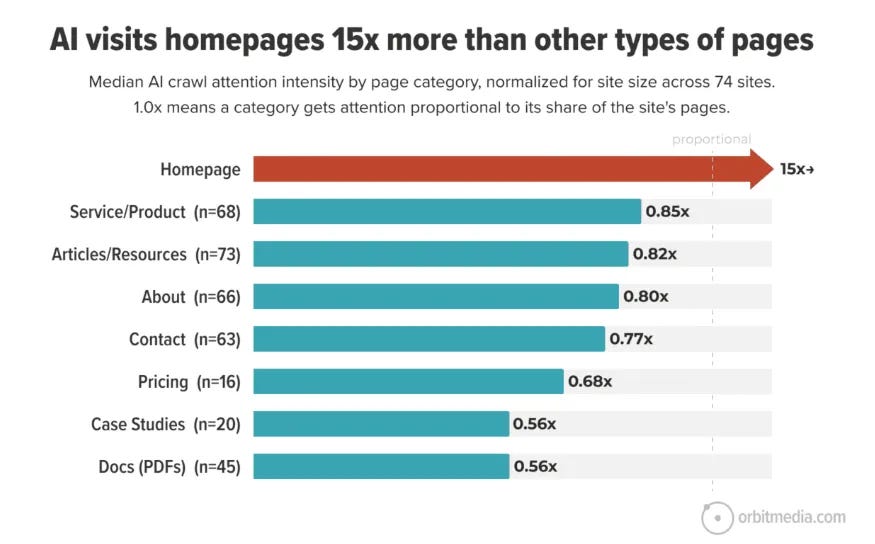
Andy Crestodina (Orbit Media) analyzed 560,695 AI crawls and 446,267 visits sent by AI, across 74 B2B sites (Cloudflare data).
AI crawls your homepage 15x more than any other page. And it’s the homepage + service/product pages that capture the real visits — not your articles, which get read and summarized without ever sending back a click (the “Dark Library Effect”).
Architecture tax: a page 3 folders deep gets a quarter of the expected AI traffic; at 4 folders deep, almost none.
👀 My take:
The new content rule for the AI era that I kept coming back to during the workshop I gave with Andy is the BIG shift in content strategy in the age of AI Search — what I call —> the 80/20 rule:
80% of content now needs to be created to live off-site (third-party mentions, press, communities — where AI learns who you are),
20% on your own site. And within that 20%, the homepage comes before the blog. FINALLY, data that puts to rest the old reflex of “I produce blog content and wait for AI to cite me.”
Your homepage is your best salesperson in front of AI — and most brands let it recite an empty slogan while the real information sits buried in an “About” page.
Your priority task this quarter → Treat your homepage like a training sheet for AI — clear positioning, what you do, for whom, your proof points, in text. The blog keeps all its value — just used differently (keep reading, I get into it further down).
🔗 Orbit Media — AI Crawls vs. AI Traffic
The Semrush study worth remembering (they churn these out nonstop, but this one deserves a bookmark): 600,000+ US keywords, 10 sectors, Nov. 2025 → April 2026.
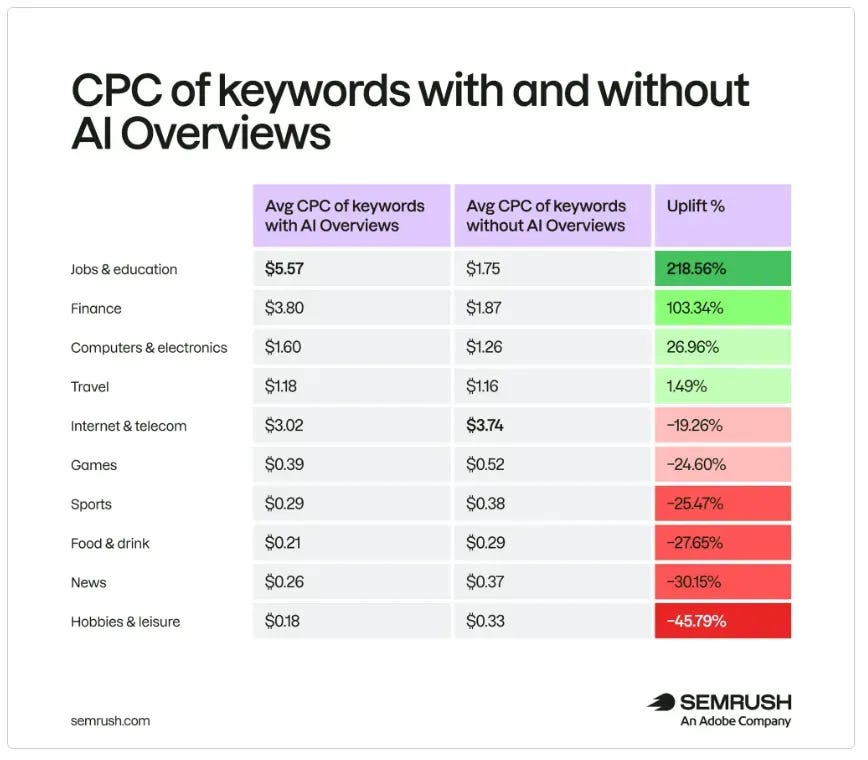
AI Overviews on commercial queries (the comparison and evaluation phase) jumped +71%. Finance is off the charts at +231%.
On transactional queries (ready to buy), they actually declined by 5%.
In plain terms: the longer and higher-stakes the research phase (finance, telecom, travel), the more AI steps in to compress the decision.
And AIOs now show up alongside Google Ads twice as often as a year ago. Worse: they appear most on the priciest keywords — up to $5 per click where there’s an AIO, versus $1.50 without.
👀 My take:
AIO is no longer just nibbling at the top of the informational funnel — it’s planting itself at the exact moment your prospect is comparing options and about to choose. That’s the worst possible place to go invisible.
And Google is playing both sides without even hiding it: it puts its AI precisely where advertisers pay the most, then charges you for a click… that its own AI may intercept before you ever see it.
For an executive, the question is no longer “SEO or Ads” but → “how do I show up across all three layers at once”→ cited in the AIO, ranking organically, and present in paid. Take the 10–20 keywords that actually drive your revenue and check which ones already trigger an AIO. That’s your battle map.
🔗 Semrush — AI Overviews are expanding across commercial intent search
Aleyda Solís analyzed 15 SaaS brands across 3 US sub-sectors, cross-referencing Semrush citation data (ChatGPT + Google AI Mode) with Similarweb AI traffic.
84–93% of citation weight comes from third-party sources. Your own site is necessary — but never sufficient.
ChatGPT and AI Mode don’t draw on the same evidence: ChatGPT leans on structured writing (docs, comparisons, tech press), while AI Mode gives heavy weight to video (23% of its mix versus 1% for ChatGPT), social, and creators (not to be cynical, but what a shock that Google’s AI Mode routes traffic toward… Google’s own products).
They don’t even cite the same pages on your site: ChatGPT anchors on your canonical pages (homepage, docs); AI Mode digs deeper into your guides and templates.
The page that gets cited is almost never the page that gets the visit. Up to 67% of AI traffic lands on pages that were never cited at all.
Bottom line → there is no universal playbook. Each category has a dominant “job” (understand/adopt, execute, decide). This is THE end of the “I’ll just copy my competitor” era (can’t say I’ll miss it): copying another SaaS’s strategy means optimizing for someone else’s answer space.
👀 My take:
Here are the hard numbers behind my 80/20 rule from above: more than 8 out of 10 citations are earned elsewhere — not on your own site. But the real gut punch is → the death of the single “AI visibility” score. There is no ONE AI, and no ONE audience: ChatGPT and AI Mode reward different content, different formats, different pages. Run one budget and one “AI strategy,” and by definition you’re underfunding half the battlefield.
For an executive, the goal isn’t “I want to be visible in AI” (that’s wishful thinking). It’s: what’s my category’s dominant job — and do my pages, my third-party sources, and my landing pages actually serve it? One number explains nothing. Adjust your reporting accordingly.
🔗 Aleyda Solís — What it takes for SaaS brands to win in AI search
A Semrush survey of 519 US B2B professionals (March–April 2026) sheds light on how buyers — i.e., your future customers — decide on their next purchase.
First, the good news: AI is now a daily habit. 84% use AI at work, and 66% of them use it to research vendors. The result → 92% say AI shaped their shortlist (45% “significantly”), and 83% say it influenced their final choice.
The number that should be your wake-up call: only 7% notice a brand because they already know it. What gets a vendor noticed is how precisely it fits their use case (53%) and how clearly it describes what it does (50%). Position in the answer? Only 36%.
One last point worth noting: AI doesn’t close the decision — it kicks it off. After a recommendation, 71% go to the vendor’s website, 63% run a fresh Google search, and 38% check G2 reviews. 75% say they trust AI — but nearly everyone verifies anyway.
👀 My take:
Brand awareness no longer protects anyone — An unknown player that’s laser-specific about its use case beats a big, vague brand. The playing field is leveling, and that’s a gift for challengers — everyone has a shot, provided the right content is tied to their brand (keep reading: there’s a lot about “entities” in this edition).
Your name is no longer enough — AI rewards clarity of fit, not brand equity. In practice, that means catch-all corporate pages don’t earn the citation anymore. You need use-case-specific pages, with documented results and transparent pricing.
One last thing → no, AI doesn’t close the sale. It opens the door — and then your website, your reviews, and your Google presence have to carry the buyer the rest of the way.
🔗 Semrush — How AI shapes the B2B buying process
According to an Exploding Topics study of 1,000 American internet users, only 8.5% always trust AI Overviews, 82% are at least somewhat skeptical, and 42% have already run into inaccurate content.
BUT — and here’s the juicy part — all that distrust triggers almost no verification: only 7.7% consistently click through to sources. At least, not directly from the AI-generated answer.
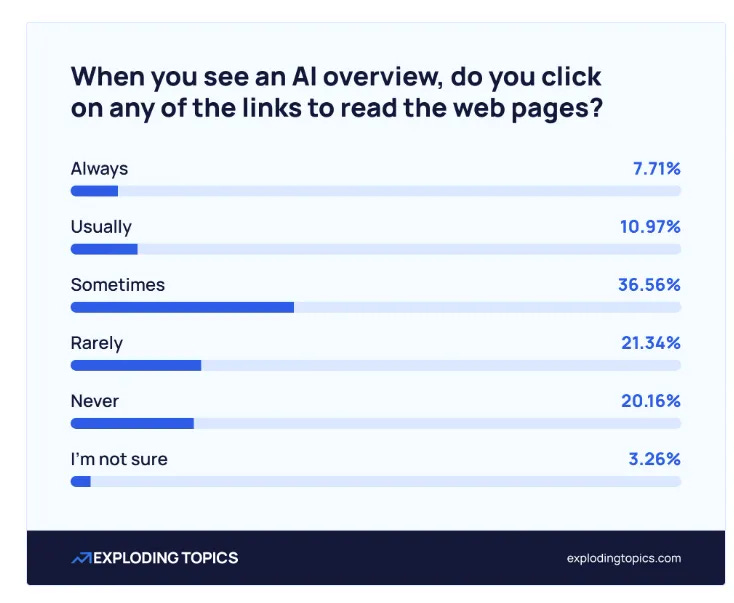
The detail that caught Wil Reynolds’ eye → the people who verify are also the people who trust the most — 63% of “always-verifiers” always trust AI, versus under 2% of those who never click through. His read:
“the problem isn’t skepticism — it’s having no system for re-testing whether AI has gotten better. Anyone still stuck on their first impression of “hallucinations and six-fingered hands” is falling behind without realizing it”.
Same vibes from Brian Dean → (who, by the way, is making his big comeback) who points to another study (Fractl, 1,000+ consumers): the share of consumers who find AI “more useful than regular search” plummeted from 82% to 54% in a single year(!!).
Boomers (63%) now find it more useful than Gen Z (47%) — which makes sense, since Gen Z uses it the most and therefore catches the most errors.
His conclusion: showing up in the AI answer is only half the job. The other half is being present where people go to double-check — Reddit, reviews, your own site (my famous 80/20 rule again!).
👀 My take:
I bring up this paradox in every workshop I run, because it explains something many executives refuse to see. We distrust AI, yet we don’t verify — because what we’re really after in an AI Overview isn’t necessarily a correct answer. It’s a better experience.
Getting an answer — right or wrong — will always beat being handed a research project: the 22 blue links you’d have to open in traditional Google Search, hoping to piece it together yourself. Google wasn’t wrong to transform its Search product. It bet that comfort would beat accuracy, and it’s been saying so openly for three Google I/Os running, ever since SGE.
What this means for your brand?
→ your future customer is lazy (we all are). They won’t verify — they’ll go with their first impression, and that first impression either carries trust or it doesn’t. So the real stakes of your content strategy circle back (yet again) to branding at its most fundamental: what feeling does your brand trigger when it shows up in an AI answer?
Becoming a trusted brand — a recognized, respected authority, what Google has spent years codifying as E-E-A-T — is the strategic throughline for everything you publish.
The test for every line you write and every piece you create: does this reinforce my brand’s authority, yes or no? Average, me-too, “just like everyone else” content only breeds more distrust — genuine authority is your best answer to AI slop.
🔗 Exploding Topics — The AI trust gap
Metehan Yeşilyurt (Peec AI) analyzed 64.77 million Reddit citations across 20 countries and 4 LLMs.
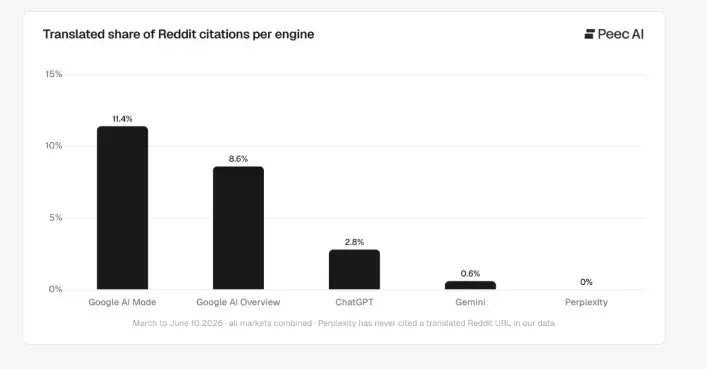
The finding that should have every non-English-speaking market on alert (👋 France): Google AI Overviews and AI Mode massively cite automatically translated== versions of English-language Reddit threads — often at the expense of local publishers who write in their own language.
The numbers tell the story: in Poland, 71% of Reddit citations point to auto-translated English content; Sweden and Norway are over 70%, Spain at 68%, Germany at 52%. And this isn’t happening on niche topics — it’s hitting the most commercial queries out there: refrigerators, soundbars, cars, SaaS. Exactly the queries that publishers, affiliates, and merchants have built their businesses on.
The language barrier that historically shielded local markets has all but vanished on Google.
One important nuance on the ChatGPT side:
Its share of translated Reddit citations collapsed from 6.14% to 0.30% in six weeks — across all markets at once — a sign that OpenAI changed something in late April or early May (possibly its grounding layer).
Glenn Gabe ran his own data and confirmed: these translated Reddit pages are now declining on Google too — the first drop of its kind after two years of explosive growth.
The engines are now behaving very differently from one another: tracking your AI visibility on just one and assuming the rest work the same way is a mistake.
🔴 And tensions escalated this week: Reddit itself, alongside major publishers (USA Today, Reuters, Politico, The Economist), is now weighing limits on Google’s access to its content for AI. Another standoff in the making?
👀 My Take:
This is a serious “blind spot” for a French company — one that deserves more attention. While we’re debating “how to get cited by AI,” Google is already citing a machine translation of an American Reddit thread in your place, on your own queries, in your own language. Your historical head start — knowing your market, writing in your language for your audience — is starting to evaporate.
Two things to remember:
1) Your AI visibility monitoring is worthless if it’s limited to a single engine: AI Overviews, AI Mode, ChatGPT, and Gemini don’t behave the same way, and what’s true for one is false for another — the translated-Reddit case proves it, massive on Google, nearly zero on ChatGPT.
2) Same old tune… don’t try to fight over fairness — try to become the source that not even a machine translation can replace: real local experience, data the English Reddit thread doesn’t have, a grounding the machine can’t fabricate. Language no longer protects you, sure, but there’s no other brand quite like yours “in and out” of Reddit. You just “simply” need to share content that proves it.
An entity is a real-world “thing,” uniquely identifiable, independent of the words used to describe it: a person, a company, a product, a place, a concept.
The Knowledge Graph is the massive database Google launched in 2012 to store these entities and their relationships (billions of facts like “Tim Cook — runs — Apple”). Its launch slogan remains famous: “things, not strings”.
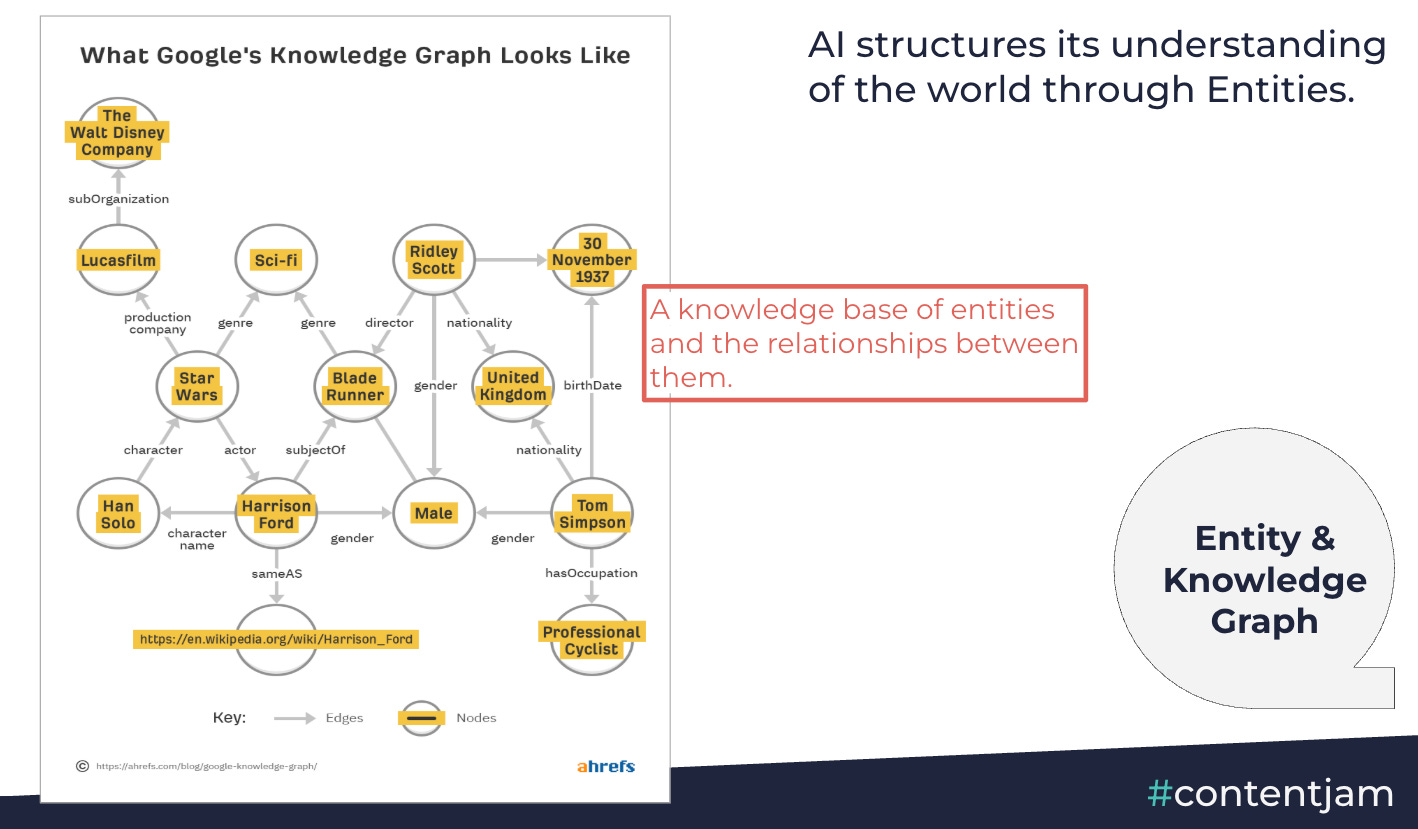
Take the word “Jaguar.” For a keyword-based engine, that’s six letters. For an entity-based engine, it’s three different things — a big cat, a car brand, an old Apple OS — and context tells you which one you mean.
That’s the leap: the machine no longer reads words, it recognizes things and what connects them. Your brand, your products, your executives, your areas of expertise: each one is an entity — or should be — in the machines’ “minds.” And that “mind” is no longer just Google’s Knowledge Graph: ChatGPT, Claude, and Perplexity each build their own understanding of who you are, by cross-referencing everything the web says about you.
Because the unit of visibility has changed. For twenty years, we optimized pages for keywords.
But when you ask an AI “which tool should I choose?”, it doesn’t rank pages: it compares entities — brands it knows, understands, and trusts to varying degrees.
Three consequences:
If the AI doesn’t clearly know who you are, it can’t recommend you — it replaces you with a competitor it understands better, or worse, it invents things about you (hallucination hits fuzzy entities first).
Understanding costs the machine money — every ambiguity about your identity burns compute; a clear entity is mechanically cited more often than a confusing one, all else being equal.
Everything we’ve seen in this edition follows from this — fan-outs that type in brand names, categories that brands “own,” the audit “ask ChatGPT to explain your business” (↓ keep reading the “tactics” section): every time, it’s your entity being evaluated, not your pages.
Be consistent: Your website, your Google listing, your LinkedIn, your directory listings must tell the same story: same business, same services, same positioning. Every contradiction creates “entity fuzziness” and lowers the machine’s confidence.
Be explicit and simple: Clearly tell machines who you are: that’s the role of structured data (Schema Markup — decoded right here back in February) and the sameAs field, which links your entity to references AIs already know (Wikipedia, Wikidata, LinkedIn).
→ A “ smart trick” recommended by Andy Crestodina:
Create an “AI disclosure” page— a page on your site, linked from the footer, that condenses your entire identity sheet (business, offerings, clients, service areas, certifications, contacts) into plain text, marked up in schema. It’s not some magic file for AI — it’s a regular HTML page, crawlable by everyone, including the engines that Gemini and Perplexity rely on. Its big advantage is bringing together in one place what your “About” page usually scatters. Andy even offers a free generator (his AI Training Page Generator, which I already shared with you in a previous edition).
Go all in on social proof: An entity can’t be declared, it has to be corroborated: press, reviews, podcasts, conferences, certifications — everything others say about you either reinforces (or contradicts) what you claim.
Create relationships between entities: An isolated entity is illegible; a connected entity — to its category, its partners, its ecosystem, its key people — becomes understandable and recommendable. The final test is in the “Tactics” section below: ask AI to explain your business. Its answer is the current state of your entity.
🔗 Benu Aggarwal (Search Engine Land) — Why entity authority is the foundation of AI search visibility
🔗 Orbit Media — Is your website AI-friendly? The 8-point checklist
LinkedIn is no longer just a social network: it’s a surface that AI engines actively search (AI Mode gives a lot of weight to social and creators, ChatGPT’s fan-outs query LinkedIn) and a full-fledged algorithm you need to know how to work.
Except… this surface is saturating.
A Pangram study (1,002,627 posts scanned, April 24 → June 30) puts a number on the scale of it: on LinkedIn, more than 40% of long-form posts are entirely AI-generated — the worst score of any platform.
And LinkedIn alone accounts for 62% of all detected AI content, even though it only makes up a third of the posts analyzed.
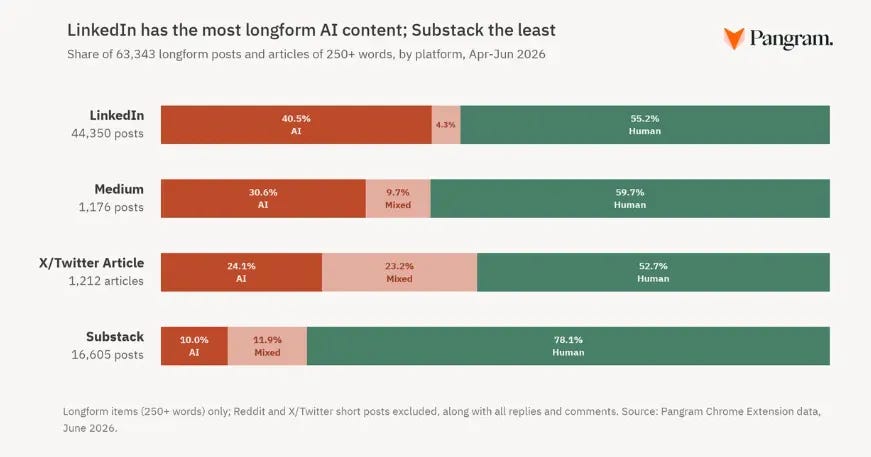
One paradox the study points out → people are most likely to hand their writing over to a machine on the platform where they post under their real professional names (anonymous Reddit sits at just 4%). Meanwhile, LinkedIn is actively pushing AI with its “Enhance post” button — while announcing it plans to downrank AI content. Go figure 🤷♀️.
👀 My take:
No — I’m not going to tell you to ditch LinkedIn. It’s still an essential platform, its algorithm can absolutely be worked, and none of that changes overnight. But this data raises a real prioritization question. Jumping in just to join the AI-slop dance — posting synthetic content because everyone else is — gets you nowhere: you’re adding noise to an ocean of noise, on the very platform that’s about to start filtering that noise out.
The real question for a decision-maker → does LinkedIn actually need to be your #1 platform? Until now, the knee-jerk answer was “of course.” Today, it deserves an honest second look: maybe not. Maybe it’s simply the place where you repost what you’ve already published elsewhere (good old “repurposing”) — your newsletter, your study, your actual point of view — as long as it stays authentic. In other words: LinkedIn as your foundation? Not necessarily. LinkedIn as an amplifier? Probably. What’s certain is that this channel deserves your presence — but it doesn’t deserve your leftovers. In a feed drowning in AI slop, the only thing that makes you visible — to humans and machines alike — is what only you can write.
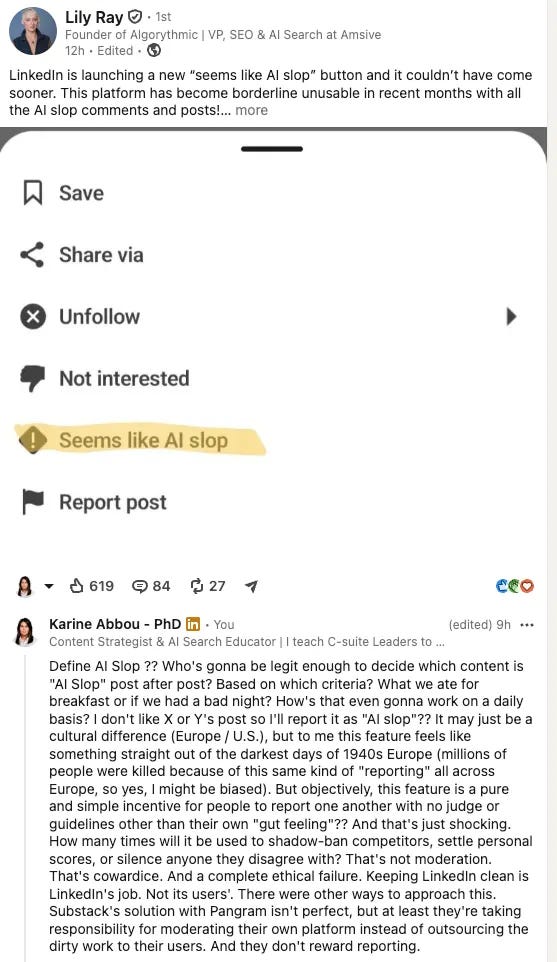
Last-minute note – I'd planned to send this edition out this morning, but a "HUGE" new LinkedIn feature dropped yesterday, so I held it back to add this note and keep things as current as possible. It ties directly into this whole AI-slop conversation — and it made my blood boil!! In short: anyone on LinkedIn can now "report" an author whose content looks like AI slop to them. I didn't hold back — I said exactly what I think, both on Substack and on LinkedIn in an exchange with Bruno Fridlansky in France. That's how angry it made me. Even though most of Lily Ray's fans found this new feature awesome, I'm not one of them. And I'm O-K with that 🙃.
🔗 Pangram — AI content is everywhere on social media, especially LinkedIn
Reddit shows up in 11.3% of AI answers — more than almost any other single source. With mentions now the currency of AI Search, Reddit became the easiest distribution channel around: one agency even saw its clients’ posts cited by ChatGPT within a day.
Except… Reddit has tightened the screws.
Its new LLM-based detection system now catches around 25,000 spam posts a day, blocks 23 million unwanted views daily, wiped out nearly 2 million fake votes per day over a three-month stretch, and cut spam exposure by roughly 20% between January and March #ugh😨.
The unofficial target is obvious → brands and GEO/AEO consultants planting fake testimonials for LLMs to pick up later as sources. Which is why the “citation half-life” keeps shrinking — cited one day, deleted the next. And when the manipulation does survive, it backfires: twenty sponsored comments can’t erase two hundred real complaints that are older and more credible. Worse, reviving the thread bumps it right back to the top — and hands the mic back to the genuinely unhappy customers.
Redditors sniff this stuff out in seconds, and the pile-on that follows becomes the record AI reads about your brand. The only approach that still holds up hasn’t really changed: aged, credible accounts, real subject-matter experts, value delivered before any mention (at most one brand comment in four), and clearly disclosed affiliations.
The goal isn’t karma — it’s credibility. Becoming the most useful answer, not “doing marketing on Reddit.” The formats racking up citations bear this out: Q&A threads (more than half of all cited Reddit content), comparisons, first-hand experience posts with real numbers, pricing discussions (reused 60% of the time), and problem/solution threads.
👀 My take:
Seemingly everyone woke up one morning and decided to “do Reddit” for AI — and that’s exactly where it goes wrong. Reddit isn’t a marketing channel; it’s a reputation play, and that distinction changes everything.
You don’t place your brand on Reddit — you let it earn a reputation there, which is not the same thing and can’t be run off an editorial calendar. The shortcut — fake accounts, manufactured testimonials, automated replies “in your brand voice” — now costs more than it pays: Reddit exposes you, AI forgets your citation within a day, and the community turns you into a textbook case of what not to do.
The good news: for once (finally!!), the honest approach and the effective approach are one and the same: be useful, be yourself, be patient. If your brand has a bad reputation on Reddit, the answer isn’t to flood it with positive posts — it’s to fix what’s actually wrong with your product, and to build on the genuinely good things people already say about you online. Reddit doesn’t amplify what you say about yourself. It amplifies what your customers actually experience. And no bot is going to change that.
🔗 Reddit — How we’re keeping Reddit real and safe in the AI era
🔗 Search Engine Journal — Buying reddit to win AI citations is the new link farm
A year after brands rushed onto Substack, the first numbers are in (Modern Retail).
The RealReal launched its Gossip Girl-style newsletter, “The RealGirl,” with zero sales agenda — until it noticed the products it linked were selling out, one after another: over $334,000 in sales, views quadrupling (58,400 → 236,000), and subscribers up 139% in a year.
M.M. LaFleur moved its magazine The M Dash from WordPress to Substack and picked up 6,000 subscribers purely through the platform’s built-in discovery tools — with open rates around 50%, practically unheard of in traditional email marketing. One editorial surprise along the way: their best-performing content isn’t style advice but personal essays — the most-read post is the founder’s piece on her co-founder’s departure.
Rare Beauty doesn’t even track sales: viewership is up 281%, and they steer by sentiment (DMs, comments) rather than KPIs.
What the three have in common → a maintained pace (Substack recommends at least one post per week — “your growth is tied to your output”) and content perceived as useful, not promotional.
👀 My Take:
Connect the dots with the Pangram study seen above: Substack is the platform least polluted by AI content — and it turns out to be the one where brands are starting to generate real revenue. That’s not a coincidence, it’s an equation: chosen audience (the inbox, not the algorithm) + embodied content + zero slop = trust, and trust converts. Notice carefully what performs: not the catalog, not generic advice — personal essays, the founder recounting a painful departure. Same law of the month, once again: authenticity pays, literally this time.
For an executive, the question is no longer “should we have a brand newsletter?” but “who in the company has a genuine voice — and are we prepared to keep the pace?” Because the only documented failure here is inconsistency: a ghost newsletter damages more than it builds. If you have neither the voice nor the cadence, don’t do it. If you have both, it’s probably the channel with the best trust-per-dollar ratio right now.
And one of the reasons I love Substack is that it’s the voice that mixes perfectly with the AI era: where the blog is losing its color, where the website gets pared down to a few key pages, where the newsletter format is the most appealing form of “owned media,” and where community remains the safest place to connect with real people (rather than unknowingly flirting with a bot). An improbable, perfect blend. As you can tell: I’m an absolute fan.
🔗 Modern Retail (Allison Smith) — Brand substacks are starting to show real results
Two Google announcements landed a few weeks apart — the first flew under the radar in late June, the second dropped on July 29 — and taken together, they point to a deeper trend. So I’m covering them as a pair.
→ On one hand, Search Profiles: public URLs that let eligible creators and publishers pull their whole presence — content, social posts, articles — into one official profile built into Google. The payoff (as Cyrus Shepard points out): more visibility in Google Discover for your followers, the ability to trigger a Knowledge Panel by claiming your profile, and richer existing panels.
For now it’s US-only and limited to audiences of 100k+. And a nice little SEO bonus: profile links are currently followed 😉.
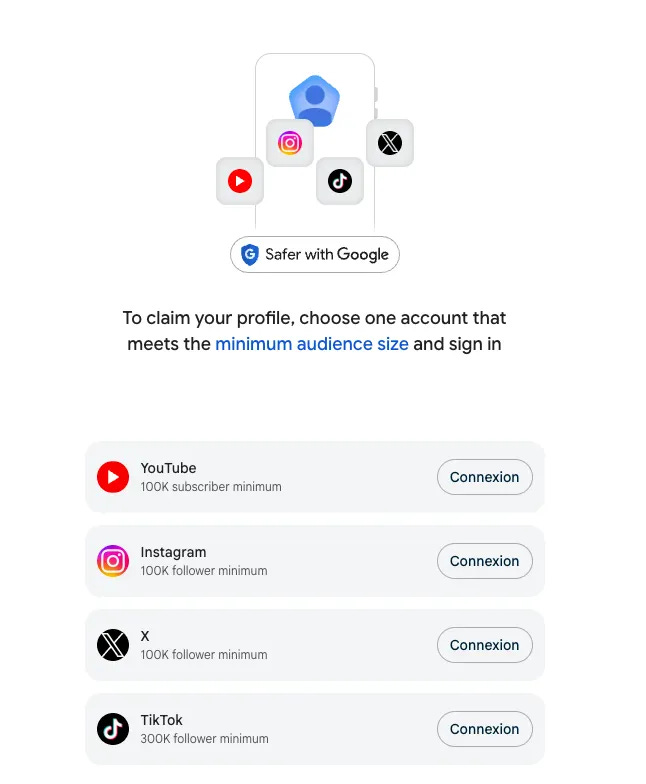
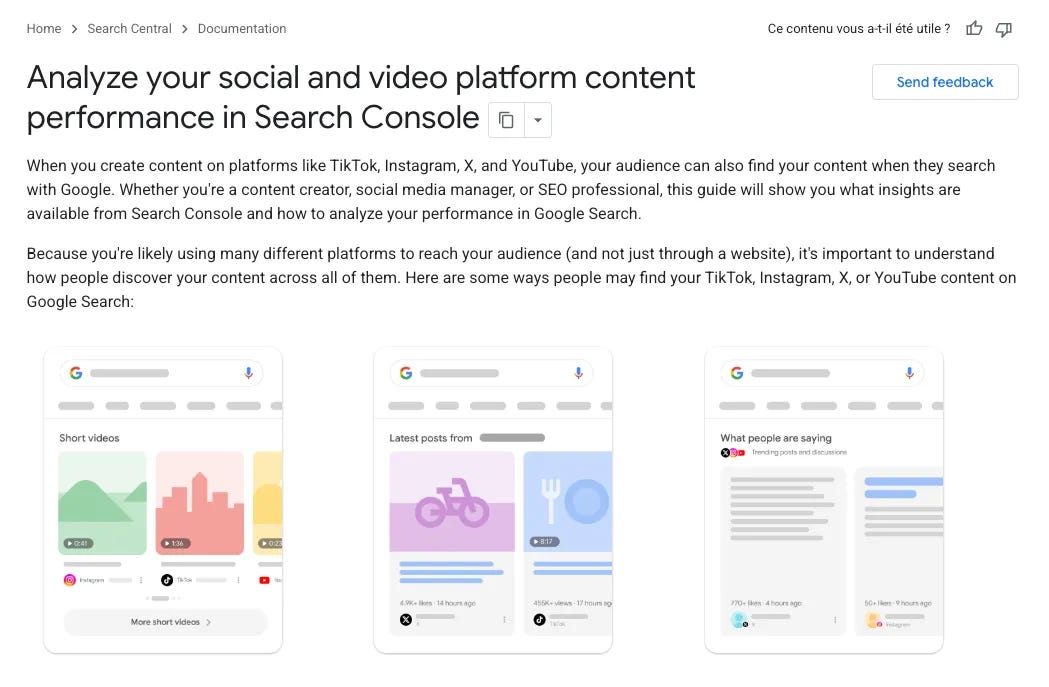
→ On the other hand, Google Search Central just announced (July 29) the global rollout of “platform properties”== in Search Console — open to everyone, with no audience threshold at all, unlike Search Profiles.
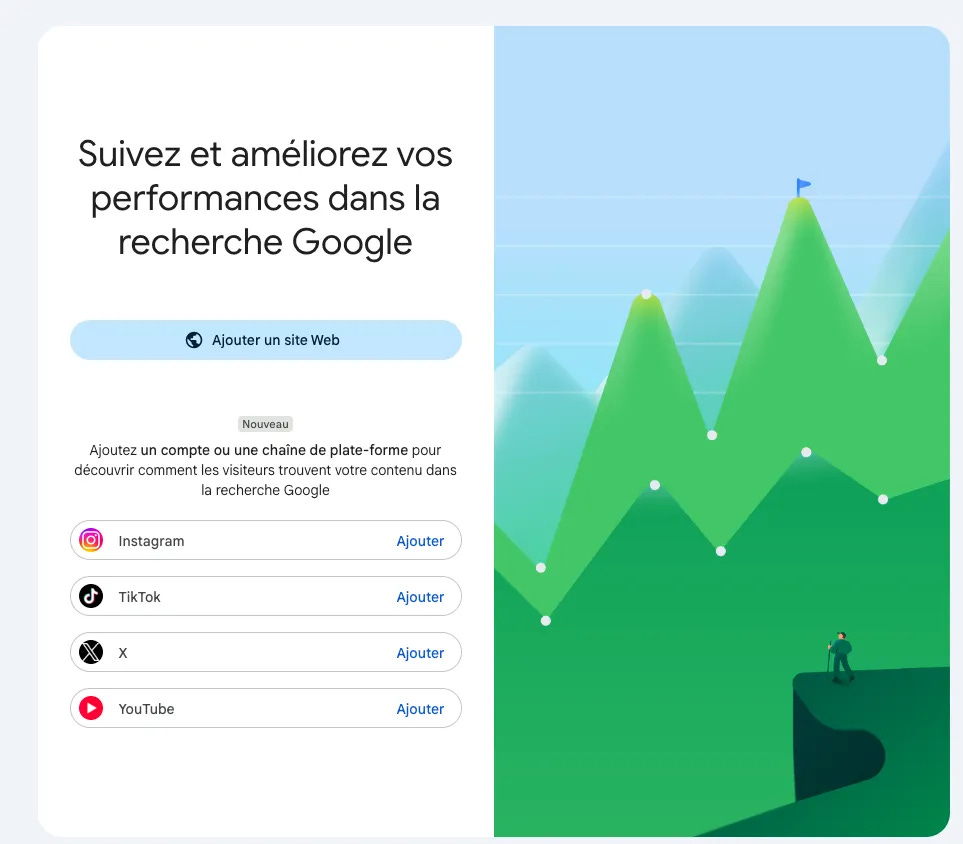
You can now connect your Instagram, TikTok, X, and YouTube accounts and measure how your posts perform across Google Search, Discover, and Google News. The official guide that shipped with the launch walks through the use cases:
Identifying the query themes that send you traffic,
Catching a post as it takes off, using the 24-hour filter, and comparing your performance across platforms,
Or testing — with annotations to back it up — whether rewriting a YouTube title moves your search traction.
👀 My take:
Watch the direction, not the features. In a single month, Google did two things: it gave creators an official identity (the profile), and it gave platform content an official measuring stick (Search Console). That’s the clearest admission yet that Search no longer happens on websites alone — Google is institutionalizing the very “Search Everywhere” trend this section has been documenting month after month.
And note the subtlety most people will miss: the measurement is for everyone, but the identity is still a club. Any brand can plug its TikTok into Search Console today — the official public profile, though, stays reserved for the 100k+ crowd.
So start with what’s open to you → connect your accounts and, for the first time, prove with Google’s own numbers that your social presence is a search asset. Then have your eligible in-house experts claim their profiles — these thresholds always drop over time, and early adopters get the head start. Social is no longer a silo sitting next to SEO. It’s a search surface in its own right: your TikTok posts, YouTube videos, and Instagram content are now indexed, measured, and served by Google on equal footing with your web pages. Same playing field, same visibility rules, same dashboard. Google just made it official — and shipped the tools to prove it.
An Inc. article (Victoria Watters) makes a clear bet: according to Gartner, earned media budgets will double by 2027.
Why? Because AI has become a major place where brands get discovered — and it doesn’t rank, it learns. Not your brand as presented on your own site: what credible third parties say about you.
94% of citations in AI answers come from unpaid sources, half of which are less than 11 months old. Credibility and freshness above all.
A visitor coming from AI converts at 11.4% versus 5.3% for organic: they arrive already convinced, recommendation in hand.
And AI isn’t fooled by fake earned media: 20 genuine press mentions beat 200 sponsored pieces of content.
👀 My Take:
A bit of an irony — the new “visibility merchants” (as I’ve seen some self-describe) are often fairly opaque about themselves. The PR profession has rarely done that “old school” content marketing à la Joe Pulizzi: explaining their trade, answering every question a future client might have, explaining their methods, being transparent about how their pricing is structured. AI Search is clearly a new opportunity that smart PR people have seized aggressively over the past two years. That said, we haven’t really seen them deploy genuine content strategies for themselves yet, to stake out their own position on this new web.
That’s a shame.
Before AI, there was a kind of invisible line between pure media-relations PR people and those coming from SEO (the link-building crowd). I never quite understood it, honestly, but that’s a topic for another edition. Today in the US, I’m seeing a lot of the latter group building brilliant content strategies to turn their agencies into “PR for the AI Search era” agencies. On the traditional PR side, though, I see very few genuinely positioning themselves and explaining and communicating about what they do. Every frustration hides an opportunity… Those traditional PR people who “dare” to create content that brings more transparency to their own profession will do more than just stand out. They’ll take the whole pot. The position is vacant.
🔗 Inc. — Gartner says PR budgets will double by 2027
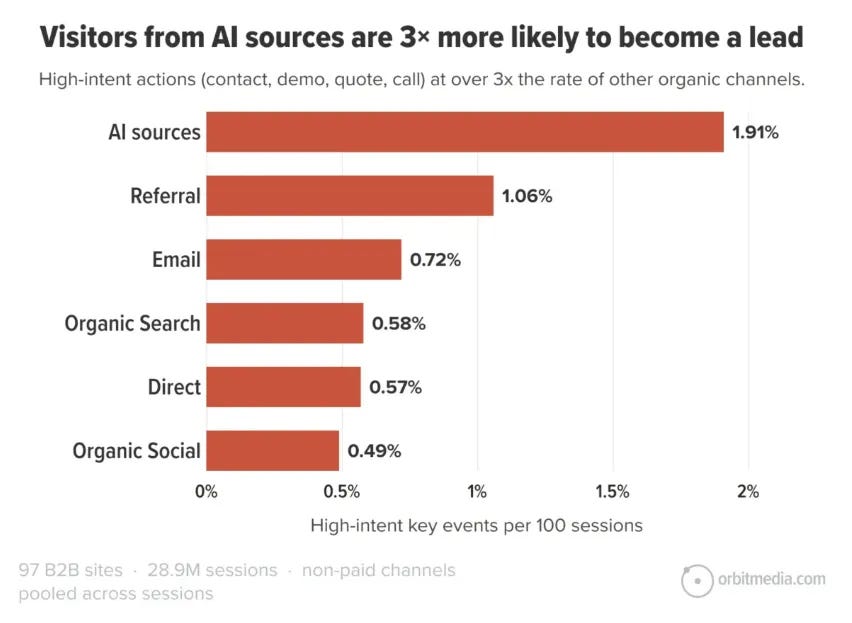
Andy (again, I know, I’m a fan) put out another GREAT study: 97 B2B sites, 29M visits, over one year (through June 2026).
Traffic coming from AI accounts for only 0.5% of visits — 1 in 200. But it converts 3x better into leads than other organic sources (and up to 7x at the per-site median). ChatGPT accounts for 82% of this traffic and converts 2.1% of its visitors, versus 0.5% for Google — which, for its part, sends 100x more people.
Why?
Because the visitor arrives late. The consideration phase — comparing, shortlisting — happened inside the model, before the click. They’re no longer coming to discover: they’re coming to confirm. Gaetano DiNardi sums it up well: these visitors are better informed, because their journey was conversational and personalized.
👀 My Take:
Here’s the number that should change how you read your dashboards. As long as you judge AI by volume, you’ll wave it away: “0.5%, we’ll deal with it later.” Strategic mistake. ==AI is not a mass-acquisition channel, it’s a== ==closing== channel: it sends you few people, but nearly-decided buyers.
The funnel has inverted — consideration has migrated inside the LLM, and your site now only inherits the last step. Two consequences for your board: stop measuring AI in traffic, measure it in lead quality; and make sure the pages where AI drops off these buyers (homepage, service pages, case studies) are built to convert, not to inform. What AI brings you is the hottest prospect on the web. Don’t waste them on a lukewarm page.
↑ Study to read alongside Andy’s other study, his companion piece on which pages AI crawls and where it sends traffic (in the Top Searches & Data section).
🔗 Orbit Media — AI traffic conversion rates (Andy Crestodina)
I’ll be breaking down this funnel flip — and everything else covered in this edition — in practical, hands-on detail during my back-to-school AI Search masterclass this September. Join me!! In just 90 minutes, you’ll walk away with a clear picture of exactly what to tackle to adapt your content strategy to AI Mode and AI Overviews.
Disclaimer: No, I’m not an AI 😬. Just a certified AI Search addict who’s been eating, sleeping, and breathing this stuff for three years — and, as my friends will happily confirm, I LOVE to share. Can’t wait to see you there ;)
David Konitzny (Peec AI) analyzed the use of the “site operator” in ChatGPT 5.6’s query fan-outs — (you’ll have gathered by now, these are the sub-queries the model fires off behind the scenes to build its answer). Two points stand out:
First, 84% of targeted domains are branded: when your query is about a product, the model already knows which brand site to query. It knows you.
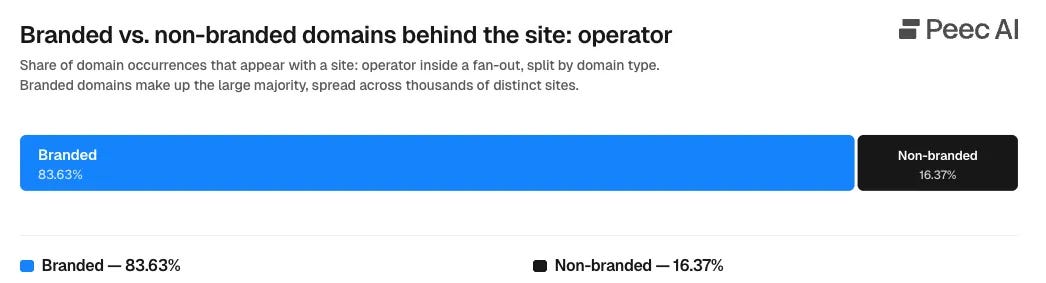
Then — and this is where it gets improbable — among the 16% of non-branded sources, the ones the model goes to for validation and context, Reddit accounts for 71%, and on the reviews side… Trustpilot takes 54% 😳.
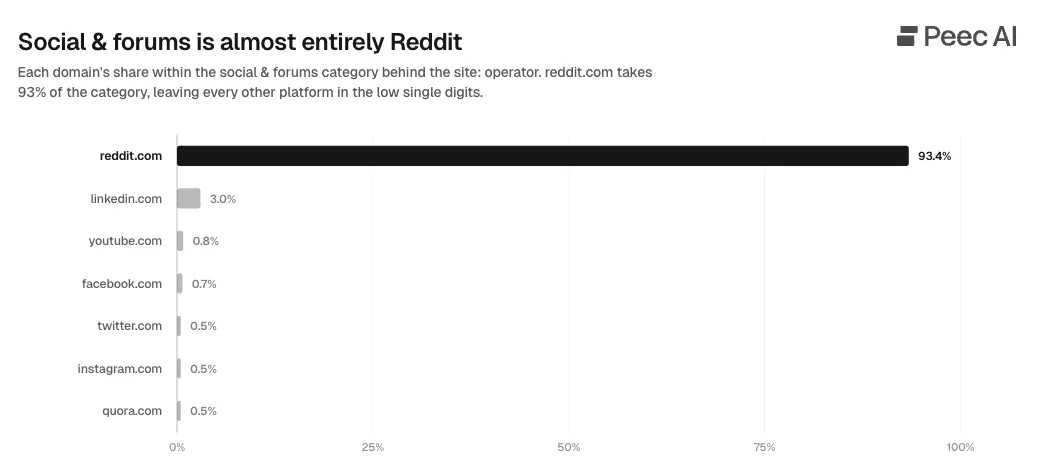
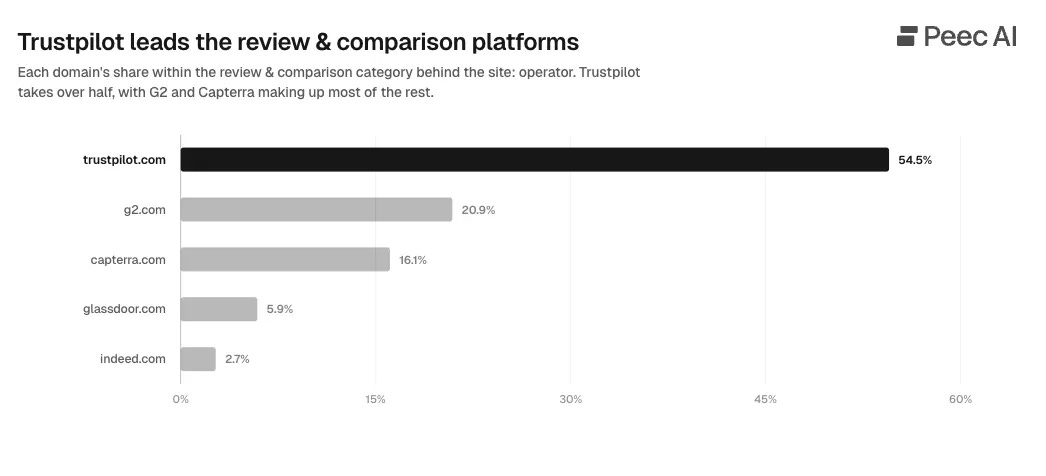
Translation: the “second opinion” AI forms about you doesn’t come from your site, nor from your advertising. It comes from two platforms most brands don’t control.
👀 My Take:
Another proof, this time at the mechanism level, that your AI visibility is decided off your own turf. The model really does have two reflexes: it knows your brand (your 84% branded), then it goes to check what’s said about you elsewhere — and “elsewhere,” concretely, means Reddit and Trustpilot. Your reputation on these two platforms is no longer a customer-service matter: it’s a direct input into the answer AI gives about you.
For your board, that means one simple and uncomfortable thing: if your Reddit presence is nonexistent and your Trustpilot reviews are neglected, you’re letting a machine build your reputation out of what others have written. Go check what Reddit and Trustpilot say about your brand today. It’s probably already in the answer. Except, as you’ll see further in this edition, being “well” present on Reddit turns out to be more complicated than it looks.
🔗 David Konitzny (Peec AI) — Site operator usage in ChatGPT 5.6 fan-outs
Topical authority is the bet of concentrating your content strategy on a core set of subjects rather than spreading wide with no structure around one key theme — in order to become the brand that consistently comes up whenever a question in that domain is asked, right up to the question that matters (the one that tips the purchase decision).
Kevin Indig analyzed, using Semrush data, 50,000+ brands and 1,094 categories in ChatGPT (January → June 2026).
Verdict: Yes, topical authority does transfer to AI. And the reason is one word — durability. Once a brand owns a category, it keeps it: an “owner” retains its spot month over month in 90% of cases.
But the real strategic signal lies elsewhere: today, only 15% of categories have a clear owner. And crucially, 89% of demand in AI Search is concentrated on categories without an owner — the biggest topics are precisely the most wide open.
One last point that should change how you measure things: winners win on brand mentions, not citations. The most-cited domain is rarely the most-mentioned brand — and it’s the mention that the user sees and acts on (74% choose the brand mentioned first).
👀 My Take:
This is a gold rush with a countdown clock. The lesson isn’t “produce more,” it’s “produce concentrated” — hyper-focus on one precise thematic domain and fully own the semantic field of that domain. Brands that scatter their content across every subject vaguely adjacent to their core business never reach the share of mentions that sustains leadership.
For your board, the trade-off is fairly simple: pick 5 to 10 categories where you want to be the answer, prioritize attacking the ones without an owner or with a weak leader, defend the ones you already hold, and let go of the ones a big brand has locked down on every prompt. The cost of picking the wrong category today is low — in twelve months, the spots will be taken.
→ The mentions / citations / third-party web (external social proof) triptych are the pillars of your topical authority and your positioning in AI within your category.
And the only metric that matters: is it my name that comes up in AI when my category is mentioned.
🔗 Kevin Indig (Growth Memo) — Does topical authority matter in AI Search?
Wil Reynolds (Seer Interactive) ran 617 executive-level prompts, rerunning each one 30 times to extract the signal. His discovery on ChatGPT 5.5: fan-outs — those sub-queries the model generates before answering, which I keep talking about in this edition — no longer say “best GEO agencies,” they say “Lily Ray’s GEO strategy,” “iPullRank’s AI search study.”
The model has decided that certain brands are the subject.
Consequence: when your name shows up in a fan-out on a non-branded prompt, you’re “hardwired” into the model. And at that point, good luck to a competitor trying to beat you on your own search. This small discovery, frankly, also sounds the death knell for listicles: you don’t climb into a fan-out through industrialized content that any AI can churn out today.
How do you become “hardwired”?
The “do humans care” audit: sort each piece of content’s traffic into two piles — algorithmic (ChatGPT, Google, Perplexity) vs. human (LinkedIn, direct, podcasts, press). Content that wins human hearts is the content that ends up in the fan-outs. Human validation kickstarts the algorithmic flywheel.
The point is a consensus among experts: several leading industry voices relay and endorse this thesis — authentic brand, not manufactured mentions.
👀 My Take:
This is the end of the “ballot-stuffing” era. For two years, mediocre but industrialized content grabbed AI visibility — Reynolds, like others, was waiting for the referee to blow the whistle on recess. ChatGPT 5.5 is starting to blow it, and the new judge is the brand.
For your board, this completely flips the logic: your most durable AI-visibility asset is neither a page, nor an acronym, nor a volume — it’s becoming, within your category, the name the machine types in on its own. And that can’t be bought with scaled content: it’s built by producing things real humans want to share, cite, and debate.
Ask your teams a key question: what is our category? And add a metric to your dashboard: does my brand show up in the fan-outs, not just in the answers? These are the two leading indicators for everything else. (Tip: Bing Webmaster Tools now gives you these fan-outs. More on that further down.)
🔗 Wil Reynolds (Seer Interactive) — ChatGPT 5.5’s fanout patterns reveal the importance of brand
Suganthan Mohanadasan doesn’t read ChatGPT’s answers — he reads ChatGPT’s network traffic to see, mechanically, how it picks its sources. Between his Part 1 and this Part 2, ten days passed, and OpenAI had already added a retrieval engine, changed vendors, and modified the data structure. His conclusion is worth its weight in gold for you: anything bearing a proper noun or a number has a shelf life of a few days; only the mechanisms last.
And these mechanisms are stable and exploitable:
ChatGPT injects a hidden prompt that, for a fact, goes looking for the “official” source — it literally adds that word to its queries. Facts get routed to official pages (yours); opinions get routed to reviews and Reddit.
Citations link by claim, and deduplicate by domain. Translation: on a single claim, your 20 weak pages fight each other — 19 lose to the 20th.
Staying “scrapable” matters: blocking scrapers at the firewall can cut you off from an entire segment of users.
👀 My Take:
Be wary of anyone selling you “ChatGPT’s ranking factors” backed by an undated screenshot — that’s folklore. The real instructions never leave OpenAI’s servers, and the plumbing shifts every week. Build on the durable mechanisms; treat every tool name and every percentage like the weather.
Be the official source of your own facts. AI routes facts to your page — put your prices, your specs, your documentation in plain text on pages that are indisputably yours. And drop the “Contact sales” routine: if your page refuses to state a price, a Reddit comment will do it for you, and ChatGPT will repeat it as fact.
Since late June, ChatGPT can cite Bing directly as a source (spotted by Konitzny, relayed by Josh Blyskal) — and not for everyone: it’s rolled out by cohort. This lines up with Glenn Gabe’s observations (sites weak on Google but well-cited via Bing/Copilot).
On your to-do → go check your Bing indexing in Bing Webmaster Tools. It’s a five-minute insurance policy, and if you land in a “Bing” cohort, whatever Google ignores about you, Bing can hand to ChatGPT.
🔗 Suganthan Mohanadasan — ChatGPT changed how it picks sources (Part 2)
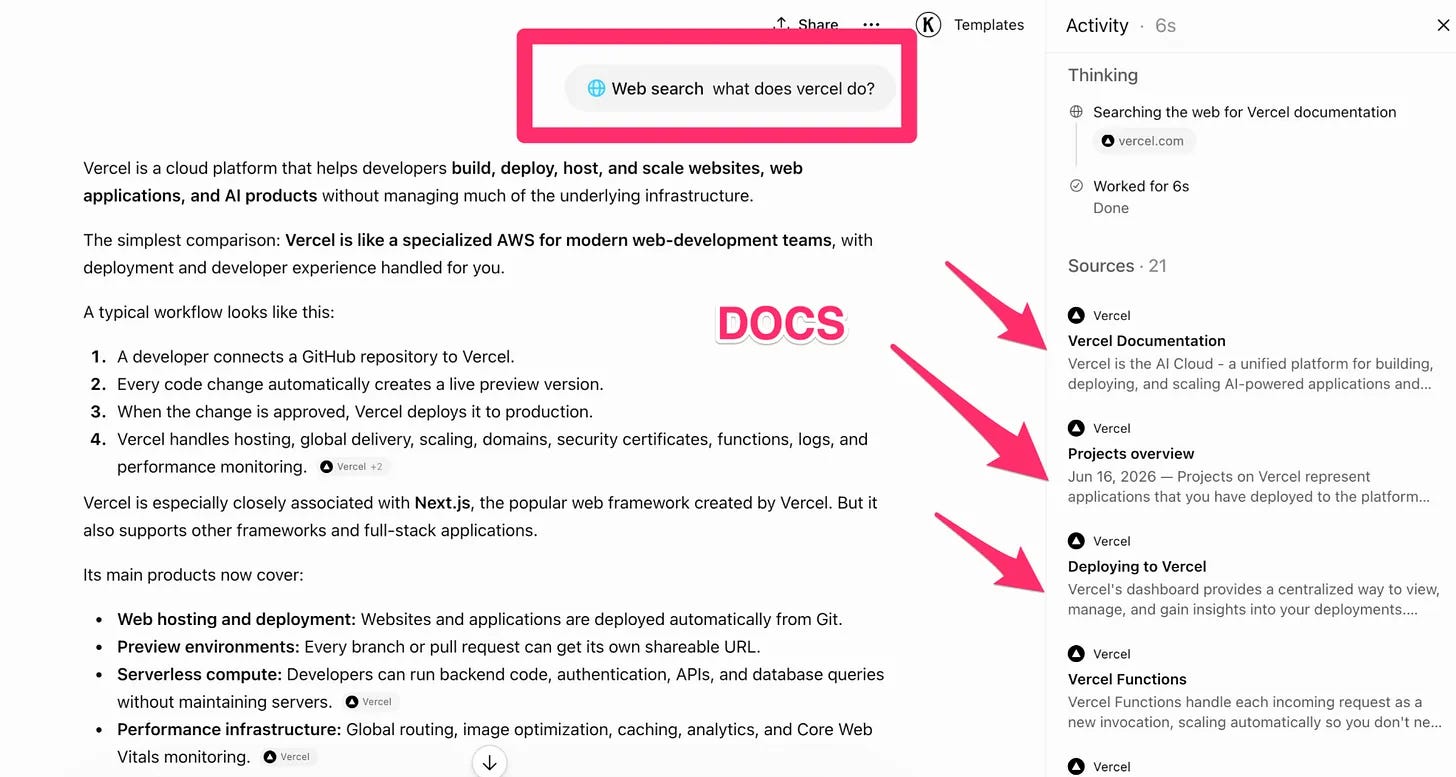
For two years, content teams have been asking themselves what to create for AI Search — more blog posts, more programmatic pages, more “LLM-optimized” assets. Josh Spilker (AirOps) flips the question: the most under-exploited asset already exists — it’s your documentation, your help center, your FAQs, your technical specs, your support pages. Structured, declarative, close to the source of truth, docs natively speak the language AI extracts — whereas a blog post unfolds a narrative arc, docs go straight to the point.
At AirOps, some of their most-cited pages are support docs, which even surface on prompts for which they had produced dedicated “SEO content.”
👀 My Take:
This is probably the cheapest GEO win on the table, and too often neglected. Your docs are the only content in your company written to help, not to sell — and that’s exactly why AI trusts them when everything else reeks of self-promotion. The irony: you’re already paying to maintain them, but they sit with another team, outside the marketing calendar. Before briefing a single new page “for AI,” go audit what your help center already says about your product — and give it a seat at the table in your content strategy. Not by stuffing it with keywords: by making it clear, connected, and accurate. The asset that best explains your product is already written. You just call it “support.” You just need to pull it out of its closet so it can shine like the gem it is.
🔗 Josh Spilker (Growth Content) — Companies want content for AI search. They already have it.
Darren Shaw (Whitespark, Local SEO and Google Business Profile specialist) points to two fields on your listing that AI now reads to understand — and recommend — your business.
Your Google reviews: Google and AI use them to grasp what you actually do: your flagship services, the problems you solve, why you get recommended.
In his example, most of the details Gemini highlights are summarized directly from Google Maps reviews. Hence his tactic: when you ask for a review, encourage the customer to naturally name the service they received, the problem that was solved, what made the experience memorable. The more specific the review, the better AI understands your business — so aim for a steady stream of fresh, detailed reviews, rich in text, not just five stars.
Your GBP description: This field everyone used to neglect (no impact on local ranking) is now picked up by AI when it answers about a local business.
No more “family-run business with impeccable service”: clearly state what you offer, your services, your service areas, who you help. And pay attention to phrasing — not “We offer plumbing in Denver” but “ABC Plumbing provides emergency plumbing and drain-clearing services in Denver.” This structure — the semantic triplet [business] provides [service] in [location] — is much easier for a model to digest. The field is short, but deserves regular updates.
🔴 Industry proof, dropped in late July: OpenAI just signed a deal with Yelp to inject its reviews, ratings, and photos directly into ChatGPT’s local answers — quote requests included. Your customer reviews are no longer just read by AI: they’re now being bought by it.
👀 My Take:
This is, today, the most actionable side of the month’s big principle — “AI learns who you are outside your own site.” Except here, you have a direct lever. On Reddit you’re at the mercy of others; on your Google listing, you’re in the driver’s seat. What to do? Stop chasing the star rating, start chasing the text — a review that names the exact service becomes a sentence AI will surface about you. And stop “making it pretty” in your description. Write for the machine instead, in clean semantic triplets. This is low-hanging, nearly free ground, and remarkably effective if you have local roots. Most of your competitors leave these two fields abandoned. That’s precisely where you gain the edge.
🔗 Darren Shaw — Vos avis apprennent votre business à l’IA (LinkedIn)
🔗 Darren Shaw — Votre description GBP influence les réponses IA (LinkedIn)
🔗 Search Engine Land — ChatGPT gains access to Yelp reviews, ratings, and photos
Lily Ray describes one of the fastest AEO workflows once your prompt tracking is set up: export all the fan-out queries (the sub-queries the LLM generates to search for you), then group them into broad themes.
❌ What NOT to do: optimize each fan-out in isolation, or worse, create one page per query — a direct route to SEO spam (it reminds her of pre-Helpful-Content-Update tactics). Analyzed at scale and clustered, on the other hand, fan-outs produce a matrix comparable to your SEO keyword matrices — and let you compare your current content portfolio against the actual questions models are asking about your brand.
She did it in 5 minutes → exported via Peec AI, clustered in Claude, with the bonus of comparing fan-outs across different models. Her guardrail: keep SEO tools with real search volumes in the loop, not made-up “prompt volumes.”
And to go from principle to execution, [Cyrus Shepard] just published THE complete how-to: a 5-step framework — start from a keyword you already rank for, collect the fan-outs (free tools and copy-ready prompts included), clean, cluster, optimize your existing page rather than creating new ones, then measure via Bing and Search Console.
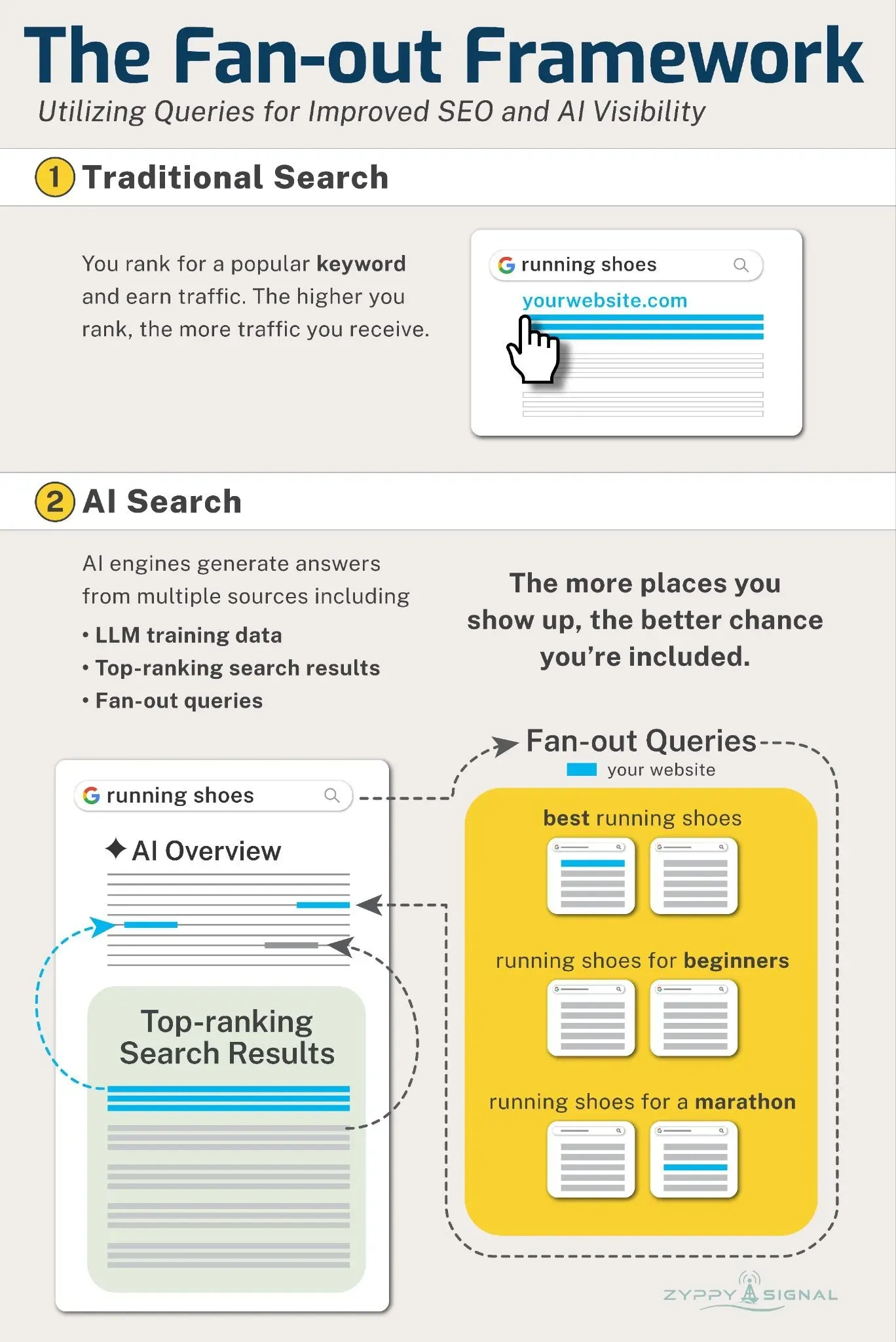
With the same guardrails as Lily Ray: not one page per fan-out, no “Godzilla pages,” no generic content.
👀 My Take:
The good news of the month for anyone afraid of having to relearn everything: the fan-out isn’t a break from the past, it’s a new layer on top of a reflex you already master. For fifteen years, SEO has “clustered” keywords by intent (in France, my friend Laurent coined the term “semantic cocoon”); now, you’re “clustering” machine questions. Same gesture, new raw material — except this material, you never had before: it’s literally the model’s reasoning as it investigates you, laid bare.
The real trap to avoid is the “one query = one page” reflex that sank so many sites before 2024: AI rewards topic coverage, not stacks of near-duplicate pages. For a board: don’t let your team turn a strategic signal into a page factory. The deliverable is a map of the gaps between what you publish and what AI is looking for — not 300 new URLs.
↑ Fan-out comes up a lot in this edition. Read the Strategy section on Konitzny’s and Suganthan’s findings (above) — what fan-outs are, mechanically speaking.
Barry Schwartz relays an exchange between John Mueller and Martin Splitt (Google) on the Search Off the Record podcast.How to read the Indexing Report
THE key takeaway: ==being crawled does not guarantee being indexed.== When Google’s systems have serious doubts about a site’s overall quality, they crawl less and index less — hence the “Crawled – currently not indexed” or “Discovered – currently not indexed” statuses in Search Console. Mueller is clear on one point: this isn’t a technical bug to “fix.” If Google isn’t indexing a large chunk of your pages for no technical reason, that’s a signal to step back and look at your overall quality. And he specifically calls out generic AI content — not AI itself, but text where you think “anyone could have written this, it teaches me nothing.” This kind of content drags a site’s quality down, and indexing along with it.
👀 My Take:
The reminder that deflates the current GEO panic. We spend the month talking fan-outs, citations, brand mentions — and Google puts the first rung back in its place: if you’re not indexed, you don’t exist anywhere, not in SEO, not in AI Search.
Yet the race for AI content volume produces exactly the opposite of the intended effect: generic pages that drag down the quality score of the entire domain, until Google stops indexing part of it. For a board, this is a healthy reminder: better twenty pages people remember than two thousand that “anyone could have written.” Before investing in any sophisticated GEO tactic, open your Search Console. If your pages are piling up as “crawled, not indexed,” you have a quality problem, not a tactics problem — and no AI optimization will make up for it.
This month, three serious studies landed on the same subject — comparison pages (X vs Y, “alternatives”) — and seem to give opposite orders. I’ve put them face to face.
→ The thesis (Siege Media, Ross Hudgens):
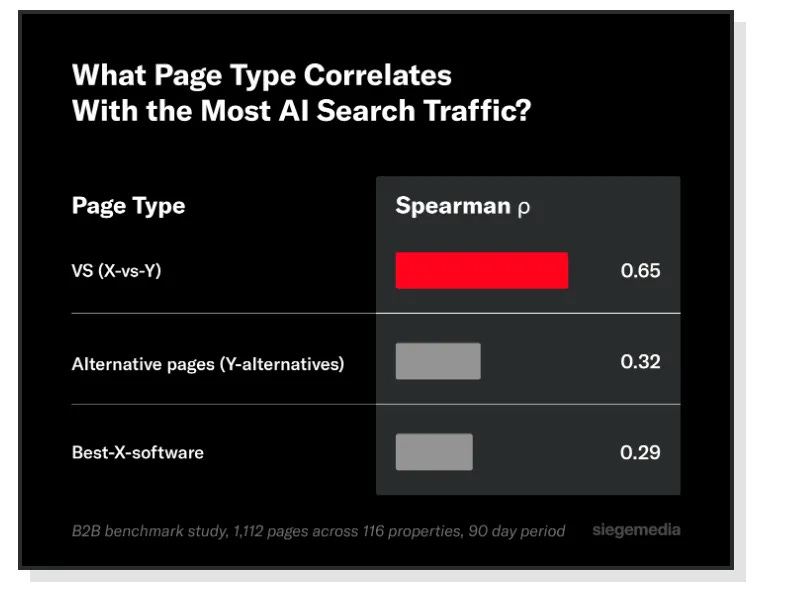
Across 116 B2B sites and 1,112 transactional pages, “X vs Y” pages are the best predictor of AI traffic — 2x ahead of the next-best format, far ahead of “best software” listicles. The reason: an “X vs Y” page matches the query intent exactly, with little competition for the citation slot (the “best X” pages fight against G2 and Capterra, so given how successful those platforms are today, that fight is somewhat lost in advance). Going from 1-5 to 6-20 pages = +350% median AI traffic. Verdict: if you’re only going to build one format, build this one.
→ The antithesis (Lily Ray):
Of course, it was too good to be true... Lily Ray predicts these pages are the next anti-spam target. Google already applies its strict review criteria to them — prove you actually tested the thing. But has a brand that compares itself to its competitors really used both offerings? Almost never. Industrialized and inauthentic, they become a low-quality signal — and some sites have already been hit by the late-January update.
→ The synthesis (Ahrefs, Mateusz Makosiewicz):
Over 4 months and 9,886 AI answers, the trap gets quantified: when AI cites your comparison page, it skips your brand 43% of the time and recommends a competitor listed on your page. Worse! when the page is “found” without being cited: 74%. And citations don’t last — a cited page is only cited on average one eligible day out of three.
👀 My Take:
No contradiction, once you separate three things everyone conflates: generating traffic (Siege), getting the recommendation (Ahrefs), and lasting (Ray). A versus page can bring you people while recommending your rival, and hold up for six months before getting swept away. What reconciles all three comes down to one word: authenticity. Yes, make comparison pages — they work. But make them real: actual testing, backed by numbers, even if it means conceding a point to a competitor where they’re better.
One way around the difficulty (rightly) flagged by Lily Ray is, for example, to ask your customers questions (or the ones you actually poach from your competitors because they were unhappy). Also take a look at their reviews and/or their social proof.
These are often a goldmine for seeing what does or doesn’t hold up at your competitor. The “REAL” is what will win you the citation and the recommendation and the longevity. Above all, beware of the rush effect: these pages perform mainly because there are few of them and most are mediocre; the day everyone follows this advice, only the one who did a genuine comparison will survive. One last guardrail for your board: content only accounts for ~28% of AI traffic — the rest is your brand and your category. “20 versus pages = AI leadership” is nonsense. The right pitch: versus pages raise your floor; your brand sets your ceiling.
↑ See the GEO Strategies section: we cover the same subject, same logic, but one level up — AI reuses your reputation, not what you claim about yourself.
Rich Sanger proposes a deceptively simple exercise: ask ChatGPT, Gemini, or Claude to tell you everything about your company — who it is, what it does, for whom, what sets it apart, and with what proof.
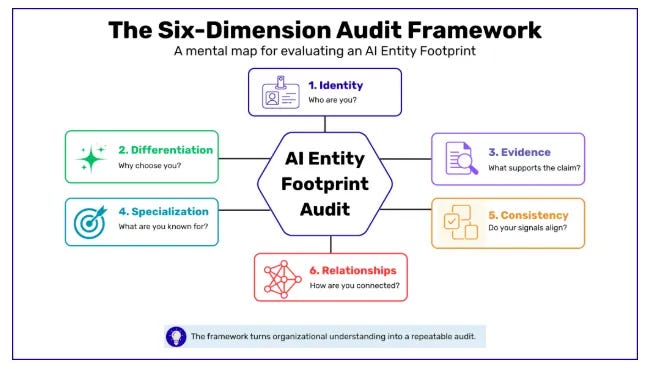
Not your website: your business. The answer is a mirror: sometimes AI explains you the way your founder would; sometimes it produces a generic description that could apply to ten competitors. Rich Sanger draws from this a six-dimension audit framework — identity, differentiation, proof, consistency, relationships, specialization — scored 0 to 5, cross-referencing everything that feeds the machine’s understanding: your site, your Google listing, your reviews, the press, podcasts, directories, partnerships.
👀 My Take:
Being understood is not the same as being recommended — and a business that’s excellent in real life can have a weak footprint if the online evidence is thin or inconsistent (site says one thing, reviews say another). Sanger even packaged the first pass as a free Custom GPT. Do the exercise this week: the prompt is in the article, it takes ten minutes, and whatever AI can’t say about you is your list of things to work on.
🔗 Rich Sanger (Search Engine Land) — How to audit your AI entity footprint
A year after its first “Content Independence Day” (the default blocking of AI crawlers without compensation), Cloudflare is moving from defense to offense. The premise underlying it all: more than 50% of web traffic is now non-human, and when Google displays an AI summary, people only click through to a regular link 8% of the time (1% within the summary itself — Pew figures). The old pact of “let me crawl you, I’ll send you visitors” is dead.
Cloudflare proposes replacing it with two initiatives:
network signals that tell AI engines what’s fresh and what hasn’t changed (50%+ of crawling re-fetches unchanged pages — pure waste),
and above all, the shift from Pay Per Crawl to Pay Per Use: getting paid not when you’re crawled, but when your content is actually used in an answer. First experiments with Ceramic.ai (pay-per-query) and You.com — with, as a bonus for participants, unprecedented AEO/GEO reporting: which queries surface your content, which snippet, which position.
👀 My take:
A must-read, because this is the first serious attempt to rebuild the web’s economy around the AI answer rather than the click. The web’s unit of value is changing before our eyes — no longer the crawl, no longer the click, but usage within the answer. Whether it works or not, this is the read that tells you where the money is heading.
No curation this month — for a good reason. I’m currently writing a VERY big article on the topic. The SEO vs GEO debate deserves better than snippets of LinkedIn posts squabbling over acronyms: it deserves to be laid out flat, once and for all. That’s what I’m doing. See you very soon — with a big, abundant topic of conversation 👀. Subscribe so you don’t miss it — this is where it’ll come out first 👇.
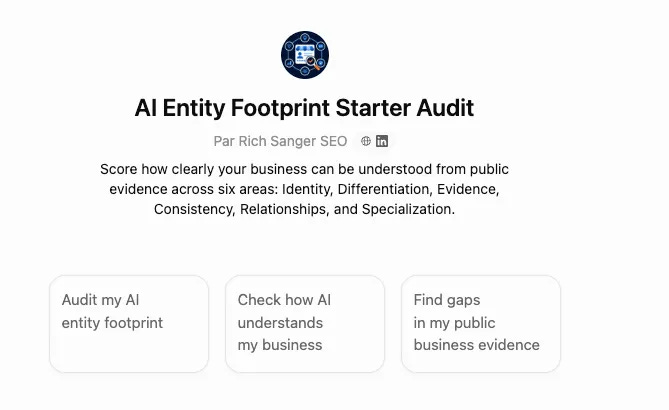
The Custom GPT that scores your entity the way an AI would. Free, by Rich Sanger (mentioned above).
Why it’s great
It’s the direct execution of THE tactic of the month (↑ “Audit your AI entity footprint”) and the final test from the Tech Corner (↑ “what is an entity”). The tool does the first pass for you: it analyzes everything the web publicly says about your company — site, Google listing, reviews, LinkedIn, press, directories — and scores you across the six dimensions that make up your entity (identity, differentiation, proof, consistency, relationships, specialization), from 0 to 5, with deliberately harsh scoring. The real deliverable isn’t the score: it’s the list of what’s missing — absent proof, contradictory information, fuzzy positioning. Your entity roadmap, free, in ten minutes.
How to use it:
Run it on your brand, then run it again on your two main competitors. The delta is often more telling than your absolute score.
Focus on the dimensions scoring 0-2: that’s where AI is “guessing” about you instead of knowing you.
Redo the exercise in six months — it’s your new AI visibility barometer, far more honest than a ranking.
🔗 AI Entity footprint starter audit
Finally measure how your Instagram, TikTok, X, and YouTube content performs in Google. Free, official, and just opened to everyone.
Why it’s great:
This is THE Google news of the month (↑ Search Everywhere Optimization): previously in limited preview, now global and with no audience threshold at all — unlike Search Profiles, reserved for 100k+. For the first time, you can prove, with Google’s own numbers, that your social presence is a search asset: which queries send traffic to your posts, which content is taking off, how your platforms compare to each other. The social channel officially steps out of its silo — and your social-vs-SEO budget meeting will never look the same again.
How to use it:
Add each account (Instagram, TikTok, X, YouTube) as a property in your Search Console — two minutes per platform.
Use the Insights report to spot rising query themes: that’s data-driven inspiration for your next topics, captions, and hashtags.
The 24-hour filter flags a post that’s taking off via Google → cross-promote it elsewhere while it’s hot.
Export data from multiple properties into the same spreadsheet to compare your platforms side by side.
🔗 Ajouter une platform property + le guide officiel d’analyse
The tool everyone mentally uninstalled long ago… and which has become a window into ChatGPT. Free, by Microsoft.
Why it’s great:
Two reasons, both born this month.
Since late June, ChatGPT can cite Bing directly as a source — so your Bing indexing has become a full-fledged ChatGPT visibility channel, and whatever Google ignores about you, Bing can serve up to AI.
Bing Webmaster Tools now displays fan-out queries — those sub-queries AI generates to search for you (↑ Lily Ray’s clustering tactic).
In other words, the most underrated free tool of the moment gives you both a ChatGPT visibility insurance policy and raw analytical material that paid tools are only just starting to sell.
How to use it:
Check the basics first: is your site properly indexed on Bing? It’s a five-minute insurance check that 90% of companies have never taken.
Explore the fan-outs visible in the tool: export them and cluster them to map out what AI is really looking for on your topics.
Compare your Bing vs. Google performance: the gaps flag blind spots — in either direction.
The Chrome extension that reads your Google reviews the way AI reads them. Free, by Celeste Gonzalez.
Why it’s great:
Remember Darren Shaw’s tactic (↑ “Your Google listing now talks to AI”): Gemini summarizes your business directly from your Google Maps reviews. But you still need to know what those reviews collectively say. This extension analyzes the sentiment and recurring themes in your reviews — not the average rating (which teaches nothing), but the text: which services keep coming up, which words your customers naturally use, which strengths emerge. This is exactly the material AI extracts to describe you. You discover what you’re actually known for — versus what your homepage claims. “Mind-blowing,” as my teenager would say.
How to use it:
Run it on your own listing: the themes that surface = your entity as seen by your customers. If they don’t match your positioning, you’ve found your entity inconsistency (↑ Tech Corner, item 1).
Run it on your local competitors: their review themes tell you what AI recommends them for — and where there’s an empty gap.
Use your customers’ actual vocabulary in your pages: that’s what AI is trying to match.
🔗 GBP Reviews Sentiment Analyzer — extension Chrome
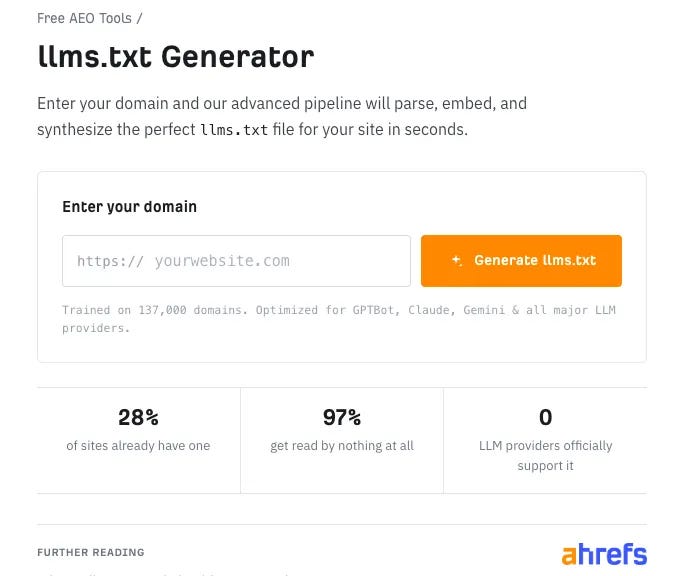
The llms.txt generator built on the analysis of 137,000 sites. Free, by Ahrefs (Ryan Law).
Why it’s great (despite everything I told you in May): Yes, you read that right. Back in May, I showed you the study that killed the idea: across 900 domains and 45 million bot requests, almost no real AI bot ever reads llms.txt. And Google stated in black and white that Search ignores it. So why is this tool here?
You shouldn’t always believe what Google states in black and white — the history of SEO is full of “we don’t use that” followed by quiet reversals; skepticism cuts both ways.
More importantly, if you think llms.txt might be relevant for you, the only sensible answer is free or nothing. This file is NOT a critical deliverable — so any GEO vendor charging you a hefty fee for it is feeding you nonsense, and this tool gives you the argument to shut that down.
In this case, Ahrefs built it on the analysis of 137,000 domains; it spits out a best-practices-compliant file in two minutes. Two free minutes for an asymmetric bet: probably useless today, ready to go if adoption takes off tomorrow — and a vendor invoice avoided either way.
How to use it:
Generate your file, place it at your site’s root, and move on — don’t spend one more minute on it.
If an agency proposes “llms.txt setup” in a quote: show them this tool and… 🍿!!
Keep an eye on the one signal that would change the picture: server logs showing real AI bots actually reading this file. For now, that’s not the case.
🔗 Free LLMs.txt Generator — Ahrefs
The agent that audits your presence in LLM training data. Freemium, by Fractl.
Why it’s great:
Every AI visibility tool looks at the same thing: what ChatGPT answers about you. This one looks further upstream — what the models learned about you. It scans major training datasets (C4, OpenWebText) to measure whether, how often, and in what context your brand appears in them: sentiment, source authority, and benchmarking against competitors. This is the deepest layer of your entity (↑ discussed in the Tech Corner): before it even searches the web, AI already “knows” things about you — or doesn’t.
If you’re absent from the training data, you start out with a handicap that even good SEO can’t offset: you’re 100% dependent on real-time retrieval. And the deliverable is actionable: which authority domains mention you (or don’t), which types of content are most likely to make it into future datasets — giving you a target for your third-party mentions strategy (↑ the off-site thread of the month).
How to use it:
Enter your domain + your brand terms, run the scan, and compare against 2-3 competitors: “share of voice” in the datasets is a benchmark no other tool gives you.
Spot authority domains where your competitors appear and you don’t: that’s your ready-made PR/earned-media target list.
Cross-reference with your entity audit (↑ Sanger’s Custom GPT): that one tells you what AI understands, Fractl tells you what it has learned. Two angles of the same battle.
🔗 AI Brand Visibility Agent — Fractl
The free tool that measures your visibility in AI answers… and tells you what to do to improve it. By Microsoft.
Why it’s great:
Back in February, Bing Webmaster Tools launched the first official AI-citations dashboard (covered right here at the time). Microsoft is doing it again — this time inside Clarity, its free analytics tool — and taking it up a notch: Topic Insights tells you how often your content is cited in AI answers, how much it influences them, and which competitors get cited alongside you… or in your place.
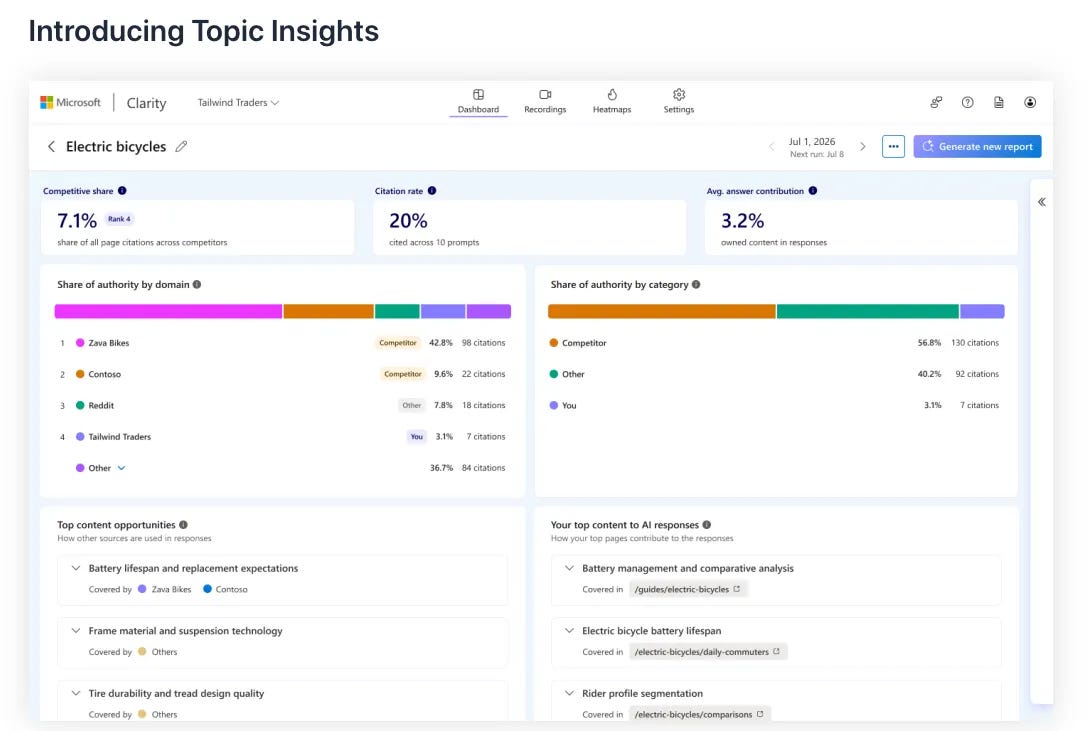
But the real leap is what comes next: the tool identifies your content gaps, the topics to prioritize strengthening, and recommended actions to close the gap. Not just metrics — a roadmap. And all of it FREE 😱. Spotted by Mark Williams-Cook, who drops the message everyone’s thinking: “Take note, Google!” While Search Console does the bare minimum, Microsoft is methodically building the go-to free GEO measurement suite. Second building block in five months.
How to use it:
If you’re already using Clarity (free, no traffic limit), Topic Insights is waiting for you in the interface — zero cost, zero friction. Otherwise, setup takes ten minutes.
Start with the competitor view: who’s being cited in your place, on which topics? That’s your AI gap analysis, served on a platter.
Treat the “recommended actions” as an editorial backlog: each identified gap = a candidate topic for your next piece of content.
Cross-reference with Bing Webmaster Tools (↑ in this section): Bing gives you the fan-outs and citations on the engine side, Clarity gives you the influence and gaps on the content side. The full Microsoft combo, free end to end.
The Chrome extension that shows you what ChatGPT is really searching for behind your prompts. Free, by Nati Elimelech (former Head of SEO at Wix).
Why it’s my favorite💜:
The fan-out is the central mechanism of this entire edition: when you ask ChatGPT a question, it doesn’t search your exact phrase — it breaks it down into a dozen parallel searches, reads a pile of pages, and only cites a handful of them (we talk about this a lot in the “Tactics” section). Until now, observing this mechanism required a paid tool like Peec AI.
Now, this extension shows you everything, for free, live 😱: the queries actually fired off, every page read (grouped by domain), and the key distinction of read vs. cited — because ChatGPT reads far more than it cites, and that gap is exactly where your visibility is decided. You can see at a glance whether it’s you or your competitor who lands the citation.
Rare bonus: Everything stays on your machine — zero tracking, zero ads, no data sent to any server. Released a week ago, already indispensable.
How to use it:
Install it, open the side panel, and use ChatGPT as normal: every fan-out is captured automatically — even your old conversations sync when you reopen them.
Ask the questions your prospects ask about your category, and watch: which sub-queries get generated? Who gets read? Who gets cited?
Export everything to CSV and cluster the queries (↑ the Lily Ray method, ↑ Tactics): you get your fan-out map without paying for a tracking tool.
Compare “read but not cited” on your pages: that’s your most actionable signal — ChatGPT finds you, but prefers to cite someone else. Why?
🔗 ChatGPT Query Fan-Out Extension — Chrome Web Store + le guide fan-out de Nati Elimelech
And if you want to start it with a clear picture of your AI, Search, Content, and SEO priorities, join me for the September masterclass. I’ll share EVERYTHING I’ve updated on GEO over the past few months.
E V E R Y T H I N G!!
No posts
Comments
Nothing yet. Say the first thing.
Sign in to join the conversation.