
Who gets to decide what every student in a state is required to read?
Is it classroom teachers? Local school boards? Curriculum departments? State boards of education? Legislatures? Parents?
That question has always been part of public education, but in recent years it has taken on new urgency. Across the country, debates over books have expanded beyond individual library shelves and classroom assignments. They now include state legislation, curriculum standards, parental rights, and the role government should play in shaping what students learn.
Texas has just added another chapter to that conversation.
Whether or not it is technically the first of its kind, the Texas policy represents one of the most comprehensive state-mandated literary works lists adopted in recent decades. Beginning in 2030, public schools will be required to teach specific literary works selected by the Texas State Board of Education. The list includes nearly 200 required works spanning kindergarten through high school, including classic literature, historical documents, speeches, poetry, and selected Biblical passages.
Supporters argue the list ensures that every student is exposed to foundational works that have shaped American history, literature, and civic life. Critics argue it gives the state unprecedented influence over required reading while raising questions about local control and the inclusion of religious texts in a public school curriculum.
As I read through the policy, I found myself thinking less about the individual books and more about the larger question behind them.
Who should decide what every student is required to read?
For school librarians, this question matters. Our work has never been limited to managing collections. We help students discover literature, evaluate information, understand historical context, and engage with ideas from many perspectives. As more curriculum decisions move beyond the local level and into state policy, librarians need to understand not only what is changing, but why it matters.
This article is not about telling you what to think about the Texas policy. Instead, I want to explore what the state adopted, why it matters beyond Texas, the constitutional questions it raises, and one irony I noticed while reading the required literary works list that I haven’t seen discussed elsewhere.
Much of the discussion surrounding the Texas decision has focused on a handful of books and the inclusion of selected Biblical passages. Those details are certainly part of the story, but they are only one piece of a much larger policy.
The Texas State Board of Education approved a Required Literary Works List that will be phased into public school classrooms beginning in 2030. The list spans kindergarten through high school and includes nearly 200 literary works, historical documents, speeches, poems, essays, and excerpts that students will study as part of the state’s English Language Arts curriculum.
The selections include many of the works that have traditionally appeared in American classrooms for decades alongside historical documents that have shaped the nation’s civic and political history.
Examples from the list include:
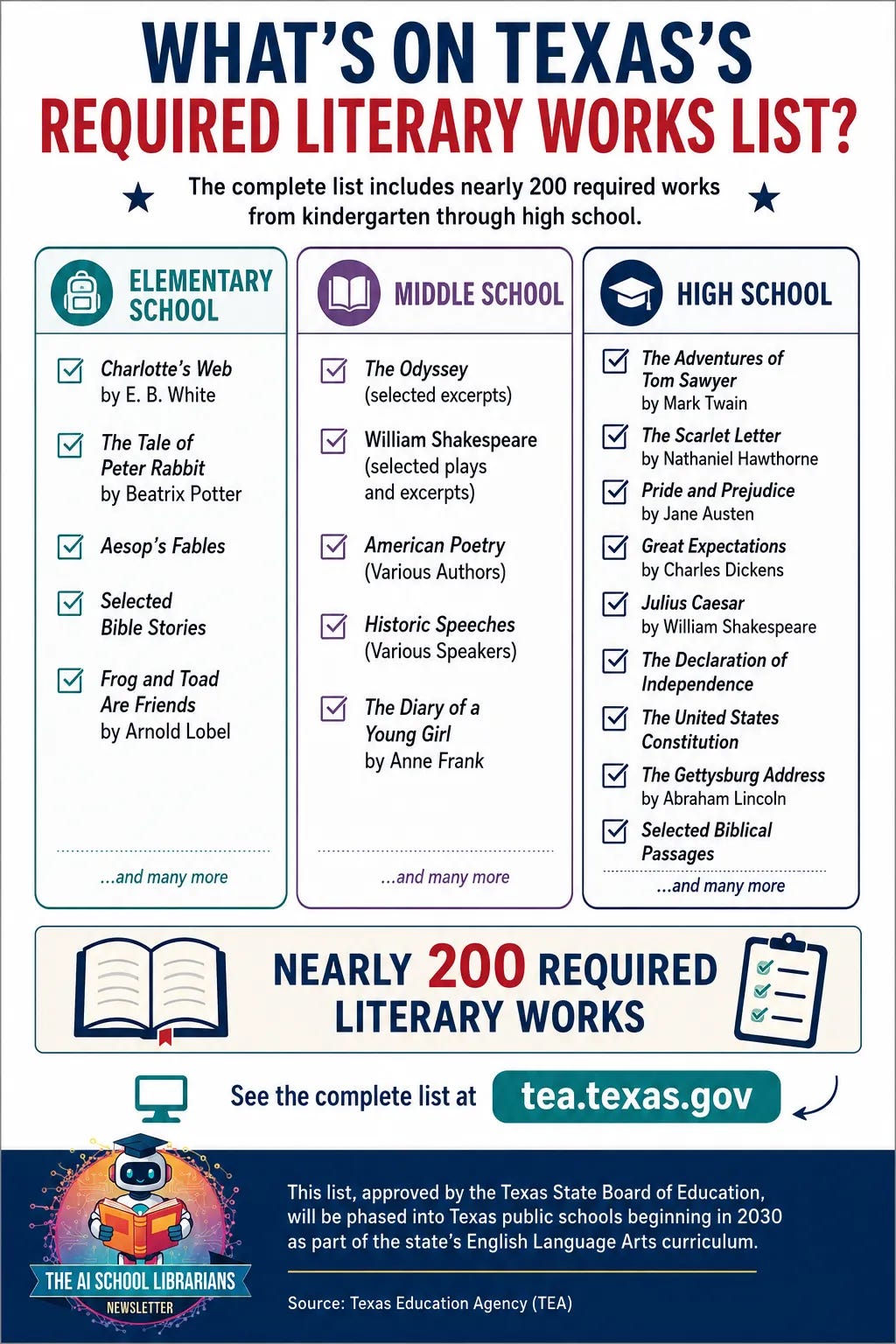
The complete list is far more extensive than the examples above. If you’re interested in reviewing every required work by grade level, I encourage you to read the Texas Education Agency’s official documents rather than relying solely on news coverage or social media summaries.
One of the principles librarians teach every day is to start with the primary source. Before forming an opinion about this policy, I encourage you to spend a few minutes reading the actual documents. Whether you ultimately support the decision or oppose it, understanding the policy begins with reading what the Texas Education Agency and the Texas State Board of Education actually adopted, not just the headlines or social media reactions.
The New York Times (gift link): Texas Schools Required Reading Books
https://www.nytimes.com/2026/07/20/us/texas-schools-required-reading-books.html?unlocked_article_code=1.zFA.7dF6.dxZts-aQ_ik2&smid=nytcore-ios-shareTexas Education Agency: House Bill 1605 and Instructional Materials Review and Approval (IMRA)
https://tea.texas.gov/curriculum-and-instruction/instructional-materials/house-bill-1605/house-bill-1605-and-imraTexas Education Agency: Required Literary Works Lists and Supporting Documents
https://tea.texas.gov/laws-and-rules/sboe-rules-tac/proposed-state-board-education-rulesTexas State Board of Education: Instructional Materials Review and Approval (IMRA)
https://sboe.texas.gov/state-board-of-education/imra
After reading the policy and reviewing the required literary works list, I kept coming back to the same thought.
The real story isn’t the books.
It’s who gets to decide they’re required reading.
For decades, curriculum decisions have been shared across multiple levels of public education. States establish academic standards that outline what students should know and be able to do. Local school boards adopt curriculum. District curriculum leaders select instructional materials. Teachers decide how lessons are taught. School librarians build collections that support classroom instruction while also helping students discover books beyond the required curriculum.
Each group has a different responsibility, creating a balance between statewide expectations and local decision-making.
The Texas Required Literary Works List changes that balance.
Rather than establishing learning standards alone, the state has identified many of the specific literary works students will study. Supporters view that as a way to ensure every student, regardless of where they live, is exposed to important works of literature, history, and civic education. They argue that a shared body of knowledge helps create consistency across districts and strengthens students’ understanding of foundational texts.
Critics see the policy differently. They argue that statewide required reading reduces local flexibility and limits the ability of districts, teachers, and curriculum specialists to make decisions based on the needs of their own students and communities. Others question whether selecting specific literary works should remain primarily a local responsibility rather than a state one.
Neither perspective can be dismissed lightly.
Public education has always required balancing statewide expectations with local control. The Texas decision shifts that balance in a way that will likely be studied well beyond the state’s borders.
As I thought about the policy, I found myself asking a simple question.
If states begin deciding not only what students should learn, but also exactly what they should read, how might that change public education?
That question extends far beyond Texas.
It is a question that every educator, school board member, policymaker, parent, and school librarian should be thinking about.
For librarians, the conversation is especially important. Our work has never been limited to managing collections. We help students understand context, evaluate ideas, explore multiple perspectives, and connect literature to history and civic life. As curriculum decisions increasingly become matters of state policy, understanding those policies becomes part of our professional responsibility.
Whether other states follow Texas’s lead remains to be seen. What is clear is that conversations about curriculum are no longer taking place only in local school board meetings. Increasingly, they are happening in state legislatures and state boards of education, and those decisions have the potential to shape what millions of students read for years to come.
One aspect of the Texas policy has received more attention than any other: the inclusion of selected Biblical passages on the Required Literary Works List.
For some readers, that immediately raises a constitutional question.
Can public schools require students to read passages from the Bible?
The answer is more nuanced than many headlines suggest.
The U.S. Supreme Court has long recognized that the Bible may be studied in public schools when it is presented for its literary, historical, or cultural significance as part of a secular educational program. In fact, the Court has specifically noted that objective study of the Bible is consistent with the First Amendment when taught as part of a complete education.
The constitutional question is not whether students may study the Bible.
The more difficult question is how it is taught.
Courts have historically distinguished between teaching about religion and promoting religion. Public schools may teach students about the influence of religion on history, literature, art, music, government, and culture. They may not use classroom instruction to endorse or encourage religious belief.
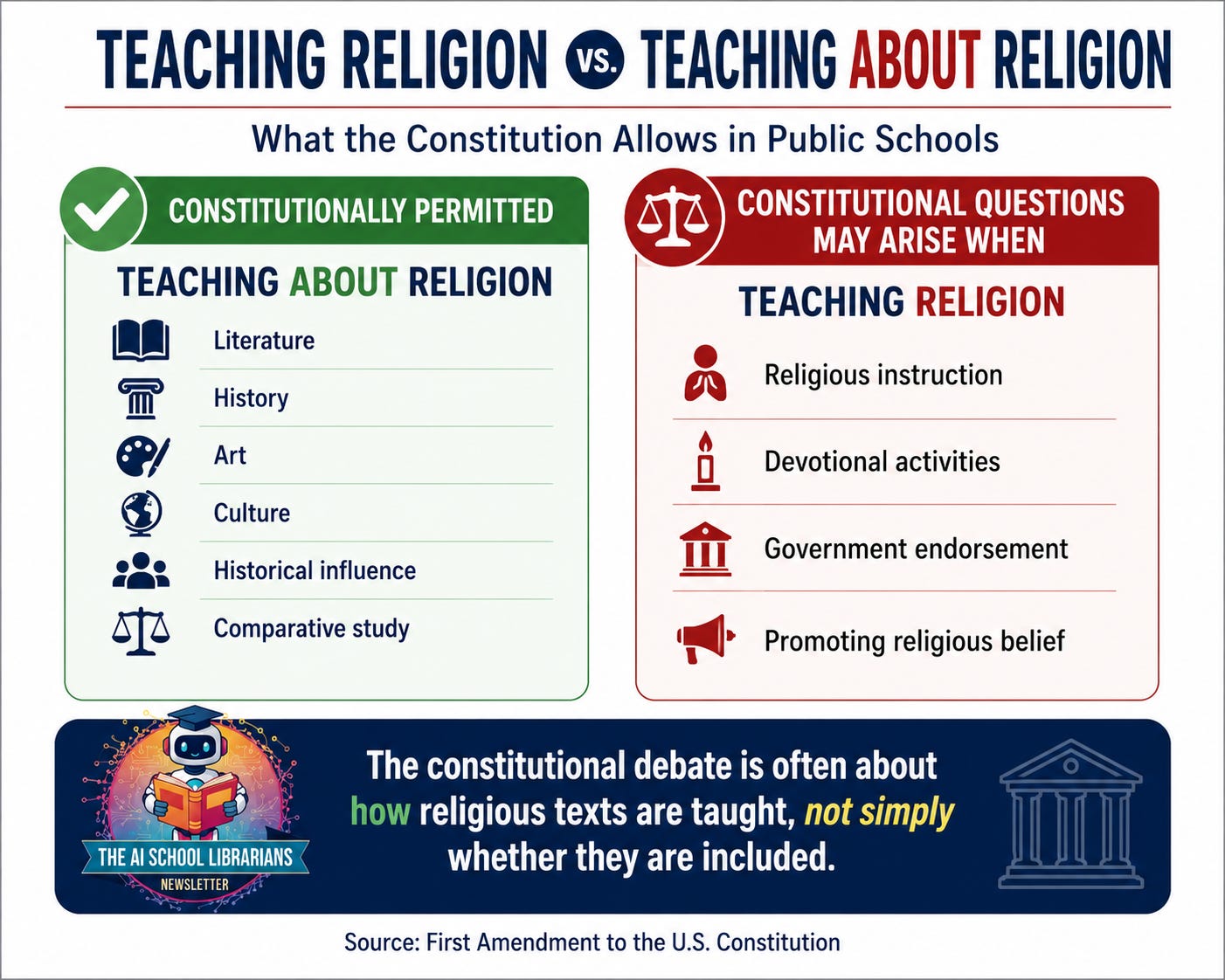
That distinction may become especially important as Texas begins implementing its new literary works list.
Supporters argue that the selected Biblical passages are included because of their influence on Western literature, history, and civic life. Many classic works referenced throughout the curriculum contain Biblical allusions, making familiarity with those stories part of understanding the literature itself.
Critics argue that because the Bible is the only religious text specifically included as required reading, the policy could raise questions under the Establishment Clause of the First Amendment. They contend that courts may eventually be asked to determine whether the policy maintains the appropriate constitutional balance.
Whether legal challenges emerge remains to be seen. If they do, courts are likely to look beyond the list itself and examine how the curriculum is implemented. Factors such as teacher guidance, instructional materials, classroom practices, and the educational purpose of the readings could all become part of the legal analysis.
As educators, it’s important to remember that this conversation extends beyond one state or one list of books. Public schools have long taught religious history, literature, and culture. The challenge has always been ensuring that students learn about religion without schools appearing to endorse a particular faith.
That is the constitutional line policymakers, educators, and potentially the courts will continue to examine.
As I worked my way through the Texas Required Literary Works List, I found myself doing something I suspect many librarians would do. I started recognizing titles, not because they were unfamiliar, but because many of them have been part of a very different conversation over the past several years. They were books that had already made headlines after being challenged or removed from school libraries in individual Texas districts.
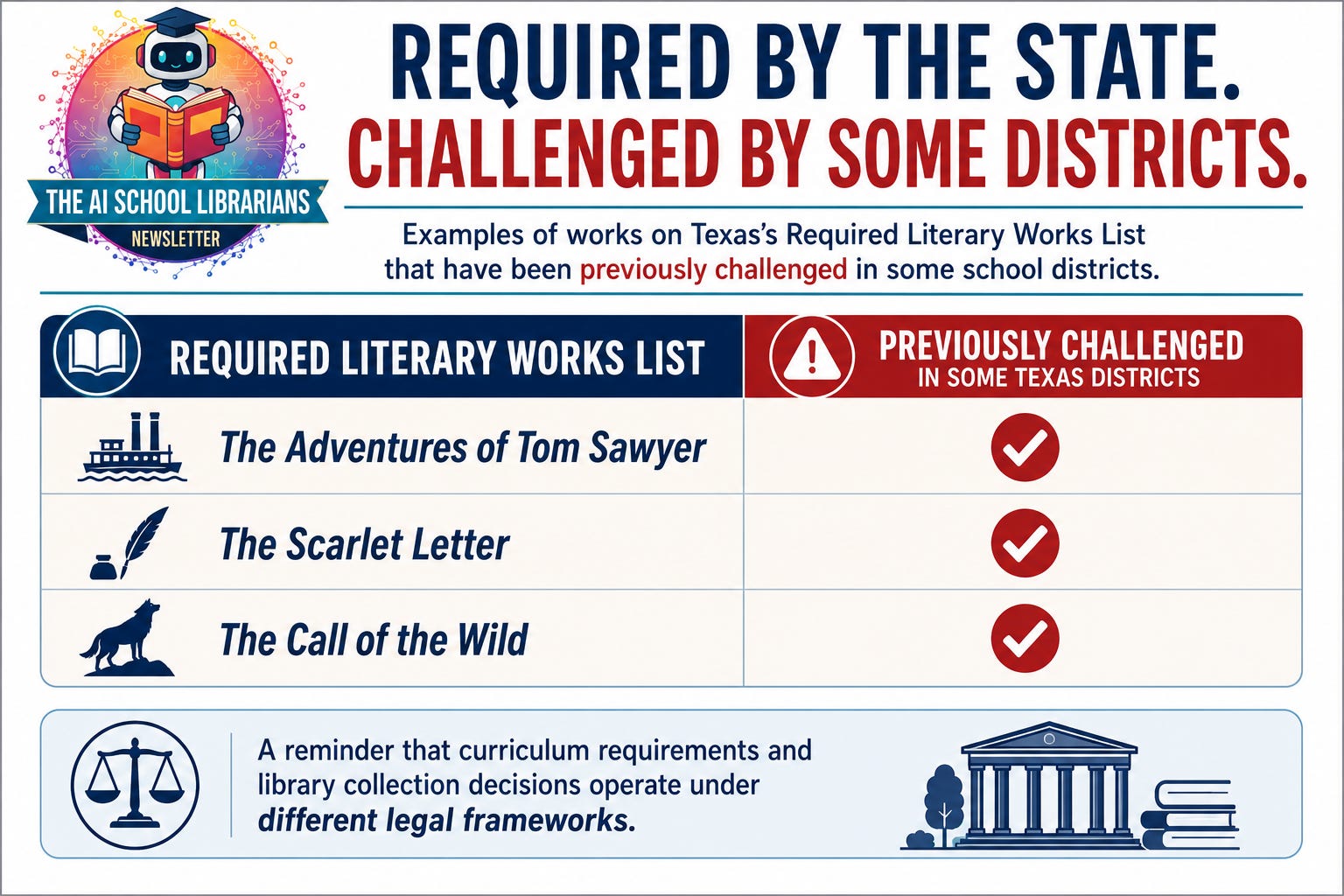
Several classic works that now appear on Texas’s required literary works list have also faced challenges at the local level. Among them are The Adventures of Tom Sawyer, The Scarlet Letter, and The Call of the Wild. Each has been questioned in one or more Texas school districts for reasons ranging from racial language and depictions of violence to concerns about age appropriateness. Seeing those same titles appear on a statewide required reading list immediately caught my attention.
It’s important to be precise here. Texas did not ban these books statewide, and most Texas school districts never removed them from their libraries. The challenges occurred at the local district level through library review processes. Even so, the contrast is difficult to ignore. Books that have been considered inappropriate for some school library collections are now among the works the state expects students to study as part of its English Language Arts curriculum.
As a school librarian, I find that fascinating. For years, much of the national conversation has focused on whether certain books should remain on library shelves. This policy shifts part of that conversation in a different direction by asking which books should be required reading for every public school student. Those are different questions governed by different legal frameworks, but they now intersect in a way that educators and librarians cannot ignore.
The policy also raises practical questions that districts will eventually need to answer. If a title appears on the state’s required literary works list but was previously removed from a district’s library collection, how will students access it? Will districts purchase classroom sets? Will library collections change? Will curriculum requirements ultimately influence earlier local decisions? The answers may vary from district to district, but they will become increasingly important as implementation moves closer.
Whether you support the Texas policy or oppose it, this is one of the most interesting aspects of the entire debate. It reminds us that education policy is rarely as simple as a headline suggests. Sometimes the most revealing stories are found where two different policies unexpectedly collide.
It would be easy to dismiss this as a story about one state.
I don’t think it is.
Whether other states adopt similar policies or chart a different course, the questions raised by the Texas decision are likely to remain part of the national conversation. Who determines required reading? How much authority should states have over curriculum? Where should the balance between statewide standards and local decision-making be drawn? How should schools approach religious texts in a way that is both educationally meaningful and constitutionally sound?
These are not new questions, but they are becoming increasingly important as states play a larger role in shaping public education.
For school librarians, understanding these debates is no longer optional. Our profession has always been about more than books. We help students evaluate information, understand historical context, explore multiple perspectives, and develop the critical thinking skills they need to become informed citizens. Increasingly, we also need to understand the policies and laws that shape what students are taught and how those decisions are made.
As I researched this article, I found myself thinking less about the books themselves and more about the process behind them. Who decides what every student is required to read? How are those decisions made? How do we balance statewide expectations with local decision-making? Those are questions every educator, librarian, policymaker, and parent should understand because they are shaping the future of public education.
As librarians, we ask students to go beyond the headline. We encourage them to seek out primary sources, evaluate evidence, consider multiple perspectives, and ask thoughtful questions before reaching conclusions. I believe we should hold ourselves to that same standard.
Whether you support the Texas Required Literary Works List or oppose it, I hope you’ll take the time to read the policy, review the complete literary works list, and explore the constitutional questions it raises. Information literacy doesn’t end when we graduate from school. If anything, it becomes even more important when we are asked to make decisions about the future of public education.
The debate over this policy isn’t simply about books. It’s about who gets to decide what every student is required to read, how those decisions are made, and what that means for the future of public education.
Comments
Nothing yet. Say the first thing.
Sign in to join the conversation.