
For the past several years, librarians have found themselves at the center of a growing national debate over books, censorship, and intellectual freedom. We have watched books challenged, school board meetings become battlegrounds, and librarians publicly criticized simply for doing their jobs.
Last week, that conversation changed.
A federal appeals court ruled that Arkansas can begin enforcing portions of Act 372 while the legal challenge continues. Among those provisions are ones that expose librarians and booksellers to potential criminal liability for knowingly providing material considered “harmful to minors.”
Think about that for a moment.
Librarians and booksellers now face the possibility of criminal prosecution for decisions that have traditionally been guided by professional judgment, collection development policies, and the needs of the communities they serve.
The lawsuit is not over, and the court did not decide whether the law is ultimately constitutional. What it did decide is that these provisions can be enforced while that legal challenge continues.
Supporters of the law say it is intended to protect minors from obscene material. Many librarians, booksellers, educators, and First Amendment advocates argue that it creates uncertainty, encourages self-censorship, and places professionals at risk for doing their jobs in good faith.
As I read about the decision, I couldn’t stop thinking about my friends and colleagues in Arkansas. None of them went to work expecting that doing their job could someday expose them to criminal liability.
Even if you don’t live in Arkansas, this matters.
Education policies rarely stay within one state’s borders. What begins in one legislature often becomes part of the national conversation. That is why every librarian, educator, bookseller, and advocate for the freedom to read should be paying attention.
As I was reading about the court’s decision, I kept coming back to one question.
What exactly does Arkansas mean by “harmful to minors?”
The answer is important because it is at the center of this case.
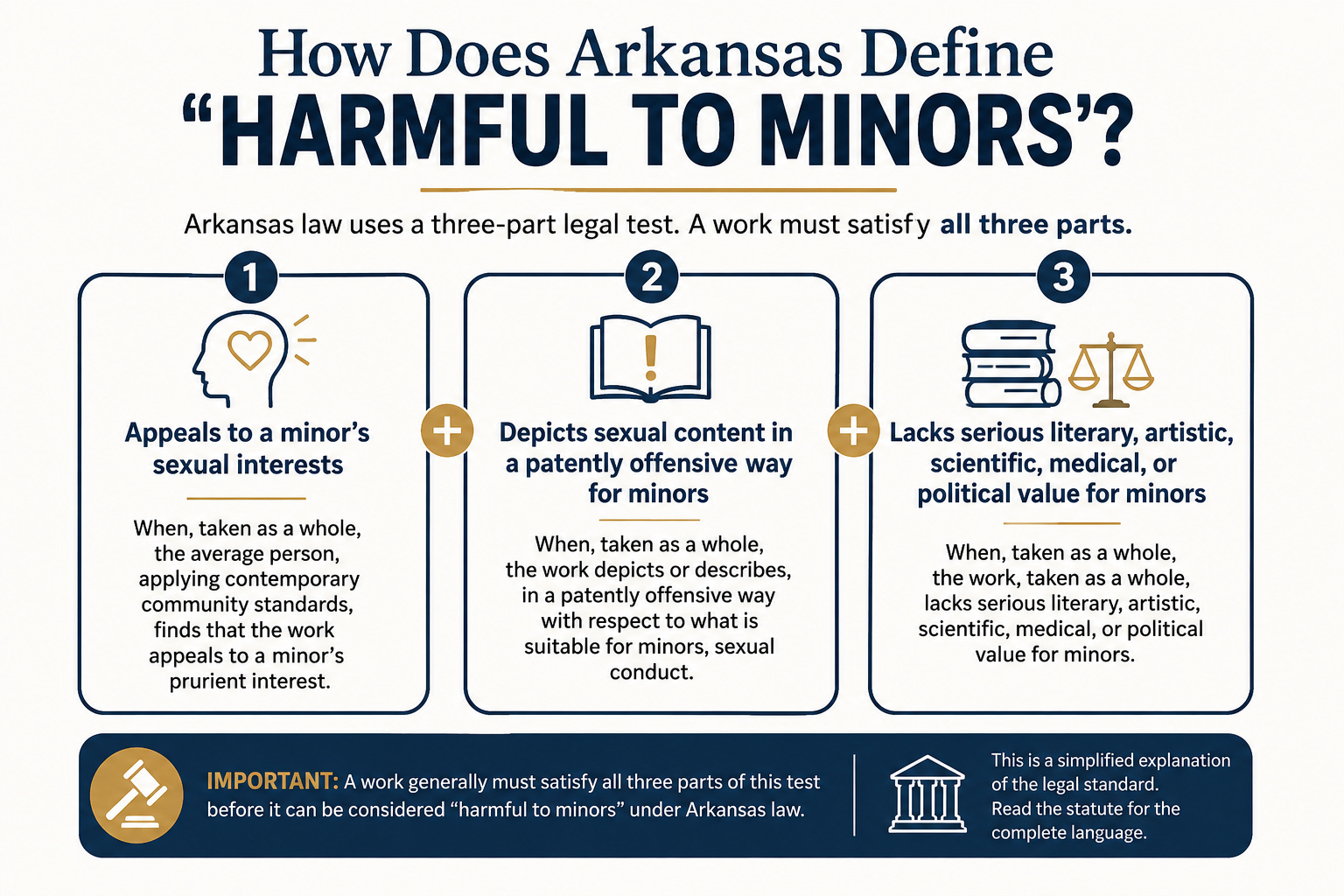
Arkansas law does not say that every book with mature content is illegal. Instead, it applies a legal test that asks whether a work appeals to a minor’s sexual interests, depicts sexual content in a way considered patently offensive for minors, and, when viewed as a whole, lacks serious literary, artistic, scientific, medical, or political value for minors.
Generally speaking, a book has to meet all three parts of that test.
At first, I thought, “Okay, that seems fairly straightforward.”
Then I started thinking about what that actually looks like in a library.
Our collections are filled with award-winning novels, memoirs, biographies, history books, health resources, and other books that sometimes include mature themes while also having significant educational and literary value. These are often the same books recommended by professional review journals, taught in classrooms, and recognized for helping students better understand themselves and the world around them.
Now put yourself in the librarian’s shoes.
You have read the reviews. You know why the book matters. You believe it belongs in your collection because it will educate students, encourage thoughtful conversations, or help a young person see themselves reflected in a story.
Then the questions start.
What if someone files a complaint? What if a prosecutor believes the book meets the legal definition of “harmful to minors?” What if a judge or jury sees it differently than you do, even though you followed your collection development policy and acted in good faith?
When the consequences of getting that decision wrong include the possibility of criminal charges, it changes the calculation.
The safest professional decision may no longer be to buy the book.
That is what librarians mean when they talk about a chilling effect.
Self-censorship rarely begins with someone telling a librarian they cannot buy a book. It begins quietly, when fear starts to influence what feels safe to add to a collection in the first place.
That is a question no librarian should ever have to ask.
As I thought more about this decision, I kept coming back to one question.
Who stands to lose if fear becomes part of collection development?
We already have a pretty good idea.
Over the past several years, national data has consistently shown that books featuring LGBTQ+ characters, people of color, and stories exploring race, identity, mental health, sexuality, and other historically underrepresented experiences are challenged at disproportionately high rates.
That matters because we are not just talking about books. We are talking about students.
We are talking about the student who finally finds a character who understands what they are going through. The student who learns about a culture different from their own. The teenager who realizes they are not the only person who has ever felt that way.
Libraries have always been about more than providing access to books. They help students ask questions, discover new perspectives, and develop empathy for people whose lives may be different from their own.
As librarians, we often talk about books as mirrors and windows. Some books help students see themselves reflected in a story. Others help them better understand someone else’s experience. Our libraries need both.
Now go back to the question from the last section.
What happens when fear becomes part of collection development?
When librarians begin wondering whether adding a book to their collection could expose them to criminal consequences, it is reasonable to worry that some books will simply never make it onto the shelf. Not because they lack educational or literary value, but because the personal and professional risk feels too great.
That should concern all of us.
This is why I believe this decision reaches far beyond Arkansas. Education policies have a way of spreading from one state to another, and the chilling effect created by one law can influence decisions well beyond the state where it was passed.
At the end of the day, this isn’t just about librarians.
It’s about whether students continue to have access to books that help them learn, grow, ask questions, and better understand both themselves and the world around them.
As I was writing this article, I realized I wasn’t just thinking about Arkansas. I was thinking about my own experience and about how quickly a professional decision can become something much bigger.
Several years ago, I lost my job after a controversy surrounding a book display. My experience is different from what librarians and booksellers in Arkansas are facing today, and I would never suggest otherwise. But I do know what it feels like when your professional judgment becomes the center of public scrutiny.
I know what it feels like to replay every decision in your mind and wonder if you could have done something differently. I know what it feels like to question decisions that once came naturally. And I know how easy it is to start thinking, “Maybe it just isn’t worth the risk.”
That is how self-censorship begins.
It doesn’t usually happen all at once. It happens one decision at a time. A librarian hesitates before ordering a book. A display idea is set aside. A program is changed because it feels safer. None of those decisions seem significant on their own, but over time they shape what students see, what they read, and what they have access to.
That is why this decision in Arkansas concerns me so deeply. When the possibility of criminal liability becomes part of collection development, it is reasonable to worry that fear will begin influencing professional decisions long before a case ever reaches a courtroom.
I also recognize how fortunate I am.
I live and work in New Jersey, where the Freedom to Read Act provides important legal protections for librarians acting in good faith. I don’t take those protections for granted because I know many librarians across the country do not have them.
Those protections don’t lessen my responsibility to speak up.
If anything, they increase it.
If you are a librarian or bookseller in Arkansas reading this today, I want you to know one thing.
You are not alone.
I know many of you are scared. I know many of you are wondering what this decision means for your collections, your careers, and your future. Those are real concerns, and they deserve to be acknowledged.
Over the past several years, I have had the privilege of getting to know librarians from across the country who have experienced censorship campaigns, investigations, public criticism, and even the loss of their jobs. It is a community none of us ever wanted to become part of, but it is also a community built on supporting one another.
When I lost my job, other librarians showed up for me. They listened. They shared advice. They reminded me that one difficult moment did not define my career. I will never forget that kindness.
That is the same support I want every librarian and bookseller in Arkansas to know is available.
If you are feeling overwhelmed, reach out.
If you don’t know where to turn, reach out.
If you simply need someone who understands what you are going through, reach out.
I can’t provide legal advice, and I can’t promise to solve every problem. What I can do is connect you with librarians who have walked this road before. People who understand the emotional toll of censorship battles, public criticism, and professional consequences because they have lived through them.
No one should have to face this alone.
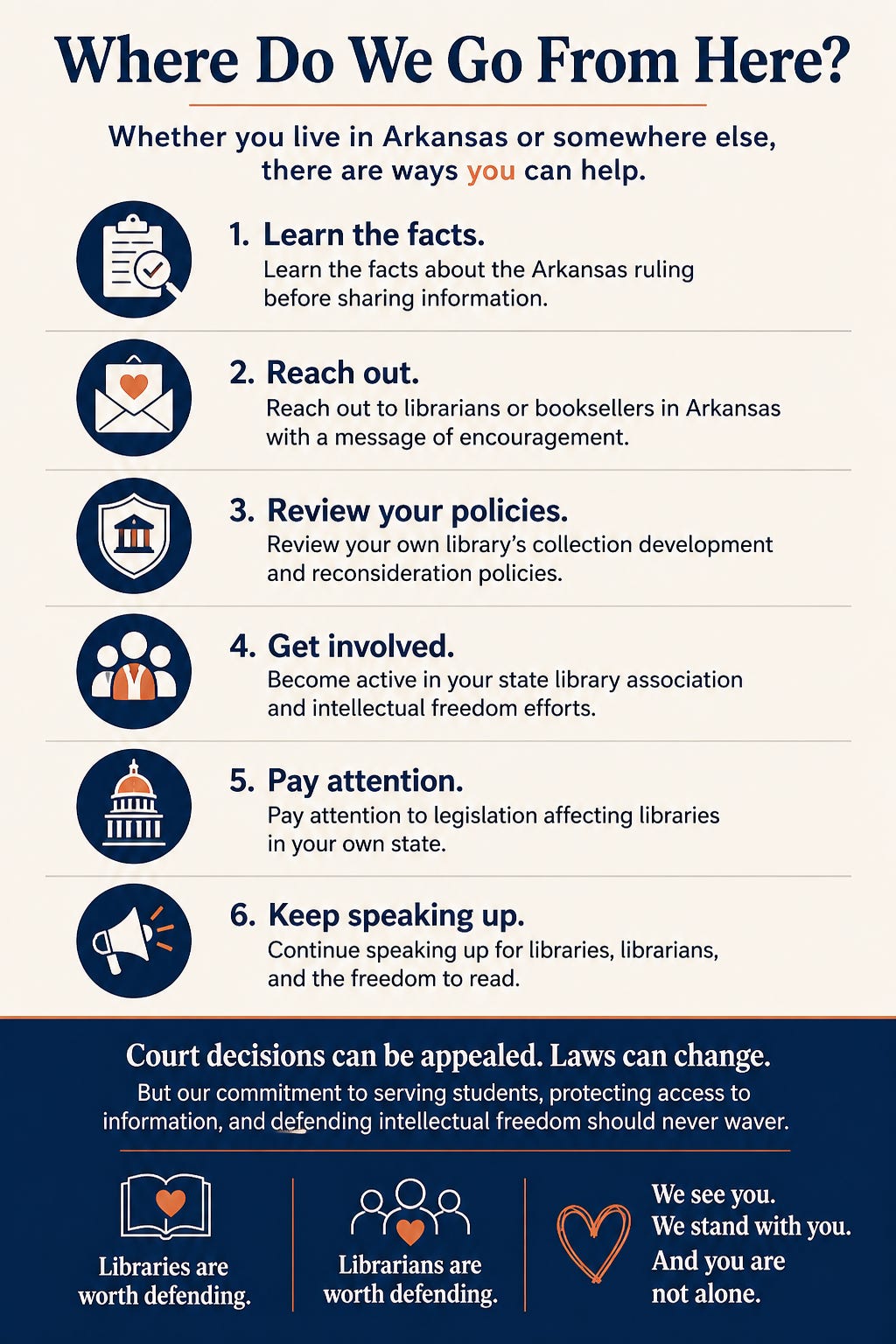
Whether you live in Arkansas or somewhere else, there are ways you can help.
Learn the facts about the Arkansas ruling before sharing information.
Reach out to librarians or booksellers in Arkansas with a message of encouragement.
Review your own library’s collection development and reconsideration policies.
Become active in your state library association and intellectual freedom efforts.
Pay attention to legislation affecting libraries in your own state.
Continue speaking up for libraries, librarians, and the freedom to read.
Court decisions can be appealed. Laws can change. But our commitment to serving students, protecting access to information, and defending intellectual freedom should never waver
.
To learn more about this issue, I encourage you to read the court decision itself, Arkansas Act 372, reporting from Book Riot, resources from the American Library Association’s Office for Intellectual Freedom, the Freedom to Read Foundation, PEN America, and information about New Jersey’s Freedom to Read Act.
Thank you for reading.
I know this article may leave many of you feeling unsettled, especially if you live in Arkansas or another state considering similar legislation. My hope is that it also reminds you of something equally important.
Libraries are worth defending.
Librarians are worth defending.
And to my friends in Arkansas, please remember this.
We see you.
We stand with you.
And you are not alone.
Comments
Nothing yet. Say the first thing.
Sign in to join the conversation.