
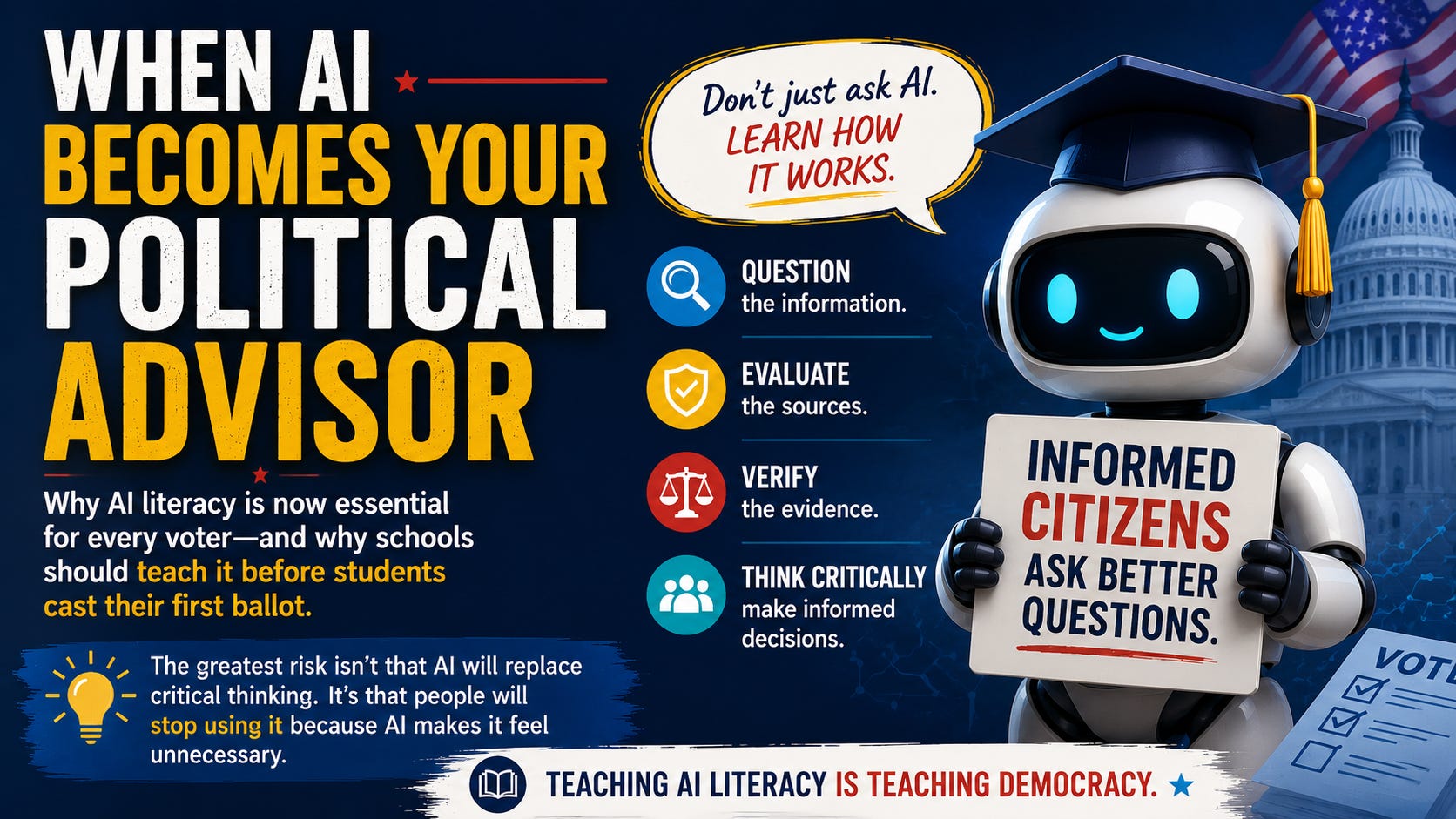
A recent New York Times article caught my attention because it highlighted a growing trend. More voters are turning to AI chatbots to answer questions about candidates, ballot initiatives, and public policy instead of searching for information themselves. At first glance, it looks like another story about politics. I don’t think that’s what makes it important.
As I read the article, I found myself thinking about the students sitting in our classrooms today. Many of them will cast their first vote in a world where asking ChatGPT, Gemini, Claude, Grok, or another AI assistant feels as natural as using Google once did. For them, AI will not be a novelty. It will simply be another way to learn about the world.
That realization made me ask a different question. If artificial intelligence is becoming part of how people understand current events and make important decisions, are we doing enough to teach students how these systems actually work?
For school librarians, I believe this is one of the most important information literacy conversations we can have.
For years, information literacy has focused on helping students evaluate sources. We teach them to identify the author, consider the purpose of the information, recognize bias, verify claims, and compare multiple perspectives before reaching a conclusion. Those skills have served students well because they encourage curiosity instead of blind acceptance.
Artificial intelligence changes that process in a significant way. Instead of reviewing several articles, students and adults are increasingly asking a chatbot to summarize information for them. The research process has become a conversation. Rather than moving from source to source, many users begin and end with a single AI-generated response.
That shift matters because AI is no longer acting only as a search tool. It is beginning to act as an interpreter of information. Instead of simply helping us find sources, it often decides which information to emphasize, how to organize it, and what context to include. Even when an answer is factually accurate, those decisions influence how we understand a topic.
This is why I believe we need to expand our conversations beyond AI literacy and begin thinking about AI Civic Literacy. Whether students are researching elections, healthcare, climate science, history, or local government, they need to understand how AI generates information before they rely on it to make important decisions. This is not just about preparing future voters. It is about preparing informed citizens.
One of the biggest misconceptions about artificial intelligence is that it is objective simply because it is a machine. AI often sounds confident, organized, and authoritative. That confidence can make it feel impartial, but confidence is not the same thing as neutrality.
Artificial intelligence does not independently decide what is true. Every response is generated by identifying patterns learned from enormous collections of human-created information. Books, research articles, news stories, websites, public records, and countless other sources all contribute to how an AI model learns. Just as important, developers make decisions about what information becomes part of that training data and what information does not.
The human influence does not end there. Developers establish safety policies, create system prompts, determine how the model should respond to sensitive topics, and continue updating the system after it has been released. Every one of those decisions shapes the conversations we have with AI. By the time a user types a question, thousands of human choices have already influenced the answer they are about to receive.
That does not mean AI cannot be useful. I use AI every day in my own work. It helps me organize ideas, draft outlines, edit writing, and think through complex problems. The goal is not to distrust AI. The goal is to understand it. Just as we teach students to evaluate books, websites, videos, and social media posts, we should also teach them to evaluate AI-generated information with the same critical eye.
One of the most important lessons students can learn is that every AI answer has a history. Long before a response appears on the screen, people have made decisions about how that answer might be generated. Once students understand that, they begin asking better questions.
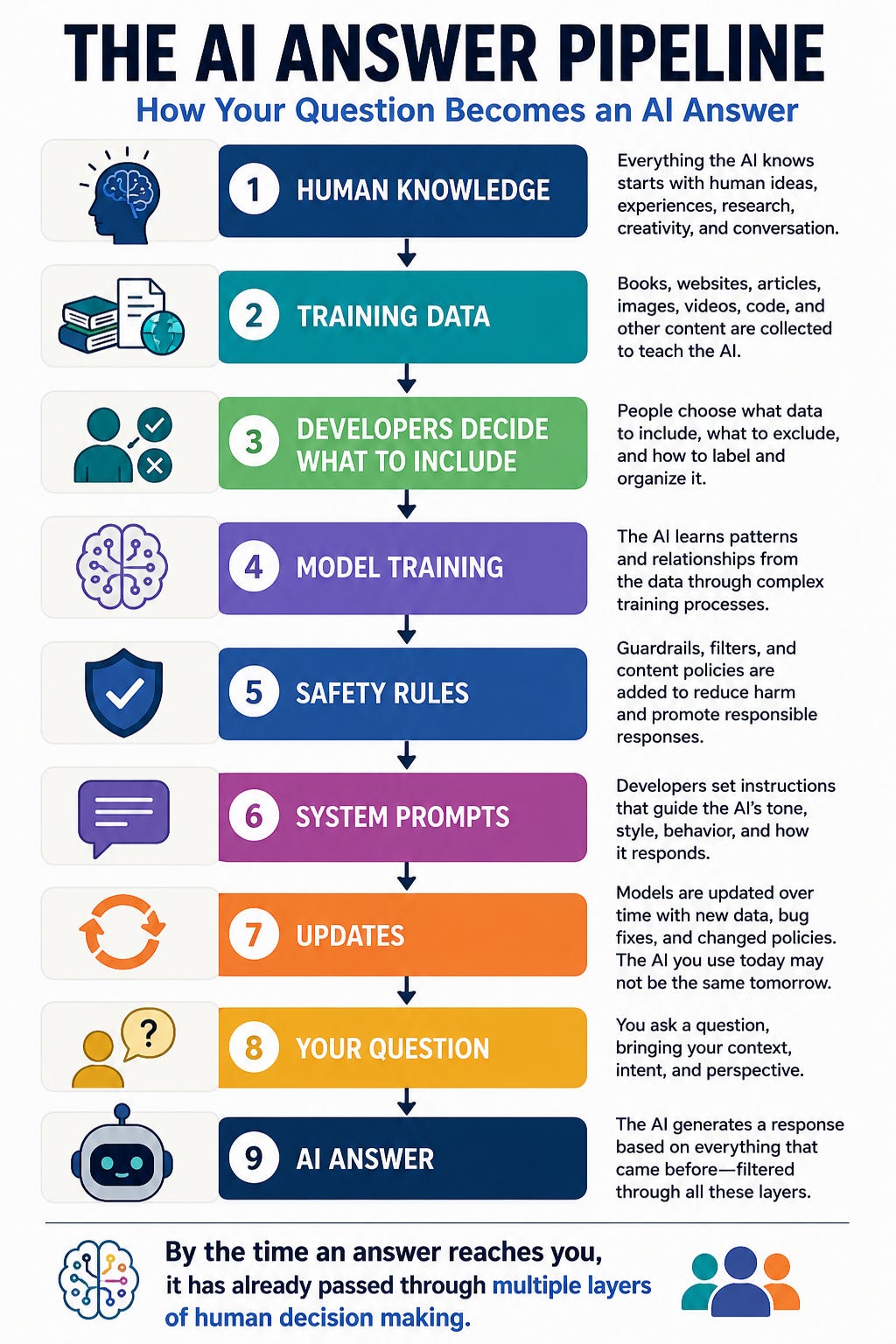
Every AI response is shaped by human decisions long before a user asks a question. Understanding that process is one of the foundations of AI literacy.
Understanding how AI is built also helps explain why different AI systems sometimes produce different answers. ChatGPT, Gemini, Claude, Grok, Copilot, and other AI assistants were not trained in exactly the same way, nor do they follow identical instructions. Each reflects different design choices, safety policies, training methods, and update cycles.
We have seen this play out publicly over the past two years. In 2025, Grok made headlines after an unauthorized change caused it to repeatedly reference the “white genocide” conspiracy theory in unrelated conversations. Later that year, additional updates resulted in antisemitic responses that prompted xAI to publicly apologize and revise the system. Google’s Gemini faced criticism after generating historically inaccurate images of well-known historical figures, leading Google to pause the feature while improvements were made. ChatGPT has produced fabricated legal cases and citations that users mistakenly accepted as real. Microsoft’s early Bing Chat, now known as Copilot, became known for argumentative conversations before Microsoft redesigned important parts of the system.
I don’t share these examples to suggest that one company is better or worse than another. In fact, I think they teach a much more important lesson. AI systems evolve. They are updated, refined, corrected, and sometimes changed in ways that users never notice. The chatbot you used six months ago may not behave exactly the same way today.
That reality reinforces one of the most important principles of information literacy. No source should be accepted without question simply because it is easy to access or sounds authoritative. AI should be held to the same standard we expect of every other information source.
As school librarians, we have never been responsible for telling students what to think. Our responsibility has always been to teach them how to think. We encourage students to ask questions, examine evidence, compare sources, and remain curious even when answers appear simple.
Artificial intelligence has not changed that mission. It has expanded it.
Today’s students are growing up in a world where AI will increasingly shape how information is presented to them. Whether they are researching a historical event, comparing colleges, exploring career options, or learning about an election, AI will often be one of the first places they turn. If that is the reality they are entering, then AI literacy is no longer just a technology skill. It is an information literacy skill, a digital citizenship skill, and increasingly, a civic literacy skill.
Helping students understand how AI works may be one of the most important ways we prepare them not just for school, but for life.
Artificial intelligence is changing how people access information, but it should never replace critical thinking. In the paid section, I’ll share practical classroom strategies for teaching AI Civic Literacy, including a student evaluation checklist, a classroom activity comparing multiple AI systems, discussion questions, and a curated reading list that models the very information literacy practices we want our students to develop.
Comments
Nothing yet. Say the first thing.
Sign in to join the conversation.