
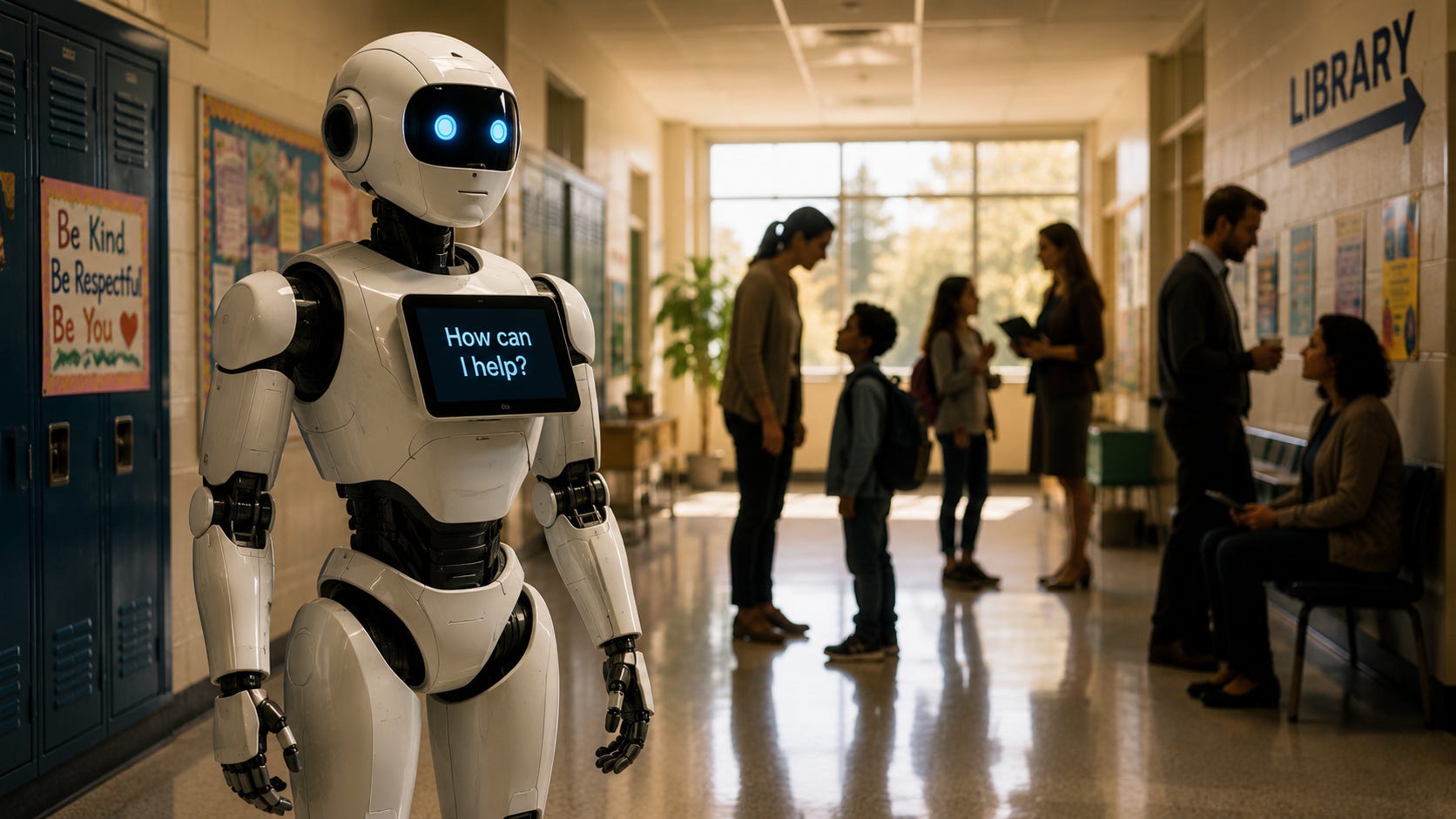
A California charter school’s investment in humanoid AI raises questions that go far beyond technology. It forces us to think about educational priorities, human relationships, special education, and the future we want for our schools.
When I first read that a California charter school had purchased two AI-powered humanoid robots for approximately $500,000, my first reaction wasn’t curiosity about the technology or excitement about what the future of artificial intelligence might look like in schools. Instead, I immediately started thinking about the people that kind of money could support. I couldn’t help but wonder how many teachers, counselors, librarians, paraprofessionals, or special education professionals that investment could fund. As someone who has spent years working in schools, writing about artificial intelligence, and serving on a board of education, that was the question I simply couldn’t shake.
I spend a great deal of my time helping educators understand AI. I believe artificial intelligence has tremendous potential when it is used thoughtfully and responsibly. I have written books about AI, I use it in my own work every day, and I encourage schools to explore ways it can reduce administrative work, improve accessibility, and create new opportunities for teaching and learning. At the same time, serving on a board of education taught me that every budget reflects a series of difficult choices. There is never enough money to fund everything a district needs, and every major purchase represents a decision not to invest somewhere else. Looking at this story through both lenses, I found myself struggling, not because the technology exists, but because of what this investment represents.
Every Budget Is a Statement of Priorities
One of the most valuable lessons I learned while serving on a board of education is that budgets are more than spreadsheets. They are statements of priorities. Every dollar a district spends reflects what it believes is most important for students, and every significant investment comes with an opportunity cost. That reality makes this story much bigger than two humanoid robots. It raises important questions about what schools value and where they believe their limited resources will have the greatest impact.
Across the country, school districts continue to make incredibly difficult decisions. Many are struggling to hire special education teachers, counselors, school psychologists, librarians, and paraprofessionals. Others are freezing positions, reducing programs, or asking educators to do more with fewer resources. Families are frequently told that there simply isn’t enough money. Those realities are why this story stayed with me long after I finished reading it. Instead of asking what these robots are capable of doing, I kept asking myself whether this is the investment that should take priority at a time when so many schools are still struggling to meet students’ most basic educational and emotional needs.
Half a million dollars represents far more than a technology purchase. It represents possibilities. Depending on salaries and local costs, that investment could support several educators or student support professionals. It could strengthen special education services, expand mental health resources, improve intervention programs, or increase access to certified librarians and counselors. Those may not be flashy investments, but they are the people who build relationships with students every day, and those relationships are often what make the greatest difference in a child’s educational experience.
Schools Run on Human Relationships
The longer I thought about this story, the more I realized that my concern really isn’t about robots. It’s about relationships. Schools have always been relationship-driven environments. Students learn best when they trust the adults around them, and those relationships develop through daily interactions that technology cannot replicate. As a school librarian, I see this every day. Students certainly come to the library because they need help finding information or completing a research assignment. Still, they also come because they know there is an adult who will listen, encourage them, and notice when something doesn’t seem right. Those moments rarely make headlines, but they are part of what makes schools work.
The same is true throughout a school building. Teachers recognize subtle changes in a student’s behavior. Counselors know when a student who is usually outgoing suddenly becomes withdrawn. Paraprofessionals often develop an understanding of a student’s communication style that only comes from working together over time. These are not simply tasks that can be assigned to another tool. They are professional relationships built on trust, experience, and genuine human connection. Artificial intelligence may eventually become a valuable support for educators, but I struggle with the idea that it could ever replace the people who make those relationships possible.
My Biggest Concern Is Special Education
As I continued thinking about this story, my mind kept returning to students with disabilities. Many students receiving special education services rely on consistency, predictable routines, and trusted adults who understand their individual needs. Some students experience anxiety when routines change. Others communicate in ways that require patience, experience, and careful observation. Those relationships cannot be downloaded into a machine, no matter how sophisticated the technology becomes.
Reports indicate that these humanoid robots may eventually assist with wellness coaching, advising, and student support. That is where I believe we need to pause and have a much larger public conversation. Should artificial intelligence ever be placed in a position where students begin viewing it as a source of emotional support? What happens if a student becomes emotionally attached to a robot? How do we ensure that vulnerable students understand the difference between genuine human empathy and a system designed to simulate empathy? Those questions are not meant to criticize innovation. There are questions about student well-being, disability rights, ethics, and the responsibility schools have to protect the children entrusted to their care.This Isn’t About Being Anti-AI
Whenever I raise questions like these, I know there will be people who assume I am arguing against artificial intelligence in schools. Nothing could be further from the truth. If you’ve been reading this newsletter for any length of time, you know I believe AI has the potential to transform education in positive ways. I have spent years researching these tools, writing about them, speaking to educators across the country, and helping schools think about how to use AI responsibly. I want teachers to have access to tools that reduce repetitive tasks, help differentiate instruction, improve accessibility, and give them more time to focus on students.
That is exactly why I believe this conversation is so important. There is a significant difference between using AI to support educators and using AI in ways that begin replacing the work built on human judgment and relationships. Those are two very different conversations, yet they are often discussed as if they are the same thing. The more capable AI becomes, the more important it is that we clearly define where technology adds value and where the human element simply cannot be replaced.
We Need This Conversation Before It Becomes Normal
What concerns me most isn’t that one school purchased two humanoid robots. Every school and every district has the right to explore new ideas and pilot emerging technologies. What concerns me is how quickly something like this can become normalized. Education has a long history of adopting new technologies before we fully understand their long-term impact. Sometimes those decisions prove beneficial. Other times we spend years trying to address consequences we never anticipated.
I don’t want us to repeat that pattern with physical AI. By the time a technology becomes common in schools, many of the important decisions have already been made. Policies are written after the fact. Parents are informed after purchases have been approved. Educators are expected to adapt to systems they had little voice in shaping. If humanoid AI is going to become part of our schools, then educators, families, students, disability advocates, researchers, and school boards deserve an opportunity to discuss its role before these systems become commonplace.
That conversation should include difficult questions. What responsibilities should never be given to AI? Should a machine ever provide wellness coaching or emotional support? What safeguards should exist for students with disabilities? How should parents be informed? What data is being collected, and who has access to it? These are not questions that should be answered by technology companies alone. They are questions every community should have the opportunity to discuss openly.
Questions Every School Board Should Be Asking
Serving on a board of education changed the way I look at stories like this. I know firsthand that school boards are responsible for far more than approving purchases. They are responsible for asking difficult questions, weighing competing priorities, and making decisions that reflect the values of their communities. Before approving an investment like this, I would want every board member to have thoughtful answers to questions such as these:
What educational problem are we trying to solve?
What evidence demonstrates that this technology improves student learning or well-being?
Could hiring additional teachers, counselors, librarians, paraprofessionals, or special education staff have a greater impact?
How will this technology affect students with disabilities and other vulnerable learners?
What training will staff receive before these systems interact with students?
What student data will be collected, and how will it be protected?
How will parents be informed and provide meaningful consent?
How will we measure success, and what happens if the technology fails to deliver the outcomes we expected?
Those questions are not anti-technology. They are the kinds of questions good school boards should be asking any time they consider a significant investment.
Library Lens
School librarians have always taught students to think critically about the information they encounter. We teach them that a professional-looking website is not automatically credible, that confidence is not the same as expertise, and that every source deserves careful evaluation. Humanoid AI introduces another lesson that I believe will become increasingly important in the years ahead.
Students need to understand that something can appear human without actually being human. A robot may speak naturally, recognize faces, remember names, and respond in ways that sound remarkably empathetic. None of those qualities mean it understands a student’s experiences, emotions, or needs in the way a trusted adult does. As physical AI becomes more sophisticated, helping students recognize that distinction may become one of the most important forms of AI literacy we teach.
The Conversation We Need to Have
I don’t expect everyone to agree with me after reading this article, and that isn’t really my goal. My hope is much simpler. I hope this story encourages educators, parents, school leaders, board members, policymakers, and community members to start asking questions before humanoid AI becomes another accepted part of school life.
Artificial intelligence is going to continue evolving, and I believe schools should continue exploring how it can improve teaching and learning. At the same time, I believe we have a responsibility to think carefully about where technology belongs and where human relationships must remain at the center of education. Those decisions should never be driven solely by what technology makes possible. They should be guided by what is best for students.
As I finished reading about this investment, I kept coming back to the same thought that crossed my mind when I first saw the headline. If a district has $500,000 to invest in its students, is purchasing two humanoid robots really the best use of those resources? Maybe some people will answer that question with an enthusiastic yes. As someone who has spent years working in schools, writing about AI, and serving on a board of education, I’m not there yet.
Before more schools follow this path, I think we need to talk.
Comments
Nothing yet. Say the first thing.
Sign in to join the conversation.