
One of the things I enjoy most about writing this newsletter is that the conversation doesn’t end when I hit publish. Readers email me, leave comments, and often ask questions that deserve more than a quick response.
After I published I’ve Sat on Both Sides of the Table, I received this message from a reader in Minnesota.
“I work to support the few school librarians that still exist in my part of Minnesota, but I’m also a parent of a student in a school that hasn’t had a school librarian in over a decade. I’ve reached out via email to my administration and explained what a school librarian does and what students are missing out on when they don’t have one. I plan to use some of the tactics, especially the questions you offer, too.
Do you have any other advice for how to proceed? It can be additionally hard to advocate because people don’t have anything to compare our current situation to and assume everything is just fine.”
At first, I thought I’d answer her with an email.
The more I thought about it, the more I realized she was asking a question that thousands of librarians and parents are struggling with.
Where do you start when your district doesn’t have a school librarian?
Maybe the position was eliminated this year, and you’re trying to bring it back. Or maybe it’s been gone for so long that people don’t even realize what students are missing. Either way, if I were moving into a district tomorrow that didn’t have a certified school librarian, here’s exactly where I would start.
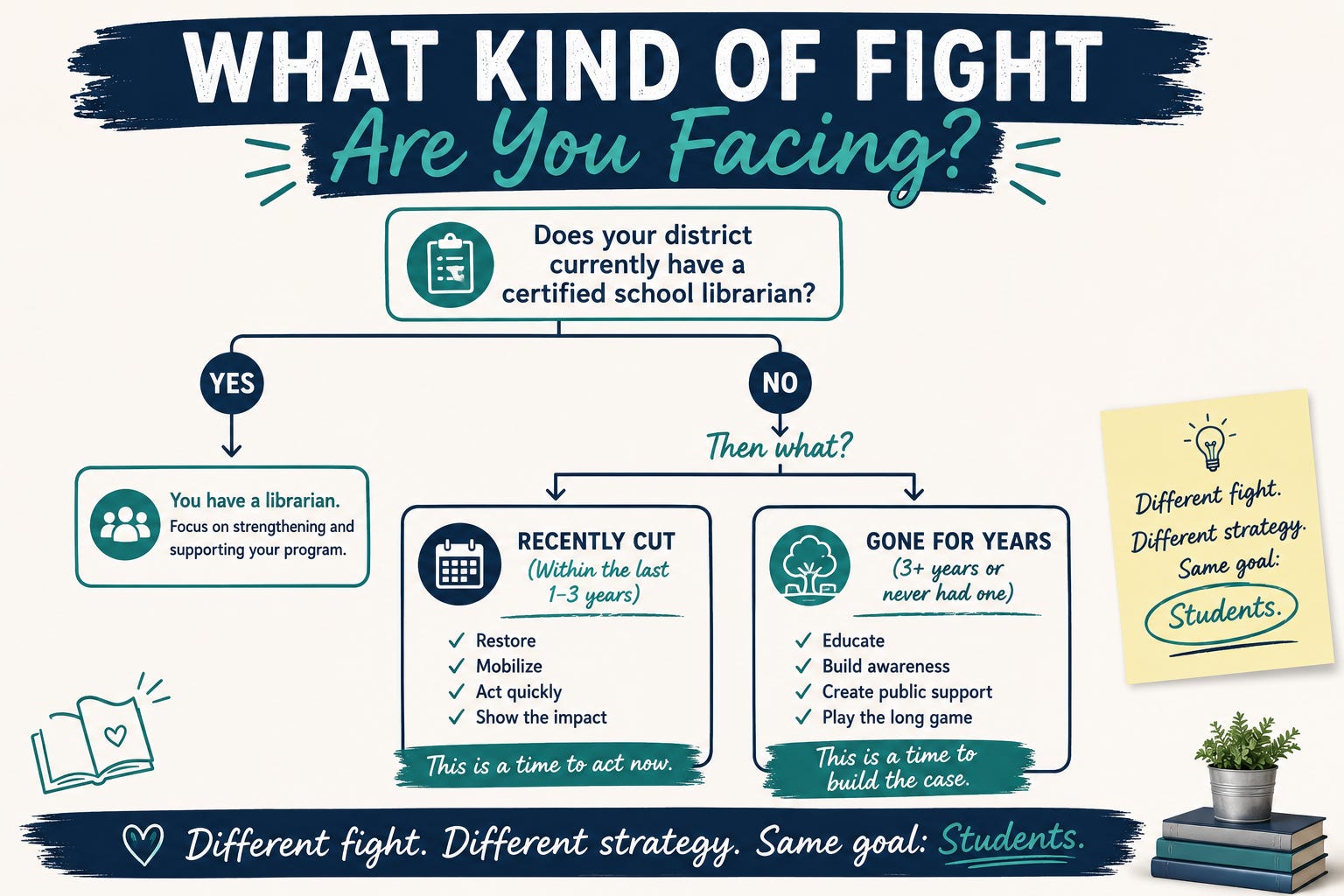
Before I wrote a single email or attended a board meeting, I’d spend time understanding exactly what kind of situation I was walking into. Not every district without a school librarian got there the same way, and not every district needs the same advocacy strategy.
If your district just eliminated the position, people still remember what was lost. Parents are frustrated, teachers miss the collaboration, and board members know the issue is fresh. Your job is to help them understand why restoring that position should become a priority.
If your district hasn’t had a school librarian in years, the challenge is completely different. Parents don’t know what their children are missing because they’ve never experienced a modern school library program. Students assume their experience is normal, and administrators may have inherited a system that’s operated this way for years.
That’s why I think this is actually the harder fight.
You’re not asking people to restore something they remember. You’re asking them to invest in something many of them have never experienced.
Before you decide how to advocate, figure out why the position disappeared in the first place. Was it budget cuts? A retirement that was never filled? Declining enrollment? A different philosophy about libraries? Understanding how your district got here will help you decide how to move it forward.
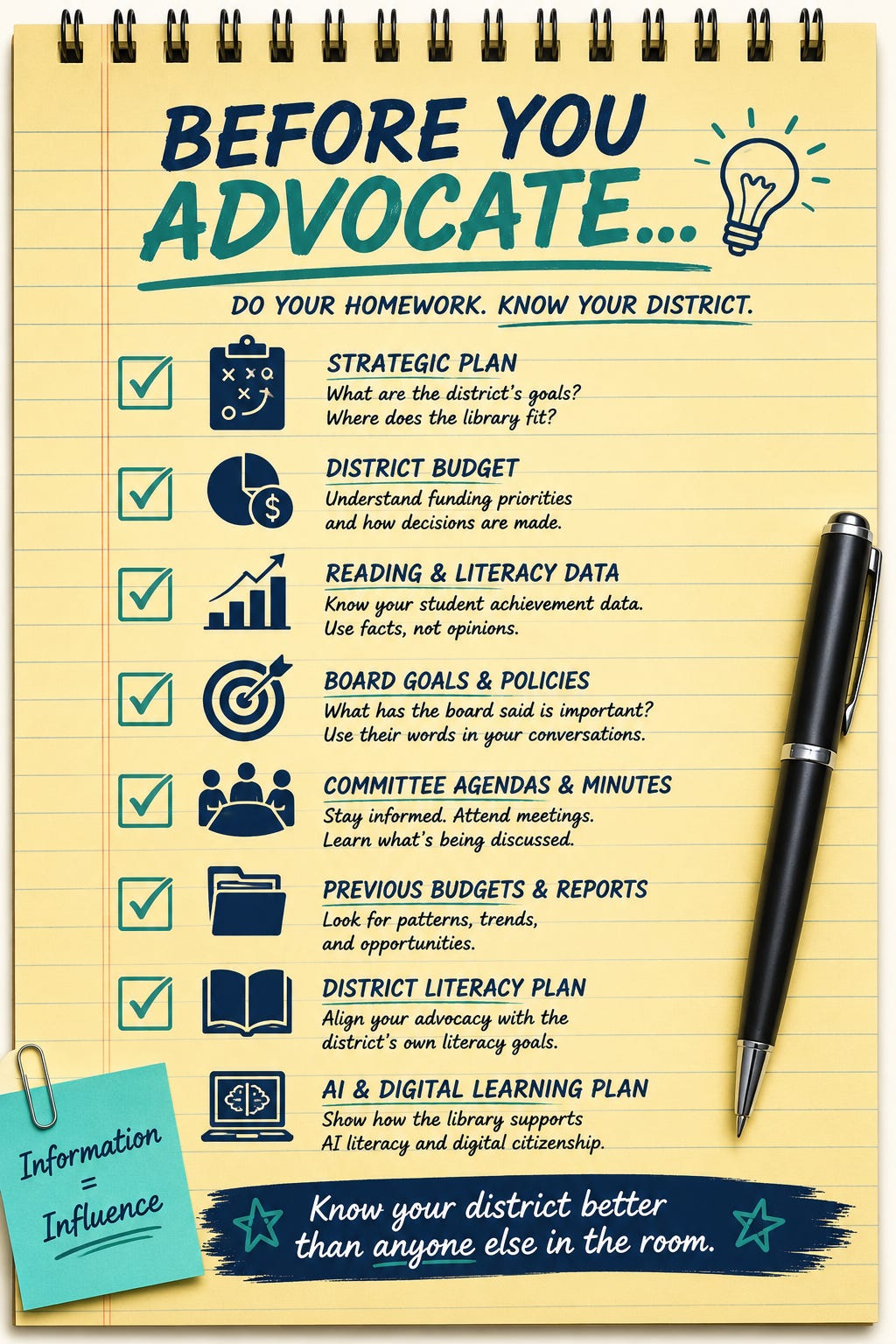
Once I understood what kind of fight I was facing, I’d start doing my homework.
The first document I’d read wouldn’t be the library policy. It would be the district’s strategic plan. Every district has one, and it tells you exactly what leaders say is important. If literacy, student achievement, critical thinking, AI, equity, or college and career readiness appear throughout the plan, you’ve just identified the language your district already uses.
Next, I’d read the budget.
Not because I’m looking for something to criticize, but because budgets tell a story. They show what a district chooses to invest in when money is limited. As a former board member, I can tell you there is never enough money to fund everything. Every budget is a series of difficult choices.
That’s why I don’t spend much time arguing about whether there is enough money. Instead, I ask a different question.
Do the district’s spending decisions reflect the priorities it says it has?
I’ve found that’s a much more productive conversation. If literacy is the priority, does the budget reflect that? If equity is a district goal, where do you see that investment? The more you understand your district’s priorities, the better prepared you’ll be to advocate for the role a school librarian plays in achieving them.
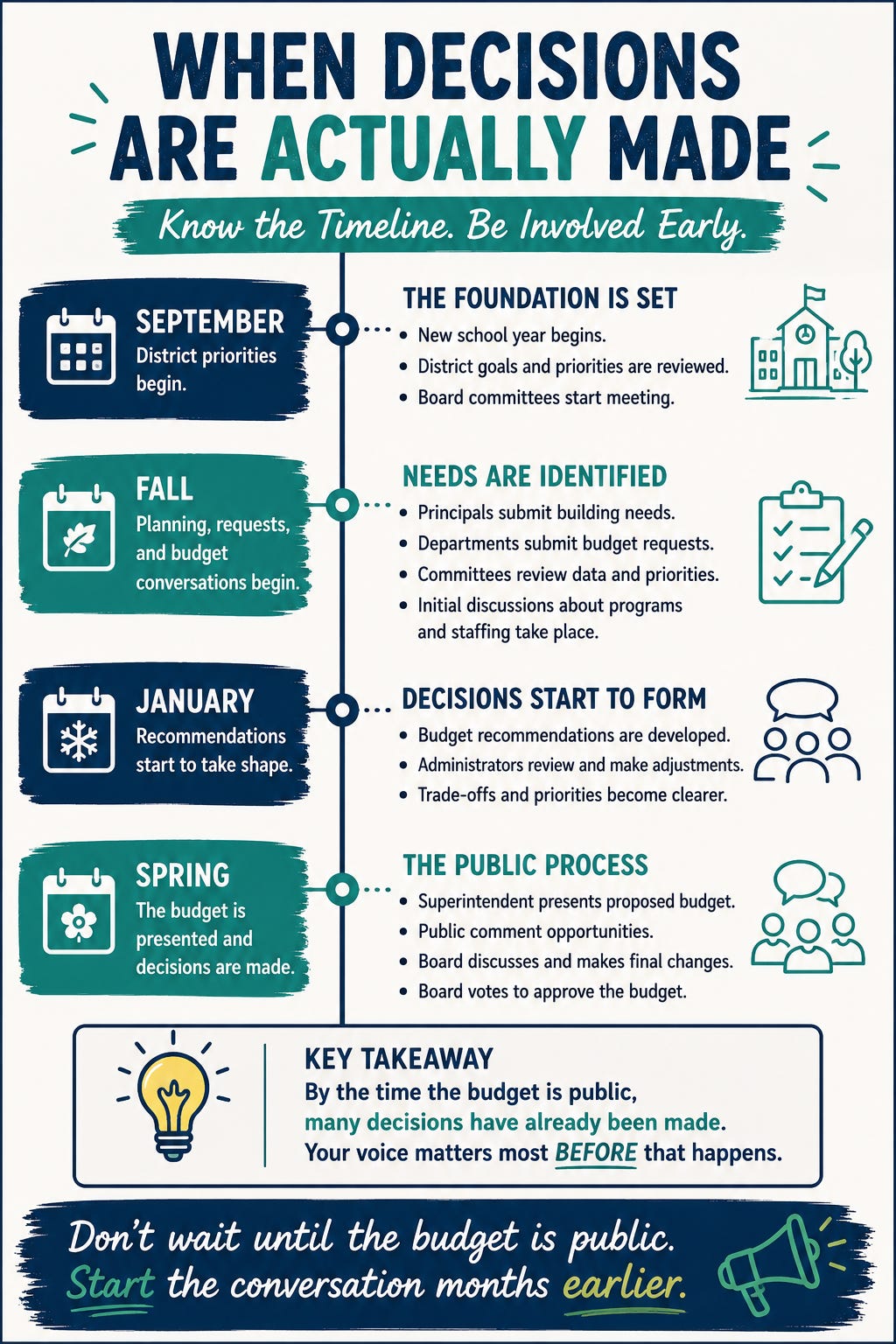
One of the biggest surprises for many people is that school boards don’t start talking about the budget when it’s presented to the public.
By then, many of the biggest decisions have already been made.
Most districts begin planning for the next school year in the fall. Principals are identifying needs, administrators are discussing priorities, and early budget conversations are already underway. By January, those discussions become much more focused, and recommendations are beginning to take shape.
That’s why waiting until the proposed budget is released can put advocates at a disadvantage.
If you really want to influence a decision, start much earlier. Attend board and committee meetings throughout the year. Learn what the district is talking about before budget season begins. Build relationships with administrators and board members while ideas are still being discussed, not after recommendations have already been finalized.
One of the biggest lessons I learned as a board member is that advocacy isn’t something you do during budget season.
The strongest advocacy begins months before anyone starts talking about cuts.
One thing I’ve learned over the years is that conversations have a way of drifting. You start talking about literacy, and before long the discussion is about enrollment, transportation, state aid, or the overall budget.
I’ve learned not to chase every new argument.
Instead, I keep bringing the conversation back to the same place.
Students.
When someone tells me there isn’t enough money, I don’t argue with them (ok, maybe I do sometimes), but I also know budgets are difficult because I’ve helped make those decisions. Instead, I ask whether the choices being made reflect the district’s priorities.
If literacy is the priority, how does this decision improve literacy?
If student achievement is the priority, how does this decision help students succeed?
If equity is a district goal, how does this decision provide equitable opportunities for students?
I’ve found those questions are much harder to dismiss because they aren’t really about libraries.
They’re about whether the district is doing what it says is important.
That’s the conversation I try to have every single time.
One of the best opportunities to advocate for school libraries isn’t during budget season.
It’s during school board elections.
Candidates spend months talking about literacy, student achievement, equity, and preparing students for the future. Those conversations create the perfect opportunity to ask where school libraries fit into their vision.
If your district doesn’t have a certified school librarian, ask the question publicly. Attend candidate forums. Submit questions in advance. Ask candidates how they plan to improve literacy, information literacy, AI literacy, and whether they support restoring a certified school librarian.
If incumbents voted to eliminate library positions, it’s also fair to ask them to explain that decision and whether they would make the same choice again. Elections are one of the few times when candidates are actively asking the community for their support. Use that opportunity to make school libraries part of the conversation.
One thoughtful question at every candidate forum can do more to raise awareness than months of social media posts.
When I finished reading that email from Minnesota, I realized there wasn’t one simple answer to her question.
If I could leave her—and everyone else trying to advocate for school libraries—with one piece of advice, it would be this.
Don’t assume people don’t care.
Assume they don’t yet understand.
Most parents have never experienced a modern school library program. Some administrators have never worked with a certified school librarian. Board members are balancing dozens of competing priorities while making difficult decisions with limited resources.
Your job isn’t simply to ask for a librarian.
Your job is to help your community understand what students are missing, why it matters, and how a certified school librarian helps the district achieve the goals it has already said are important.
That won’t happen overnight.
It takes persistence. It takes relationships. It takes asking thoughtful questions. And it takes bringing every conversation back to the same place—students.
If your district doesn’t have a certified school librarian today, don’t assume the conversation is over.
It may just be getting started.
School libraries aren’t brought back because someone wins one argument. They’re brought back because a community slowly comes to understand what its students have been missing.
Comments
Nothing yet. Say the first thing.
Sign in to join the conversation.