
“If you were told you were paying for castles in the sky, you’d think it was a fraud scheme. Now we’re paying on the promise of data centres in space.”
Professor Sijuade Animashaun of the School of Law at City University of Hong Kong joined us to talk about his research into the money behind the AI boom: where it comes from, how it moves between firms, and why the existing regulatory rulebook cannot control it. His talk examined whether current valuations are backed by real business models, or instead by capital circulating between the same handful of companies.
Money is pouring into AI from IPOs, private funding, private credit, and private debt, and an “AI” label alone can now unlock capital that would not otherwise arrive. Siju set out to examine whether the builders and facilitators behind this have business models that hold up over the medium-to-long term, or whether much of it runs on empty hype that could unwind at any moment.
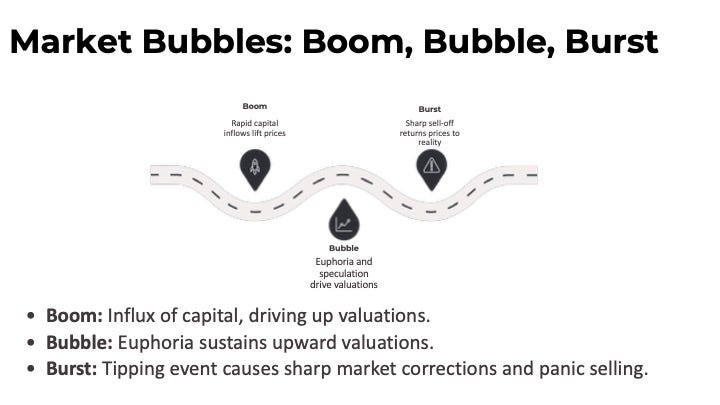
A bubble, on his definition, is a matter of price to earnings. When you buy a share you are paying for a company’s future profitability, not its present state, so high valuations are not automatically irrational. The trouble starts when cheap money and light oversight pull a flood of capital into the market: investors grow less cautious, and prices climb until what is holding the valuation up is the inflow of capital itself, not any evidence the companies are actually profitable. That is the bubble phase. It ends when something interrupts the inflow (often a rise in interest rates). Outside financing dries up, companies that were living on it rather than on real earnings go under, and shareholders, who are last in line to be paid, can lose everything.
To judge whether AI is heading the same way, Siju turned to the closest precedent, the dot-com crash.During the boom, new tech firms were valued rapidly despite weak business plans; roughly 600 companies went public within a couple of years on the promise of disrupting incumbents. What the founders discounted was that the incumbents were adopting the same very technologies at the same time, so any advantage was short-lived without a sustainable model. When the earnings reports came and the profits were not there, the Nasdaq fell about 78%, and the sell-off spread from firm to firm: because they shared similar business models, a loss of confidence in one became a loss of confidence in all of them. Pets.com, the online pet-supply retailer with the well-known mascot, never displaced in-person shops; when it failed it dragged down peers running the same playbook, like Webvan.
Today looks different because the key players are different. In 2000 the main actors were startups without cash flow or a proven model; now they are established companies, and the Magnificent Seven alone account for roughly a third of the S&P 500’s market capitalisation. Many of the warning signs are familiar, including stretched valuations, regulatory flexibility, and unrealised productivity gains from enterprise AI adoption. However, the companies at the centre are not the thin startups of the last cycle. Siju was careful not to call a bubble outright. Whether we are in one turns largely on whether these big players are financially sound; if their businesses genuinely hold up, then the case for a bubble, which rests on the finances of exactly those companies, loses much of its force.
Systemic risk is the risk that one institution’s failure spreads through an interconnected system, as Lehman Brothers did in 2008. The dot-com companies were interconnected too, through cross-selling of affiliate and sponsorship deals, but when they fell, regulators treated the damage as a matter of fraud and weak corporate governance, not as systemic risk. The timing of the event explains part of that: systemic risk only became a prominent idea after the 1997 Asian financial crisis, and was not really used as a regulatory lens until the 2008 crisis, by which point dot-com was long over.
AI has produced a new version of it: circular deals. Siju pointed to a Bloomberg chart showing NVIDIA functioning as a self-referential system. Normally, chip makers sell to data-centre operators, who run models for AI companies. In a circular arrangement, the same firms invest in each other, often through off-balance-sheet structures, so that revenue travels in a loop:
“I’ll invest in your chips on the condition that whatever you’re selling comes to me.”
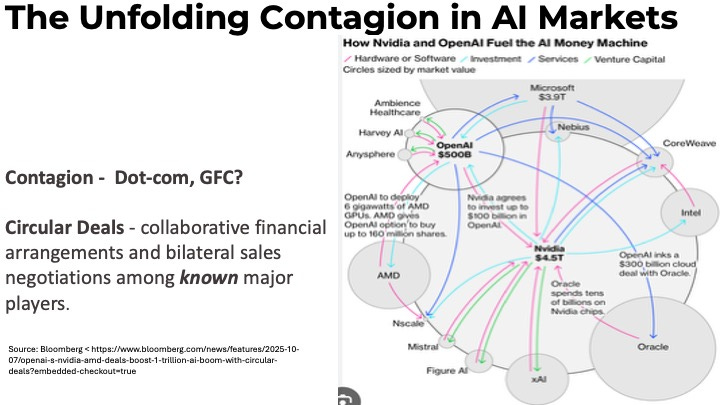
NVIDIA’s most recent quarterly earnings beat expectations, but part of what supports valuations across the AI ecosystem is this aforementioend funding loop rather than profit in the ordinary sense. And the visible deals are only part of the picture. His lesson from the global financial crisis and shadow banking was blunt:
“What you do not see is what really causes the problem.”
A self-referential revenue cycle inflates valuations artificially, since part of the “profit” is the loop feeding itself. Concentration then creates vulnerability to “information runs,” the market equivalent of a bank run: when sentiment turns, investors panic not over one firm but over everyone exposed to it, and the heaviest AI spenders’ valuations were already showing strain when Siju gave his presentation. Interdependency compounds technology risk: if the productivity gains do not materialise, the cost of building ever-larger systems has nothing to monetise against. Siju connected all of these observations to Hong Kong, pointing to local research that many local secondary-school educators are not yet deeply engaged with the technology. Data centres are a means; integration into real economic and social systems is the end; a gap there eventually feeds back into sentiment.
No single one of the existing regulations is strong enough on its own to catch the risks that circular deals create, Siju argued, though together they could form a foundation:-
Sarbanes-Oxley strengthened corporate governance, external audit, and financial transparency, but only attaches to public companies. Much of the AI market’s activity sits in privately-held firms.
FASB accounting standards on related-party transactions and conflicts of interest reach all companies, public and private, and speak to exactly the off-balance-sheet concentration that circular deals create.
DOJ and FTC antitrust rules only trigger automatic scrutiny when one company acquires more than a 30% ownership stake in another. Below that level, regulators may still choose to investigate, but in practice they rarely exercise that discretion. So the firms in these circular arrangements keep their cross-investments in each other small, typically between 5% and 20%, deliberately staying under the 30% line so their deals never face mandatory review.
The Volcker Rule and Dodd-Frank Act brought macro-prudential, ecosystem-level oversight, but the 2008 crisis came from financial institutions. Whether a tech firm counts as a “financial institution” is contestable; at their core these are information intermediaries, so macro-prudential rules do not cleanly apply.
Together, these rules focus on corporate governance rather than systemic risk, leave private funding under-covered, and point their strongest tool at banks rather than tech. Where regulation is absent, Siju was blunt: a free-for-all, “the badlands,” where opacity becomes concentration risk, and a failure among a concentrated group can move the US market, which makes up around half of global market capitalisation.
Siju’s recommendation is not to rush a formal regime onto dynamics no one yet fully understands, nor to kill innovation in the attempt. Instead, he proposes a transitional “soft law” approach: flexible guidelines that adapt as the market develops, anchored jointly by the agencies that already hold the relevant pieces. The SEC covers public companies; the DOJ and FTC cover financial transparency and consumer protection across all companies; FASB covers related-party transactions and conflicts of interest; and the FSOC carries the post-2008 expertise on contagion and systemic risk. A guideline binding these together could show how AI-sector dynamics are affecting valuations and the business models of the key enablers, and from there inform a more formal framework.
The talk centred on the US, but Siju also turned to the international picture. He pointed to frameworks like the EU AI Act and MiFID II as part of a baseline for regulatory interoperability across jurisdictions. The aim, as he framed it, is not for other markets to copy the EU wholesale, but to draw on a shared set of considerations that each can adapt to its own stage of development, and to coordinate at the multilateral level.
After his presentation, Siju addressed some questions raised by the audience.
The first question pressed on the Magnificent Seven: with their strong cash flows, wouldn’t they simply absorb AI’s losses, and doesn’t that change the bubble picture? Siju’s read was that the largest players can survive downturns the way eBay, Microsoft, and Amazon survived the dot-com crash, by leaning on established businesses, cutting costs, and drawing on vertical and horizontal integration across the wider tech sector. The way to judge durability, he said, is to map those connections and see who actually holds power in the market.
A second question turned to GPUs. Railways and fibre last for decades, but GPUs might be obsolete within five years, so how should we treat depreciation? Siju took the point seriously: if we cannot say when chips become unproductive, or price their depreciation properly, we cannot price the long-term profitability of the firms staking everything on them. Another reason, he said, to understand who owns the infrastructure, how it is funded, and who the related parties are.
A third question asked whether the 2008 Great Recession, rather than the dot-com crash, was the closer analogy to the current AI situation, given the entrenched players and the circular deals, and whether soft law was adequate if those players treated themselves as too big to fail. Siju agreed that the 2008 experience was instructive but warned against conflating two genuinely different sectors; there is not yet a strong understanding of how contagion works in tech specifically. He also noted an important distinction: the fraud in past crises tended to surface afterwards, whereas the AI circular deals are, for now, technically legal. His soft-law proposal is explicitly not self-regulation, but is instead anchored by the regulators above, acting as a bridge to a formal regime rather than a substitute for one.
The last question was about network effects. Many regulators focus on firm-level risk, but the circular financing arrangements create ecosystem-level dependencies, so do regulators need new tools? His view: there is no ecosystem-level view without the firm-level view first. A full ecosystem approach is where the transitional period ends up. For now, however, the work to focus on is understanding each firm’s exposure to the system around it.
You can connect with Siju on LinkedIn and read more about his work on his CityU profile.
If anything here resonates and you’d like to get involved, follow AI Safety Hong Kong on LinkedIn or visit aisafetyhk.org, wherever you are.
Thanks for reading! Subscribe for free to receive new posts and support our work.
All views shared here are the speaker’s own, and do not reflect the views of City University of Hong Kong or AI Safety HK. Any errors in summarizing the talk are our own.
No posts
Comments
Nothing yet. Say the first thing.
Sign in to join the conversation.