

Hey, AI Ready Seeker! 👋🙂
What if your business could answer every call, qualify leads, book appointments, and support customers without hiring additional staff?
In a previous article, we explored an AI research and product company that specializes in advanced AI voice generation. In case you've missed it, here it is.
Today, we’re going to explore an AI tool you can use to create your very own AI voice agent for your business.
That tool is Vapi!
Founded in 2023 by Jordan Dearsley and Nikhil Gupta, Vapi helps developers and businesses build AI voice agents that can answer calls, have conversations, book appointments, qualify leads, and connect with business systems in real time.
The way it works, Vapi acts as a central hub that connects different AI services together, giving developers the flexibility to choose the voice, intelligence, and speech recognition tools that work best for their needs.
To help you better understand how Vapi works, we’ll take a quick look at:
🤷 What is Vapi?
🌟 What’s So Special About Vapi?
👷♀️ How AI Voice Agents Work
👥 Who Vapi Is Best For
🌎 Real World Use Cases
✔️ Pros and Cons
💳 Pricing and Plans
📈 Return on Investment
Vapi is a developer-focused platform for building, testing, and deploying AI voice agents across phone calls and websites.
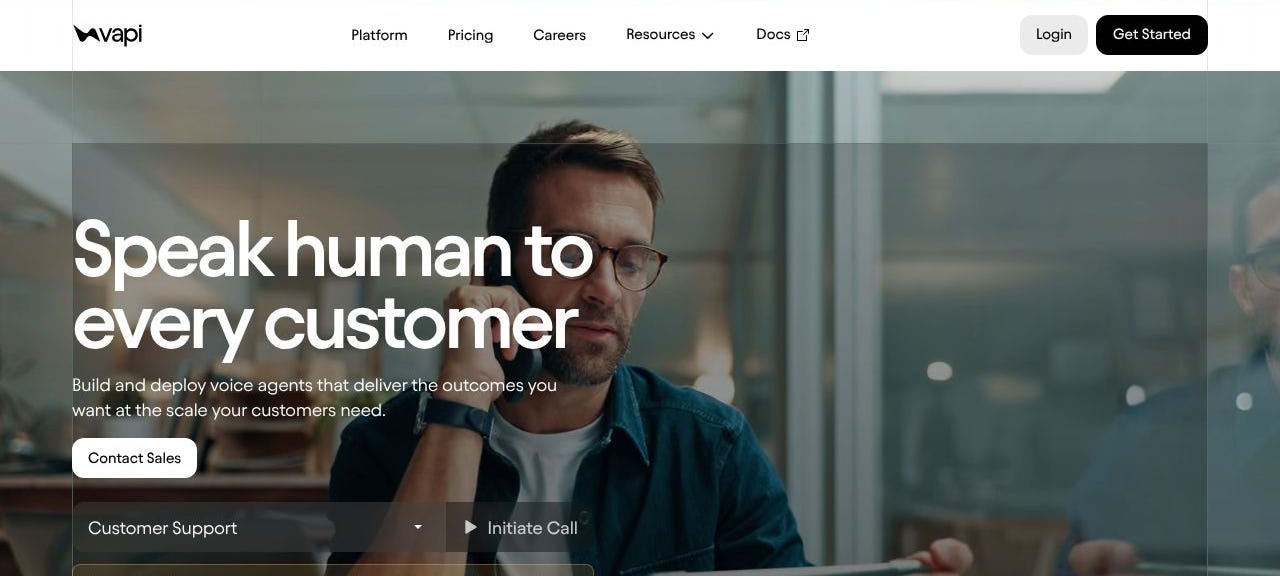
Instead of building everything from scratch, Vapi handles much of the complicated infrastructure behind the scenes. So, developers can focus on designing the conversation and business logic rather than managing the technology that keeps everything connected.
Vapi is the layer that sits between phone systems, AI models, voice providers, and business software. It brings all of those systems together into one seamless workflow experience.
Most AI voice platforms provide a single system for building voice agents. Vapi takes a different approach by acting as the central hub that connects multiple AI models, voice providers, phone systems, and business tools together.
This flexibility allows businesses to build custom voice agents that are not locked into one provider and can evolve as new AI technologies become available.
Key features include:
🔌 Multi Provider Support
One of Vapi’s biggest strengths is flexibility.
Builders can connect providers such as OpenAI, Anthropic, Google, Deepgram, and ElevenLabs.
This allows businesses to choose the best combination of intelligence, speech recognition, and voice generation for their specific use case.
💡 If a new AI model launches tomorrow, you can often switch providers without rebuilding your entire system.
☎️ Voice API
Vapi provides the infrastructure needed for inbound and outbound phone calls.
Businesses can create voice agents that answer calls, make calls, and interact with customers automatically.
💡 Businesses can automate many repetitive phone conversations.
🤖 Assistants
Assistants are individual AI voice agents that can be given instructions, tools, and workflows.
These are trained for specific jobs. One agent can answer questions, while another can collect information and perform tasks on behalf of a business.
🧩 Squads
Squads allow businesses to combine multiple specialized AI assistants into a single workflow.
Each assistant is responsible for a specific task and can hand the conversation off to another assistant when needed while maintaining the conversation context.
For example, one assistant may qualify a lead, another may answer product questions, and a third may handle appointment scheduling.
This approach helps manage complex conversations more effectively than trying to make a single assistant handle everything.
📊 Dashboard and Developer Tools
Vapi includes a dashboard for monitoring calls, managing phone numbers, testing agents, and reviewing conversations.
Developers also get access to SDKs and tools that help them build and deploy solutions faster.
This makes it easier to improve and maintain voice agents over time.
🔗 CRM and Database Integrations
Vapi can connect with customer relationship management systems, databases, calendars, and other business tools.
This allows voice agents to retrieve information, update records, schedule appointments, and personalize conversations.
Instead of simply answering questions, the agent can take action inside your business systems.
When you speak with an AI voice agent, it may feel like you are talking to a single system.
In reality, several technologies are working together at the same time.
The process usually looks like this:
👂 Speech Recognition
The AI listens to what the caller says and converts spoken words into text.
This is often called Speech-to-Text or STT.
It acts as the agent’s ears and allows the system to understand what the caller is saying.
🧠 Language Model
Once the speech has been converted into text, a large language model analyzes the request, understands the intent, and decides how to respond.
This acts as the agent’s brain.
It determines what information the caller needs and what action should happen next.
🗣️ Voice Generation
After the AI creates a response, the text is converted back into speech.
This is often called Text-to-Speech or TTS.
This would be the agent’s mouth, making the conversation flow naturally.
🎼 Orchestration
This is where Vapi comes in.
Vapi coordinates all of these moving parts and ensures information flows smoothly between them.
Similar to the conductor of an orchestra, making sure every instrument plays at the right time.
👨💻 Developers
Developers who want maximum flexibility and control over their voice AI stack will appreciate Vapi’s ability to connect different providers and services together.
It is designed for those who want to customize almost every part of the voice experience.
🏢 Businesses With High Call Volumes
Companies handling large numbers of customer calls can use Vapi to automate repetitive conversations and reduce workload on staff.
This can help reduce missed calls and improve response times.
⚙️ Teams Building Custom Solutions
Organizations that need integrations with existing software, databases, or internal systems can use Vapi as the foundation for highly customized voice experiences.
This makes it a strong choice for businesses with unique workflows.
🚀 AI Builders and Startups
Startups experimenting with AI voice technology can benefit from Vapi’s developer tools and flexible architecture.
Many startups use it to prototype, test, and launch voice agents quickly without building infrastructure from scratch.
📞 AI Receptionists
Businesses use Vapi to answer incoming calls, provide information, collect customer details, and transfer more complex issues to a staff member when needed.
This helps ensure calls are answered even outside business hours.
📅 Appointment Scheduling
Voice agents can schedule appointments, manage calendars, and send booking information without requiring staff to manually handle every call.
This reduces administrative work and saves time.
💰 Sales and Lead Qualification
Companies use Vapi to call potential customers, ask qualifying questions, and identify the most promising leads before passing them to a sales representative.
This allows sales teams to focus on higher value conversations.
🏥 Healthcare Support
Medical organizations can use multiple AI agents to help with patient intake, appointment scheduling, and answering common questions.
This reduces pressure on front desk staff and improves patient responsiveness.
🍔 Food Ordering
Restaurants and food businesses can automate phone orders by allowing customers to place orders through natural conversation.
This can reduce order mistakes and improve customer convenience.
🏠 Real Estate
Real estate businesses can use voice agents to answer inquiries, collect prospect information, and schedule property viewings.
This ensures potential buyers receive a quick response even when agents are busy.
🚀 Fast Deployment
Vapi removes much of the infrastructure work normally required to build a voice agent.
Businesses can launch solutions much faster than building everything themselves.
🔄 Flexible Provider Selection
You are not locked into a single AI provider.
This makes it easier to adapt as new models and technologies become available.
🛠️ Extensive Integration Options
Vapi can connect with CRMs, databases, calendars, and automation tools.
This allows businesses to create highly customized workflows.
📈 Scales With Your Business
Whether you need a simple receptionist or a complex multi agent system, Vapi provides tools that can grow with your needs.
You can start small and expand as demand increases.
⏱️ Latency Can Vary
While Vapi aims for fast conversations, response times can vary depending on the complexity of the workflow and the providers being used.
💡 More integrations often mean more moving parts.
📚 Learning Curve
Although Vapi simplifies many technical tasks, more advanced features and configurations can take time to learn.
New users should expect some experimentation and testing.
👨💻 Built For Builders
Vapi is primarily designed for developers.
Non technical users may find platforms with drag and drop builders, such as Make or Zapier, easier to get started with if they do not have technical support available.
Vapi uses a usage based pricing model.
Instead of paying a large monthly subscription, you pay based on the minutes your voice agents use.
🧪 Build Plan
The Build plan is Vapi’s self service option.
Starts at approximately $0.05 per minute for Vapi’s platform fee.
Additional costs apply for the speech recognition provider, language model, voice provider, and telephony services you choose.
New users also receive free credits to test the platform before committing.
🏢 Scale Plan
The Scale plan is designed for larger organizations with higher call volumes.
Pricing is customized based on usage requirements.
Enterprise customers receive volume discounts, higher concurrency limits, dedicated support, security features, and enterprise level service agreements.
💡 Important Pricing Note
One thing many new users overlook is that Vapi’s platform fee is only part of the total cost.
You will also pay for the AI models, voice services, phone providers, and speech recognition services connected to your workflow.
Depending on the providers you choose, a real world production voice agent may cost anywhere from roughly $0.15 to $0.40 per minute.
The exact cost depends on the complexity of your setup and the providers you select.
One of the easiest ways to understand ROI is to compare the cost of an AI voice agent against the cost of handling calls manually.
For example:
📞 Small Business Receptionist
Imagine a business receives 1,000 calls per month.
The average call lasts 3 minutes.
That equals 3,000 minutes of call time.
Assuming an average voice AI cost of $0.25 per minute, the monthly cost would be approximately $750.
If a receptionist costs $3,000 per month in wages and benefits, the business could potentially save over $2,000 per month while still ensuring every call gets answered.
The exact savings will vary, but the potential return can be significant.
🚀 Lead Qualification
Imagine a sales team receives hundreds of inbound inquiries every month.
An AI voice agent can ask qualifying questions automatically and only pass high quality leads to the sales team.
This allows sales representatives to spend more time closing deals instead of screening prospects.
Even a small increase in conversions can produce a return that greatly exceeds the cost of the voice system.
🏢 Real World Example: Instawork
Instawork uses Vapi to conduct voice screenings for job applicants.
According to publicly shared case studies, the company scaled its voice screening operations by approximately 50 times.
It now handles over one million minutes of voice screening per month and increased successful skills matching by 30%.
The company also moved from concept to production in about 30 days.
This demonstrates how voice agents can dramatically increase operational capacity without requiring a proportional increase in staff.
📦 Real World Example: Ring
Ring evaluated dozens of voice AI providers before selecting Vapi.
According to public reports, Ring now routes its inbound call volume through Vapi powered voice systems.
The company reported improvements in customer satisfaction while maintaining support quality at scale.
While financial figures were not publicly disclosed, improvements in service quality combined with large scale automation typically create strong returns on investment.
By connecting speech recognition, language models, voice generation, telephony, and business systems into one platform, Vapi makes it significantly easier to create powerful voice experiences without building everything from scratch.
For developers and businesses looking to build custom AI voice agents with maximum flexibility,
Vapi is one of the best suited platforms available for building AI voice agents today!
If you're interested, here an article on how you can build your own AI voice agent.
If you want more articles like this, tap the ‘❤️’ and ‘🔁’ to show your vote.
Bookmark ‘⭐’ AI Ready Tips in your browser or inbox 💌
Thanks for sharing, I truly appreciate your feedback 👍
If you found this helpful, share it with a friend who could use these AI-ready tips too. Have a great day! 🙂
Comments
Nothing yet. Say the first thing.
Sign in to join the conversation.