
Whenever I use an AI chat tool, I always wonder: how does it generate text so quickly?
What’s going on behind the scenes that makes it so efficient?
Last month, I attended the vLLM meetup at the Red Hat Pune office and learned from one of the experts that the key to this fast response is the KV cache.
So, I decided to dig deeper to understand it better. Here’s what I learned.
The Problem Without KV Cache
When LLMs generate text, they produce one token (word or word piece) at a time. For each new token, the model needs to:
Look at all previous tokens in the sequence
Calculate attention scores between the new token and every previous token
This means recalculating the same key and value vectors over and over again
For example, when generating "The quick brown fox jumps":
Token 1: "The" → Calculate attention for "The"
Token 2: "quick" → Recalculate attention for "The" AND calculate for "quick"
Token 3: "brown" → Recalculate attention for "The", "quick" AND calculate for "brown"
And so on...
This becomes extremely inefficient as sequences get longer.
The Solution: KV Cache
KV Cache solves this by storing the key and value computations from previous steps.
What is KV Cache?
KV Cache (Key-Value Cache) is a memory optimization technique used in transformer-based Large Language Models (LLMs) to speed up text generation dramatically.
It works by storing previously computed key and value vectors from the attention mechanism so they can be reused instead of being recalculated for every new token.
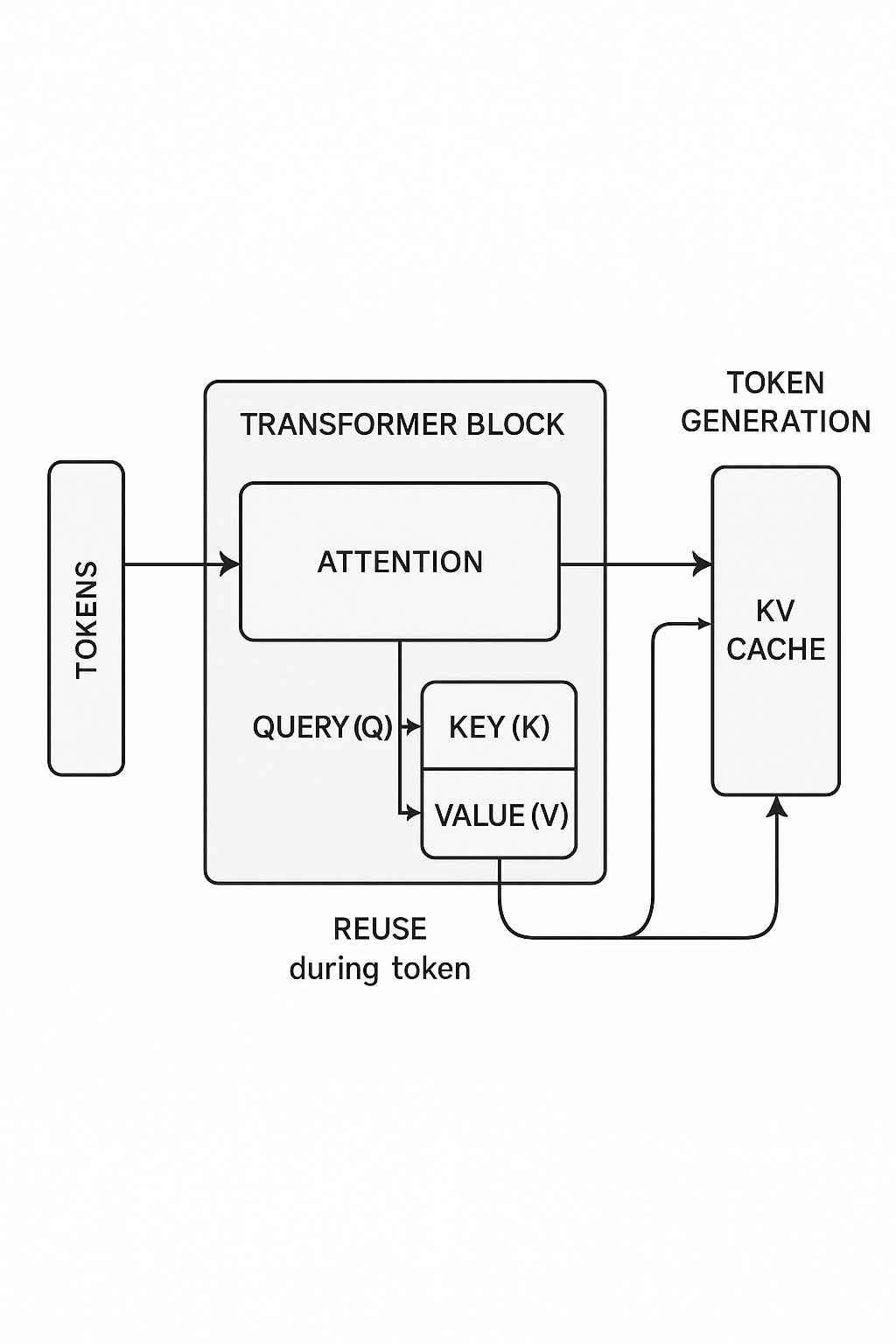
Here's how it works:
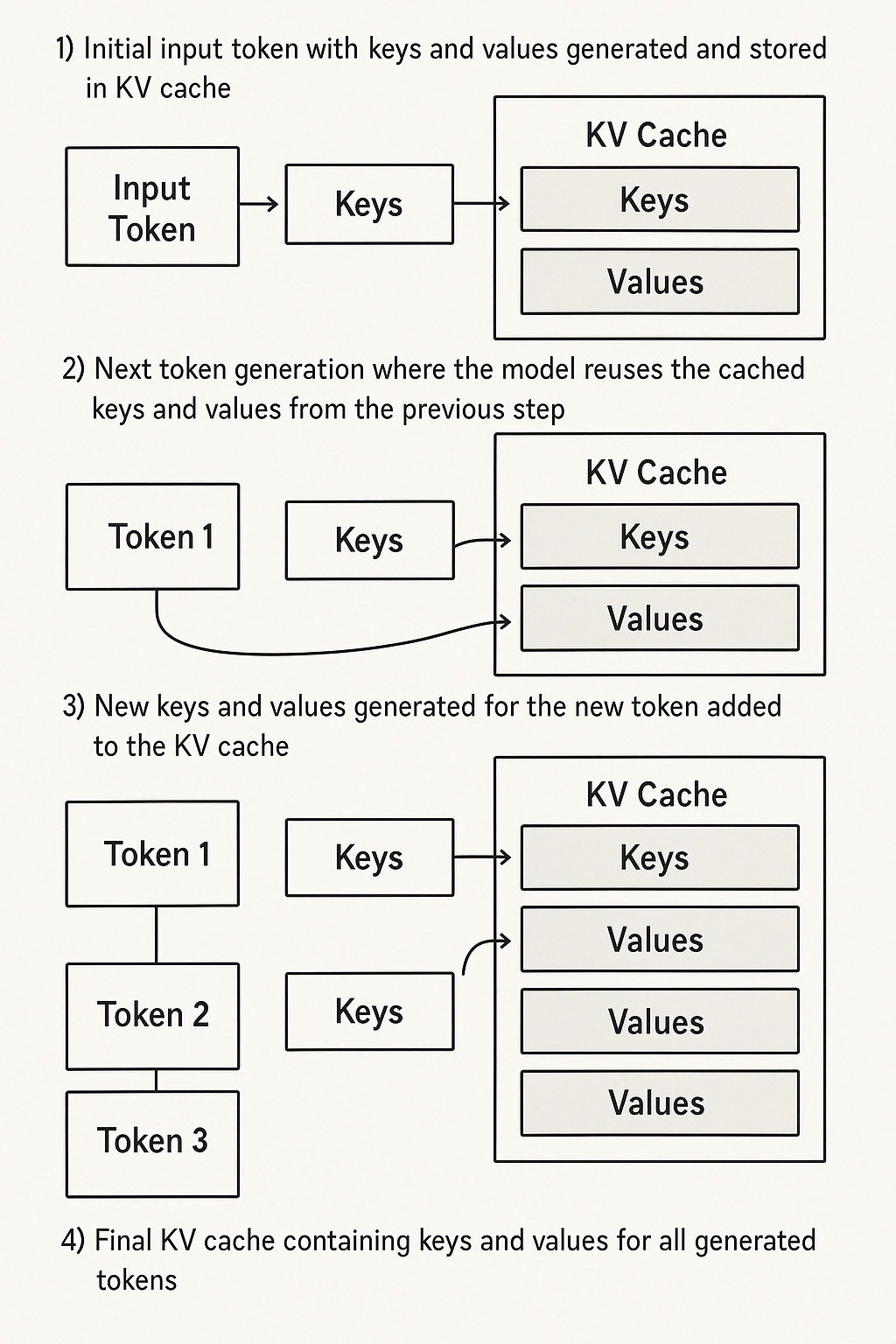
Step 1: For the first token, calculate and store its key (K) and value (V) vectors in the cache
Step 2: For the second token, retrieve the cached K and V from step 1, calculate new K and V for the current token, then store everything
Step 3: Continue this pattern, always reuse cached computations, and only calculate new ones for the current token
Token 1: [K1, V1] → Cache: [K1, V1]
Token 2: [K2, V2] → Cache: [K1, K2], [V1, V2]
Token 3: [K3, V3] → Cache: [K1, K2, K3], [V1, V2, V3]
...
Token n: [Kn, Vn] → Cache: [K1...Kn], [V1...Vn]
The attention computation then uses:
Query (Q): Only for the current token
Keys (K): All cached keys + current key
Values (V): All cached values + current value
Why KV Cache is Critical for LLM Inference
1. Dramatic Speed Improvements
KV Cache provides substantial speedups in text generation:
4-8x faster inference in many cases
Real-world example: With KV cache enabled, generation takes 9 seconds vs 40 seconds without it (4.5x speedup)
After the first token, each subsequent token has roughly constant generation time regardless of sequence length
2. Computational Efficiency
Without KV Cache:
Time complexity: O(n²) where n is sequence length
Every token requires recalculating attention for all previous tokens
With KV Cache:
Time complexity: O(n) for each new token
Only calculates attention for the new token while reusing cached computations
3. Enables Long Context Processing
KV Cache makes it feasible for models to handle very long contexts:
Models like Claude 2 (100K tokens) and GPT-4 (32K tokens) rely heavily on KV caching
Without caching, processing such long sequences would be computationally prohibitive
Critical for applications like document analysis, long conversations, and code generation
4. Production Deployment Requirements
In real-world applications, KV Cache is essential because:
Enterprise AI systems require fast response times for user interactions
Multi-user serving: Can reuse cached computations for shared prompt prefixes across different users
Cost reduction: Up to 75% lower serving costs through reduced computational waste
Memory efficiency: Prevents redundant calculations that would otherwise consume excessive GPU resources
Modern Optimizations
To address memory concerns, researchers have developed several techniques:
Grouped-Query Attention (GQA): Shares key/value heads across multiple query heads
Multi-Query Attention (MQA): Further reduces the number of distinct key/value heads
Quantization: Compresses cached values to use less memory
Sliding Window Attention: Only keeps a fixed window of recent tokens
PagedAttention: Efficient memory management for KV cache in production systems eg, vLLM + LMCache
While KV Cache does increase memory usage, modern optimizations and careful memory management make this trade-off worthwhile for the substantial performance gains it provides.
Without KV Cache, the responsive AI applications we use today would not be practically possible.
Comments
Nothing yet. Say the first thing.
Sign in to join the conversation.