
👋 Welcome to AI-native GTM!
AI-native companies are re-writing the GTM playbook. On this Substack, I will highlight the stories and frameworks behind some of today’s fastest growing startups. You can expect deep dives, analysis and insights to inspire the next generation of AI-native founders and operators.
Today, we take a look at ElevenLabs.
Year Founded: 2022
Headquarters: New York, NY
Total Funding: $281M
Founders: Mati Staniszewski, Piotr Dabkowski
Key Hires: Luke Harries, Carles Reina
Let’s dive in 👇
Introduction: The full-stack audio AI company
When two Polish childhood friends started ElevenLabs in 2022, they had a clear mission: break down language barriers by making any content accessible in any language and voice. CEO Mati Staniszewski (formerly at Palantir) and CTO Piotr Dąbkowski (formerly at Google) believed voice would become a primary way humans interact with computers—and they wanted to build the AI to make it happen.
What makes ElevenLabs unusual in today’s AI landscape is their approach. Most companies pick a lane: either build cutting-edge AI models OR create user-friendly applications. ElevenLabs does both. They run deep research into voice AI models, then build the creative platforms and developer tools that put that technology in people’s hands. They control the full stack—from foundational research to end-user apps to enterprise APIs.
This vertical integration strategy isn’t just about being comprehensive. It’s a deliberate moat-building exercise. Start with research superiority, layer in proprietary data from millions of users, deepen integration with customers’ workflows, and expand from a point solution into a full platform. The goal? Become the “Adobe Creative Cloud for AI audio.”
ElevenLabs by the numbers: The road to $6.6B
ElevenLabs is one of the fastest growing startups in recent memory.
Revenue acceleration: The company reached $100 million in annual recurring revenue in just 20 months from launch. Then they doubled it—hitting $200 million only 10 months later. Current projections show them crossing $300 million in 2025.
Viral user adoption: Within five months of launching their beta, over one million people had signed up to try the product. In just two years, ElevenLabs’ millions of users have generated 1,000 years of audio content.
Enterprise market penetration: By early 2025, over 60% of Fortune 500 companies were using their technology. Even more impressive, revenue has shifted from mostly individual creators to nearly a 50/50 split between enterprise and self-serve customers.
Unsurprisingly, investors are leaning in:
July 2022: Started with a modest $2 million pre-seed round at a $9 million valuation
March 2023: Raised $19 million from prestigious investors including Andreessen Horowitz (a16z)
December 2023: Secured $80 million at a $1.1 billion valuation, achieving unicorn status
January 2025: Raised $250 million at a $3.3 billion valuation
September 2025: Completed a $100 million tender offer at a stunning $6.6 billion valuation
That’s a 700-fold increase in valuation in under three years—a testament to sustained hypergrowth and market confidence.
How they found their product: The art of the pivot
ElevenLabs didn’t nail their product on the first try. The founders started with a personal problem: in Poland and most of the world, movie dubbing is notoriously bad. A single monotone narrator voices every character, ruining the viewing experience. They wanted to use AI to create authentic, emotional voice dubbing that preserved the original feel of films and shows.
So they built a dubbing tool and co-founder Mati started emailing thousands of YouTubers to test interest. The response was lukewarm—only about 15% replied, and most were skeptical or pointed out technical roadblocks (like YouTube not supporting multiple language audio tracks at the time).
But these conversations revealed something important: creators had a simpler, more urgent problem. They needed high-quality narration and voiceover for their videos, audiobooks, and content creation—and they needed it fast and affordable.
This insight led to their breakthrough moment. During the beta, an audiobook author started using their simple text box—which was limited to just a few hundred characters at a time—to generate an entire book. They copy-pasted their manuscript hundreds of times to get around the limitation.
This user’s “hack” was the signal they needed. Someone was willing to endure a painful, inefficient process because the voice quality was that good.
The lesson here is powerful: they started with a grand vision (dubbing), couldn’t get traction, pivoted to a simpler use case (narration), proved the technology was valuable, built a massive user base, and are now circling back to tackle their original vision with the resources and credibility they’ve earned.

The horizontal paradox: Why owning everything matters
Every startup advisor preaches the same gospel: choose one customer, build one product, dominate one channel. ElevenLabs does none of this. The key to their product strategy is solving the “whole workflow” by positioning themselves simultaneously as a research lab producing state-of-the-art models and an application company serving end users.
The reasoning draws from observing OpenAI and Anthropic’s trajectories. Pure research advantages compress quickly as open-source alternatives emerge. The sustainable defense requires operating across the full stack: proprietary models, accumulated training data, end-to-end product integrations, and ecosystem lock-in through features like ElevenLabs’ voice library, where creators monetize their voices through revenue sharing.
This layered approach creates multiple go-to-market entry points. Developers integrate via API. Creators upload voices to the marketplace. Enterprises deploy conversational AI agents. Each constituency represents a distinct motion, but all reinforce the others—the classic platform flywheel, except accelerated to AI timelines.
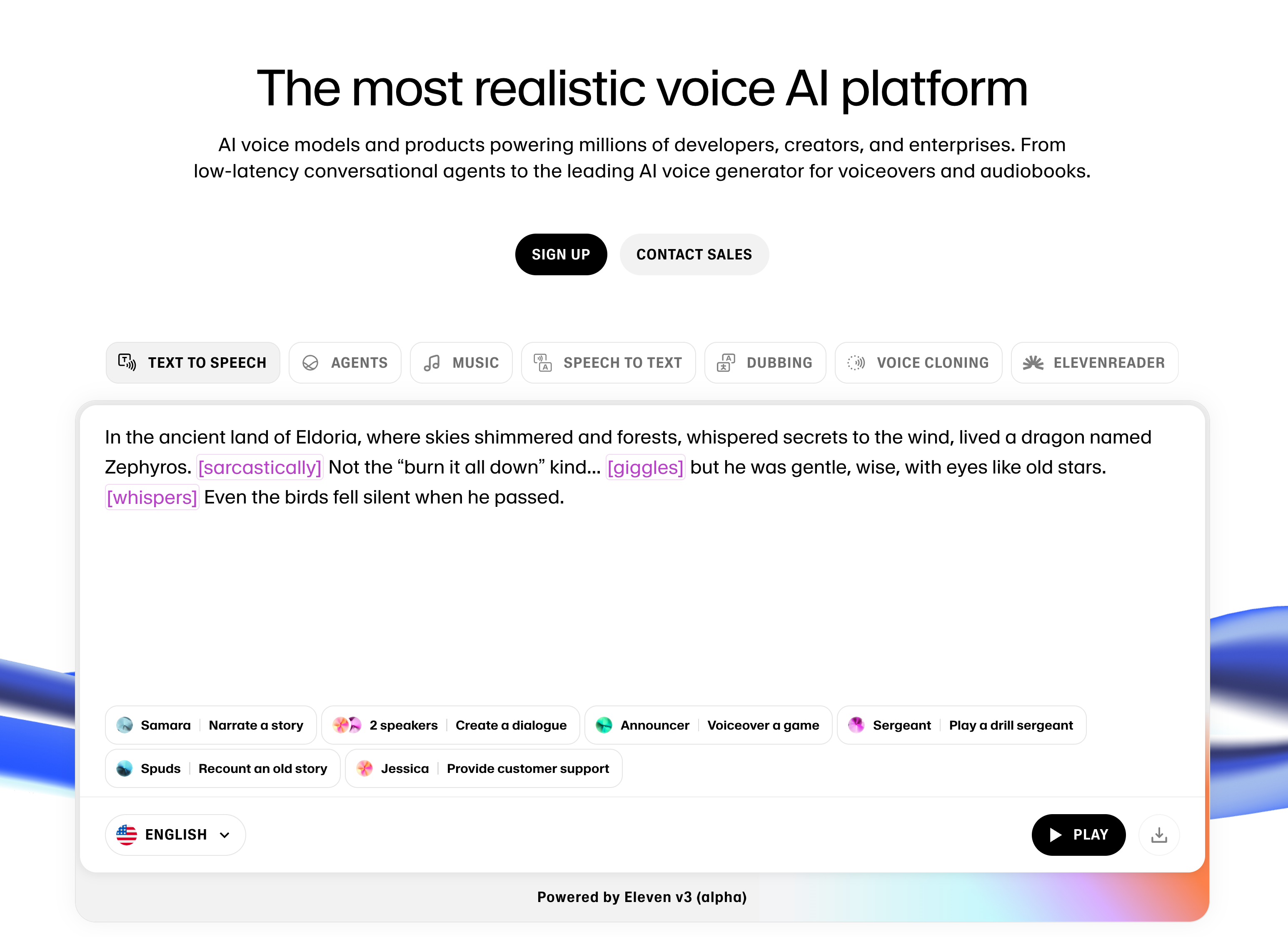
ElevenLabs delivers its technology through two main interfaces: an intuitive web platform for creators and a robust API for developers.
The Creative Suite
Core Voice Technology:
Text-to-Speech and Speech-to-Speech for generating and transforming audio
Voice Lab and Voice Cloning to create digital voice replicas or design entirely new synthetic voices
Production Tools:
Projects (formerly Studio) for creating audiobooks and long-form content with speaker assignment and chapter management
Dubbing Studio for translating and dubbing videos into 29+ languages while preserving original vocal characteristics
Expanded Capabilities:
Eleven Music and Sound Effects for generating royalty-free audio from text prompts
The Agents Platform
This newer platform represents a strategic leap. It enables developers to build, deploy, and manage conversational AI voice agents for customer support, sales, and interactive entertainment. This moves ElevenLabs from being a component provider to an end-to-end solutions platform.
By expanding from Text-to-Speech to include Speech-to-Text, music generation, creator payout systems, and agent monitoring, they’ve built deep integration. This approach increases stickiness, raises switching costs, and creates multiple revenue expansion opportunities within single accounts.
Go-to-market implications: The hybrid engine
This vertical integration isn’t merely a product strategy—it’s the foundation of their entire go-to-market approach. Rather than choosing between top-down and bottom-up enterprise sales, ElevenLabs does both simultaneously. A dedicated enterprise marketing team runs ABM campaigns, executive dinners, webinars, and events targeting senior decision-makers. Separately, a developer advocacy team builds awareness through hackathons, technical content, and community engagement.
Luke Harries (from PostHog and Microsoft) leads Growth while Carles Reina (early Uber employee) leads sales efforts. The teams have different goals but overlapping audiences—engineering managers and product leads who consume developer content but make purchasing decisions in enterprise contexts.
How ElevenLabs does Growth: Organized chaos at scale
ElevenLabs’ growth strategy defies conventional wisdom about focus. While most B2B playbooks advocate for a singular ICP and tightly integrated product suite, ElevenLabs operates what Luke Harries calls a “shared” model—treating their developer API, consumer apps, and creator tools as discrete products, each with dedicated growth teams.
The structure is deliberately bifurcated. Horizontal specialists—a former Shopify performance marketing lead, an ex-Canva SEO expert—provide channel expertise across the organization. But execution lives with product growth leads who function as mini-CMOs, owning everything from messaging to metrics for their specific product line. The enterprise marketing team alone will reach 20 people by year-end, while the mobile app growth team operates as its own five-to-ten person unit.
Launch Execution as Competitive Moat
Every major product release follows a three-tier classification system, with Tier 1 launches commanding the majority of resources. The process begins not with distribution but with rigorous messaging discipline: defining the primary value proposition (never more than one), identifying secondary benefits, and distilling everything into formats that can survive the attention economy.
The cornerstone is video—specifically motion design—where the first 30 seconds receives disproportionate focus. “Nearly all your attention for your video should be on the first 30 seconds,” Harries explains. Most launches generate 200,000 to 700,000 views, a CAC arbitrage that typically exceeds traditional paid channels. The company moved video production in-house early, recognizing that the one-week sprint from product readiness to launch required velocity that contractors couldn’t provide.
Distribution follows a saturation model. Tweet threads anchor the launch, carefully structured with hooks in the first post and CTAs in the final tweet (avoiding Elon Musk’s documented down-ranking of links in initial posts). The same core assets cross-post to X, LinkedIn, Blue Sky, Threads, Product Hunt, Reddit, and Hacker News. An internal Slack amplification channel enables the entire 200-person team to create “surround sound” in the first five minutes—the critical window when algorithms assess content quality through engagement velocity.
SEO as Product, Not Content
While traditional blog-based SEO faces an existential threat from LLMs, ElevenLabs doubled down on “tool pages”—interactive demos requiring actual engineering work. Searching “text to speech Spanish” surfaces an ElevenLabs text box where users can immediately type, select a voice, and play audio. These mini-tools, built by front-end focused growth engineers, create proprietary touchpoints that LLMs can reference but not replicate.
The metric framework prioritizes CAC to payback period over LTV ratios, with thresholds varying from 12 months for self-serve products to 36 months for enterprise deals. For enterprise specifically, the North Star became marketing-sourced sales qualified leads—prospects that marketing identified, nurtured to book an SDR call, and qualified as legitimate opportunities.
Perhaps most controversially, ElevenLabs eliminated product managers entirely. Engineers own roadmaps and ship end-to-end, tested through product challenges that assess feature prioritization, wireframing, and system architecture. Growth teams handle activation and acquisition, but stay deliberately lean to avoid “meddling” in engineering decisions. The bet: great engineers with AI-powered tools don’t need intermediaries translating user needs into technical requirements.

The sales playbook: From PLG foundation to enterprise scale
ElevenLabs’ sales strategy builds on top of the PLG foundation and highlights a calculated bet on market maturation. VP of Revenue Carles Reina describes a fundamental ICP shift that occurred in 2024: the company moved from primarily serving tech-native startups building custom orchestration layers to courting non-technical enterprises seeking turnkey solutions. “Today, the majority of companies we’re interacting with don’t want to build their own applications,” Reina explains. This transition mirrors cloud adoption patterns, compressed into an impossibly accelerated timeframe—what took a decade for AWS is playing out in under two years for generative AI.
The urgency stems from existential stakes. Mid-market logistics firms, 200-employee e-commerce operators, and healthcare systems now view AI adoption as survival-critical rather than experimental. These customers bring dramatically different economics than their predecessors: they resist API switching, sign longer contracts, and generate stickier revenue. Bertelsmann, Europe’s largest media conglomerate, exemplifies the opportunity—38 separate business units now deploy ElevenLabs technology across production, publishing, and education.
Dual-Motion Architecture
The go-to-market organization operates as two parallel engines. The Growth team owns B2C and prosumer segments, optimizing for volume and self-serve conversion. The Enterprise team pursues strategic accounts through dedicated sales cycles. Between them sits an automated handoff mechanism: product-qualified leads trigger when usage patterns or company profiles signal enterprise readiness, surfacing prospects for white-glove engagement before they churn or plateau.
This structure was deliberate insurance against the “AI tourist” phenomenon that devastated content tools in 2024. “We planned for it,” Reina notes. “We realized that if we want to build a $100 billion company, we need a pure B2B motion as soon as possible.” The decision to invest in enterprise infrastructure during hypergrowth—when PLG metrics still showed healthy expansion—contradicted conventional wisdom about not fixing unbroken systems.
Pricing as Positioning
ElevenLabs rejected investor pressure to adopt pure consumption-based pricing, opting instead for tiered commitments modeled on cloud provider economics. The credit system requires minimum monthly spending thresholds in exchange for volume discounts—a structure that provides revenue predictability for capacity planning while giving customers cost certainty. “Without barriers, it becomes a race to the bottom where nobody can predict anything,” Reina argues.
For startups under 25 employees, the company offers 11 million credits monthly for three months through a grants program that has distributed nearly 2,000 awards. The initiative seeds future enterprise relationships while generating goodwill and use cases that inform product development.
Community as Distribution
Unlike traditional enterprise software vendors, ElevenLabs maintains aggressive community programming—hackathons, webinars, case study partnerships—that blur the line between marketing and customer success. The two-sided marketplace model requires equal cultivation of voice contributors and business customers. Revenue-sharing arrangements let voice artists set their own rates (typically calculated per 50,000 credits, roughly one hour of audio), creating incentive alignment that competitors relying purely on synthetic voices cannot replicate.
The Scott-Morgan Foundation partnership, which provides free voice restoration for ALS patients, exemplifies Reina’s thesis that ecosystem value transcends immediate revenue. “This is the most rewarding thing we’ve done,” he notes—a rare admission in SaaS sales playbooks that relationship depth matters as much as pipeline velocity.
How the team is organized: Pods, autonomy, and speed
ElevenLabs’ internal structure reflects a deliberate choice to optimize for velocity over hierarchy. The company operates through “micro-teams” of 5-10 people, each granted substantial autonomy and accountability. This isn’t the typical startup claim of “moving fast”—it’s a fundamental organizational principle.
The company employs no dedicated product managers. Engineers own product development end-to-end, partnering with “product growth leads” who function as mini-CMOs for specific product areas. This structure eliminates the traditional handoffs and translations between product, engineering, and marketing that slow down most companies.
The go-to-market organization splits into two specialized units:
Growth Team (Consumer/PLG): Cross-functional unit spanning marketing, product, engineering, and developer experience. Owns:
Paid advertising
Community engagement
Developer relations
Partnerships
Entire self-serve funnel
Roles include Growth Marketer, Affiliate & Influencer Marketing, Developer Relations Engineer, PR & Communications Lead, and Startup Partnerships.
Enterprise Team (B2B Sales): Traditional sales structure scaling globally:
SDRs (outbound prospecting)
Commercial and Enterprise Account Executives
Government & Public Sector AEs
Customer Success Managers
Regional Commercial Leads
Lessons for founders: The contrarian’s advantage
Throughout this research, a recurring theme started to emerge: ElevenLabs succeeds by rejecting conventional wisdom when it doesn’t fit their reality. They launched horizontally when advisors said focus. They eliminated PMs when everyone said product management was essential. They cross-post everywhere when growth gurus advocate channel focus.
ElevenLabs’ trajectory offers several counterintuitive insights for building category-defining companies:
Vertical integration enables horizontal expansion: Owning both infrastructure and applications creates multiple sales motions that reinforce rather than cannibalize each other. The apparent contradiction—being both API provider and competitor to API customers—resolves through sheer market size and specialization.
PLG is enterprise sales infrastructure: Bottoms-up adoption isn’t an alternative to enterprise sales but the foundation for it. Product-qualified leads convert faster and retain longer than cold outbound.
Community beats Marketing: For technical products, peer validation trumps any advertising campaign. Investing in developer communities and creator ecosystems generates more authentic, sustainable growth than traditional marketing.
Pricing anchors expectations: Pure consumption models create uncertainty that slows enterprise adoption. Committed spend with volume discounts aligns incentives and enables capacity planning.
Speed through structure: Eliminating traditional product management roles and empowering engineers with full ownership accelerates innovation cycles dramatically.
This isn’t contrarianism for its own sake. It’s disciplined adaptation to genuine competitive advantages. The core lesson isn’t that ElevenLabs’ playbook works for everyone. It’s that the traditional playbook—focus, specialize, optimize—may be relics of a pre-AI era where leverage came from efficiency rather than capability expansion.
The Bottom line
ElevenLabs’ success isn’t accidental—it’s the result of deliberate strategic choices:
Starting with a simple problem before tackling the complex vision
Building a vertically integrated platform rather than a point solution
Combining product-led growth with enterprise sales
Focusing deeply on audio while others chase broader AI applications
Creating community-driven growth rather than relying on traditional marketing
The company that started with two friends frustrated by bad movie dubbing has become a $6.6 billion AI powerhouse in under three years. Their journey offers a masterclass in finding product-market fit, scaling efficiently, and building defensive moats in the competitive AI landscape.
As voice interfaces become increasingly central to how we interact with technology, ElevenLabs has positioned itself as the essential infrastructure provider—the company making AI sound genuinely human.
This analysis is based on public information, interviews, and company materials as of October 2025. Some details may have changed since publication.
Enjoying these GTM deep-dives? Don’t forget to subscribe!
Comments
Nothing yet. Say the first thing.
Sign in to join the conversation.