
👋 Welcome to AI-native GTM!
AI-native companies are re-writing the GTM playbook. On this Substack, I will highlight the stories, frameworks and patterns behind some of today’s fastest growing startups. You can expect deep dives, analysis and insights to inspire the next generation of AI-native founders and operators.
Today, we take a look at Handshake.

Year Founded: 2014
Headquarters: San Francisco, CA
Total Funding: $434M
Founders: Garrett Lord, Ben Christensen, Scott Ringwelski
Let’s dive in 👇
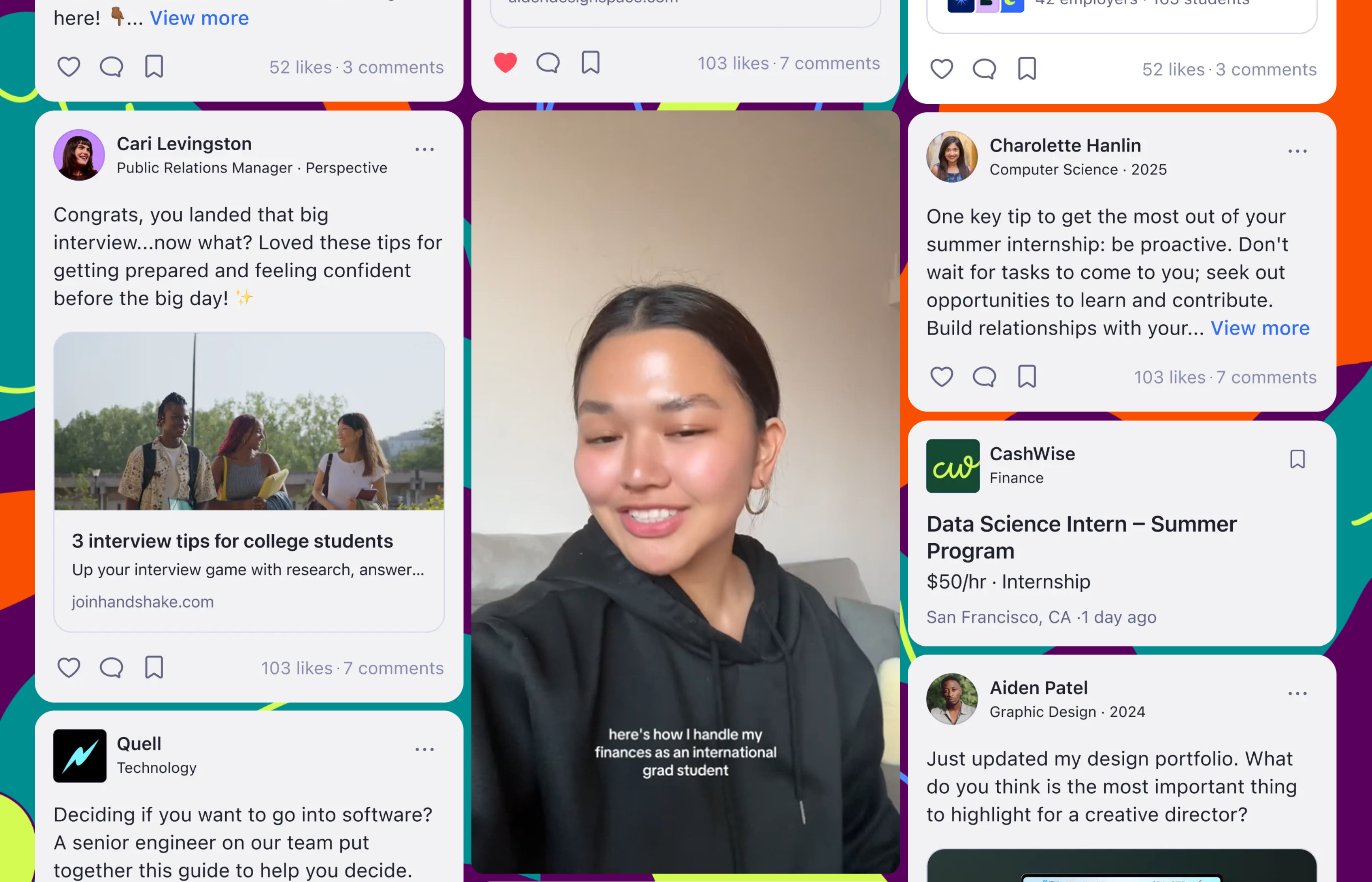
In early 2024, Handshake CEO Garrett Lord faced a choice that would define his company’s future. The platform his team had spent a decade building—connecting 20 million students at 1,600 universities with over 900,000 employers—was thriving. Every Fortune 500 company used it. The business was stable, profitable, and growing.
Then Lord did something unexpected: he essentially started a new company inside the existing one.
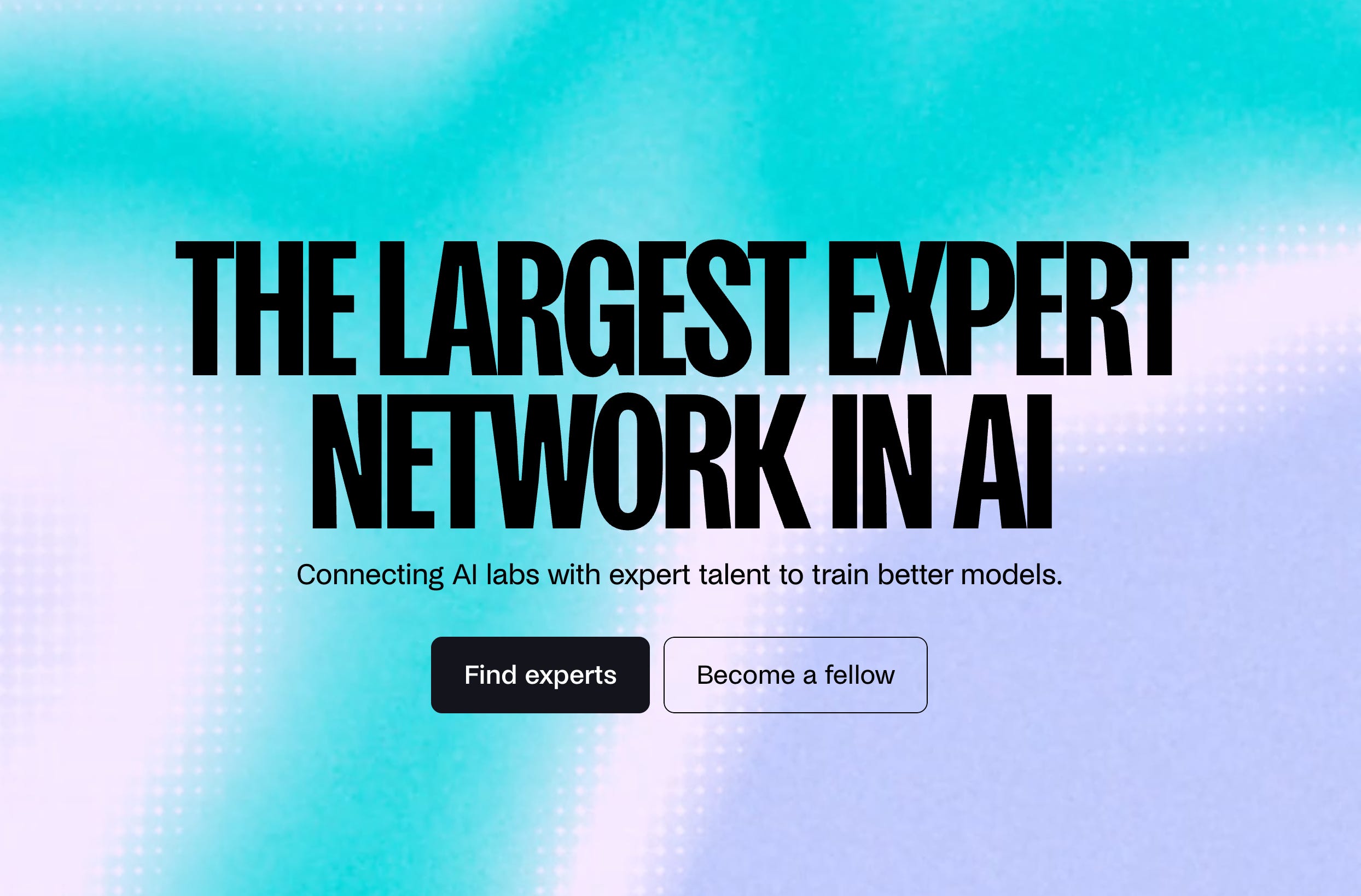
Handshake AI launched as a separate business unit dedicated to providing expert-level feedback for training frontier AI models from companies like OpenAI and Anthropic. Within eight months, this new venture hit $100 million in annualized revenue—a growth velocity almost unheard of in the software industry. By the end of 2024, Lord projected the AI unit would overtake the core recruiting business that took a decade to build.
Lord calls this strategic shift a “refounding.” But it wasn’t a random pivot. The move reveals how Handshake had quietly built something more valuable than a job board: privileged access to hundreds of thousands of verified experts, obtained at essentially zero cost.

To understand why Handshake’s AI business works, you need to understand what the company actually built over the past decade.
Before Handshake, the early career recruiting market was fragmented and inefficient. Universities used systems like Symplicity, where each school maintained its own isolated portal. If a company wanted to recruit at 50 universities, their recruiters had to log into 50 different systems with 50 different passwords. For students at less prestigious schools, this meant limited visibility to national employers who couldn’t justify the administrative burden.
Handshake’s co-founders solved this by targeting the gatekeepers: university career centers. Lord and his team executed what they called the “Ford Focus” strategy—literally driving from campus to campus, meeting with career services directors in person. They sent personalized care packages (mugs with the director’s alma mater logo, for example) to secure meetings.
The pitch was simple but powerful: join a unified network that would give your students access to thousands of employers nationwide. By aggregating schools onto a single platform, Handshake created immediate value for employers who could now access talent from any university through one login.
This approach solved the classic marketplace “chicken and egg” problem by locking down the supply side first. Once a university signed on, Handshake achieved near-total penetration of the student body almost instantly. Universities integrated the platform into their single sign-on systems and often made it mandatory for scheduling career counseling or attending job fairs. Student acquisition cost: essentially zero.
The results speak for themselves. Handshake secured partnerships with 1,600 universities and grew to 20 million student users. More importantly, this network became a durable moat with very low churn—universities rarely switch career platforms once they’re embedded in campus operations.
While students and universities provided the supply, employers provided the revenue. And Handshake built a sophisticated operation to extract maximum value from corporate recruiting budgets.
The business model follows a classic freemium approach. Most of the 900,000+ employers on the platform use the free “Core” product, which allows basic job posting and limited outreach to students. The real money comes from converting these users to paid tiers.
The flagship enterprise product is the Talent Engagement Suite (TES). At roughly $12,000 annually, it transforms Handshake from a passive job board into an active recruiting weapon. TES allows recruiters to segment students by more than 50 data points—major, GPA, participation in diversity organizations, location preferences—and send automated, personalized email campaigns. For large companies trying to meet diversity hiring goals, this capability is invaluable.
To sell these high-value contracts to Fortune 500 companies, Handshake adopted enterprise sales methodologies. The team uses MEDDIC (Metrics, Economic Buyer, Decision Criteria, Decision Process, Identify Pain, Champion) to qualify deals and navigate complex buying committees involving HR executives, CFOs, and Chief People Officers.
They also employ the “Challenger Sale” approach, which involves teaching prospects something new about their business. Since Handshake often competes against legacy recruiting behaviors—like CEOs who only want to hire from their alma mater’s “core school” list—sales reps use data to prove that this approach is biased and inefficient. They demonstrate that talent is distributed equally even if opportunity isn’t.
Behind the scenes, Handshake operates a best-in-class revenue operations stack: Salesforce as the CRM, Outreach.io for high-volume prospecting, Gong for conversation analytics to coach sales reps, and Matik to automatically generate quarterly business review presentations that prove ROI to enterprise clients. This infrastructure ensures sales efficiency and data integrity across the entire customer funnel.
By 2023, companies building frontier AI models faced a critical bottleneck. They had exhausted high-quality public data for pre-training their models on the internet. The next phase—post-training, where models learn reasoning and alignment—required something different: expert human feedback.
Generalist data labelers, the workforce that companies like Scale AI had relied on for years, weren’t sufficient anymore. When you’re trying to teach an AI to solve complex physics problems or evaluate legal arguments, you need actual physicists and lawyers to provide feedback. But recruiting verified experts is expensive and time-consuming.
This is where Handshake’s decade of patient network building paid off in an unexpected way.
The platform’s database contained 500,000 PhD candidates and 3 million master’s students with verified academic credentials from their universities. While competitors like Scale AI had to spend heavily on marketing to recruit a physics PhD to label data, Handshake could activate that same PhD with a push notification or email—at zero marginal customer acquisition cost.
This structural advantage allowed Handshake to undercut competitors on price while paying labelers more (ensuring quality). A PhD working with Handshake AI might earn $40-$125 per hour, significantly more than typical data labeling wages. Yet because Handshake’s customer acquisition cost was near zero, the unit economics still worked.
Lord called this “structural arbitrage”—leveraging an existing asset in a new market where it has disproportionate value.
Making this pivot wasn’t just about launching a new product. It required fundamentally restructuring the company.
Lord bifurcated operations into two distinct entities. The core recruiting business continued as a stable, mature SaaS operation. Handshake AI operated as a “startup within a startup,” with Lord personally recruiting technical leadership and enforcing what he called “founder mode”—a high-intensity culture focused on speed and execution.
The AI unit scaled from 15 to 150 employees rapidly. To fund this growth and realign talent, Handshake laid off approximately 15% of its workforce (about 100 people) from the core business. Lord explicitly framed this as a move to “grind hard and move fast,” signaling a departure from the comfortable culture that can develop at mature unicorn companies.
The financial results validated the risk. Handshake AI went from zero to $50 million in annualized revenue in four months. The company projected it would surpass $100 million in its first year—a trajectory that eclipsed the growth rate of the original business.
Convincing students to do data labeling work required careful positioning. The traditional data labeling industry has a reputation for being low-paid gig work. Handshake needed to reframe the opportunity.
The company marketed the AI work not as labeling but as a prestigious “Fellowship.” They addressed student anxiety about AI displacing jobs by positioning the fellowship as a way to build “future-proof” skills. By working as an expert trainer, students learn prompt engineering and model evaluation—skills that act as an “Iron Man suit,” making them more productive in their future careers.
Unlike anonymous labeling platforms, Handshake fostered community among its “AI Fellows,” organizing webinars and leaderboards to create professional development opportunities and belonging.
For the core business, marketing focused on demand generation through content. The “Handshake Network Trends Report” mines proprietary platform data (Gen Z migration patterns, gender pay gaps for interns) to generate media coverage and create gated content that feeds the sales pipeline. The “Early Talent Awards” recognize top employers, creating a viral loop where winners like PepsiCo and Merck promote their Handshake status, driving backlinks and platform validation.
Handshake now competes in two distinct markets, each with its own dynamics.
In early career recruiting, LinkedIn remains the primary threat despite having 1 billion users. LinkedIn struggles with students who lack work history, while Handshake’s profiles emphasize coursework and skills—a better signal for early talent. Symplicity, the legacy incumbent, still holds market share but has lost the cultural battle for Gen Z engagement and lacks Handshake’s network effects.
In AI data labeling, Handshake directly competes with Scale AI, Surge AI, and Labelbox. Scale AI dominated the market up to their acquisition by Meta, but historically relied on lower-cost, generalist labor in developing markets. Surge AI took a different approach and focused on expert labelers - see past article on the topic. Handshake’s differentiation is trust and verification. Because users are verified by their universities through .edu emails and registrar integration, Handshake can guarantee that a “Physics Expert” is actually a PhD candidate at MIT. Competitors relying on self-reported credentials face higher fraud risks.
However, strategic risks remain. If synthetic data generation improves significantly, demand for human expert feedback may plateau. Handshake is betting that human reasoning will remain a scarce resource for the medium term (5-10 years). There’s also a risk that universities might view the AI labeling business as commercializing their students or distracting from studies. Handshake mitigates this by framing it as educational “experiential learning” and ensuring high pay rates.
Handshake’s go-to-market success relies on a tightly structured sales organization that mirrors its segmented market approach.
At the top of the funnel, Sales Development Representatives (SDRs) focus on outbound prospecting, maintaining a 1:2 or 1:3 ratio with Account Executives to ensure sufficient pipeline coverage. Account Executives are strictly segmented: SMB AEs handle high-velocity, transactional sales of the Plus plan to smaller employers, while Enterprise AEs and Strategic Account Directors manage Fortune 500 relationships through multi-threaded sales cycles lasting 6-12 months.
Customer Success Managers (CSMs) are critical given the TES product’s complexity, which requires integration with applicant tracking systems like Workday or Greenhouse. CSMs handle implementation, drive user adoption, and manage renewals. For enterprise clients, they’re often aligned by industry vertical to provide specialized advice.
The sales motion for Handshake AI represents a departure from the core business. Instead of selling software to HR departments, the team sells data contracts to technical leads at AI labs. Engagements typically start with a paid pilot ($100,000-$500,000) to prove quality. If the data improves the model’s performance on key metrics, contracts expand rapidly to multimillion-dollar recurring arrangements. Lord noted that these buyers prefer communicating via Slack rather than traditional sales calls, requiring more technical sellers who can speak the language of model evaluation.
Handshake’s success isn’t just about sales processes—it’s fundamentally enabled by technical architecture decisions made years ago.
At the platform’s core is a unified identity graph. Unlike Symplicity, where a student’s profile exists only within their university’s isolated instance, a Handshake profile is global. This means a student from the University of Florida can be visible to an employer in Seattle who’s never heard of their school. This architectural choice is the technical foundation of Handshake’s “democratization” value proposition.
The platform employs relevance algorithms similar to Netflix or TikTok. The job feed and recommendations are personalized based on a student’s behavior, major, and stated interests. This increases application conversion rates—a critical metric Handshake uses to prove ROI to employers. If an employer sends 100 messages and gets 30 applications, they renew. If they get zero, they churn. The matching algorithm is effectively the retention engine.
Handshake has also invested heavily in integrations with applicant tracking systems like Greenhouse, Workday, and iCIMS. When a student applies through Handshake, their data flows directly into the employer’s existing workflow, reducing friction. For the AI business, the company is building APIs to pipe expert feedback directly into training pipelines, evolving from a human services model to API-based infrastructure.
Handshake’s transformation offers a case study in strategic adaptation. The company spent a decade grinding through an unglamorous market—higher education career services—to build a defensible asset. When the market shifted with the emergence of generative AI, Handshake didn’t rest on its achievements. Instead, it weaponized that asset to attack an entirely new, high-value market.
The “refounding” is a high-stakes bet. By diverting focus and top talent to the AI business, Handshake risks neglecting the core recruiting platform that serves as the foundation for everything. The company laid off 15% of its workforce to fund the pivot, and maintaining excellence across two distinct businesses with different customers, sales motions, and competitive dynamics is extraordinarily difficult.
Yet in today’s winner-take-most economy, the risk of stagnation may be greater than the risk of execution failure. With a projected combined annual revenue of over $300 million by the end of 2025, Handshake is well on its way to secured a path for a potential IPO and a valuation far exceeding the $3.5 billion mark.
The company is making a bold bet: that it can become the primary labor market infrastructure for both the human economy (jobs) and the synthetic economy (AI training). If successful, Handshake will emerge as one of the most consequential companies of the AI era—not because it built the best algorithm or recruited the best PhDs, but because it spent ten years patiently building trusted relationships with universities that no competitor can easily replicate.
That network, built one Ford Focus road trip at a time, has become the moat that matters most.
—
Company Overview:
• Valuation: $3.5 billion
• Users: 20 million students
• University partners: 1,600
• Employer users: 900,000+ (including 100% of Fortune 500)
Revenue Milestones:
• Core business: ~$150-200 million annual revenue (estimated)
• Handshake AI: $0 to $50 million annualized revenue in 4 months
• Handshake AI: On track for $100+ million in first year
• Combined projected revenue: $300 million by end of 2024
AI Business Assets:
• 500,000 PhD candidates with verified credentials
• 3 million master’s students
• Pay range for expert labelers: $40-$125/hour
• Growth: 15 to 150 employees in 8 months
Revenue Operations Tech Stack:
• CRM: Salesforce
• Sales engagement: Outreach.io
• Conversation analytics: Gong
• QBR automation: Matik
Sales Methodologies:
• MEDDIC (Metrics, Economic Buyer, Decision Criteria, Decision Process, Identify Pain, Champion)
• Challenger Sale (Teach, Tailor, Take Control)
• Land and Expand (for AI business)
Key Competitors:
• Core business: LinkedIn, Symplicity
• AI business: Scale AI, Surge AI, Labelbox
This analysis is based on public information, interviews, and company materials as of November 2025. Some details may have changed since publication.
Comments
Nothing yet. Say the first thing.
Sign in to join the conversation.