
What has become increasingly obvious across the accounting profession is that firms are not struggling because they lack interest in AI. They are struggling because they have not yet built the operating cadence required to absorb change at the pace the market is now moving.
Conference season will only amplify this dynamic over the next few months. Every event will be filled with AI messaging, new products, bold claims, and firms trying to figure out what matters versus what is simply noise. But the firms that actually make progress this year are probably not the ones taking the most notes in sessions. They are the firms that already have mechanisms established internally for turning signal into operational movement.
That sounds simple, but it is where a massive amount of innovation debt is starting to surface inside firms.
A lot of organizations spent the last two years experimenting around the edges - they enabled copilot, rolled out a few AI tools, or built workflow automations. Most firms now have pockets of activity happening across the organization. But what many still do not have is a clear operational structure for how decisions get made, how priorities get evaluated, how experimentation moves into production, or how AI initiatives connect back to broader business model goals.
And that distinction matters more than people think, because AI is not really the strategy. AI is in fact collapsing time required to execute work, generate output, move information, and make decisions. The real strategy is what firms choose to do with the capacity and leverage that AI creates.
Some firms will simply use it to push more work through the same model faster. Others are using this moment to rethink client experience, pricing structures, talent models, service delivery, staffing leverage, and the role the firm actually wants to play over the next decade. Those are two very different approaches to the allocation of their portfolio of time.
One of the patterns I continue to see among firms that are making real progress is that they are spending far less time debating whether AI matters, and far more time building operational rhythm around modernization itself. They are focused on workflow redesign, governance structures, evaluation processes for tools and infrastructure, and they are identifying bottlenecks created by legacy systems (as well as legacy thinking!) simultaneously.
In other words, they are building the absorption mechanism while much of the profession is still chasing individual use cases.
That is why so many firms currently feel overwhelmed. The issue is not a lack of information — the profession has more access to information than ever. Information overload! The issue is that most organizations were not designed to metabolize this much technological change so quickly. My dear friend and colleague, Pascal Finette, just launched a book on this called Outlearn. It’s fantastic and I highly recommend for leaders who want to understand the art of learning faster than the world can change.
And that is the real work ahead over these next few months. Not chasing every AI announcement, and definitely not launching twenty disconnected pilots. The real work is building a cadence inside the firm that can continuously evaluate change, operationalize what matters, and connect technology decisions back to actual business outcomes; all while being diligent in security and risk assessments.
Because eventually the competitive divide is not going to be between firms that use AI and firms that do not. It is going to be between firms that built the organizational capacity to adapt continuously to change, responsibly.
~Kacee Johnson, Executive Director
P.S. If you are interested in this topic, Joe Woodard flipped the script and interviewed me for a podcast where we talked all about how AI is Collapsing Time. Listen here.
Speaking of AI strategy - this latest episode of the AI Native Accounting Podcast is one of the most candid conversations we’ve recorded.
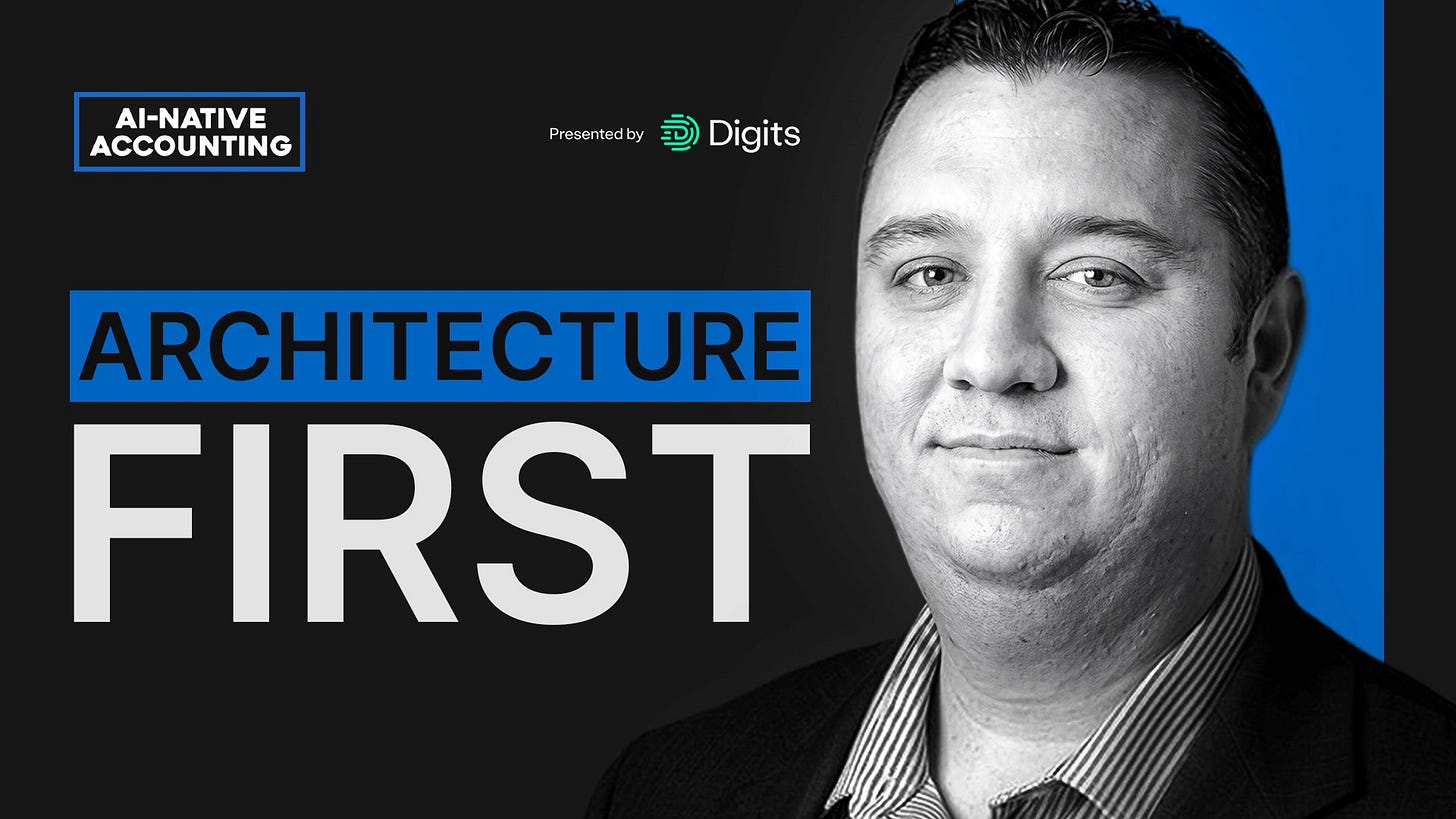
I sat down with Tom DeMayo, Partner at PKF O’Connor Davies, who walked through — in real detail — what a Top 20 firm’s AI playbook actually looks like. How the governance council was stood up. What the policy on public models is and why. The use cases that worked, and the ones they paused or killed.
A few things we got into:
• Stop chasing tools — order of operations matters more than tool selection
• The next shift coming for accounting roles
• AI beyond the billable hour
• Why a cybersecurity background changes how you build AI governance
Tom came up through cybersecurity before moving into AI leadership at the firm. That lens shapes everything PKF has built, and it shows.
Stream it now on YouTube or your favorite podcast platform. CPE available via Earmark. Listen to Architecture First here.
If you’re wrestling with where to start on AI upskilling for your team, the AICPA & CIMA’s new AI Skills Accelerator is worth a serious look.
It’s structured around the right premise: that AI transformation is 80% people and 20% technology, and that closing the skills gap is more urgent than picking the next tool. The program is offered in three tiers: Operational (productivity and automation), Transitional (core AI competencies), and Strategic (leadership and governance) — so you can pull what fits your role or build a journey across the full team.
Take it à la carte or as a bundled program with 40+ CPE hours of learning. Topics cover core AI concepts, emerging tech and future trends, leadership and strategic planning, critical thinking, ethics and governance, and productivity.
This is exactly the kind of program we’d love to see more of in the profession. Learn more at: https://blionline.org/ai#bundle
Nominations for the inaugural AINA Awards are officially closed. Thank you to everyone who submitted, nominated a peer, or championed a firm. We received an extraordinary response, and the Advisory Council is deep in review.
Winners will be announced live at the Scaling New Heights Conference directly before the Monday morning keynote. If you’re attending, don’t miss it. If you’re not, follow along on LinkedIn — we’ll publish the full list of winners and the stories behind their innovation shortly after.
May - I’m excited to join the panel on Enterprise AI at Black Ore’s AI Tax Summit on May 21st at the Nasdaq Tower in New York City. If you would like to attend, request an invite here.
June - We’re hosting a live podcast recording during the Scaling New Heights conference with special guest, Anthony Pugliese - President & CEO of the IIA. Space is limited, and seats are by invitation. If you’d like to be included, contact us to let us know that you’ll be there and we’ll get you on the list.
The work of the Foundation is made possible by organizations that believe the profession deserves independent education, research, and responsible AI implementation. Our sponsors are not just technology providers, they’re partners in advancing how the profession learns and adopts AI. We’re grateful to Ignition for joining the ecosystem and standing behind that mission.

Ignition is the leading revenue and billing automation platform for firms and agencies to transform their sales, billing and payment processes. Ignition automates proposals, engagement letters, invoicing, payments and workflows in a single AI-powered platform, empowering 8,500+ businesses to sell, bill and get paid for their services with ease.
To learn more about Ignition, and the full list of organizations supporting the Foundation, visit our Ecosystem page.
With conference season in full swing, we asked our Advisory Council a simple question:
“What are you most excited to learn about or see this conference season?”
Joe Woodard: Regarding your question, I’m most excited to see how Anthropic, OpenAI, Gemini and other GPTs are going to work with various GL solutions, given various partnership announcements over the past year, and how working with these models will differ from the custom models that companies like Digits and Campfire have built. Microsoft has some features that are interesting with CoPilot and Dynamics too.
Barry Brown: What I’m most excited about is watching vendors move past the announcement phase. The AI capabilities are real now. The question is who’s actually embedding them into accounting workflows in ways that change how work gets done, not just how it’s described.
Ellen Choi: First, I want to hear real implementation and scaling stories. Last year was heavy on awareness and experimentation. This year I’m looking for firms that can talk about how they systematically elevated their operations with AI. The gap between firms that are piloting and firms that are operationalizing is getting wider.
Second, the client side of AI. Clients are using Claude, ChatGPT, and other tools to answer their own questions, draft their own financials, and start looking at what they’re paying their accountant for. That changes the pricing conversation and the advisory opportunity at the same time and I’m curious to hear directly from practitioners on the dynamics they are seeing.
Randy Johnston: I want to know what firms are concerned about. I think it is less about security and AI and more about operations and workflow on core services.
Arianna Campbell: For me, building relationships is the most valuable part of conference season. With AI accelerating change in so many areas, there is even more emphasis on the value of authenticity and genuine person-to-person connection. It is a great opportunity to connect with both familiar and new faces, and I always leave energized by the conversations and ideas that are shared.
Got a question or topic suggestion? Comment on Substack or connect with us on LinkedIn!
Comments
Nothing yet. Say the first thing.
Sign in to join the conversation.