
Let me be honest: most people still use Perplexity like a faster version of Google.
They ask a question, get a detailed answer with 20 sources, read a few points, save a few links, and then move on. And yes, that works if all you need is a quick answer, and even I do the same.
But if you are researching something complex like a business idea, choosing an expensive product, planning a career move, learning an industry, or making an important decision, you need more than a good-looking answer with citations.
But the problem now is that there is too much content available on the internet. You can find 50 articles supporting one idea, 20 Reddit threads saying the exact opposite, five of your favorite YouTube creators with conflicting opinions, and a hundred AI-generated posts confidently telling you what to do.
And after spending 3 hours researching, you may have more tabs open but get overwhelmed about what to go through, how to combine them, which source to trust, and so on.
That is where you can use Perplexity and NotebookLM together like I do:
Perplexity is extremely good at finding current information, discovering sources, identifying competing viewpoints, and helping you explore a topic quickly by providing you with a solution.
And NotebookLM is better for preserving the sources you actually trust, comparing what they say, finding disagreements, connecting ideas, helping you to understand through quizzes, audio, video overview, and even answering questions based only on the information you selected.
And in this post, I’m going to show you 9 practical ways I use Perplexity + NotebookLM to get some complex work done.
Sure, this will take time and effort since this isn’t a generic post, but you will get what you want by spending much less time than you expect.
Note: In the workflows below, I used Perplexity to get the best sources with a specific prompt. And then I copied the generated content from Perplexity, along with the sources, after going through each one of them to validate them myself, and uploaded everything to NotebookLM to understand, question, and compare the needed information in the best and easiest way possible.
With that said, let’s get started.
Most of you simply go to ChatGPT and ask: “Is there demand for an AI tool for X?”
And what you get is simply a nice but generic answer about market growth, trends, competitors, and opportunities.
And you feel validated, but the problem is that “people are talking about it” does not mean people will pay for it. A live example is that I’m seeing tons of AI tools being launched every day, sponsored content about AI tools, but most of them go in vain since there is not a specific problem or proper need for them.
That’s where you can use Perplexity to find real demand signals, then use NotebookLM to separate those signals from hype.
Here’s the workflow:
Use Perplexity to find customer complaints, bad reviews, Reddit discussions, G2/Capterra reviews, job posts, support threads, feature requests, pricing pages, and existing alternatives related to the problem you want to solve.
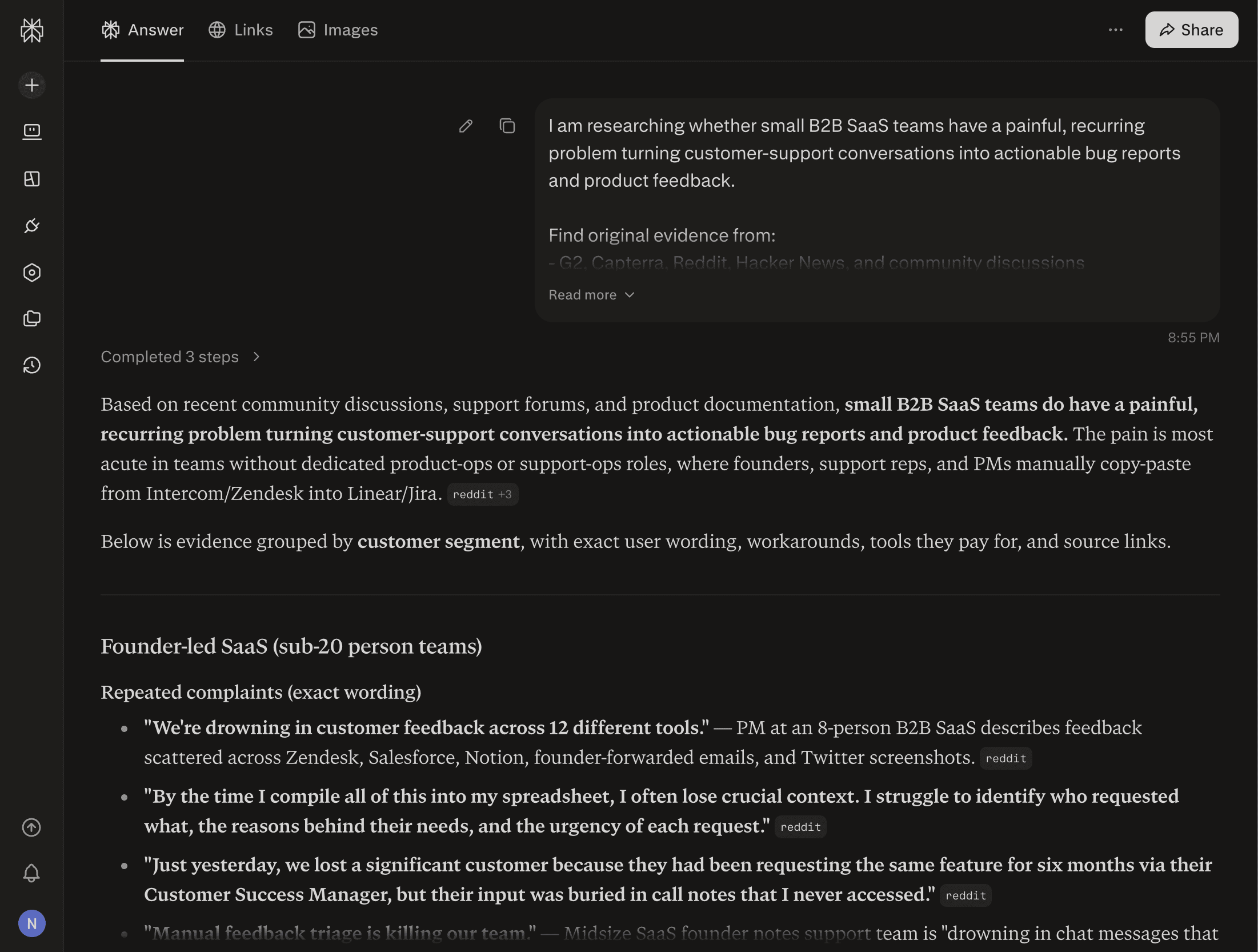
Here’s the prompt I used for the above example:
I am researching whether small B2B SaaS teams have a painful, recurring problem turning customer-support conversations into actionable bug reports and product feedback.
Find original evidence from:
- G2, Capterra, Reddit, Hacker News, and community discussions
- public feature requests and support forums for Intercom, Zendesk, HubSpot, and Linear
- job posts mentioning customer-feedback analysis, support operations, or product-ops work
- pricing pages and case studies for existing feedback-management tools
I do not want market-size estimates or generic “AI is growing” claims.
Show repeated complaints, the exact wording users use, current workarounds, tools they pay for, and links to the original sources. Group results by customer segment: founder-led SaaS, support teams, and product teams.
And no doubt, you can ask more questions like:
What are people currently using to solve this problem?
What do they complain about repeatedly?
What workarounds are they building?
What do they pay for already?
Which customer segment seems to feel this problem most intensely?
What is expensive, slow, frustrating, or broken in the current process?
But please don’t go with a generic answer like: “Is this a good idea?” since it won’t bring the right data or information that you need.
Then copy-paste and save the strongest sources in a NotebookLM notebook. Sure, you can even upload your own ideas, sources, and other info.
I’ve uploaded a couple of sources along with the content Perplexity generated inside NotebookLM and gave the prompt below:
Based only on these sources, identify the three most repeated and expensive problems in the support-feedback-to-product workflow.
For each problem, show:
1. the exact customer language,
2. who experiences it,
3. their current workaround,
4. what they already pay for,
5. evidence that it is painful enough to solve.
Then tell me which problem is most suitable for a narrow first product, and what assumptions still need direct customer interviews.
Here’s what it generated:
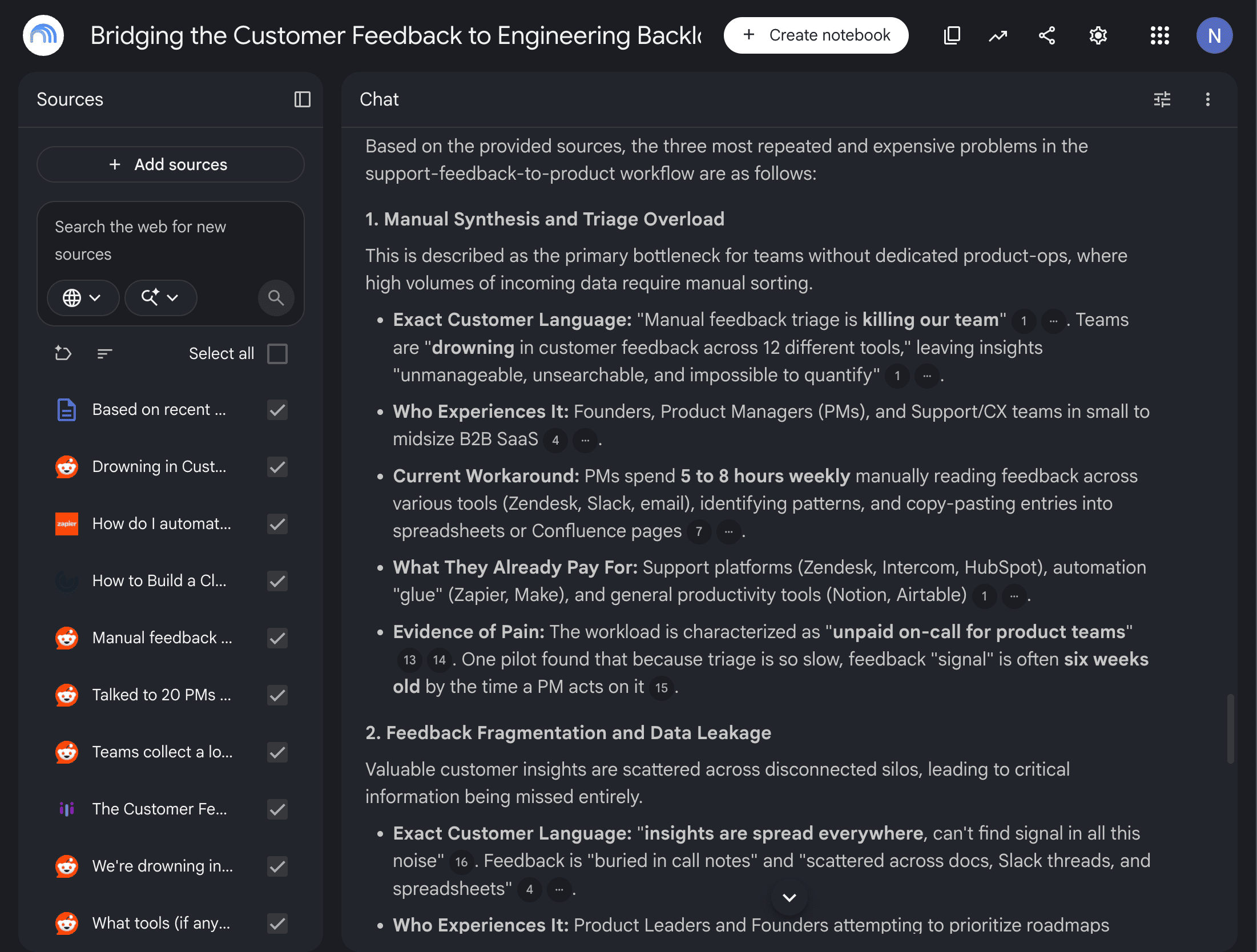
My main intention using NotebookLM is to identify the exact problems customers repeatedly describe, the alternatives they are already paying for, and the evidence that this is a real pain.
And then, with my best sources uploaded, I can further generate a customized podcast, video overview, mind map, reports, quizzes, and more to understand and learn about a problem deeply.
The takeaway: If you are researching a business idea, then this workflow is way better than you can think, helping you find a problem that actually needs to be solved and that people will pay for.
Let’s be honest, we all want to buy something like a car, laptop, camera, phone, course, home appliance, software subscription, or expensive service.
But somehow, finding the best products turns into 40 YouTube videos, 15 comparison articles, Reddit threads, review sites, and someone in the comments saying that everything is terrible.
But after consuming all of that information, you still do not know what to buy. That is because most reviews are sponsored, and others are made around the reviewer’s priorities, not yours.
A camera reviewer may take a good fee and say something good about a bad product.
Or a laptop reviewer may care about benchmark scores. You may just want something quiet, reliable, and good enough for the work you do every day.
That’s where again you can use Perplexity + NotebookLM to get the best answer.
Here’s the workflow:
Use Perplexity to find current product options, official specifications, long-term reviews, customer complaints, repairability information, warranty terms, pricing history, and alternatives.
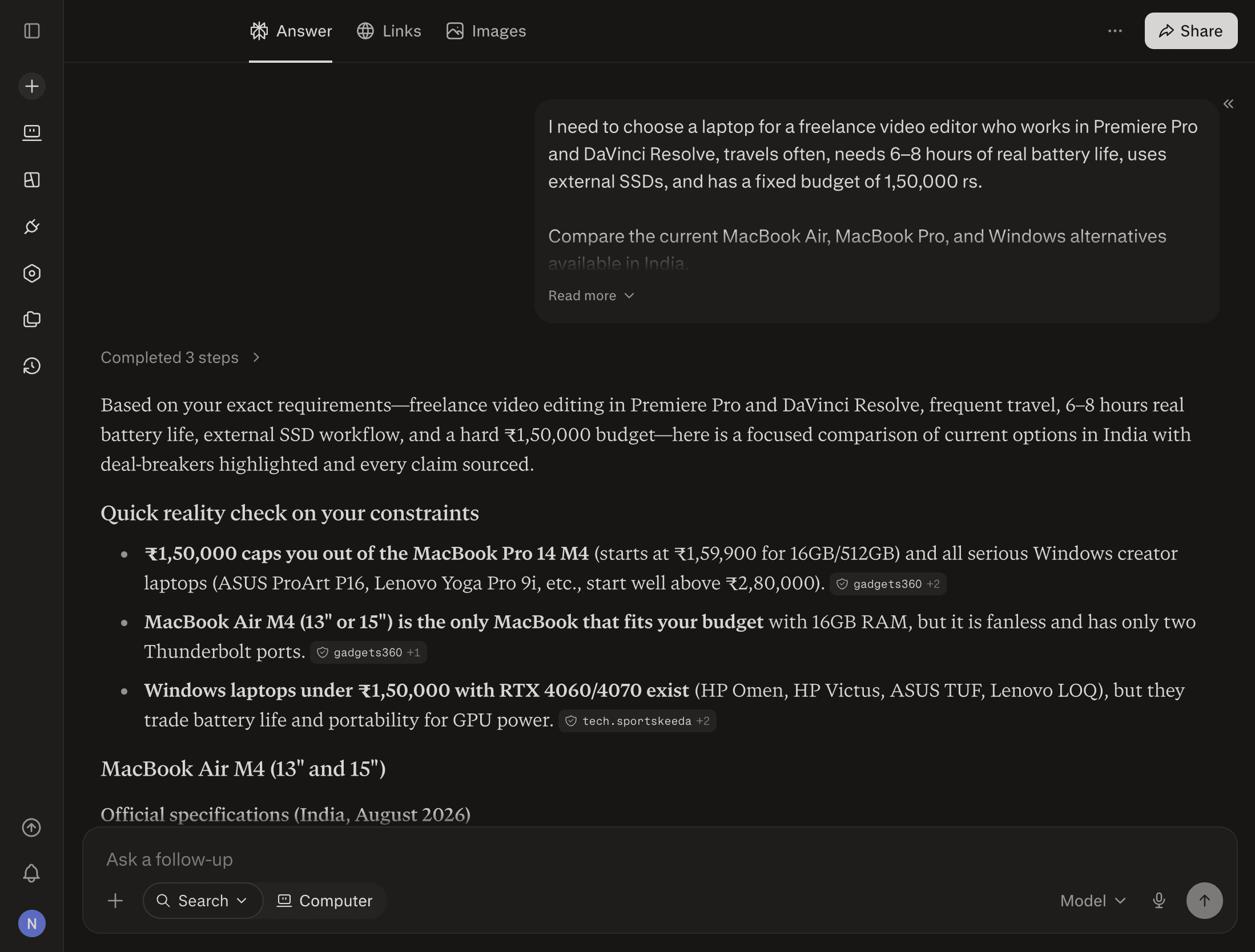
Here’s the prompt I used for the above example:
I need to choose a laptop for a freelance video editor who works in Premiere Pro and DaVinci Resolve, travels often, needs 6–8 hours of real battery life, uses external SSDs, and has a fixed budget of [budget].
Compare the current MacBook Air, MacBook Pro, and Windows alternatives available in [country].
Find:
- official specifications and warranty terms,
- independent long-term reviews,
- sustained performance and thermal tests,
- repairability and port limitations,
- recurring user complaints after 6+ months,
- current pricing and configuration differences.
Do not rank a universal “best laptop.” Focus on deal-breakers for this exact use case and link every original source.
And then I saved the official product pages, independent reviews, user discussions about recurring problems, and any comparisons that seemed useful into NotebookLM, and asked:
I need to choose a laptop for a freelance video editor who works in Premiere Pro and DaVinci Resolve, travels often, needs 6–8 hours of real battery life, uses external SSDs, and has a fixed budget of 1,50,000.
Compare the current MacBook Air, MacBook Pro, and Windows alternatives available in India.
Find:
- official specifications and warranty terms,
- independent long-term reviews,
- sustained performance and thermal tests,
- repairability and port limitations,
- recurring user complaints after 6+ months,
- current pricing and configuration differences.
Do not rank a universal “best laptop.” Focus on deal-breakers for this exact use case and link every original source.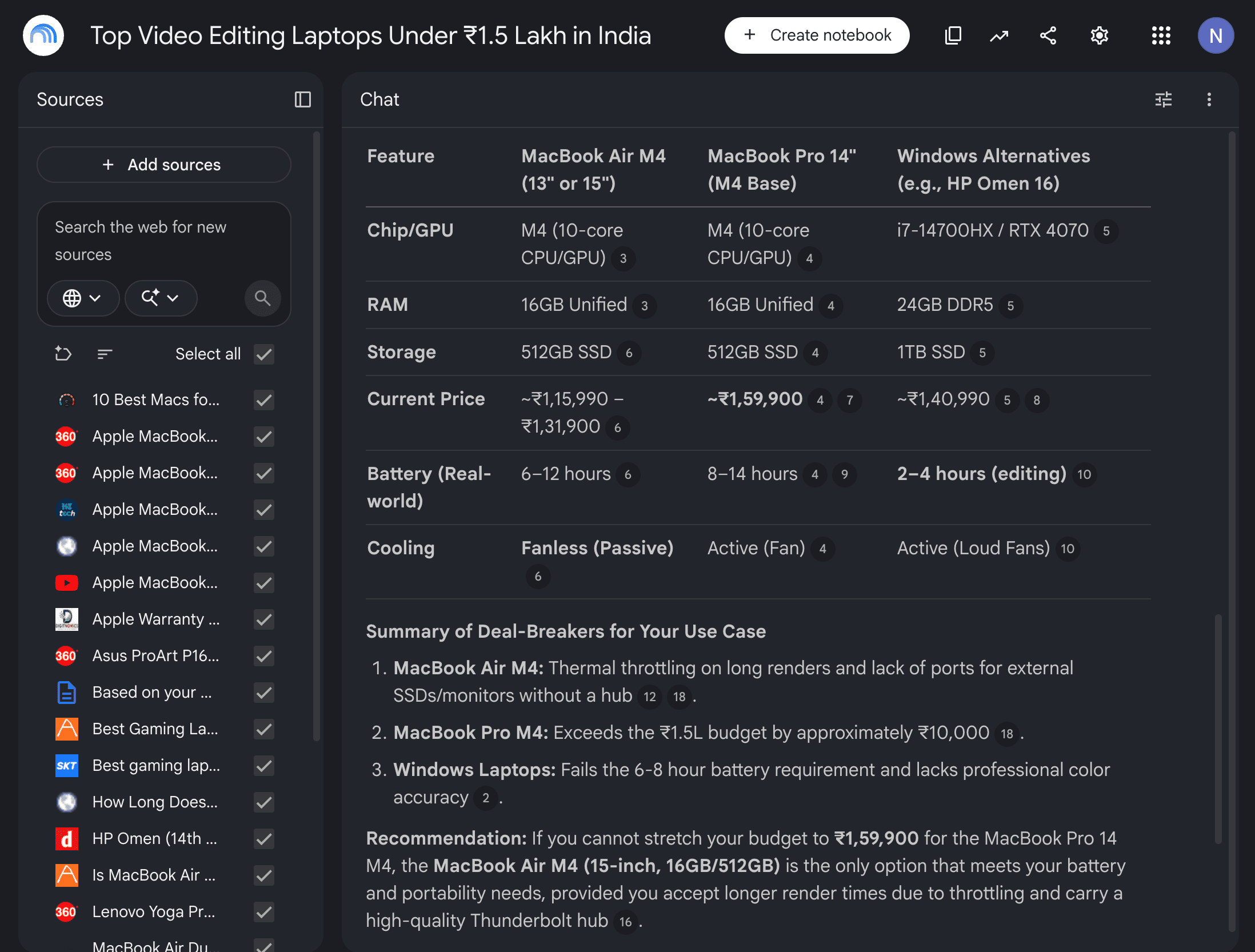
You can further ask: Based only on these sources, which option has the fewest deal-breakers for my use case?
The takeaway: This workflow is much better than asking some generic questions like, “Which one is best?” Because “best” does not exist, but the option with the fewest compromises for your life does.
Just so you know:
Everything in this post is something I actually use, but it’s only a small part of my complete AI workflow.
Over the past few months, I’ve built a practical system that helps me learn faster, research smarter, create content consistently, validate business ideas, automate repetitive tasks, and save hours every single week.
I’ve packaged everything inside “The AI Leverage System”.
Inside, you’ll find the exact workflows, prompts, templates, and step-by-step systems I use daily, so you don’t have to figure everything out from scratch or waste time jumping between random YouTube videos and blog posts.
You can spend months reverse-engineering this on your own, or you can get the exact system I use right now.
Now suppose you want to understand the creator economy, AI agents, chip making, cybersecurity, real estate, or any other industry.
Most of you will begin by watching YouTube videos or reading opinion threads from people who may or may not understand the industry themselves.
And after a few weeks, you may know a lot of buzzwords but still cannot explain how the industry actually works, how to actually get into it and make money, what customers care about, why companies compete, or where the opportunities are.
That’s because video summaries are useful, but they should not become your entire education.
And that’s where you can use this workflow:
Use Perplexity to find primary sources related to the specific industry with info like:
Company annual reports and investor presentations
Earnings-call transcripts and government reports
Industry associations and research papers
Product documentation and market reports
Job descriptions, customer reviews, and interviews with actual operators
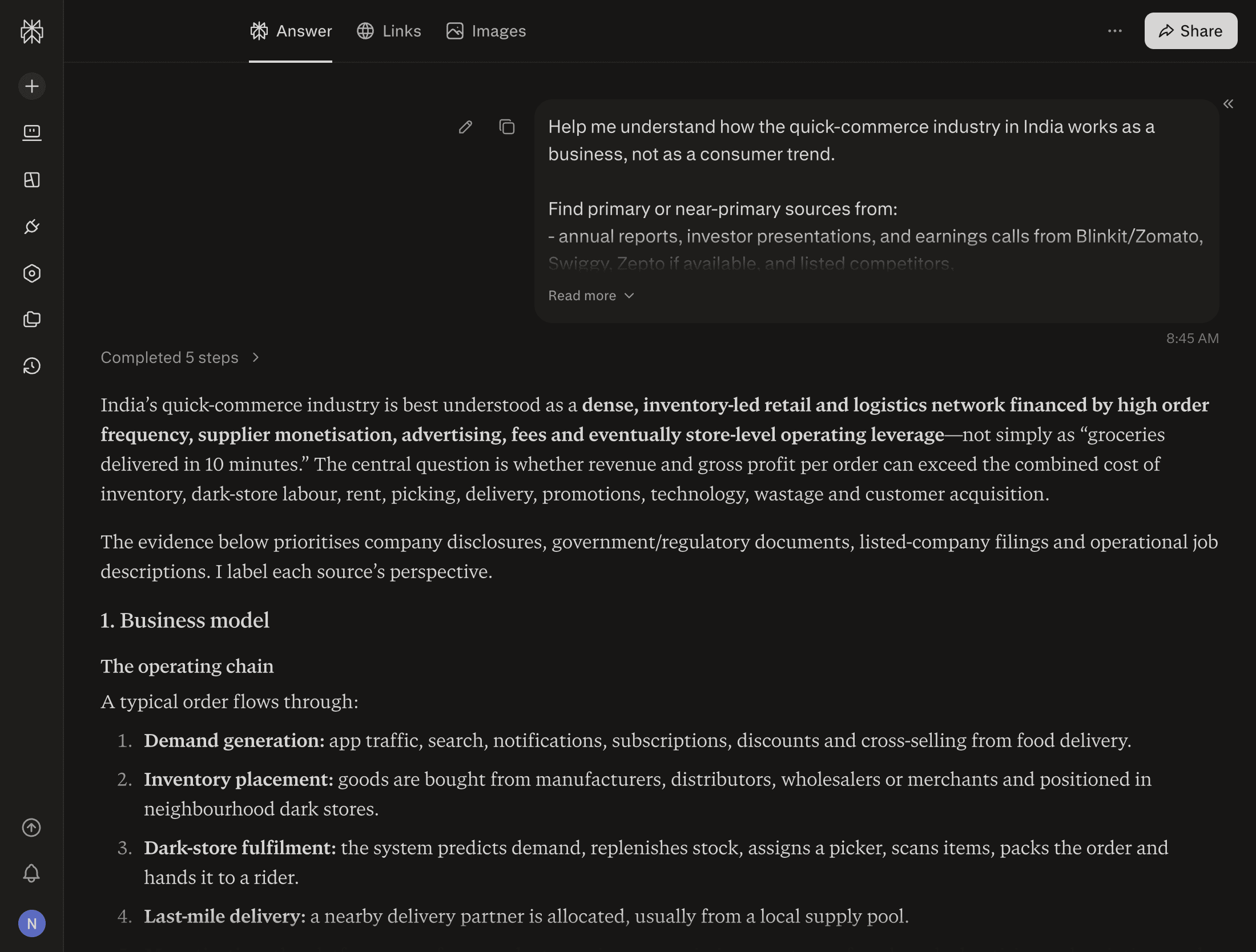
Here’s the prompt I used for the above example:
Help me understand how the quick-commerce industry in India works as a business, not as a consumer trend.
Find primary or near-primary sources from:
- annual reports, investor presentations, and earnings calls from Blinkit/Zomato, Swiggy, Zepto if available, and listed competitors,
- regulatory and government sources,
- credible market research with methodology,
- job descriptions for dark-store operations, category management, supply chain, and growth roles,
- interviews with operators, merchants, and delivery partners.
I want to understand unit economics, customer segments, dark-store operations, margins, delivery costs, competition, regulation, and the biggest unresolved risks.
Avoid influencer summaries. Link to the original documents and label the perspective of each source: company, investor, worker, customer, or regulator.
Then create a NotebookLM notebook around one question: How does this industry actually work?
That’s where you can ask NotebookLM to map the major players, business models, customer segments, revenue streams, bottlenecks, regulations, key technologies, combine different viewpoints, identify recurring disagreements, and build a clear roadmap for you.
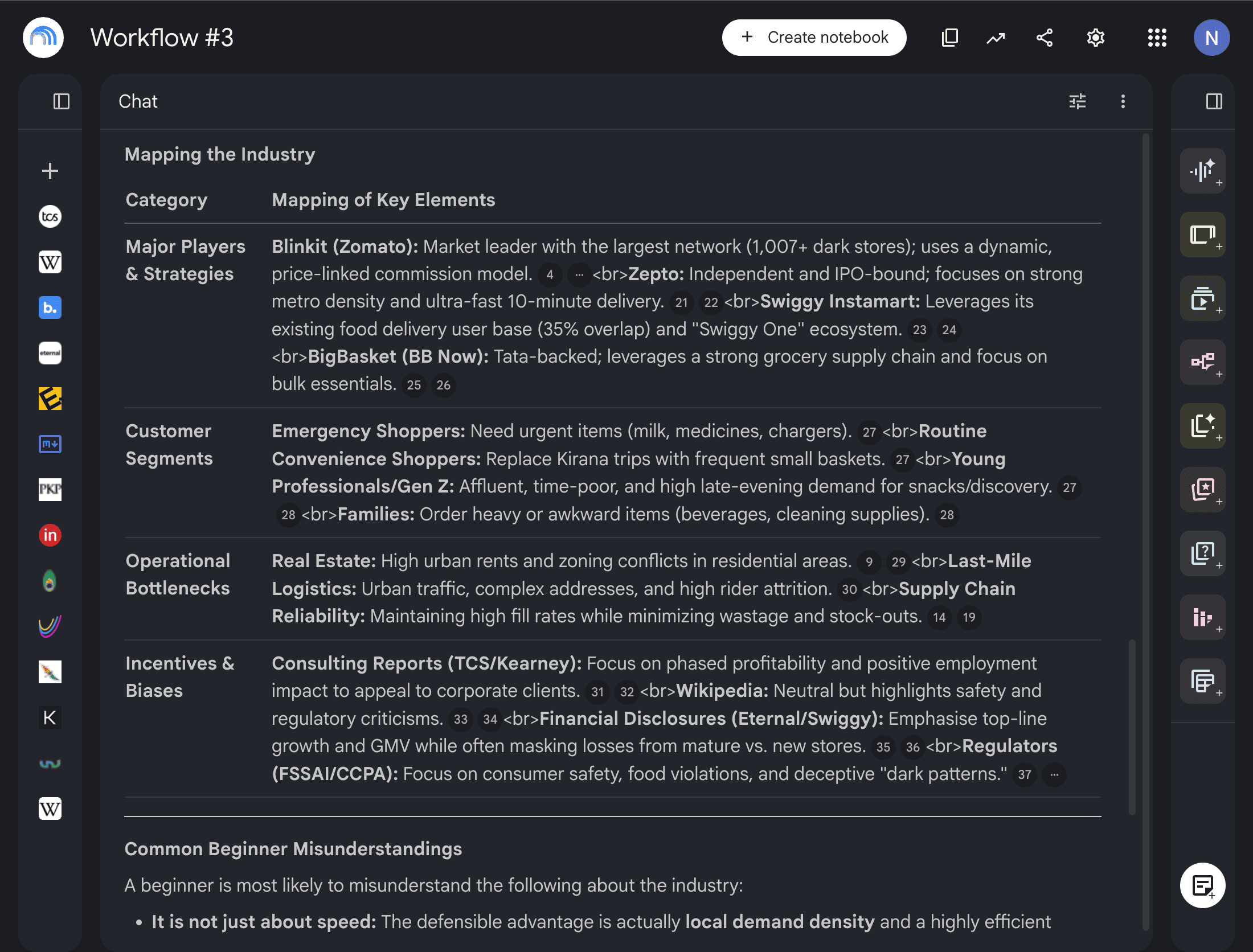
Here’s the prompt I used:
Using only these sources, explain how quick commerce in India creates revenue, where its costs come from, and which assumptions must remain true for the model to work.
Then map:
- major players and their strategies,
- customer segments,
- operational bottlenecks,
- incentives and bias in each source,
- the three disagreements the sources do not resolve.
Finally, explain what a beginner is most likely to misunderstand about this industry.
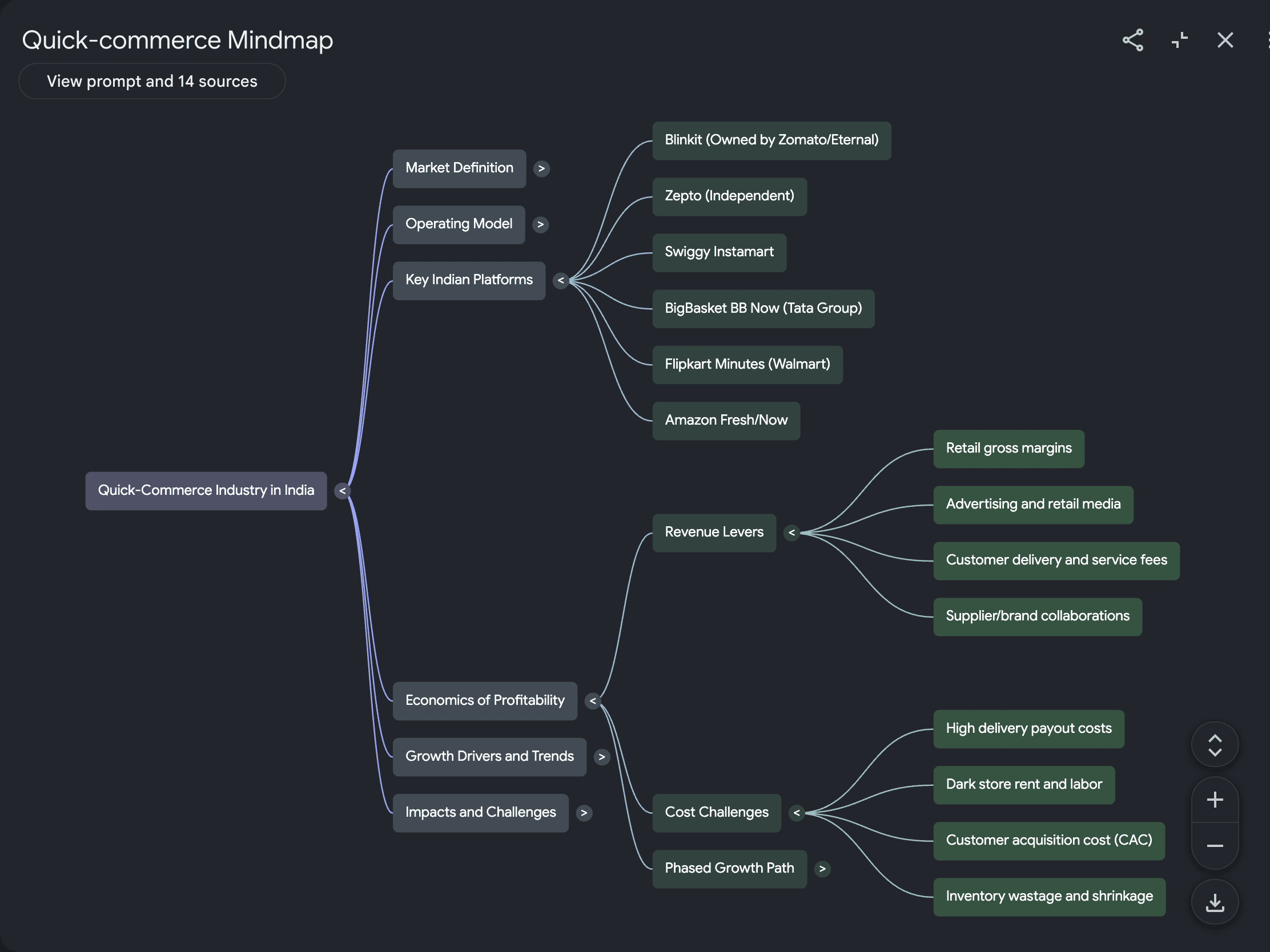
And here’s the mind map it generated for me to learn everything about the quick commerce industry in India:
You can even ask questions like:
What does a beginner usually misunderstand about this industry
Which sources here are describing the industry from a company’s perspective, an investor’s perspective, a customer’s perspective, or a regulator’s perspective?
The takeaway: Using this workflow, you will learn an industry deeply in the best and fastest way possible, using the best sources selected by you.
Comments
Nothing yet. Say the first thing.
Sign in to join the conversation.