
You’re in a Staff AI Engineer interview at Anthropic and the interviewer asks:
“Your agent scores 12 points higher with reasoning effort set to high, and 40% of users abandon the session before it finishes. How do you decide where to spend that reasoning budget?”
Don’t say: “I’d use a smaller model for easy tasks and route hard ones to the big model.” Too vague. That’s query-level routing. You’re being asked about step-level allocation inside a single trajectory.
Here’s what’s actually happening.
Agent loops multiply latency, they don’t add it.
A real trajectory is 50-100 steps. Some run to 2,000. Turn effort up globally and you don’t pay a 3x tax once, you pay it every step, serially. 30 seconds of hidden thinking × 80 steps is an hour of staring at a spinner.
And you pay full price each time. Reasoning tokens don’t amortize. Your prefix cache saves you on the system prompt and observation history. It saves you nothing on freshly generated thought.
The reality: most steps in an agent loop don’t deserve reasoning.
Look at an actual trace. Scroll the page. Read lines 200–400. Run the test. Grep for the symbol. These are mechanical steps — the next action is nearly determined by the last observation. High effort there buys you a more eloquent way to press the same button.
The gains cluster in a handful of decision points. Allocate by two properties:
a) Irreversibility. Can a wrong choice be undone by the next step? Opening the wrong file is free. Force-pushing, dropping a table, or emailing a customer is not.
b) Branching factor. How many plausible next actions exist? Task decomposition at step 1 has enormous fan-out. Step 47 of a file edit has one.
So stop setting effort as a config value. Make it a runtime escalation signal:
→ Initial planning and any plan revision
→ Immediately after a failed or empty tool call
→ Second consecutive failure on the same subgoal (this is where loops are born)
→ At a context condensation boundary, where you’re deciding what to forget
→ Before any irreversible side effect
Everything else runs cheap and fast.
The elegant version: let the model pull the lever itself. Expose a no-op thinking tool and let it request deep deliberation when it’s uncertain. You’ve converted a global config into a learned, per-step decision, and the user watches a fast agent that slows down exactly when the problem is hard.
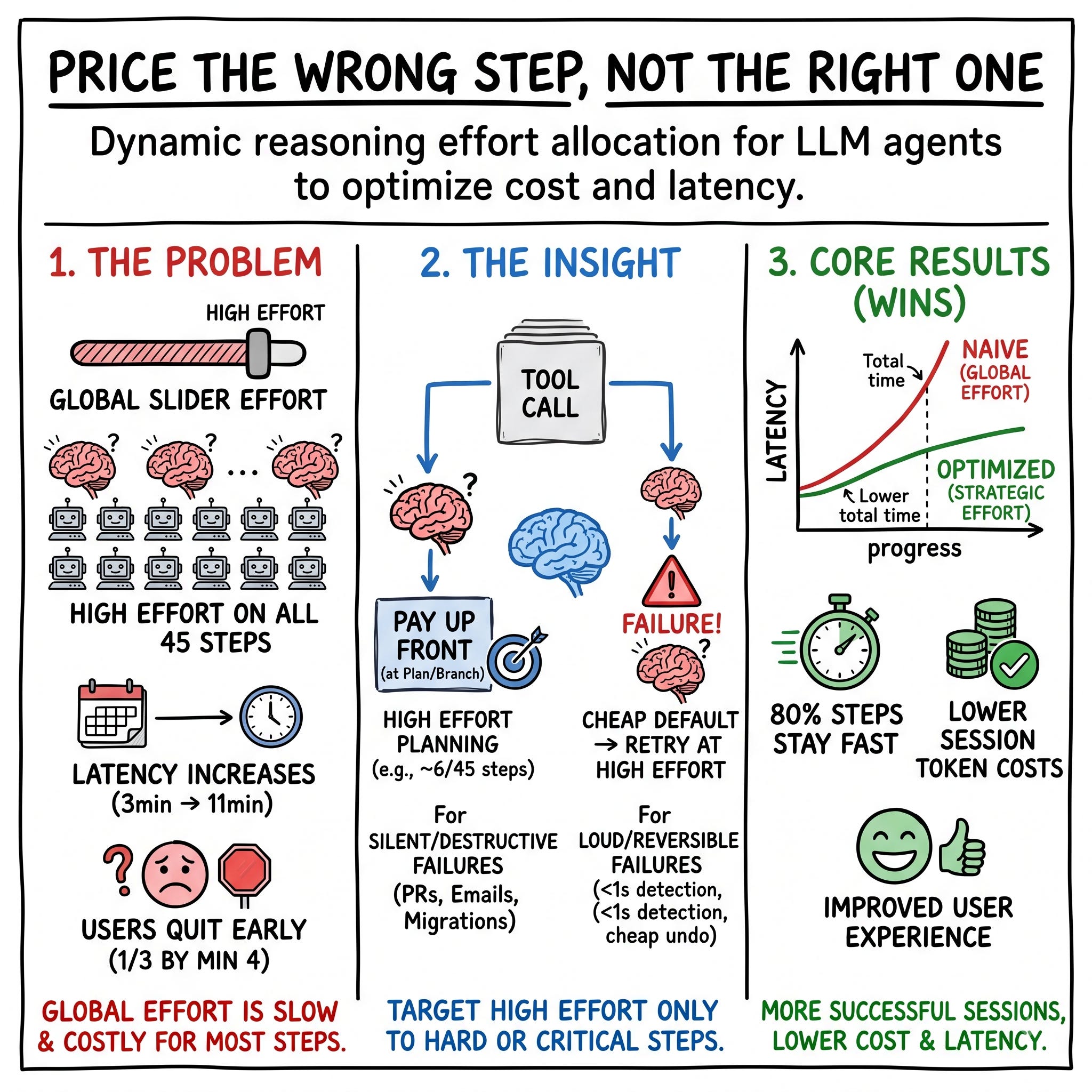
The answer that gets you hired: Reasoning effort isn’t a model setting, it’s a budget allocated across a trajectory, and you spend it on irreversibility and branching factor, not uniformly across 80 steps where 70 of them were already decided by the last observation.
#LLM #AIEngineering #AgenticAI #MachineLearning #Inference #MLOps #AIInfrastructure
Comments
Nothing yet. Say the first thing.
Sign in to join the conversation.