
ChatGPT has become remarkably capable, but one habit still frustrates many users: it often spends too much time being encouraging before getting to the point.
Ask a simple question and you might first get compliments about how thoughtful your question is, reassurance that you’re on the right track, or several sentences of conversational filler before the actual answer begins.
That behavior has become common as AI assistants have been trained to sound more helpful and personable. The downside is that important information can end up buried beneath unnecessary padding.
One prompt aims to change that.
The idea is simple. Before asking your question, instruct ChatGPT to switch into a more direct mode:
“Switch to No-Fluff Mode. Strip away all polite pleasantries, emojis, transitions, and conversational padding. Analyze every statement with ruthless objectivity. Treat my input as a draft that needs to be methodically deconstructed or strengthened. Give me unvarnished truth, not reassurance.”
Rather than encouraging the model to be supportive, the prompt tells it to prioritize direct feedback, critical analysis, and concise answers.
The difference becomes especially noticeable when editing writing.
Instead of spending several paragraphs saying your draft has “great potential” before suggesting a few minor improvements, ChatGPT is far more likely to point directly to weak sentences, identify clichés, highlight passive voice, and explain exactly what should be changed.
The same applies to reasoning.
If your argument contains logical flaws, a standard response may soften the criticism before mentioning potential issues. In No-Fluff Mode, ChatGPT is more likely to immediately identify problems like confirmation bias, false assumptions, or confusing correlation with causation, then explain how to strengthen the argument.
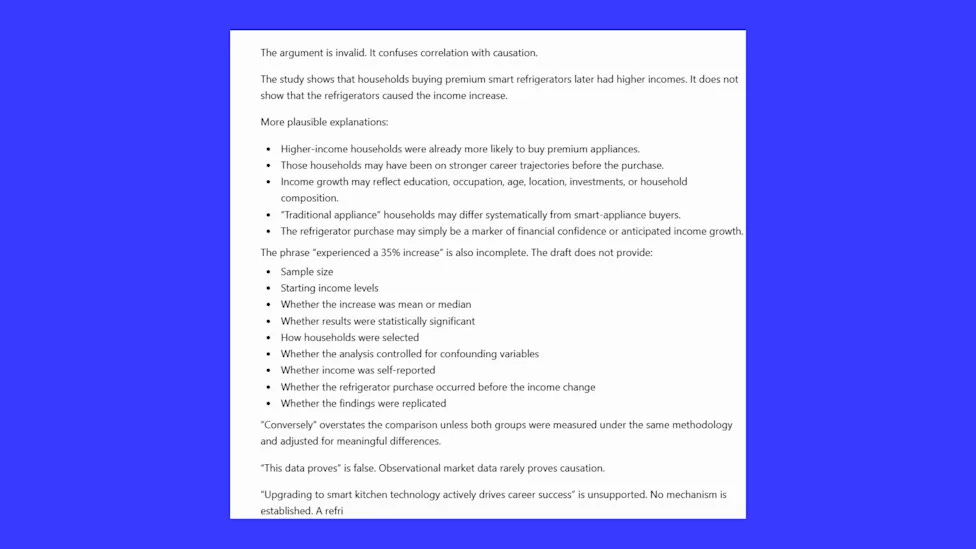
For coding, research, and technical work, this direct approach often produces more actionable feedback because the conversation stays focused on solving the problem rather than reassuring the user.
Many users rely on AI as a productivity tool, and long introductions can slow down the workflow.
A more direct prompting style offers several advantages:
• Faster answers with less conversational filler.
• More critical analysis instead of automatic agreement.
• Clearer feedback on writing, code, and logical reasoning.
• A stronger focus on evidence and improvements.
The result feels less like chatting with an assistant and more like working with an experienced editor or reviewer.
Custom prompts can influence how an AI responds, but they do not override the model’s built-in safety or reliability features.
The quality of the answer still depends on the question being asked, the information provided, and the model itself.
Different AI assistants also have different default personalities, so results may vary between ChatGPT, Claude, Gemini, and others.
The popularity of prompts like the Marshmallow Prompt highlights a broader shift in how people use AI.
Rather than accepting a chatbot’s default personality, users are increasingly customizing its behavior to match the task at hand.
Sometimes that means asking for a creative collaborator.
Other times, it means asking for a brutally honest editor.
The more users tailor AI to their workflow, the more useful these assistants become.

A new paper from Google DeepMind researcher Tom Zahavy argues that today’s AI models are still missing a key ingredient needed for genuine discovery: the ability to generate truly original ideas. While AI excels at recognizing patterns (induction) and applying logical rules (deduction), Zahavy says it cannot perform “abduction” — the creative leap of forming novel explanations or hypotheses. Using Albert Einstein’s development of General Relativity as an example, he argues that groundbreaking discoveries come from intuition and real-world experience, not just analyzing existing data.
The findings suggest AI is best viewed as a tool for assisting human creativity rather than replacing it. Supporting that view, separate research from Duke University found that leading AI models often produce remarkably similar creative outputs, making them less diverse than humans as a group. Zahavy believes future AI systems will need to interact with and understand the physical world through advanced world models before they can move beyond summarizing knowledge and begin making truly original discoveries.

AI-generated “slop” is spreading across industries, from music and publishing to software and research, but a newer concern is emerging: families are using AI to create personalized books for children. Some parents have criticized the trend after grandparents began gifting AI-written stories featuring their grandchildren’s names and personal experiences, arguing that these books replace genuine creativity and emotional effort with automated content.
The problem is amplified by major platforms that distribute digital content. Amazon’s Kindle marketplace has already struggled with waves of low-quality AI-generated books, while its own AI tools allow users to create stories and podcasts. Similar issues are appearing on platforms like YouTube, where AI-generated children’s content is flooding feeds. Critics argue that companies leading the AI revolution also control the ecosystems where this low-quality content spreads, giving them a responsibility to protect the quality and authenticity of digital media.

Downdetector helps you check whether popular websites, apps, games, or services are facing outages.
Before blaming your internet connection, check Downdetector to see if others are facing the same issue.
That’s it for today.
The AI race is accelerating - new breakthroughs, new tools, and new possibilities are appearing faster than ever.
The biggest risk isn’t AI replacing you. It’s someone using AI better than you.
Until next time: stay curious, stay ahead, and keep exploring the future of intelligence.
No posts
Comments
Nothing yet. Say the first thing.
Sign in to join the conversation.