
I Tested Meta AI Against ChatGPT and Gemini. Here’s the Winner.
Meta is entering the AI image race with a new model designed to challenge ChatGPT and Google Gemini’s Nano Banana 2.
But creating impressive images is no longer enough. The real challenge for Meta AI is convincing users that its image generation is good enough to replace the tools they already use.
To find out how competitive Meta’s new model really is, several image prompts were tested across Meta AI, ChatGPT, and Gemini. The challenges included product advertisements, wildlife photography, social media designs, comics, and style-based illustrations.
While all three models produced strong results, their biggest differences came down to one thing: understanding what the user actually wanted.
Product Design: ChatGPT Creates the Best Advertisement
The first test asked each AI model to create a polished product poster for a fictional sparkling water brand called “Moon Orchard.”
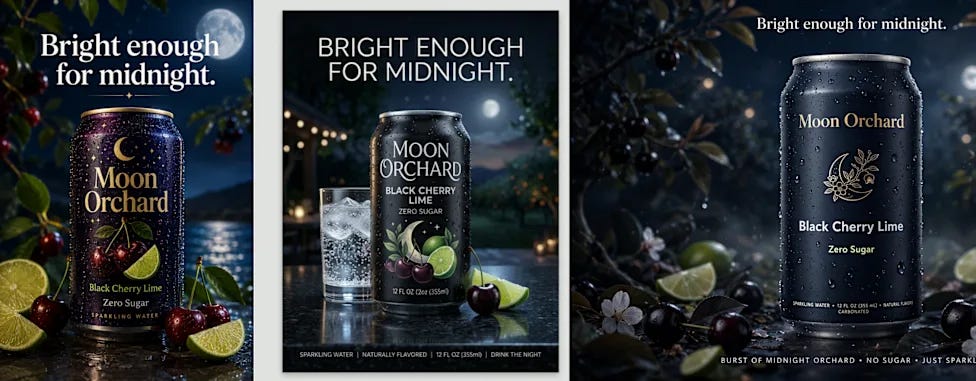
The prompt required exact text on the can and a headline reading “Bright enough for midnight,” making it a challenge for both image quality and typography accuracy.
All three models created attractive designs, but each took a different approach.
ChatGPT produced the most balanced result, creating an image that looked like a real advertising campaign with strong composition and branding.
Gemini created something closer to a magazine advertisement, but added extra text that was not requested.
Meta delivered the most premium-looking product design, with realistic details like condensation on the can, but ChatGPT appeared to understand the full marketing goal better.
Wildlife Photography: Meta Looks the Most Cinematic
The next challenge focused on realism: creating a photograph of a red fox walking through a snowy forest at sunrise.

ChatGPT created the most dramatic image, showing the fox moving toward the camera.
Gemini took a more natural wildlife photography approach, with a calmer profile shot.
Meta produced the most cinematic result, with a highly realistic fox and a background that looked almost like a professional nature documentary scene.
For pure visual impact, Meta stood out.
Social Media Designs: ChatGPT Wins on Practical Use
The models were then asked to create an Instagram post for a summer garden party, including readable text, fairy lights, flowers, drinks, and a realistic outdoor setting.

Despite Meta’s connection to social platforms like Instagram and Facebook, ChatGPT delivered the strongest result.
Its text looked more naturally integrated into the design, making it feel like an actual social media post.
Gemini created something closer to a traditional invitation flyer, while Meta generated the most realistic event photo but less of an actual promotional graphic.
Comics: All Three Perform Well
The fourth test asked the models to create a four-panel comic about a robot named Pip baking pancakes while maintaining character consistency.
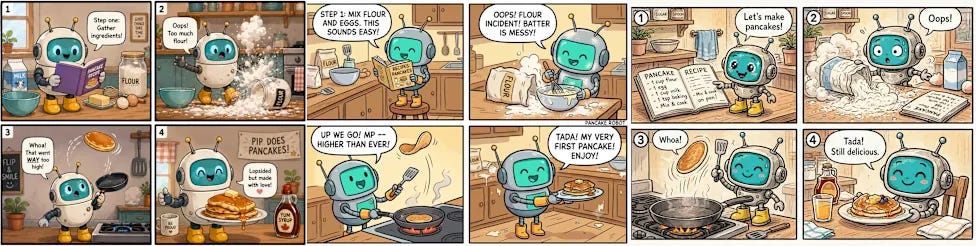
This was one of the strongest categories for all three models.
ChatGPT created the most entertaining and easiest-to-follow comic.
Gemini delivered the cleanest cartoon style.
Meta performed well overall but introduced a strange detail by giving the pancake its own speech bubble.
Style Mixing: Meta Takes the Lead
The final challenge combined two very different styles: a noir detective story and a Saturday morning cartoon.

The prompt featured a private detective investigating a missing cookie in a 1940s kitchen.
This was where Meta AI impressed the most.
ChatGPT created a strong balance between the noir atmosphere and cartoon elements.
Gemini captured the detective mood best.
But Meta understood the absurdity of the concept better, creating a more playful and memorable result with stronger comedic timing.
The Winner Depends on What You Value
After testing all five scenarios, each AI image generator showed a different personality.
Gemini’s Nano Banana 2 consistently delivered strong realism.
Meta AI showed more creative risk-taking and produced some of the most memorable images, especially in the cookie detective challenge.
ChatGPT was the most consistent overall. It repeatedly understood not only the words in the prompt but the intention behind them.
That difference matters.
AI image generation is no longer just about making beautiful pictures. The best models are the ones that understand the goal behind the request and make decisions like a human designer would.
Meta AI is clearly competitive, but ChatGPT remains the strongest all-around image generator when it comes to turning ideas into the exact visuals users imagine.

Why AI Could Make Humans Worse Decision-Makers
A former investigative journalist and Cornell professor argues that the biggest risk of AI is not inaccurate answers, but humans giving up their own judgment. Cheryl Strauss Einhorn, author of The Human Edge: Smarter Decisions in the Age of AI, says many people are using AI to think for them instead of thinking alongside it. Her research found that users often mistake AI’s confidence and fluency for accuracy, making it critical to treat AI responses as drafts that require verification rather than final decisions.
Einhorn believes the best AI users will know when to delegate and when to stay in control. She compares AI use to driving modes: a “surgeon” uses AI for specific tasks while keeping decision-making authority, while a “Lamborghini driver” hands over the entire journey without knowing the destination. Her advice is simple: use AI to gather information, generate ideas, and challenge assumptions, but never outsource the human skills that matter most, such as defining goals, weighing risks, and deciding what is truly important.

AI Just Matched the Best Human Mathematicians at the IMO
For the first time, artificial intelligence has achieved a perfect score at the International Mathematical Olympiad (IMO), one of the world’s most prestigious mathematics competitions. Chinese tech companies Huawei and Xiaohongshu announced that their AI models both scored 100% on this year’s IMO problems, matching the performance of the top human contestants. The achievement marks a major milestone after previous AI systems from Google and OpenAI reached gold-medal-level performance in 2025 but fell short of a perfect score.
The results highlight how quickly AI reasoning capabilities are advancing. The models were tested under IMO conditions, with no human assistance allowed, and their solutions were evaluated through the official judging process. Other frontier models from OpenAI, Anthropic, Moonshot AI, and Axiom Math also reportedly achieved perfect scores when tested on the problems. As AI systems continue improving at complex reasoning tasks, researchers are now questioning how far traditional benchmarks can continue measuring the limits of advanced models.

Magic Tools
Summarize.tech – Summarize YouTube Videos
Summarize.tech helps summarize long YouTube videos. It is useful when you want the main points of a lecture, podcast, interview, or tutorial without watching the full video.
It can save a lot of time for students, researchers, and busy professionals.
That’s it for today.
The AI race is accelerating - new breakthroughs, new tools, and new possibilities are appearing faster than ever.
The biggest risk isn’t AI replacing you. It’s someone using AI better than you.
Until next time: stay curious, stay ahead, and keep exploring the future of intelligence.
Comments
Nothing yet. Say the first thing.
Sign in to join the conversation.