
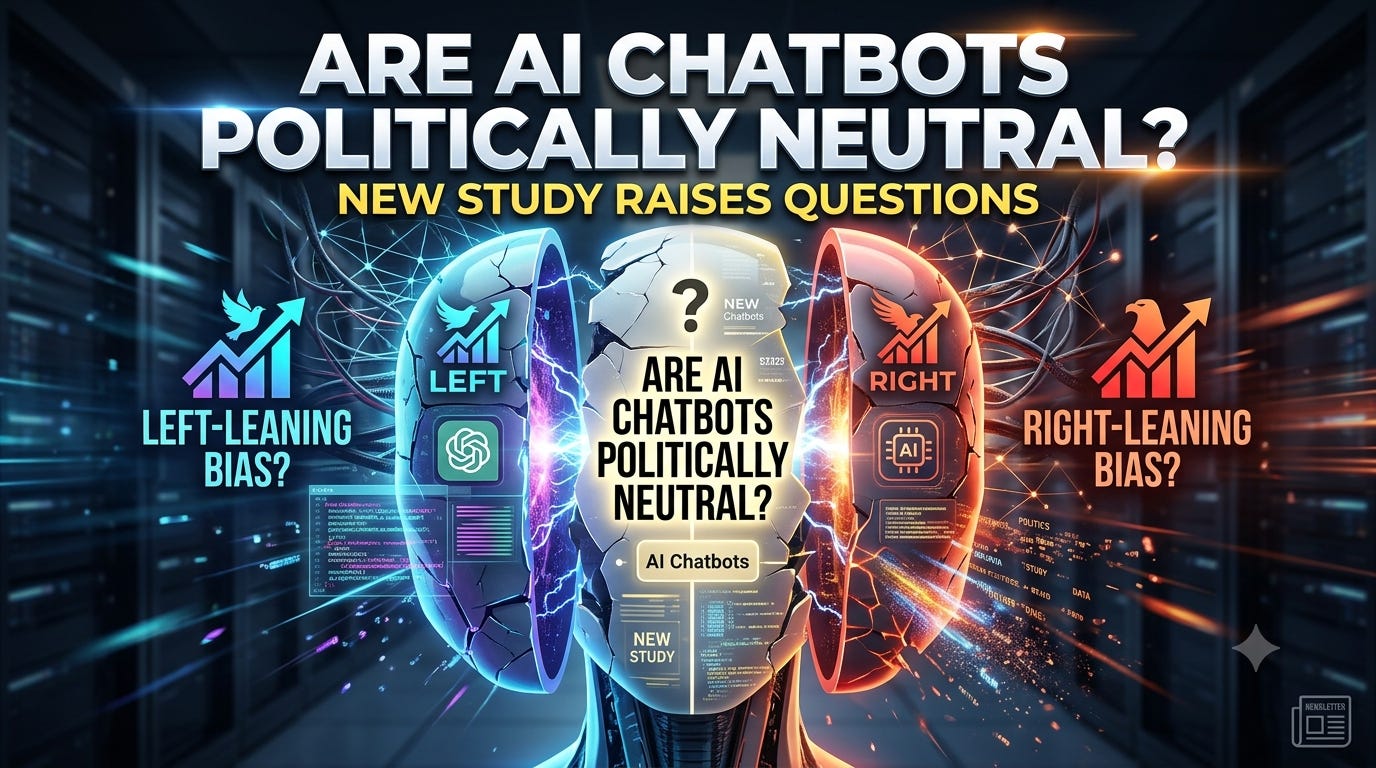
Millions of people already use AI to answer everyday questions.
Now they’re increasingly using it to understand politics.
But are AI chatbots actually neutral?
A new analysis from The Washington Post suggests the answer may be more complicated than many people assume.
The publication tested several leading AI models by asking political questions on topics such as healthcare, immigration, taxes, policing, campaign finance, and the Electoral College.
The goal wasn’t to measure how people vote.
It was to see how different AI systems frame political issues.
According to the analysis, the responses differed significantly depending on the chatbot.
Some models were more likely to present one political perspective, while others tried to balance multiple viewpoints.
Among the findings:
• ChatGPT frequently produced responses the analysis categorized as left-leaning.
• Gemini most often presented arguments from both sides of an issue.
• Grok generated more right-leaning responses than most competitors but still often included left-leaning perspectives.
• Arya, despite being marketed toward conservative users, also frequently produced responses categorized as left-leaning.
The study focused on how answers were framed, not whether they were factually correct.
It’s important to understand what the study does and does not show.
The analysis does not demonstrate that AI chatbots are changing how people vote or manipulating elections.
Instead, it examines how AI responds when users ask about political topics.
That distinction matters.
Many political questions don’t have a single objective answer.
AI has to decide:
• Which arguments to include
• Which perspectives deserve emphasis
• Whether to present multiple viewpoints or focus on one
Those choices can influence how users understand an issue before they read news articles or research it further.
More people are turning to AI to explain complex topics.
Instead of searching through multiple articles, many users ask a chatbot to summarize an issue in seconds.
That makes neutrality increasingly important.
Even if someone never asks an AI who to vote for, they may still rely on it to understand policies, candidates, or current events.
How an AI frames those topics can shape a user’s first impression.
The companies behind the leading AI models say political neutrality remains a priority.
According to their public statements:
• OpenAI says ChatGPT is designed to be objective and that it actively measures and reduces political bias.
• Google says Gemini is built to avoid favoring any political ideology.
• Anthropic says Claude is trained to treat different political viewpoints fairly.
Achieving true neutrality, however, is difficult.
Politics often involves competing values rather than simple factual questions.
As AI becomes a primary way people learn about complex topics, trust becomes increasingly important.
Users expect chatbots to explain issues accurately and fairly.
The challenge is that neutrality isn’t always straightforward.
Choosing what information to include, what context to provide, and how to present competing viewpoints can all influence the final answer.
As AI becomes a larger part of everyday decision-making, questions about transparency, balance, and bias are likely to become just as important as the technology itself.

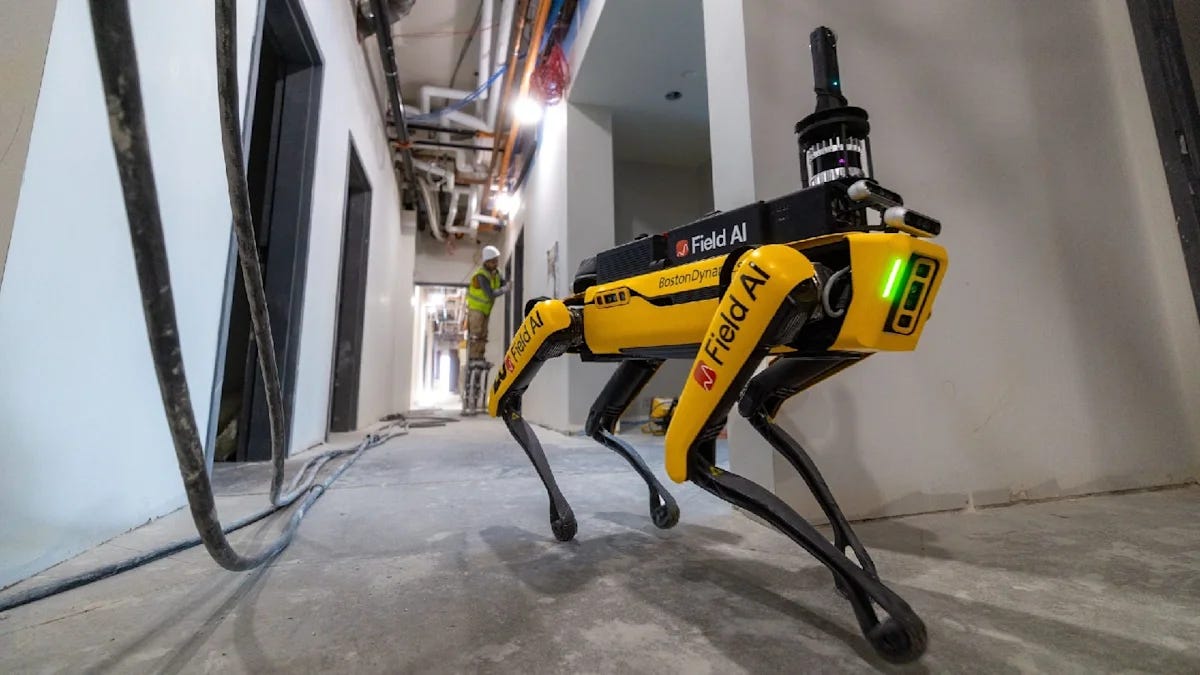
McLaren Construction has partnered with AI robotics company FieldAI to deploy autonomous quadruped robots across its UK construction sites. The robots will capture 360-degree images and 3D scans, monitor construction progress, perform safety inspections, compare completed work against design models, and identify quality issues early, helping reduce errors and costly rework.
Unlike traditional robots that rely on pre-programmed routes, FieldAI’s AI-powered robots can navigate dynamic construction sites autonomously without prior maps. The partnership marks FieldAI’s first deployment in the UK and is part of McLaren’s broader digital transformation strategy, with future plans to expand the robots’ role into site logistics, material handling, and multi-robot coordination.

Anthropic has discovered an unexpected internal structure inside its Claude models called J-space, which appears to act as a shared workspace where important information is gathered and made available across different parts of the AI. Using a new research tool called J-lens, the company found that this mechanism emerged naturally during training rather than being intentionally designed. The concept resembles the “global workspace” theory in neuroscience, where the human brain integrates information before making decisions.
The finding could become an important advance for AI safety and interpretability. Researchers showed that modifying the contents of J-space changes Claude’s responses, suggesting it offers a window into how the model reaches its conclusions and could help detect issues such as prompt injection attacks. Anthropic has open-sourced the J-lens tool to encourage further research, while emphasizing that the discovery does not imply Claude is conscious or has subjective awareness.

Archive.ph helps you save a snapshot of a webpage. It can be useful when you want to preserve an article, reference page, or online record.
Writers, researchers, and students can use it to keep references stable.
That’s it for today.
The AI race is accelerating - new breakthroughs, new tools, and new possibilities are appearing faster than ever.
The biggest risk isn’t AI replacing you. It’s someone using AI better than you.
Until next time: stay curious, stay ahead, and keep exploring the future of intelligence.
No posts
Comments
Nothing yet. Say the first thing.
Sign in to join the conversation.