

Why this guide exists, who wrote it, and why that matters, and what being told a thing is “inevitable” is actually meant to do. Start here.
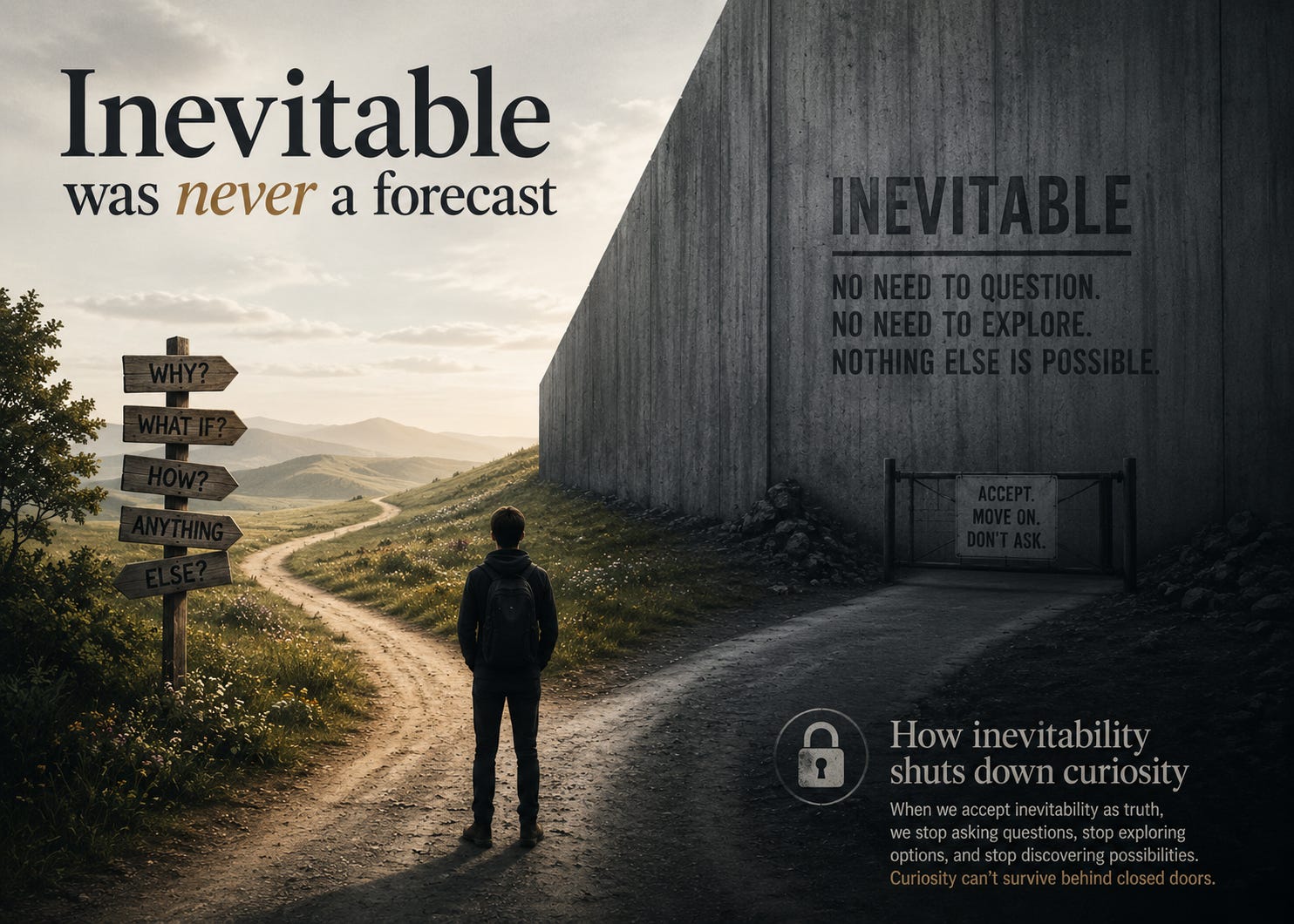
The personal essay at the heart of the guide. For the better part of a decade, I sold the coming wave of AI, and “inevitable” was the move I made for a living. Here it’s named for what it is — a quiet form of bullying that reverses the burden of proof. If you read only one chapter, read this one.
AI for Lifelong Learners is a reader-supported publication. To receive new posts and support my work, consider becoming a free or paid subscriber.

How the industry actually talks, the selling strategies that have worked on communities and those that have failed, where towns have won in real terms and where they have lost. If a project just landed in your county, keep this chapter open.

This chapter is a working reference section. What to ask before you say yes. What to put on the table. Hopefully this is a list far wider than most communities realize.
You will find information to handle the variation in leverage and deal structure that makes one-size-fits-all advice useless.
This chapter (5) takes one impact, examined in full - noise. The questions and method here are a template for interrogating any single claim a developer makes — heat, water, traffic, tax, decommissioning — not just noise.
A common assumption is that the noise problem at a data center is mainly the generators or turbines. That is partly right, but too narrow.
For many data centers, the most persistent community noise is not gas turbines running 24/7. It is usually the cooling system: large rooftop or yard-mounted fans, chillers, air handlers, cooling towers, pumps, transformers, and sometimes backup generators. Gas turbines or onsite gas plants become a major issue when the data center is designed to self-generate power, which is increasingly happening in Texas and other high-load regions, but that is not yet the default pattern everywhere.
One impact, examined in full, as a model for interrogating any single claim a developer makes.
In case you missed the other Chapters
1. Cooling fans and chillers
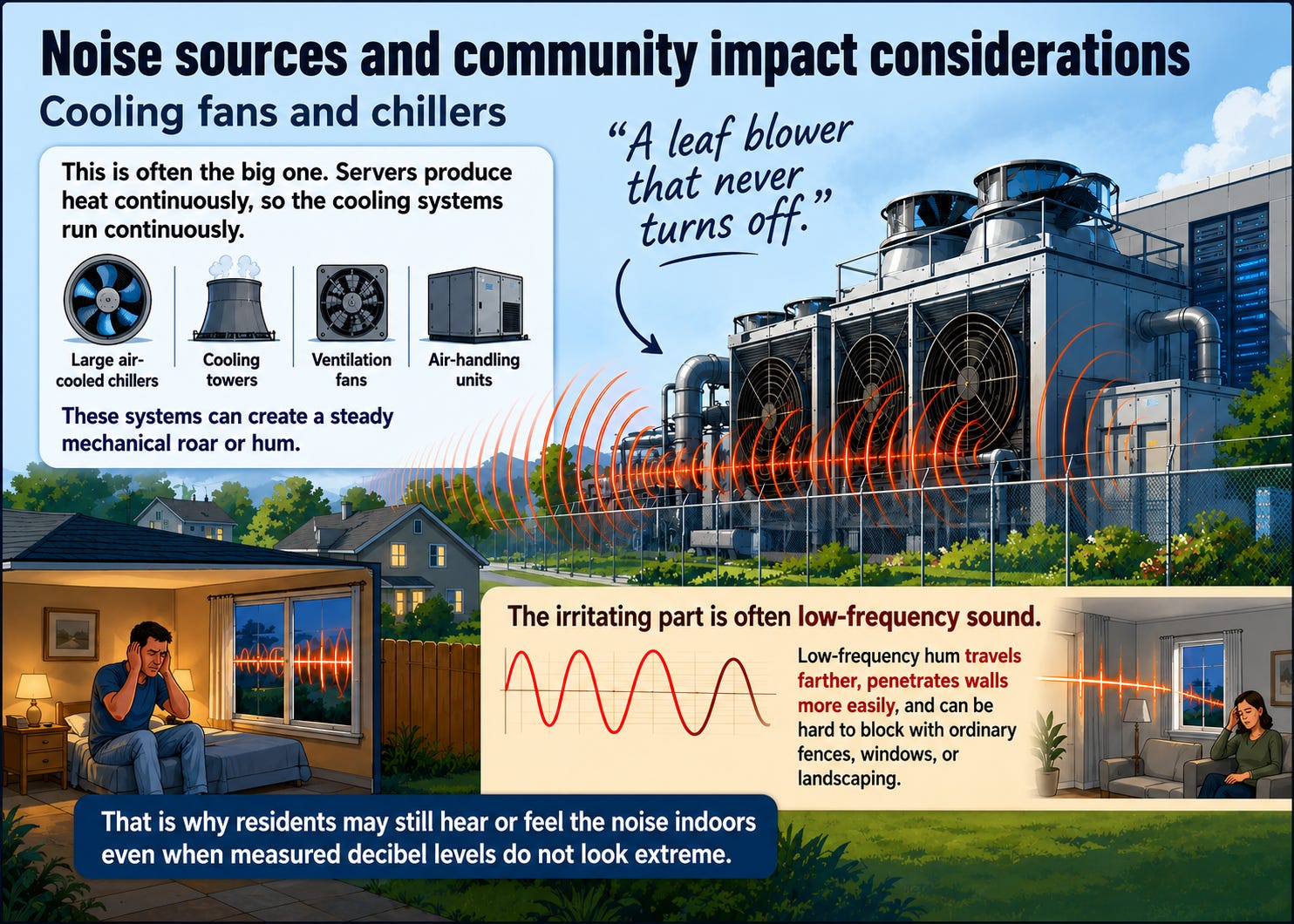
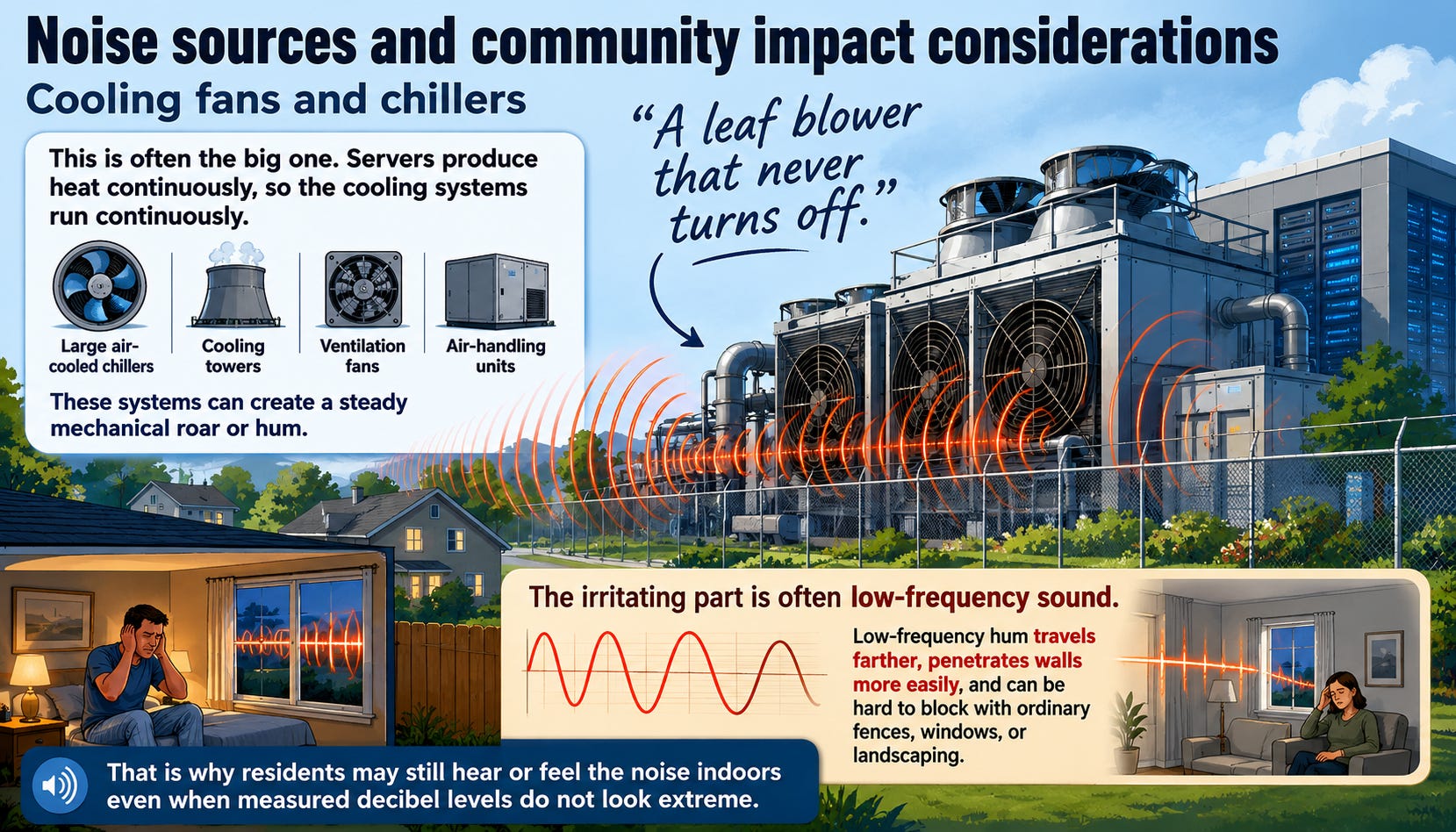
This is often the big one. Servers produce heat continuously, so the cooling systems run continuously. Large air-cooled chillers, cooling towers, ventilation fans, and air-handling units can create a steady mechanical roar or hum. Some reports describe data center sound as “a leaf blower that never turns off,” which is a useful image because the problem is not just volume, but persistence.
The irritating part is often low-frequency sound. Low-frequency hum travels farther, penetrates walls more easily, and can be hard to block with ordinary fences, windows, or landscaping. That is why residents may still hear or feel the noise indoors even when measured decibel levels do not look extreme.
2. Backup diesel generators
Most data centers have large backup generators for reliability. They may not run 24/7, but they are periodically tested and may run during outages or grid events. When they do run, they can create loud rumbling noises, exhaust smells, and additional air-quality concerns.
This is one place where community fears are justified, even if the normal daily noise comes from cooling. The generators may be episodic, but the episodes are disruptive and can happen at exactly the wrong time, such as during storms, heat waves, or grid stress.
3. On-site gas turbines or gas-fired power plants
This is where your assumption becomes more accurate. Some large AI data centers are now proposing or building on-site gas-fired generation to bypass grid constraints. In that case, turbines, exhaust stacks, compressors, cooling systems, and associated substations can become major noise sources. Texas has already seen developers move toward colocated gas generation for large data-center loads.
Gas turbines can produce broadband and low-frequency noise, and the turbine exhaust is often a leading culprit because it is a high-velocity, high-temperature flow with strong low-frequency components and sometimes tonal characteristics.
So the more precise statement is:
Traditional data centers: cooling systems are usually a constant nuisance.
AI-scale, power-constrained campuses with onsite generation: turbines and power infrastructure can become a central part of the problem.
4. Transformers and electrical substations
Large electrical systems can produce a steady 60 Hz hum and harmonics. This may not sound “loud” in a simple decibel reading, but tonal hum is especially annoying because the brain locks onto it. Substations, transformers, switchgear, and power-conversion equipment can all add to the soundscape.
5. Crypto-mining sites, which are related but not identical
A lot of the most dramatic noise complaints come from Bitcoin mining facilities. They are not the same as conventional cloud data centers, but they share the same basic physical problem: thousands of heat-producing machines that require aggressive cooling. In Granbury, Texas, residents complained about constant noise and health effects from a nearby Bitcoin mining operation, with reports pointing especially to massive cooling fans.
This distinction matters because people sometimes conflate “data centers,” “AI data centers,” and “crypto mines.” The community experience may be similar, but the business model, equipment layout, and regulatory posture can differ.
The problem is not just “it’s loud.” It is the combination of:
Constant operation. Data centers do not quiet down at night the way many factories or construction sites do. Cooling loads continue around the clock.
Low-frequency hum. Low frequencies travel farther, pass through buildings more easily, and are often underweighted by standard A-weighted decibel measurements.
Tonal noise. A steady whine, hum, buzz, or drone can be more disturbing than random broadband noise at the same measured level.
Nighttime sensitivity. A sound that is tolerable at 2 p.m. can be intolerable at 2 a.m., especially in rural or suburban areas where baseline noise is low.
Cumulative sources. A site may have cooling fans, chillers, transformers, generators, substations, and possibly turbines. Each source may meet a limit individually, while the combined acoustic signature becomes oppressive.
Poor zoning fit. Many communities have noise ordinances written for older industrial patterns, not 24/7 server farms with low-frequency mechanical hum. Acoustical consultants and policy groups have warned that conventional ordinances often do not adequately address data-center noise.
Residents near noisy facilities commonly report sleep disruption, headaches, stress, anxiety, difficulty concentrating, and loss of use of outdoor space. Some reports from Texas communities describe declining health and persistent disturbance from crypto/data-center-like facilities.
Caution is warranted: not every reported illness can be directly attributed to noise without careful study. But it is not lazy NIMBYism to object to a continuous low-frequency industrial hum near homes. Sleep disruption alone is a serious public-health issue.
The serious questions are not “Will it make noise?” It will. The better questions are:
What equipment runs 24/7? Cooling fans, chillers, pumps, transformers, turbines?
Are there onsite gas turbines or gas engines, or only backup generators?
What are the predicted nighttime noise levels at the nearest property line and nearest bedroom facade?
Do measurements include low-frequency and tonal components, not just dBA averages?
Will there be enforceable limits after construction, with independent monitoring?
Who pays for mitigation if the acoustic model is wrong?
Are barriers, silencers, acoustic louvers, fan selection, equipment orientation, setbacks, and building shielding designed before construction rather than patched afterward?
The key pushback on your premise is this: do not let the developer frame the issue only around turbines or generators. Even with no turbine running, a large air-cooled data center can produce a relentless acoustic footprint. But if onsite gas generation is part of the plan, then the project starts to look less like a warehouse full of computers and more like a hybrid industrial power plant plus server farm. That deserves a much higher level of scrutiny.
This guide is not legal advice, and I am not an attorney. It is a civic research and discussion resource meant to help communities ask better questions and negotiate from a more informed position. Before relying on it in any actual decision, please verify local facts and consult qualified legal, engineering, financial, environmental, or policy professionals as appropriate.
This guide was assembled as a contributed effort, to the best of my ability, with the assistance of AI. You are welcome to reuse it, adapt it, and move it into any useful form to help your efforts. Consider it open, in the spirit of Creative Commons CC BY 4.0 Attribution. Check my work. If you find an error or something I’ve missed, I’d be glad to hear it, offered in the same spirit it was made: as a contribution to the effort.
Comments
Nothing yet. Say the first thing.
Sign in to join the conversation.