
The story of the week
Yang Zhilin is 19 when he joins the Tsinghua University. He had been admitted to that university after winning the gold medal at the Guangdong Informatics Olympiad.
Even so, he decides to sit the entrance exam anyway, and is admitted through that route too. Then he takes the Gaokao, the toughest exam in the world, which every year puts more than thirteen million Chinese students to the test. He scores 667 out of 750: the highest score in the entire province, and his third direct ticket to the university.
He’s also the drummer in a rock band, Splay, and in this incredibly rare video of one of their 2014 concerts he’s introduced (by his American name, “Kimi”) at the 5:02 mark, as he launches into a drum solo.
In his second year at Tsinghua University he switches courses and enrols in Computer Science, in the department run by Tang Jie, the founder of Zhipu.AI, who in 2015 will become his thesis supervisor.
After university, he joins Google and then moves to Meta. Finally, in 2023, he founds Moonshot AI.

Moonshot has been operating under the radar, especially outside of China, until on 16th of July 2026 they released Kimi 3, the largest Chinese model ever built and the first to compete directly with American models. In fact, to surpass them.
The defining feature of Kimi 3 is that it’s an “open weight” AI model.
When we talk about ChatGPT, Claude or Gemini, we’re talking about “closed” models, usable only through the service provided by whoever developed them. When you send a request to the model (asking ChatGPT a question, for example), it runs on the servers of the company that built it, and you have no access to the so-called “weights”, the billions of numerical parameters the model was trained on.
Closed models are very expensive especially when used inside a company and, from the user’s point of view, the cost is directly proportional to usage: the more requests you send to the model, the more you pay. And if whoever created it decided to switch it off, you’d lose access altogether.
An open-weight model (which from here on I’ll simply call “open”), by contrast, publishes its “weights”: anyone can download it, run it on their own servers, modify it and specialise it, without paying a cent to the original developer. Chinese models like DeepSeek, Qwen and Kimi are open, as are the models developed by Mistral and Meta’s Llama.
Once released, “weights” can never be pulled back. It’s not like shutting down a service: the copies have already been downloaded and redistributed, impossible to track or deactivate remotely. And this has two implications:
open models are more dangerous, because any guardrails can be stripped out and, if vulnerabilities are discovered, they can’t be “switched off”
but they’re also harder to monetise, and the business model has to be rethought from scratch
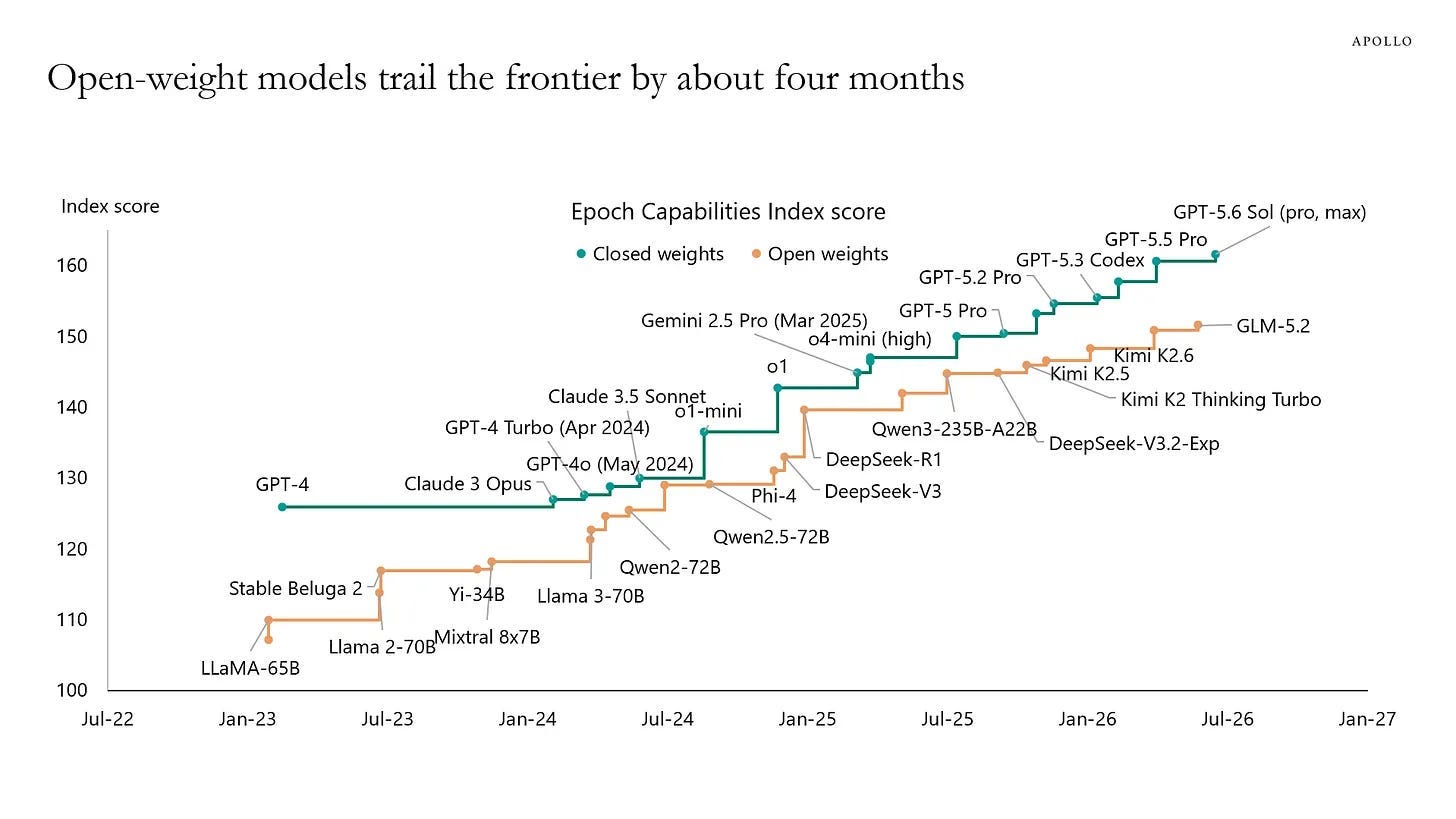
One last distinction to make: open-weight doesn’t mean open source. With open-weight models you download the parameters, but the training data and the process remain proprietary. With open-source models, you get access to the code.
Right after the release of Kimi 3, within a week every major player in Silicon Valley felt compelled to write a response making their position known.
Jensen Huang, CEO of Nvidia, in his first-ever post on X, shared a letter titled “Open Weights and American AI Leadership“ backing open models, for several reasons:
they strengthen cybersecurity (more eyes on the code, less dependence on a single vendor)
they accelerate innovation and competition
they widen access to AI for sectors and countries that would otherwise be shut out
they support American technological leadership precisely because they offer an alternative to Chinese open models

The letter explicitly asks Washington not to introduce premature restrictions on “overseas” models.
Among the signatories were 25 companies (including Nvidia, Microsoft, Meta, IBM, Dell, Palantir, Hugging Face, Mistral, Mozilla, the Linux Foundation, Andreessen Horowitz and Y Combinator), a number that immediately grew to around fifty with the addition of OpenAI and Google.
The notable absentees were Anthropic and Amazon. Anthropic responded with a blog post titled “Our position on open-weights models“ in which, while still supporting the importance of open models, it asks the United States to restrict access to Chinese technology, citing national security concerns.

The positions are obviously opposed: Nvidia has an interest in selling its chips to Chinese companies and expanding its business while Anthropic is trying to protect its own business and doesn’t want to compete with the Chinese AI companies.
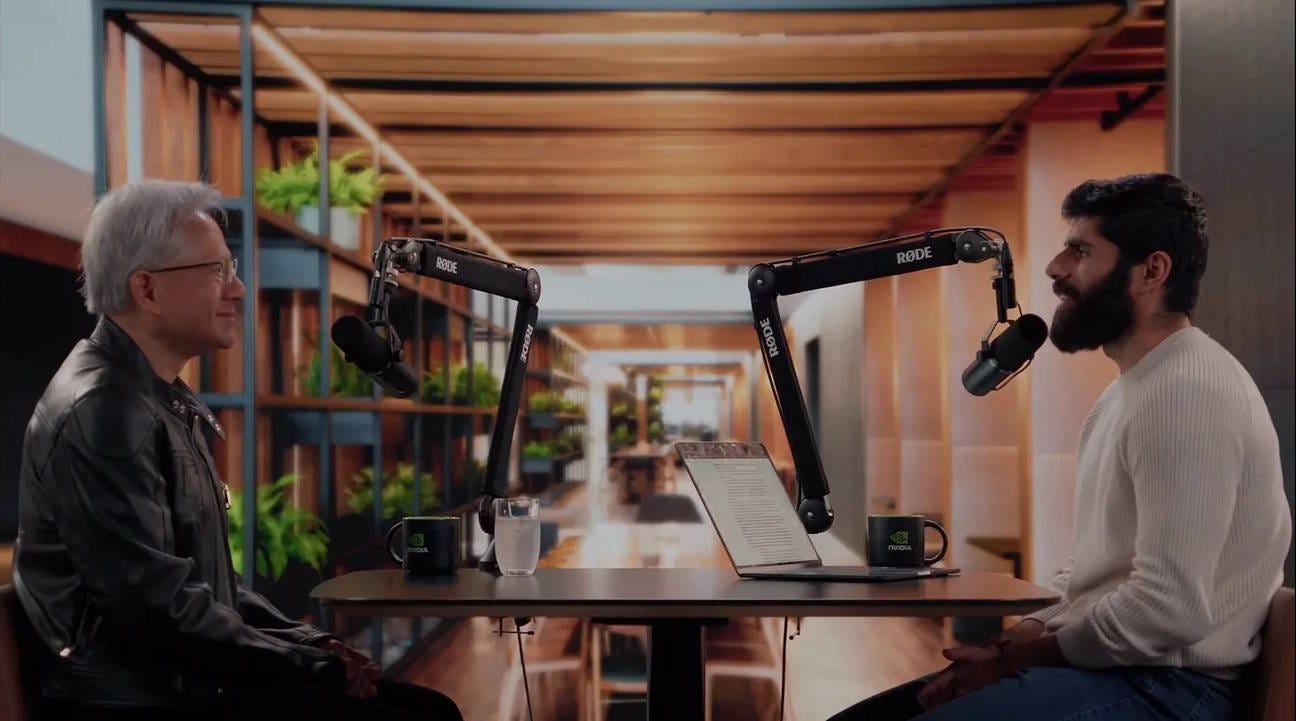
A few months ago Dwarkesh Patel discussed this seemingly unsolvable dilemma with Jensen Huang on a podcast: if you restrict chip exports to China, you slow down Chinese AI development in the short term, but you give China a reason to develop its own chips in the long term. If instead you give China access to your most advanced chips right away, you put Chinese companies in a position to build an AI potentially more advanced than America’s.
And they weren’t the only ones to speak up. Mark Zuckerberg wrote a piece in the WSJ titled “The AI Future Is for Everyone“ (that later became a full very long blog post), laying out a philosophy built on individual empowerment as the engine of progress, invention (not automation) as the primary goal of developing superintelligence and a balance of power (not centralised control) as the way to guarantee safety.
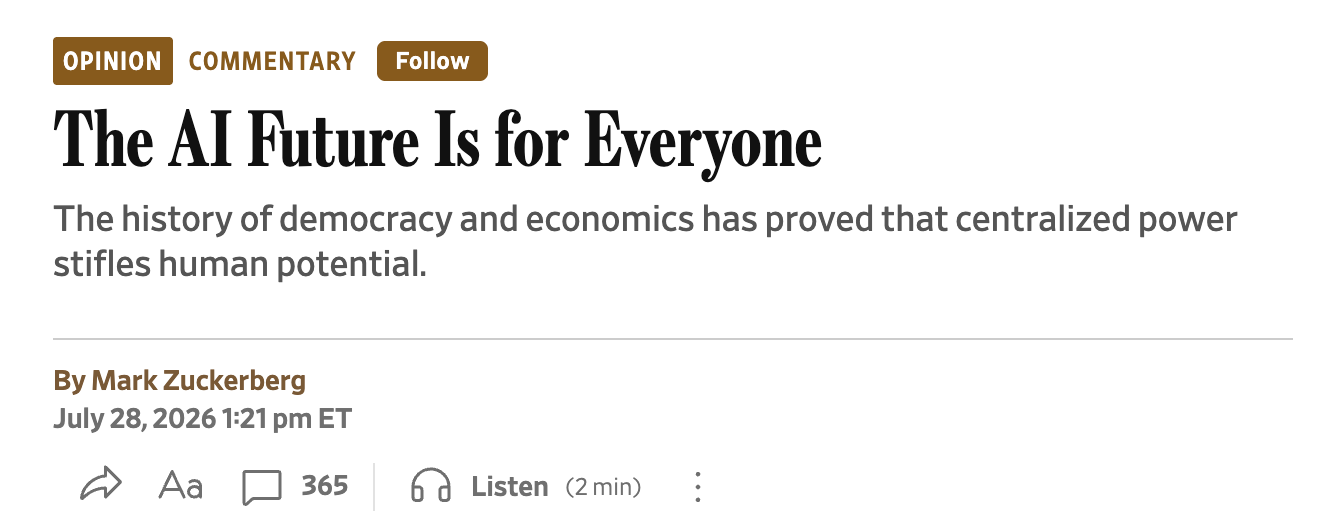
The article never mentions open-weight models directly, but it’s clear that’s what Zuckerberg is referring to when he talks about less centralised control.
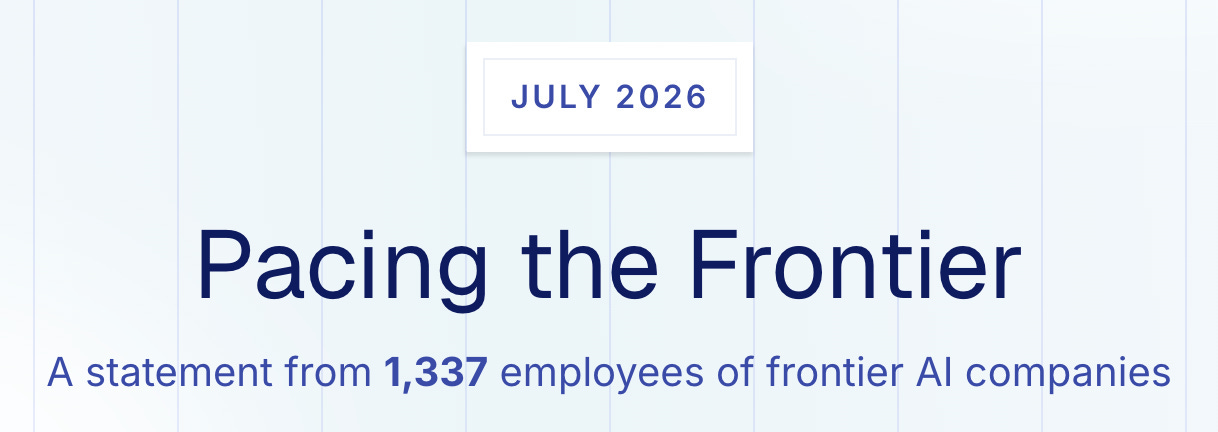
Finally, on the same day Zuckerberg’s article was being debated, more than 1,300 employees of the leading labs (OpenAI, Anthropic, Google DeepMind, Meta AI, Thinking Machines, Safe Superintelligence) signed “Pacing the Frontier“, a letter calling on the US government to lead an international effort to build the technical and governance tools needed to deliberately slow down AI development.
The four documents take apparently incompatible positions and give the impression of a debate about AI safety.
But read from another perspective, that of the balance sheets, it all looks perfectly coherent.
American AI companies have managed to build enormous value-creation engines. The credit for this new wave goes to OpenAI and in particular to Sam Altman, one of the few people in the world (probably the only one) capable of turning a scientific paper into the fastest-adopted, fastest-growing product in history: ChatGPT.
In the space of three years OpenAI and its main competitor Anthropic (born inside OpenAI) went from a couple of million to more than $30 billion in revenue each (and by the end of the year they’re expected to reach $100 billion)
Big Tech has completely reoriented its strategies (some aiming to build the infrastructure these companies need, others wanting to compete head-on, others still putting their distribution at their disposal) collectively investing more than $700 billion in capex
This gave a further enormous boost to the American venture capital system, which saw in these companies the chance for the highest returns in history, allocating 60% of all its funds in the first half of 2026 to OpenAI and Anthropic alone
OpenAI and Anthropic looked inevitable and invincible. Until Kimi arrived.
And at that point the problem became genuinely serious. Because an open model, at equal performance, is always preferable for companies, for these reasons:
Privacy and control: companies can run open models inside their own servers and adapt them to their needs, without compromises and without handing their data to whoever developed the model (I wrote about this in this episode of Technicismi)
Cost: according to Artificial Analysis’ Intelligence Index, Kimi 3 costs $0.94 against $1.80 for Claude Opus 4.8, less than half. And that’s just the price of the official API: anyone who downloads the “weights” and runs them locally on their own servers is effectively paying only for electricity and chips
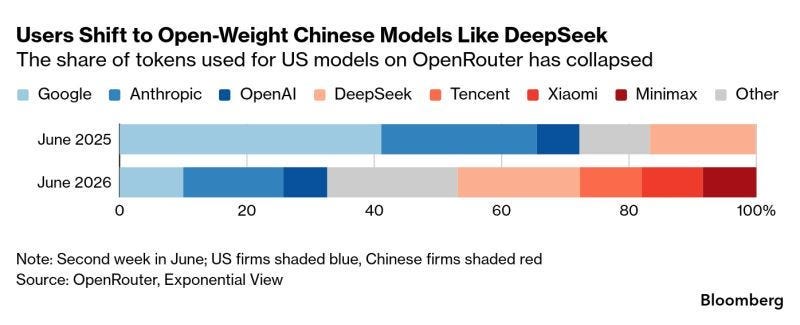
The catch is that, even though open models are more performant and more efficient, whoever releases them gives up the lock-in that’s typical of closed models, gives up the customer relationship, and drives switching costs down. Which is part of the reason the most performant open model in the world has $300 million in revenue but, above all, a $35 billion valuation after a $3.5 billion round.
In other words: the company that makes the most performant open model, MoonshotAI, is worth 3.6% of the company that makes the most performant closed model, Anthropic.
At this point American AI companies have only three options:
pretend nothing’s happening
start developing open models
ask the United States to ban Chinese open models
But if you’re a tech company that just three months ago asked investors for $120 billion (WITH A B!!), presenting a nice business plan full of charts pointing up and big numbers with lots of zeros, the last thing you want to do right now is reopen the Excel file, lower the numbers in the cells and send investors an update email saying those promised returns aren’t so certain any more…
And investors, even though that email hasn’t arrived yet, are already very anxious, because they’ve worked out for themselves that models are being “commoditised” far faster than anyone could have imagined: every time a new model comes out, within a few weeks all the others, open or closed, manage to match it and often surpass it. If that’s the case, the real game is no longer played at the model level, but above it, in the application layer, and below it, in the infrastructure (cloud and chips).
But trying, as Anthropic is doing, to maintain an “artificial” competitive advantage based on banning open models in the United States would be devastating not only for Anthropic itself, but for the entire American economy.
If Anthropic’s and OpenAI’s revenues depended on a regulatory barrier rather than a real competitive advantage, their valuations would collapse too, because the market would price them not as organic demand but as demand imposed by a monopoly (or duopoly).
The effect on the market would be more serious still, because every American company would be forced to buy AI from Anthropic or OpenAI at costs far higher than the Chinese alternatives. That would weigh on their balance sheets: compared with a European competitor free to use an open model, an American company would end up with a heavier cost structure. At that point the market would start investing in non-American alternatives, and the whole system would collapse.
The “open vs closed AI” debate is a discussion about which business model will survive, but it’s frightening because it calls into question the arithmetic the entire American economy currently rests on: “saving” Anthropic would certainly put that whole economy at risk. Not saving it could have similar consequences, bringing down the system that allowed it to emerge in the first place.
The famous flap of a butterfly’s wings in China that’s creating a hurricane in the United States.
Checkmate.

Support this newsletter 🫶
If you enjoyed this issue, you can click the little heart at the top!
And I’d love to discuss what you think of this newsletter in the comments below:

The toolkit
The most interesting things I read, listened to and watched this week:
Why compute might get 10x more expensive [Dwarkesh Patel]: a wonderful example of “first principles thinking.” I don’t have the technical knowledge to judge whether the conclusion he reaches is credible (plenty of people in the comments took care of that), but it’s a fine thought experiment nonetheless, both for 1. trying to imagine the future and 2. taking inspiration on how to write a Substack blog
Elon Musk’s first interview after SpaceX’s IPO [The Economist]: pretty much everyone covered this one — two worldviews colliding, looking at the future from very different vantage points. What I can’t help being drawn to is Musk’s optimism, which stands out all the more when set against the combative, negative stance of The Economist’s Editor-in-Chief
ByteDance’s big AI bet [Financial Times]: TikTok’s founder has ambitions well beyond being “the Chinese Meta.” Zhang Yiming wants to turn his company into China’s AI leader, developing its own models, cloud infrastructure and custom chips
Xi Jinping may be the great tech VC [The Economist]: following CXMT’s listing, The Economist devotes a piece to China’s entrepreneurial vision and to the choices of a leader who has converted political priorities into direct bets on the private market, particularly in strategic sectors like semiconductors, electric vehicles and AI. Even if all this still isn’t translating directly into greater prosperity for the population
No posts
Comments
Nothing yet. Say the first thing.
Sign in to join the conversation.