
For years, Siri has been one of Apple’s biggest weaknesses.
While competitors moved toward AI assistants that could hold conversations, analyze information, and complete complex tasks, Siri often struggled with basic requests.
Now Apple is trying to change that.
The company’s new Siri AI promises a completely rebuilt assistant:
More natural conversations.
Better understanding.
Access to personal information.
The ability to interact with apps and files.
But early testing shows a mixed picture.
The new Siri is smarter.
It is just not fully there yet.
The biggest change is that Siri no longer behaves like a simple voice command tool.
It now works closer to ChatGPT, Gemini, and other AI assistants.
Users can:
• Ask follow-up questions
• Continue previous conversations
• Search personal data
• Analyze files
• Control system settings
The difference is that Apple is positioning Siri less as a chatbot and more as an intelligent assistant built into the operating system.
Instead of casual conversations, Siri focuses on completing tasks.
Basic knowledge questions work much better than before.
When asked about historical topics, Siri provided short explanations, key points, and even sources for verification.

It also handled device-related requests effectively.
For example, it could:
• Find calendar appointments
• Change system settings
• Search through device information
• Summarize content on the screen
This is where Apple’s ecosystem advantage becomes clear.
Siri is not just answering questions.
It can actually interact with the user’s device.
The biggest issue is accuracy.
During testing, Siri struggled with several tasks.
Finding photos was inconsistent.
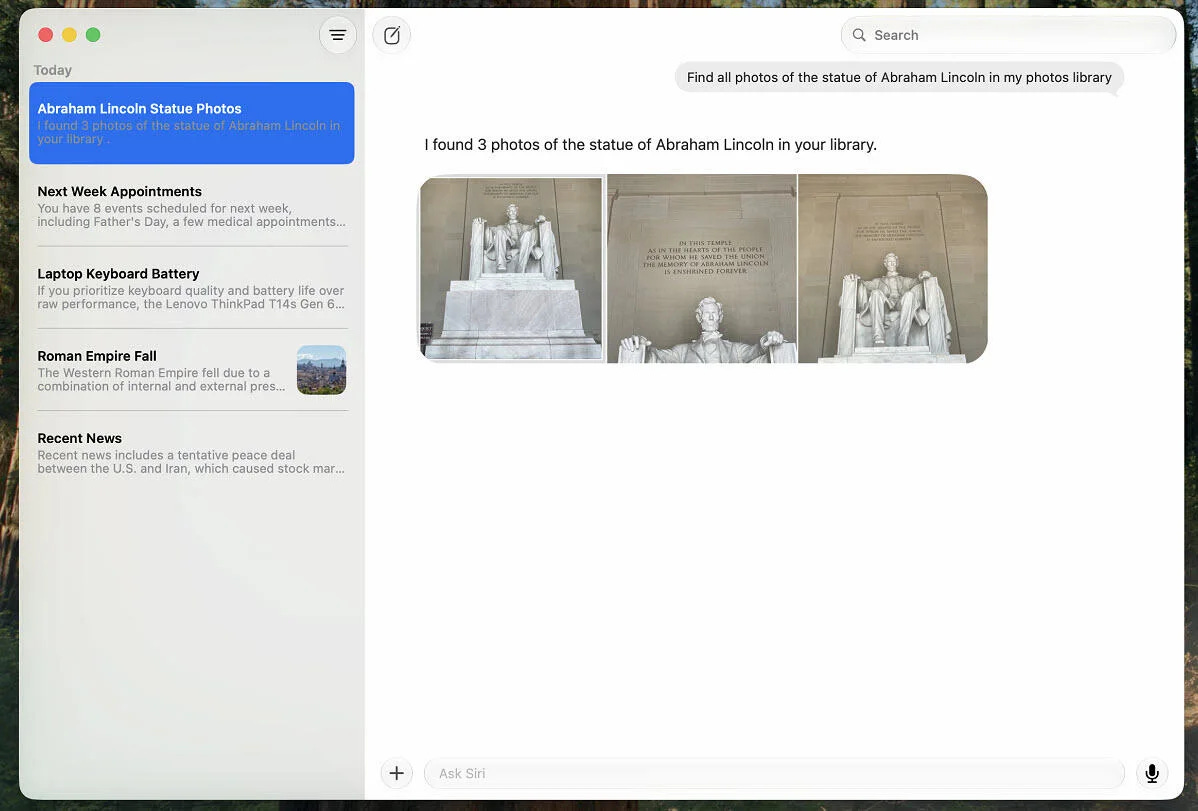
The assistant located some relevant images but missed others that matched the request.
File analysis also produced mistakes, including incorrectly identifying artwork and artists.
These problems show that Apple still has work to do before Siri can become a fully trusted assistant.
AI assistants are only useful if users can rely on the answers.
Apple improved Siri’s ability to understand context, but the conversation experience still feels behind other AI tools.
Instead of a smooth back-and-forth discussion, users often need to manually activate the microphone again after each response.
The assistant can answer questions.
But it does not yet feel like a natural conversation.
That difference matters because modern AI is moving toward continuous interaction.
One interesting discovery is that Siri’s performance depends heavily on the wording of the request.
Simple prompts sometimes produced weak results.
More specific instructions often generated much better answers.
This is similar to other AI systems.
The model may be powerful, but users still need to understand how to communicate with it effectively.
The new Siri shows that Apple is finally catching up in AI.
But catching up is different from leading.
The company has strong advantages:
• Deep integration with hardware
• Access to personal device data
• Control over the entire ecosystem
However, competitors have spent years improving conversational AI.
The challenge is no longer creating an assistant that can answer questions.
It is creating one users can trust with everyday tasks.
Siri AI is a major improvement over the old version.
But the first tests show a product still in development.
The foundation is there:
A smarter assistant.
Better device integration.
More powerful capabilities.
The next step is making it consistent.
Because the future of AI assistants will not be decided by who can generate the best answers.
It will be decided by who can become reliable enough to handle real life.

US export restrictions were designed to protect America’s AI advantage, but the early result may be pushing global buyers toward alternatives. Companies like Cohere and Mistral are now positioning themselves as providers of AI that cannot be restricted by US policy, turning Washington’s controls into a selling point for competitors.
At the same time, Chinese AI companies are gaining momentum, with major funding rounds, cheaper open-source models, and aggressive price cuts making diversification more attractive. The bigger shift is that AI access itself is becoming a strategic factor: governments and companies are no longer just choosing the best model, they are choosing who controls it and whether that access can disappear.
Anthropic spent months arguing that advanced AI models need stronger safeguards. This week, that debate became reality when US export controls forced the company to restrict access to its newest models after security concerns around potential jailbreaks and cyber capabilities. The move changes the AI race: model quality is no longer the only advantage, because regulation can determine who is allowed to use the most powerful systems.
The same tension is spreading across the industry. OpenAI is facing scrutiny over safety, user data, and how its models are deployed, while security researchers are finding that AI agents create new risks as they gain access to developer tools and sensitive systems. As frontier models become more powerful and more regulated, the key question is shifting from “Is the model better?” to “Who controls it, what can it access, and who decides where it can be used?”

Squoosh is a free image compression tool from GoogleChromeLabs. It helps reduce image file size while maintaining good quality.
It is especially useful for bloggers, website owners, and anyone who wants faster-loading webpages.
That’s it for today.
AI is moving fast - models are getting better, tools are getting cheaper, and the gap between “people who use AI” and “people who don’t” keeps widening.
The only real advantage left is speed of learning.
Until next time: stay AI smart, stay ahead, and keep building with the future instead of reacting to it.
No posts
Comments
Nothing yet. Say the first thing.
Sign in to join the conversation.