

AI has officially entered everyday life.
Millions of people now use AI assistants for work, research, entertainment, and even personal conversations.
But there is a surprising contradiction:
The more people use AI, the more worried they seem to become about it.
A new Pew Research Center survey of 5,119 U.S. adults reveals that AI adoption is accelerating, but trust is falling behind.
Nearly half of U.S. adults (49%) say they now use AI chatbots.
That is a major jump from 2024, when only about one-third of Americans reported using them.
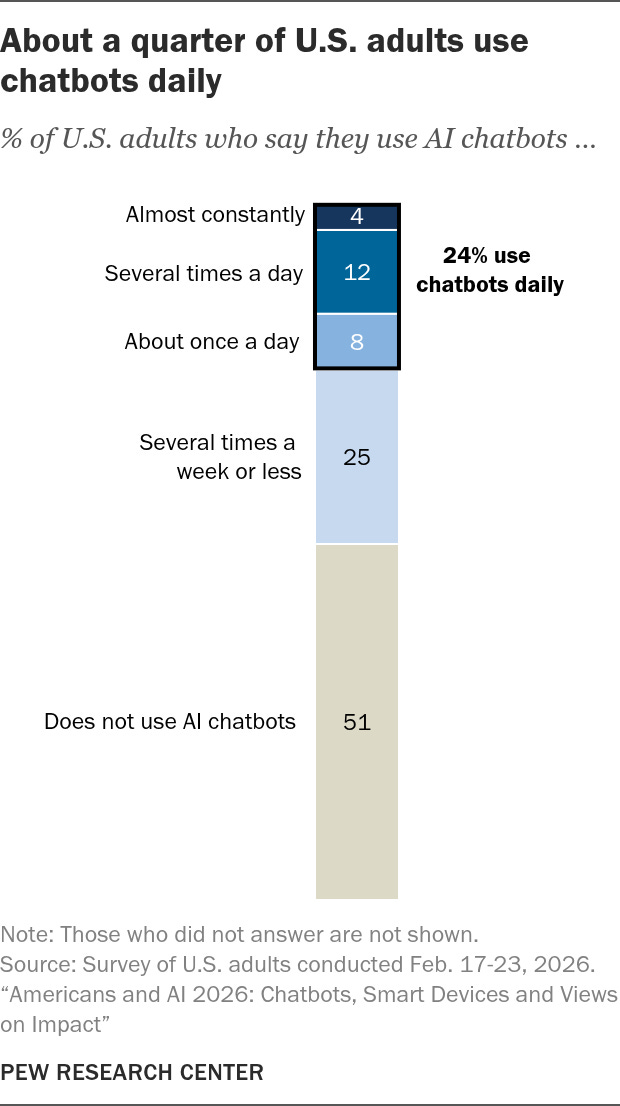
AI is also becoming part of daily routines:
• 25% use AI chatbots every day
• 12% use them multiple times per day
• 4% say they use them almost constantly
The biggest driver?
Information.
Many people are using AI as a new search engine.
42% of adults say they use chatbots to find information, while 38% of employed adults use them for work-related tasks.
Among AI assistants, ChatGPT remains the clear leader.
44% of U.S. adults say they use ChatGPT, more than double the number from 2023.
Google Gemini follows behind.
Other major AI tools include:
• Microsoft Copilot
• Meta AI
• Grok
• Claude
Interestingly, Claude, despite being popular among AI enthusiasts and developers, has much lower awareness among everyday users.
The people using AI the most are not necessarily the ones who trust it the most.
Young adults are leading adoption.
Among people under 30, 66% use AI chatbots.
But this same group is also highly skeptical about AI’s long-term impact.
48% of adults under 30 believe AI will have a negative impact on society over the next 20 years.
Older adults are less concerned, with 30% of people over 50 sharing that view.
This creates an interesting paradox:
The generation most comfortable using AI is also the generation most worried about where it leads.
AI is no longer just a productivity tool.
Some people are using it for emotional support.
Around 10% of Americans say they use chatbots for emotional support.
Among adults under 30, that number rises to around 20%.
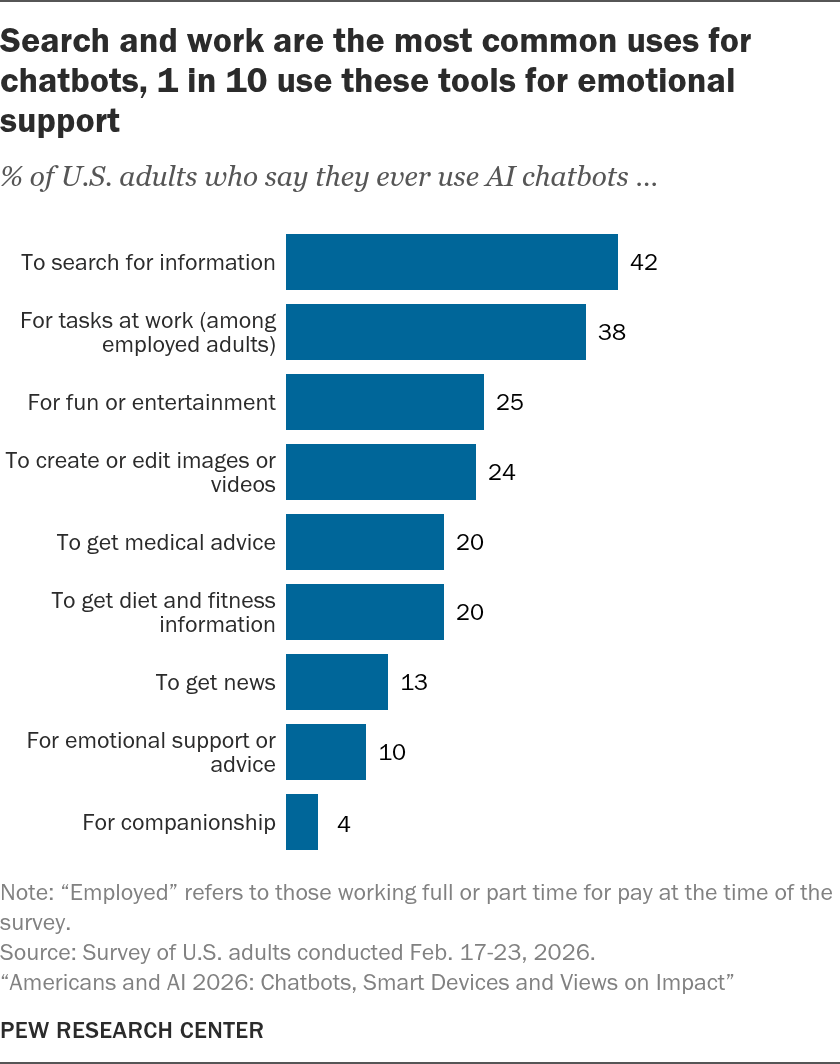
Some even use AI for companionship.
This raises a bigger question:
Are AI assistants becoming tools, or are they becoming a new type of relationship?
The main concern around AI is not job replacement.
It is personal data.
71% of Americans believe AI will make their personal information less secure.
Only 3% think AI will improve data safety.
People also remain skeptical about whether companies and governments can manage the technology responsibly.
67% say they have little or no confidence in the U.S. government to regulate AI effectively.
59% lack confidence in companies developing AI responsibly.
The majority opinion is clear:
AI development is happening faster than society can handle.
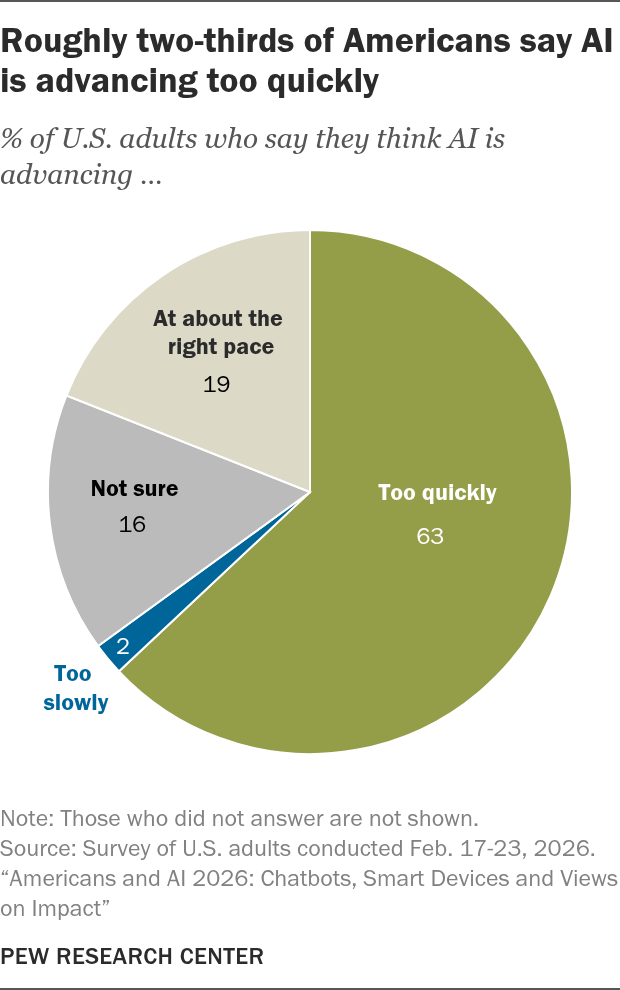
63% of Americans say AI is advancing too quickly.
Only 2% believe it is moving too slowly.
This feeling exists across demographics.
Different groups may disagree on many issues, but most Americans share one concern:
AI is changing faster than people can adapt.
Even people who do not actively use AI chatbots are interacting with AI daily.
Millions of Americans already use AI-powered devices:
• Smartwatches
• Smart speakers
• AI-powered doorbells
• Robot vacuums
• Smart thermostats
60% say they have already seen AI-generated summaries in search results.
In many cases, people are using AI without even realizing it.
About half of Americans say they do not use chatbots.
The reasons are revealing:
• 60% say they are simply not interested
• 54% worry about privacy
• 45% do not trust AI accuracy
• 29% do not know how to use it
The interesting part?
Most non-users do not seem eager to join.
67% say they are unlikely to start using AI chatbots in the next year.
AI adoption is happening.
The bigger challenge is trust.
People are bringing AI into their work, homes, and personal lives faster than ever.
But they are still asking important questions:
Can AI be trusted with our data?
Can it make accurate decisions?
Can companies build it responsibly?
The future of AI may not depend only on making models smarter.
It may depend on making people feel comfortable using them.

Discover how you can leverage ChatGPT to boost efficiency, streamline tasks, and stay ahead in your industry.
Supercharge your productivity with HubSpot’s comprehensive guide.
Don’t forget to download the file on your email.

OpenAI is previewing its upcoming GPT-5.6 series to selected partners, with three versions: Sol, its most advanced model for reasoning and cybersecurity; Terra, a cheaper everyday model similar to GPT-5.5; and Luna, a low-cost version. Sol adds a deeper reasoning mode and stronger protections after extensive testing against jailbreaks and cyber risks.
The preview comes as AI companies face growing government scrutiny over powerful models. OpenAI says it gave officials early access but does not want this to become the permanent standard. GPT-5.6 will launch publicly in the coming weeks with significantly lower pricing than Anthropic’s restricted models.
Microsoft has resumed automatically installing the Microsoft 365 Copilot app on commercial Windows 11 devices with Microsoft 365 software installed. The app arrives through the Office update system, not Windows Update, and gives organizations little warning unless IT admins disable the rollout manually. It is not the Windows Copilot sidebar, but a redesigned Office hub with AI features built in.
The rollout will begin reaching more devices through late June and early July, with EEA customers excluded due to regulatory concerns. Companies can block the installation through the Microsoft 365 admin center, but the default setting is enabled, creating extra work for organizations that are not ready to adopt Copilot.

CamelCamelCamel helps you check Amazon price history and track price drops.
Before buying an expensive product, you can see whether the current price is really a good deal or not.
That’s it for today.
AI is moving fast - models are getting better, tools are getting cheaper, and the gap between “people who use AI” and “people who don’t” keeps widening.
The only real advantage left is speed of learning.
Until next time: stay AI smart, stay ahead, and keep building with the future instead of reacting to it.
Get your brand in front of 23,000+ AI readers.
No posts
Comments
Nothing yet. Say the first thing.
Sign in to join the conversation.