

I was at the dentist last week. She was cleaning my teeth. She asked me what I do.
This is a question I have grown to dread, because what I do is a confusing combination of running a tech company and writing a newsletter about AI for non-tech people, and the explanation usually takes the entire teeth-cleaning. But the dental hygienist — her name was Zeel — seemed genuinely interested, and there’s not a lot to do during a teeth cleaning, so I told her.
I told her about my niece, the bedtime story, the eleven minutes, the moment. I told her this very simplified version of the newsletter — the part about AI for the people you love, not the loud version. The version I tell people at dinner parties when I’m tired.
She turned off the little water tool. She set down her thing. She looked at me with the mirror light still on, which is a slightly intimidating angle to be viewed from. And she said:
I made my niece a card last week with that thing on my phone.
Then she went back to cleaning my teeth.
I didn’t say anything for a minute, because I was being cleaned, but inside I was rearranging my entire mental map of who is using this technology and how. Zeel has been a dental hygienist for eleven years. She is, by every visible signal, the demographic the AI conversation never talks about. thirty-something woman, regular city life, not in tech, doesn’t know how to code, has never been on Hacker News.
And she made her niece a card.
She didn’t say what kind of card. She didn’t explain the process. She didn’t ask me which model she should use, whether her prompt structure was efficient, or what the next big tool would be. She told me, the way one mentions buying milk, that she had made her niece a card with that thing on her phone last week.
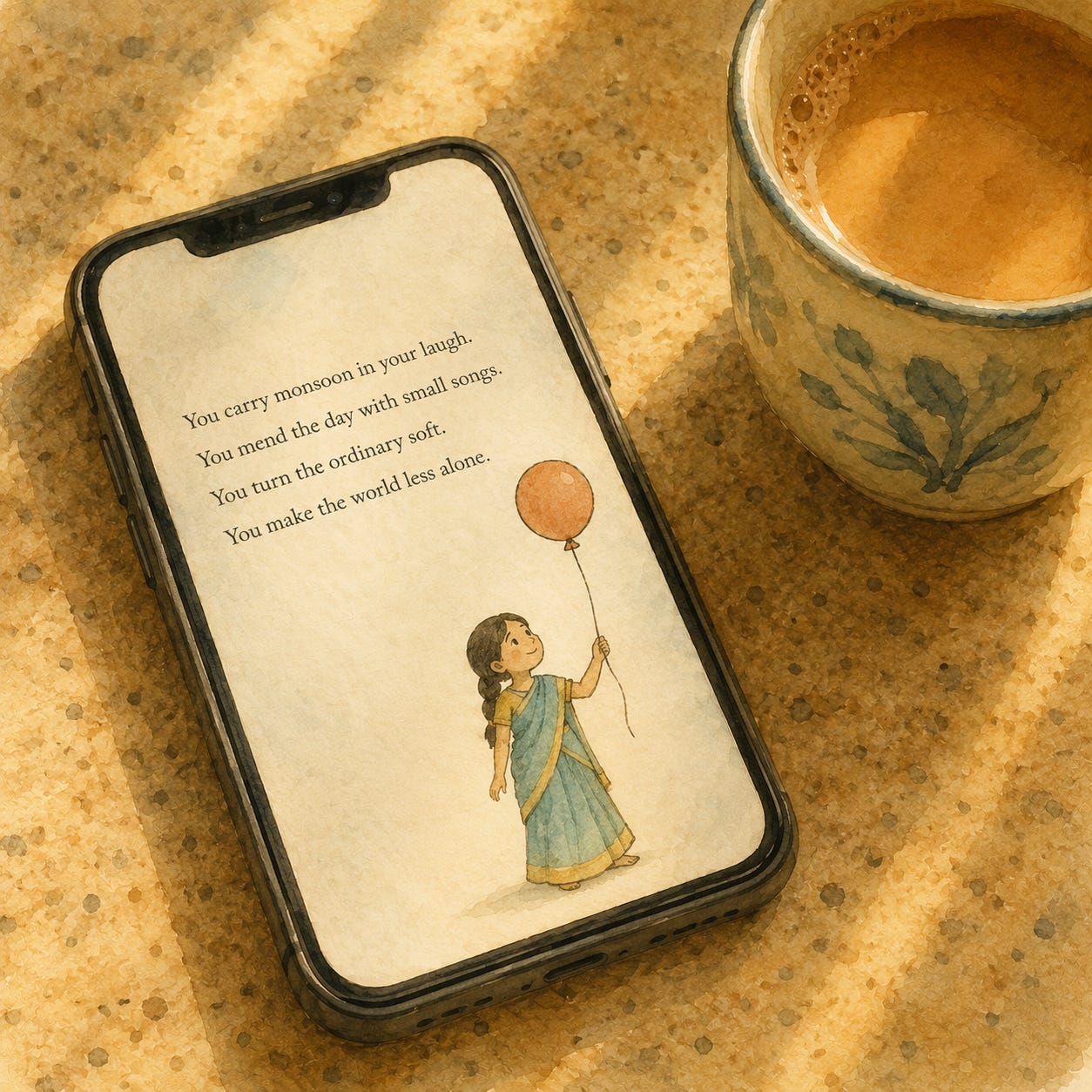
When the cleaning was done, I asked her about it. She showed me on her phone. It was a four-line poem and a picture, and the picture was a cartoon of a small girl in a sari holding a balloon, and the four-line poem was sweet and slightly weird in the way these things are slightly weird, and Zeel said her niece had stuck it on the fridge and her sister had called crying.
She said: I didn’t tell anyone I made it that way. It felt like cheating.
I told her it isn’t cheating. She said: Yeah, my niece doesn’t think so either.
I keep thinking about Zeel, two weeks later. Because the version of AI I keep meeting at conferences and on panels and on the loud internet is a version that does not contain Zeel. It contains engineers, and founders, and analysts, and policy people, and worried writers, and excited builders, and skeptical artists. It does not contain dental hygienists who made their niece a card last week with that thing on their phone.
Thanks for reading AI for Fun! This post is public, so feel free to share it.
But the dental hygienists are using it. So are the plumbers, and the high school teachers, and the social workers, and the moms in WhatsApp groups, and the grandfathers learning English on Duolingo, and the cousins who beat us all to it without telling anyone.
They are not waiting for the right tool or the right tutorial. They are just making cards for their nieces. Quietly. On the bus, on a lunch break, while waiting for the bread to rise.
I think there is going to be a lot more of this than anyone realizes. I think the part of the AI story that gets written in the next ten years is not going to be the part that gets reported. It’s going to be the part Zeel is already living. The part where the dental hygienist made her niece a card.
That’s the part I want this newsletter to keep noticing.
I’m really glad you’re here.
— Tapan (TC)
PS — Has someone surprised you lately with how they’re quietly using AI? The dental hygienists are everywhere. Tell me about yours.
Comments
Nothing yet. Say the first thing.
Sign in to join the conversation.