
I keep writing about what AI is good at, in this small, joyful corner of technology. Today I want to do the opposite. Here are five things AI is still not good at, with specifics, so you know where to push it and where to take over yourself.
This isn’t a complaint. AI is the most powerful new tool in any of our lifetimes. But pretending it can do everything is how you end up with a song with the wrong marine mammal, or a letter that sounds like a slightly different person than you, or a bedtime story where the kid’s brave moment doesn’t quite land. Knowing where the tool stops makes the things it can do feel more like what they are — gifts, not magic.
1. Your specific voice.
The first thing AI is bad at is sounding like you. It can sound like a competent generic human. It can sound like the average of a thousand people who’ve written things vaguely like the thing you’re trying to write. What it cannot do, without a lot of help, is sound like you — your phrasings, your hesitations, your way of starting a thought halfway through, your weird little tic of always overusing the word “actually.”
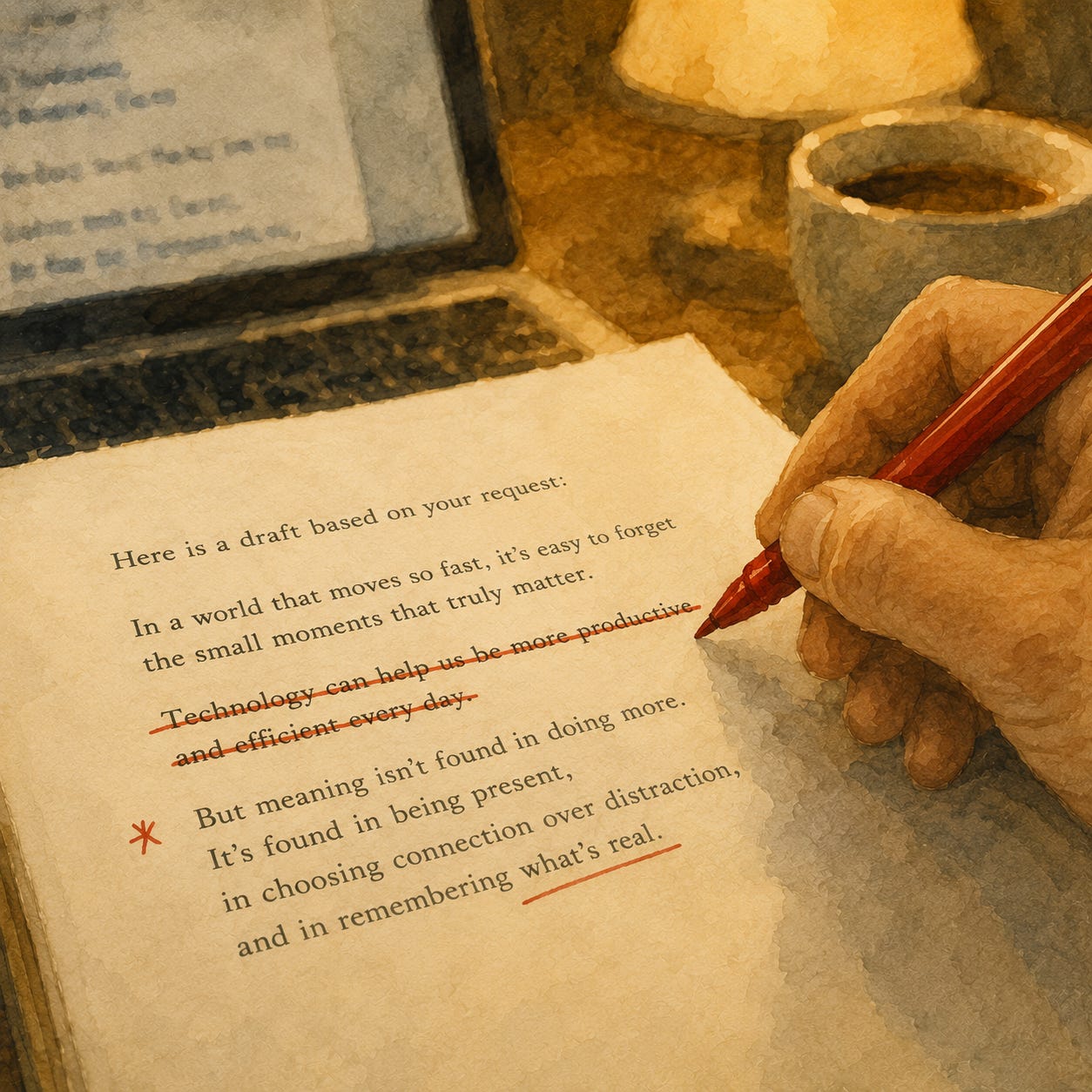
The fix: write the AI’s first draft, then read it aloud. Cross out every line that doesn’t sound like you. Rewrite those lines in your own words. The result will be 70% AI, 30% you, and the 30% you is the part that makes it land.
2. The right amount.
AI does not know when to stop. Ask it for a poem, and it will give you four stanzas. Ask it for a card, and it will give you a paragraph. Ask it for a letter, and it will give you two pages. Almost always, the right version is shorter than what came back. Shorter is more emotional. The single sentence at the end of a card lands harder than the four-paragraph appreciation letter that tries to say everything.
The fix: cut the first draft in half. Then cut what’s left by another quarter. What’s left is usually the version that works.
3. Knowing the specific person.
You can tell AI a lot about somebody — their name, their job, their birthday, their favorite color, their relationship to you. What you cannot tell is the specific texture of knowing them for thirty years. The phrase only the two of you use. The thing that’s funny is only because of the time you got lost in Lisbon. The shorthand. The grudges. The history.
The fix: give the AI a starting structure, then add the specific details by hand. The AI gives you the bones. You give it the marrow.
4. Restraint.
AI’s default temperature is enthusiastic. Everything it makes is a little too bright, a little too smooth, a little too “this is wonderful, you are wonderful, your friend is wonderful, this song is going to be amazing.” That cheerful tone is fine for some projects and wrong for others. A love letter shouldn’t sound like a marketing email. A memorial poem shouldn’t sound like a graduation card. A note about something hard shouldn’t sound like a pep talk.
The fix: explicitly ask it to be more restrained. “Make it understated.” “Don’t be sentimental.” “No exclamation marks.” Tell it the emotional register you want, and it’ll mostly get there.
5. Knowing when not to use it.
This is the most important one. AI is not the right tool for some moments. It’s not the right tool for the call to your dad after the doctor’s appointment. It’s not the right tool for the conversation you owe your spouse. It’s not the right tool for the last words you say to someone in a hospital bed. It is not, in any meaningful sense, the right tool for being there.
The fix: there is no fix for this one, because it isn’t a fix. It’s just a thing to remember. The technology helps you make things for the people you love. It does not replace being one of those people.
I’ll keep writing about what AI can do. But every few weeks I want to come back here and write about what it can’t, because the can’t-do list is part of being honest about the tool.
The newsletter you can trust about what AI is good at is the same newsletter that will tell you what it’s bad at. That’s the whole job.
I’m really glad you’re here.
— Tapan
Thanks for reading AI for Fun! Subscribe for free to receive new posts and support my work.
PS — Have you run into something AI is just bad at, in the personal-use corner? Tell me. The list is going to keep growing.
Comments
Nothing yet. Say the first thing.
Sign in to join the conversation.