
I’m sharing a new publication with y’all that is co-authored by Larry Davis and myself.
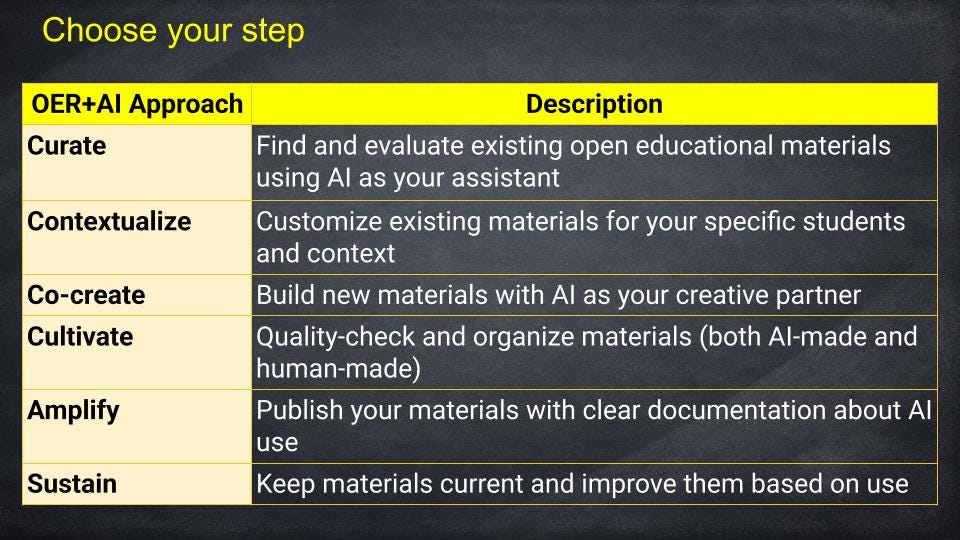
Expanding OER with GenAI in EDUCAUSE Review dropped this week and we’re excited to share it with the world! The piece explores some of the questions and opportunities that generative AI might provide us in the space of open educational resources. Furthermore, it provides a framework for faculty to use to get started and exploring GenAI for the purpose of OER.
In this post, we’re going to share a little bit about our thoughts about the piece and why we wanted to write it. We threw together a few questions and you can see our answers below. We wrote these separately but wanted to place them together as a kind of look at where we both came from in this work.
Where did the idea come from?
Larry: The idea for the article was Lance’s brainchild. It grew out of conversations we had about AI and OER that began when we prepared and taught an AI/OER course for EDUCAUSE. More broadly, Lance and I have been talking about teaching and learning—including OER—for roughly fifteen years. Now that AI is part of the landscape, it has taken that long‑running conversation to a new level.
Lance: Since AI came out, the question about its relationship with open educational resources has been on my mind, especially as the legal questions continue to loom. In 2024, I was approached by two opportunities to dive into thinking about it. The first was a from colleagues at UMass Lowell, Framingham State University, and Northern Essex Community College to do a talk and workshop for their Career and AI Readiness while Remixing Open Textbooks through an Equity Lens grant. Coupled with that, I was invited to develop a program for EDUCAUSE, Applying Generative AI to Open Educational Resources: Enhancing Learning and Solving Ethical Challenges.
Around the same time, Larry and I were chatting about this intersection of OER and AI. We had long been advocates and collaborators around OER and its benefits, going back more than a decade. We had also been tinkerers with technology and considering its implications for learning, going back to 2010 when we did our first presentation together (on blogs and wikis and why we should think about them in our teaching).
After developing the course and leading into the talk and workshop, I began to adapt the Adopt, Adapt, Build framework as a way for faculty to step into it. I eventually shared that here.
At that point, Larry and I realized there was something more robust to say and so we started writing.
Why was it important to write about?
Larry: OER has had a transformative impact on higher education. In my own teaching, it has removed paywalls and the high cost of textbooks that created inequities in student access, while giving students more direct and flexible ways to engage with course materials—something traditional textbooks often can’t match. AI introduces new possibilities for OER by expanding its “range and impact,” a theme the article highlights. It also raises essential questions for the AI era: How can faculty ensure their use of AI remains “human‑centric”? How should they navigate copyright concerns? What do AI and OER contribute to effective pedagogy? And which AI tools are truly necessary for meaningful learning?
Lance: AI opens up so many questions and so many directions in general, and doubly so when it comes to OER. Everything’s overwhelming these days. And I can remember back to being in a room at UMASS Medical when Kim Thanos discussed the Adopt, Adapt, Build framework. Its clarity and simplicity was incredibly helpful and would serve as a model for my own approach to OER as well as scores of faculty to help them think about how they step into that work.
If we could find another way of creating easy or relatable first steps into the work, then I thought it was important to create it and share it. Like so many of the things that I try to put into the world, I don’t expect it to be perfect, but I do expect that it will be helpful for those trying to sense make.
Share AI + Education = Simplified
What are you most proud about this work?
Larry: The collaboration itself has been both energizing and enjoyable. I’m thrilled that my first co‑authored article on this topic is with Lance—every meeting felt like a mini‑graduate seminar where he pushed me to rethink my assumptions. I believe this piece makes a meaningful contribution because it speaks to multiple stakeholders: faculty, instructional designers, librarians, and administrators. It is a rigorous piece of scholarship that I hope will engage all readers.
Lance: I know I wrote the question with the idea of being “most proud”, but I’m going to share three.
The first is that I think this helps to make things a bit clearer in terms of the relationship between AI and OER and where educators can use AI effectively and appropriately to support OER.
The second is that it is now my 6th publication with EDUCAUSE Review and all of them have been collaborations with colleagues and friends whom I deeply respect and get to learn with through this writing process.
The third is that I’ve gotten to collaborate and publish with Larry. He has been a mentor, colleague, and friend for decades whom I’ve learned much from and have appreciated the care, thoughtfulness, and humor he brings to the work of education.
Has anything changed in terms of what you wrote when you wrote it and now?
Larry: I don’t think anything has changed fundamentally. However, I am increasingly concerned that more faculty may end up feeling alienated because their institution lacks the capacity to engage with GenAI in a meaningful way. We noted this risk in the article, but it deserves deeper exploration. At many institutions, a small group of “pioneers” is taking on the GenAI challenge, while a much larger group of colleagues chooses to remain on the sidelines for a variety of reasons. Ensuring that faculty can participate in ways that genuinely empower them will be essential for their success and their students’ success.
Lance: I have fewer considerations about what has changed since we wrote it and more about where to go next. There’s still a lot of questions left on the table about how to do this and how to do it well. [Maha’s post–with permission].
I think the framework is a good start, but continue to think about what does AI offer us (students and faculty) for the ability to mold our own learning tools, and how might that change how we think of classrooms. Could it move us towards the classroom increasingly as learning labs?
About Larry Davis
Larry is a Professor of History at North Shore Community College in Danvers, Massachusetts, where he teaches world history, European history, and Russian history. He also serves on the Advisory Council in the Center for Teaching, Learning, and Innovation. In 2025, he completed a certificate in E‑Learning and Instructional Design at the University of California, Irvine.
Upcoming Sightings & Shenanigans
Keynote speaker at the Reimagining the Liberal Arts in the Age of AI Conference, July 21-23 at the University of Mary Washington.
EDUCAUSE Online Program: Teaching with AI. Virtual. Facilitating sessions: ongoing
Recent Recordings, Resources, & Writings:
Davis, L., & Eaton, L. (May 2026). Expanding OER with GenAI. EDUCAUSE Review.
AI x Higher Ed Podcast with Anand Rao & Stefan Bauschard. Episode: Universities Must Adapt to AI—Here’s How They’re Doing It (May, 2026)
Damm, C., & Eaton, L. (2026, March). From prompt to practice: A framework for transparent GenAI use in higher education. EDUCAUSE Review.
Eaton, L., Nemeroff, A., & Sun, X. (2026). AI-assisted course design and development. In K. S. Ives, M. Cini, & R. Schroeder (Eds.), AI applications in online higher education administration: Strategies for maximizing returns and improving outcomes. Routledge.
Margin of Thought with Priten: Season 1, Episode 5: How Can We Center Pedagogy During the AI Tech Wave? (February 2026)
Online Learning in the Second Half with John Nash and Jason Johnston: EP 39 - The Higher Ed AI Solution: Good Pedagogy (January 2026)
The Peer Review Podcast with Sarah Bunin Benor and Mira Sucharov: Authentic Assessment: Co-Creating AI Policies with Students (December 2025)
David Bachman interviewed me on his Substack, Entropy Bonus (November 2025)
The AI Diatribe Podcast with Jason Low (November): Episode 17: Can Universities Keep Pace With AI?
The Opposite of Cheating Podcast with Dr. Tricia Bertram Gallant (October 2025): Season 2, Episode 31.
The Learning Stack Podcast with Thomas Thompson (August 2025). “(i)nnovations, AI, Pirates, and Access”.
Intentional Teaching Podcast with Derek Bruff (August 2025). Episode 73: Study Hall with Lance Eaton, Michelle D. Miller, and David Nelson.
Dissertation: Elbow Patches To Eye Patches: A Phenomenographic Study Of Scholarly Practices, Research Literature Access, And Academic Piracy
AI Syllabi Policy Repository: 200+ policies (always looking for more- submit your AI syllabus policy here)
Finally, if you are doing interesting things with AI in your higher ed classrooms, consider being interviewed for this Substack or even contributing. Complete this form, and I’ll get back to you soon!
We periodically host small-group workshops and leadership sessions for higher ed teams. You can learn more about our current offerings here.
AI+Edu=Simplified by Lance Eaton is licensed under Attribution-ShareAlike 4.0 International

Comments
Nothing yet. Say the first thing.
Sign in to join the conversation.