
Last week, I had the honor to be one of the keynote speakers at University of Mary Washington’s Reimagining the Liberal Arts in the Age of AI Conference. It was a fantastic two-day conference that include an opportunity to hear some other voices (who will be featured here in the future) as well continue along a train of thought I’ve been working on since last summer. The talk, From Awakening to Building: Liberal Arts “Next Moves” for Teaching and Learning in the Age of AI built upon my two previous talks regarding AI and the liberal arts.
Of course, the slides are available here and I’ll be including some of them below for proper effect. If you want the TL/DR (then what are you doing here?—lol), the Fredricksburg Free Press actually covered the conference and my talk.
You’ll see I had a lot of fun with this talk—maybe too much fun?
And before we start, I have to say that the following is a provocation. Not to dismiss or undermine higher education and the liberal arts. I love them both deeply and have spent a good deal of my life connected and uplifting them. Rather, it’s here to push us to be more true to our beliefs that I think we are at times. It’s a call for us to consider different paths in front of us.
Picture this with me: A stylish function hall. The kind of place that they hold weddings, proms, and even craft fairs. You got that in your head; great. It looks something like this:
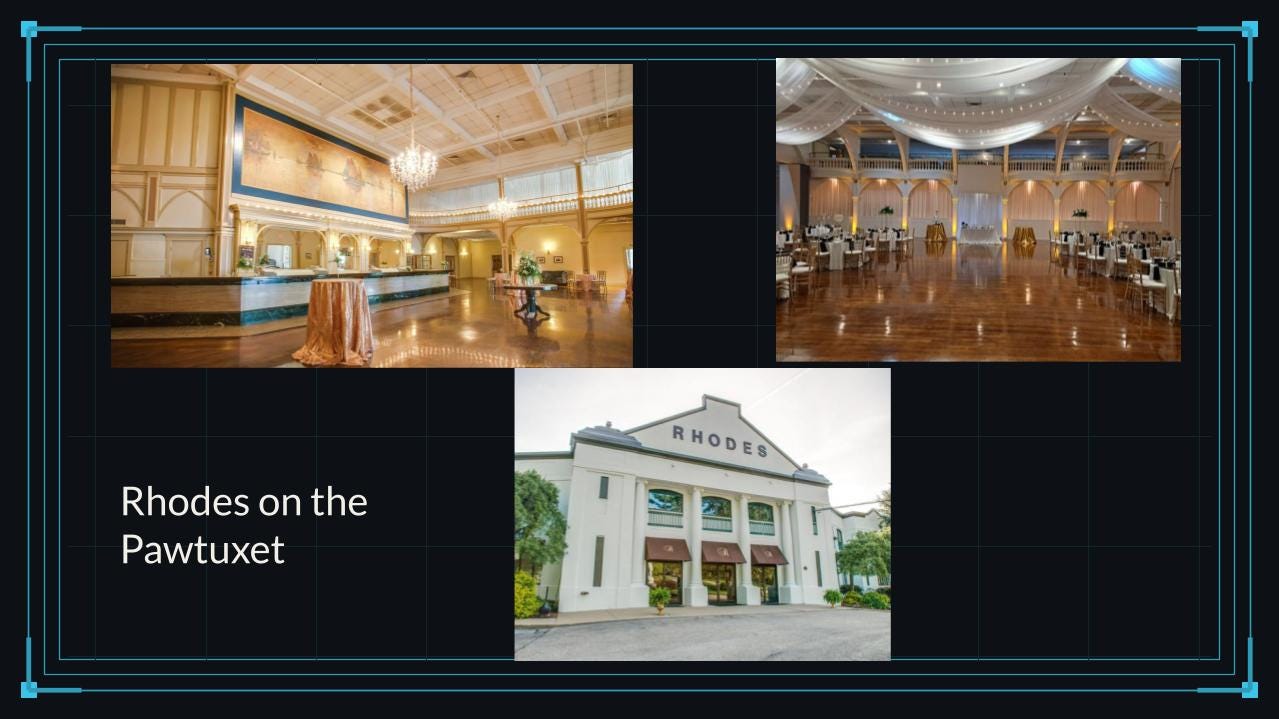
Now, instead of chairs and tables and maybe a band ready to play, it’s filled with a giant wrestling ring. At the center of it all, two enormous human beings are pretending, and I do mean pretending, to try to destroy each other.
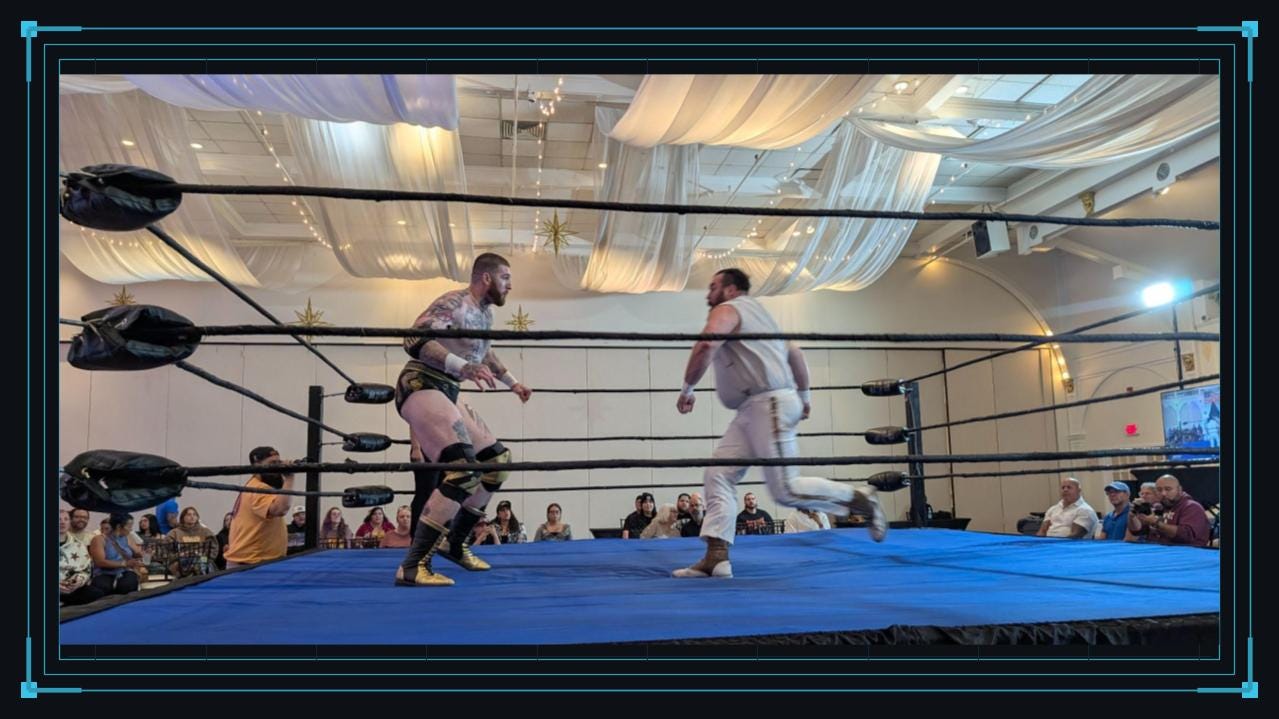
Next to me happens to be my spouse and our 9 year old nibbling; people who would stop the car to help a turtle cross the road. They are on their feet, screaming for someone to get hurt.
They know it’s fake. They know the posturing is fake. They know the folding chair is a prop. They know the villain and the hero rehearsed this backstage an hour ago and will probably share a drink after. They know all of it. And they are still screaming.
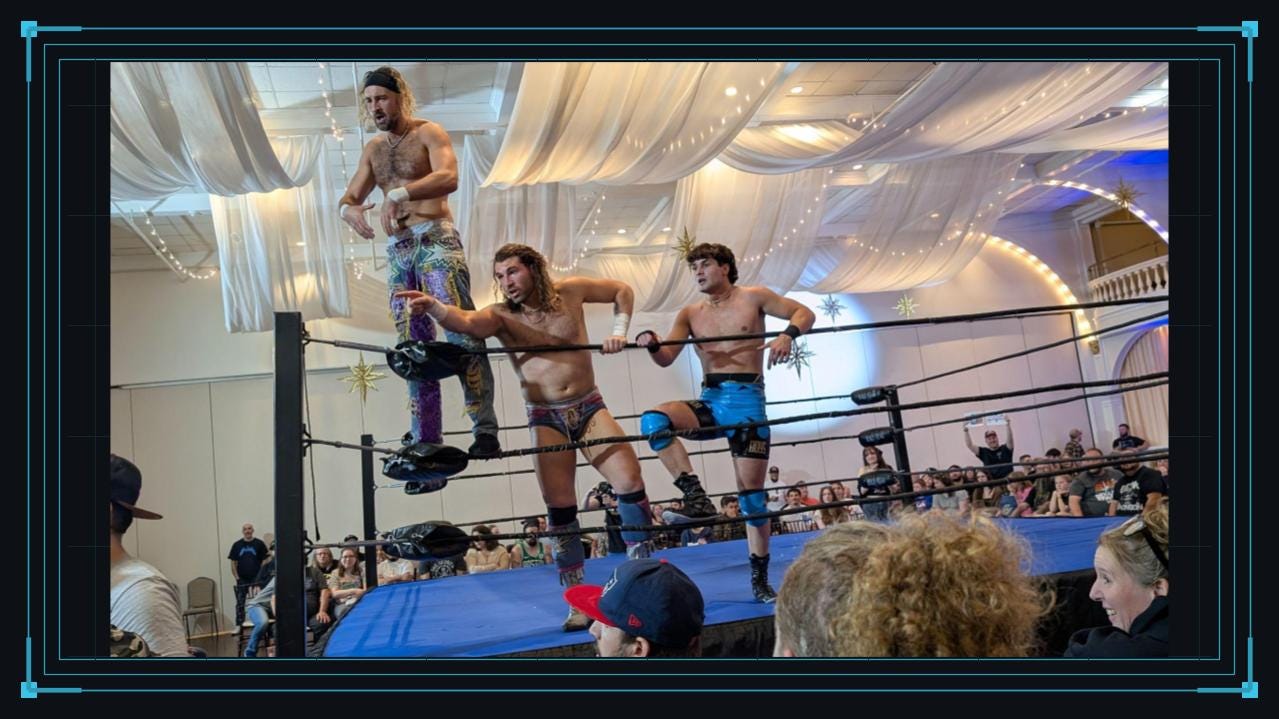
I want to hold us in that hall this morning because I’ve come to believe that we, all of us in higher ed, have been standing in a hall a lot like it for about four years now.
We came in. We found our seats. We learned the chant. And a good deal many of us started to boo.
I’ll get to the booing. But not yet.
Because before I talk about AI at all, I want to tell you where I’m standing when I talk about it.
Share AI + Education = Simplified
These are my operating assumptions in education.
All exploration is meaningful.
Everyone is a critical thinker; doubly so for every student who shows up in our classes.
I categorically reject any discourse that begins from the position that people are somehow less than they were in the past.
That third one is the insidious one. It comes wrapped in a whole bundle of self-righteous views that have helped put us exactly where we are. Every generation, somebody stands up and announces that the young people have finally, this time, broken the covenant.
That they don’t read anymore. That they can’t think anymore. That they’ve traded their souls for a screen. And in every generation, that person is wrong. Not partly wrong. Wrong.
So those are my assumptions.
Hold onto them because we’ll return to them. Now, let’s get back to the wrestling hall.
I came to wrestling the way I came to most of the things I love: sideways, and with a raised eyebrow by others.
I’ve spent much of my life finding meaning in things I was told were meaningless": Comic books, video games, audiobooks, genre fiction. The stuff of the low shelf, or the thing your father tells you is a waste of time.
I studied history. Then I went and got a master’s in American Studies, where I was allowed to take popular culture seriously as a site of scholarship. I’ve pursued zombie movies as post-9/11 allegory. Socialism in early Superman comics, transpeople’s representation in early 2000s media, what Dracula and Jekyll & Hyde have to teach us about creativity and copyright.
I’ve spent a significant portion of my life arguing that the things people actually love are worth thinking about carefully. And somewhere in there, I found Roland Barthes.
Barthes has an essay from his book Mythologies called “The World of Wrestling.” And what Barthes does in that essay is refuse the easy move to walk into the wrestling hall, cross his arms, and say: this is ridiculous and fake, therefore this is beneath me. Barthes doesn’t do that.
Barthes says: wrestling is not a contest to be judged real or fake. It’s a spectacle and it’s a system for making meaning. Each gesture is legible. The villain’s cruelty, the hero’s suffering, the great public drama of justice arriving in the third act….sometimes. It’s a language the whole hall speaks together.
The fighting is fake. But the performance is real. The punches may not be real, but also, the physical toll on wrestlers’ bodies is.
When I started to attend local amateur wrestling in December after some 35 plus years of disinterest in it, Barthes came to mind.
Artificial does not mean meaningless. The made-up thing, the scripted thing, the thing the cultural gatekeepers sniff at: it can still be a powerful meaning-making machine, if we know how to look and we don’t mistake artifice for meaninglessness.
When you walk into a wrestling hall, you don’t just watch. You take a role.
You learn who to cheer. You learn who to boo. You fall into the chant: the collective chant that feels right the second it starts. Your body seems to know it before your mind agrees to it.
And the important, revealing thing is that the role you take in the hall can be flatly and completely at odds with who you are everywhere else. It is its own artifice.
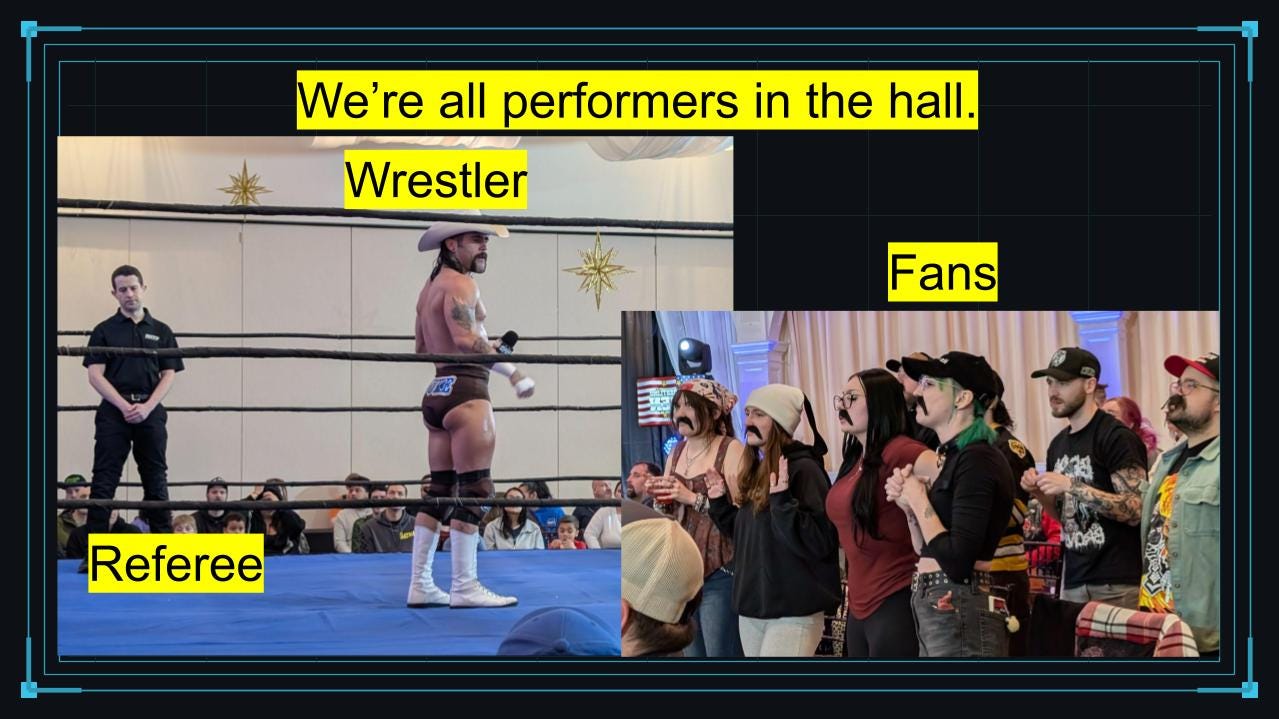
My partner who has built a cat-colony on our back porch for homeless cats can walk into that hall and scream for blood. And feel good doing it.
Her values remain unchanged; it’s just that the room handed her a role, and the role came with a script, and the script felt righteous in the moment. She knows the difference; most of the performers in the wrestling hall do too.
It’s artificial but it’s also meaningful. Artificial and real–can we hold those things? I want to suggest to you this morning that AI discourse is a wrestling hall. We may be in a fancier hall—the one we call academia; but just like Rhodes on the Pawtuxet, it has been transformed into a wrestling arena.
We walked in. We were handed roles; roles that academia has named and perfected for a very long time. There’s vigilant professors, guardians of right at the gate, lazy students, cheaters, etc.
We know these parts. We could play them in our sleep. Some have been playing them in their sleep.
So a lot of us walked into the AI hall already knowing our line. And the line was: boo. AI as the villain. Students as the suspects. Faculty as the last defenders of the real. Critique as the proof that we’re the good ones.
The part that should trouble us, as people who claim this particular set of skills: once you’re booing, it stops mattering who the wrestler even is. You’re not evaluating anymore. You’ve fallen into the reinforcing narrative. The boo becomes a reflex, devoid of judgement. It’s the thing you do to stay legible to the crowd.
The liberal arts — of all things — should be the place where we notice the script and its artificiality. Instead, many of us chant louder.
This all came to crashing relief or disbelief for me when scrolling one day and seeing this:
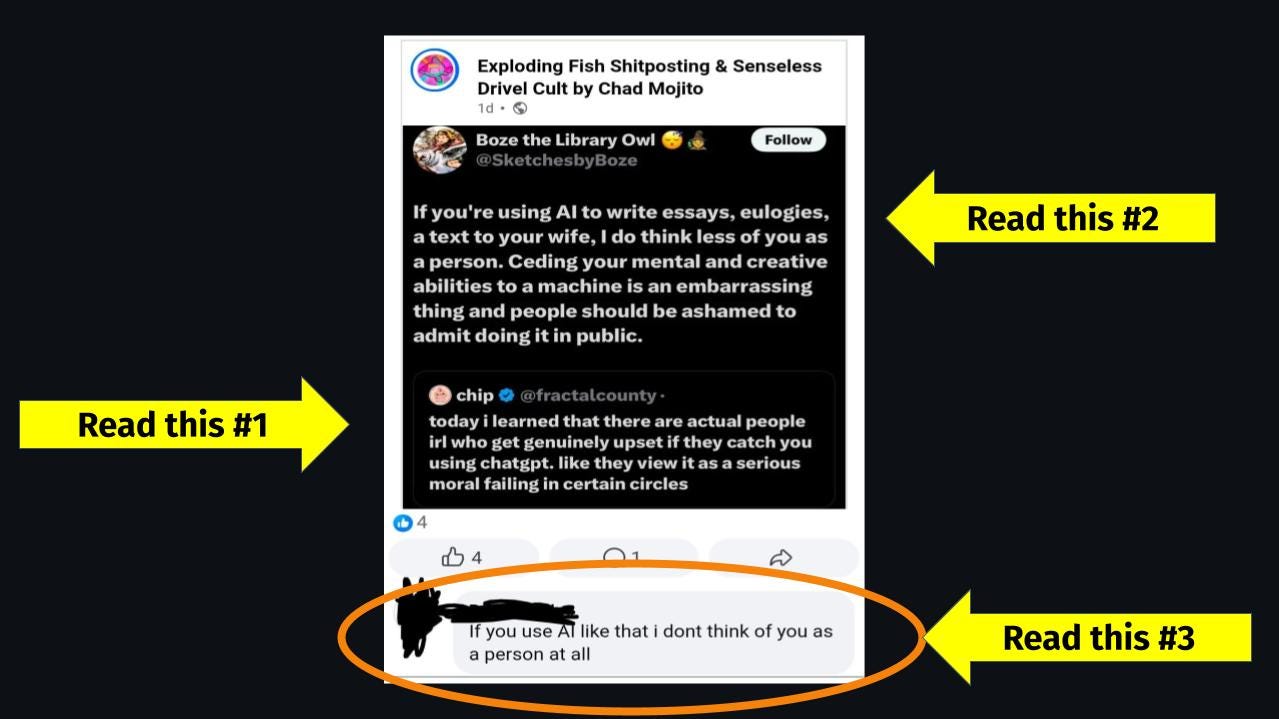
The commentary at the bottom is a real comment from a real person, someone I know: someone from the world of studying and exploring and critically engaging with culture. A thoughtful person. A genuinely critical thinker.
And in this post, shared with no irony at all, on Facebook — on Facebook, a platform soaked in extraction and algorithmic amplification and, yes, AI: this person argues that if you use AI, you barely even constitute a human being anymore.
I’m not showing you this to shame anyone. I want to be careful with this person, because the point isn’t them. The point is how fast it happened.
They are someone who has developed the criticality that comes with liberal arts and trained to see how meaning gets made. They know better than most how dehumanization works. They stepped into the hall, took the role, and pretty much led the chant. At full volume, the chant sorts human beings into the legitimate and the illegitimate. The real and the not-quite-real.
This isn’t about having a critique of AI. That’s healthy. But I do wonder about having a critique that becomes so scripted that dehumanization starts to feel like insight. This is supposed to be our work and, I find myself asking, is that critical thinking? Or is that the performance of critical thinking?
Because it looks an awful lot like the thing we accuse our students of doing: unexamined moves, borrowed conclusions, and answers that arrive before thinking does.
Is this what our critical thinking should be producing? Hundreds of millions of people waved out of the human race with one status update. We owe it to ourselves to ask whether we’re doing critical thinking at all, or just performing the role in an audience.
And since we’re on the topic of critical thinking, I want to go back to that operating assumption. Every time I hear a colleague say “our students aren’t critical thinkers,” or “our students can’t do X anymore,” something in me goes quiet. Because I don’t think that’s accurate. I don’t think it’s true to who those students actually are, or to the worlds they’re actually navigating.
I think it’s a chant. It feels less like the product of critical thinking itself and sounds more and more like just booing and falling into the role.
Again, to be clear, critique is not the enemy here. Criticality is essential, and I am not asking anyone to set it down. There is a great deal about AI worth being critical of: the companies, the labor practices, the environmental costs, the bias, the surveillance, the sheer hyper-capitalist machinery of the thing. Those concerns are real, and I hold them too.
But watch what we did with the critique. We let it harden into demonization of the technology itself. Not the company that produces it but the tool. Once we demonize the technology, we demonize the users. And those users are our students. Those students are trying to make sense of a world in which, on the whole, the main thing we’ve handed them about this technology is dismissal.
A brand-new technology that is genuinely curious and interesting and can do a bunch of things that are entirely new to them and to many of us and we booed it.
But our overwhelming fixation on its wrongness has left us here scattershot after four years in. Scattershot in what’s been built and in what students are actually getting from one classroom to the next.
We’ve been so busy hating it or ignoring them that we’ve left ourselves almost no room to see where it might have some intriguing, meaningful place in the actual work of our disciplines.
So what’s the alternative to demonization? For me, it’s curiosity. Curiosity as a disciplined liberal arts posture: sitting with the thing, asking where it makes sense and where it fails, asking what it makes visible, asking what our students are actually doing with it and why.
What happens when liberal arts educators become better at critique than at curiosity?
Because I think that’s exactly what happened because, in part, we let someone else write the script. With no systematic or structural response in our disciplines or our institutions, except for “it’s bad”, we let the discourse get defined as AI is an answering machine or a shortcut or that little box you type your homework into.That frame largely came from vendors, boosters, and tech-bros and well, just the plain gravitational pull of capitalism.
They defined it AI as an answering and efficiency machine and then we spent four years being furious that students used it like one without exploring with them what else it might be.
Of course, I don’t mean all of higher ed. Many folks here at this conference and elsewhere are doing meaningful work, but it’s been individual work, not structural work. And yes, there are good reasons for that that I’m not trying to dismiss. I’m trying to articulate where and how we got here.
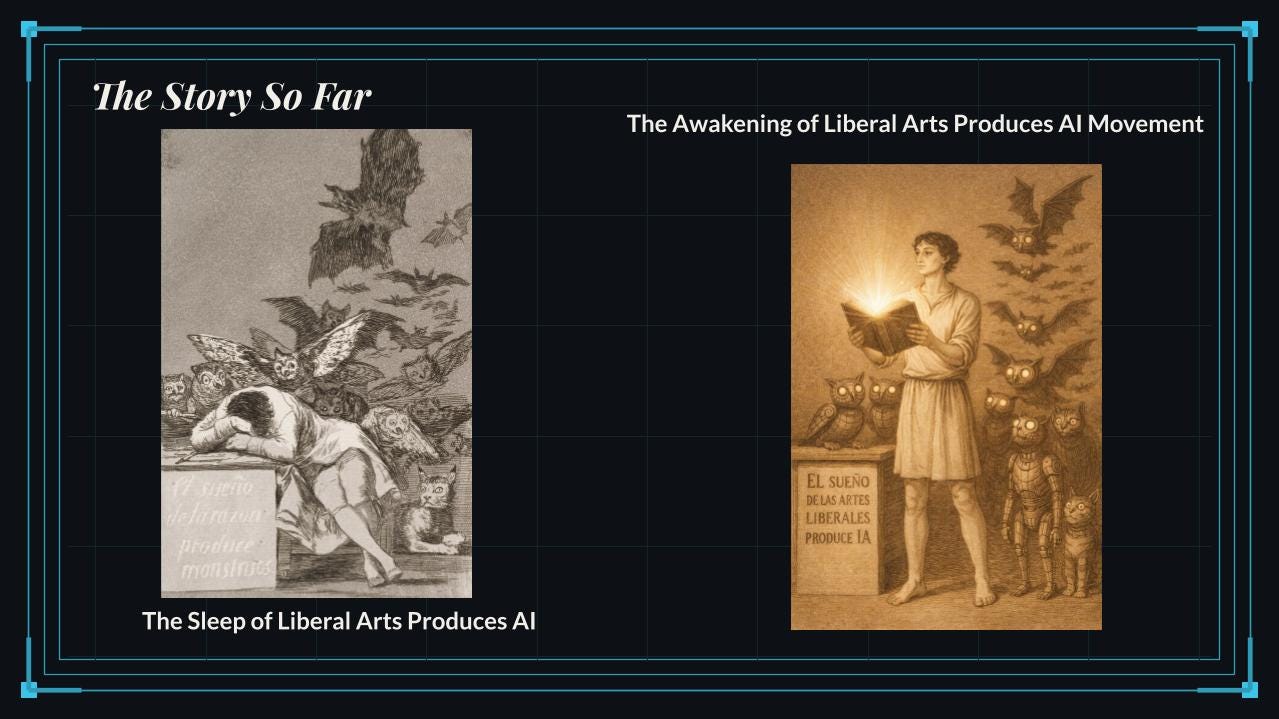
Some of you have heard me work this territory before, and some of you are walking in cold, so let me take a minute to put the whole arc on the table.
This talk is the third movement of something. The first talk at the AI and Liberal Arts Symposium at Connecticut College in October 2025 was called The Sleep of Liberal Arts Produces AI. It borrowed Goya’s art: The Sleep of Reason Produces Monsters.
It made an uncomfortable argument: that AI didn’t invade the liberal arts from outside. It rushed into a void, and we helped dig the void. We had mistaken three habits for virtues.
We dismissed what people actually find meaningful: the new, the popular, the accessible.
We fetishized narrow forms of demonstrating knowledge, until writing a certain way in a certain register became the price of admission to being taken seriously.
And we externalized the costs of learning: the money, the time, the access onto students and the public, until people had to break the law just to read the scholarship that their own taxes funded (for more on that, see here). We built the void that AI filled.
The second talk was The Awakening of Liberal Arts Produces AI Movement. was a lightning talk in February, 2026 for the AI@Conn Webinars. It moved into what I started calling the new moves.
Using research as the example: students are already starting their research with AI, the way we once moved from card catalog to database to Google and Wikipedia. Each of which, in its day, felt suspicious, illegitimate, dangerous.
Awakening meant starting where students actually are and trying one or two moves, in one place, and pausing there.
So if we are awake and we are moving, what do we build? And what do we have to stop performing in order to build it?
Before we can build, we have to take account of where we’re building from. And that’s the hard part. What we’re dealing with right now is compound debt.
For centuries, higher education made choices because they were convenient. Efficient. Scalable. Comfortable for us.
Not necessarily meaningful or right for students, but what’s manageable for the institution. And the debt on those choices has been quietly compounding the whole time, all of our professional lives and longer, in fact.
Most don’t recall that our entire higher education system–the one that we are so deeply clinging to as a pure form of how it should be or the version of higher ed that so many longs to harken back to–is the the product of the tech bros and industrialists of the late 19th century.
There’s a reason we call it the Carnegie Credit Hour–and it’s efficiency and scalability of education.
Assessment offers a sharp version of this. We have built assessment as a one-size-fits-all structure. Standardized. Transactional. Already artificial. We’ve largely created assessments that were efficient for us, back when we held enough power that we could get away with calling “good enough” as the gold-standard.
We’ve asked students to demonstrate the richness of their thinking through these narrow, constrained forms that never perfectly fit. And now? Now students are meeting our one-size-fits-all assessment with one-LLM-answer-fits-all learning.
Students are not introducing artificiality into some pure, authentic system. They are using artificial tools to respond to the artificial systems we already built and bought into.
We built the ring. We assigned the roles. We wrote the scripts. And then we got upset when they learned to perform inside them.
But let’s make it concrete by discussing online learning.
I grew up learning on the internet. I have thoroughly enjoyed building communities, making connections, finding whole worlds of people and ideas. I’ve spent much of my youth and adult life in and believing in the possibilities of online learning.
By 2000, I took my first online college course. We had a discussion each week. Does anybody want to guess what counted as discussion in 2000?
That’s right, post once; reply twice. You know what the discussion still looks like in a distressing number of online courses in 2026? Post once, reply twice.
We then asked for specific word count, proper grammar and punctuation. Rigid formality. Citations. Basically, write mini essays 3 times a week to prove your learning.
This is not discussion; this is LARPing discussion
Online learning arrived with enormous possibilities in the realms of access, flexibility, and connection. It offered new kinds of participation for people that the in-person forms had always left out.
And what did higher education, on the whole, do with it?bWe flattened it. We took Freire’s banking model as the goal, not as the critique. Here’s the content, now give it back to me in strict forms that we’ll pretend are “discussions.
We shoved online learning into that shape, because institutions didn’t see a new modality that deserved investment and imagination. They saw a revenue stream.
They used the language of access (“This will make college more possible for more people”), but too often the courses weren’t actually accessible, and “access” really meant a mass-produced, flattened version of learning that served the institution’s efficiency far more than it ever served a student’s meaning-making.
We never gave online learning the support, the investment, the dynamism we take for granted in our face-to-face rooms. And then (and this is the low-hanging fruit), we get to stand around and say in-person is just better, as if we ever actually tried.
So here’s why I’m really telling you this. We are about to walk into the age of agentic AI. While agentic AI may not make meaningful online learning irrelevant, it will certainly make transactional online learning harder to defend. And transactional is the vast majority of what we built. That’s the part I don’t think we’ve fully reckoned with.
If a course can be completed by an agent moving smoothly from task to task to task (consume the module, post once, respond twice, submit the quiz), then AI didn’t create that problem. AI revealed how thin the learning already was. The course was already too agent-ready by reducing the learning to task completion. We just couldn’t see it until something came along that could complete the tasks.
That’s compound interest.
We accepted artificial assessment because it was efficient. We accepted flattened online learning because it scaled. We accepted content delivery as a substitute for relationship because it was manageable. And now, all at once, the bill is visible.
Alright. I’ve painted a fairly uncomfortable picture, but I don’t actually think the picture is entirely bleak. I think it’s an invitation. Because if the problem is that we built systems out of convenience, then the work in front of us is to build different ones out of care.
And while doing so at the institutional and societal level is the long-work, we can find ways of building it in our classrooms and our own frameworks. For me, building is a shift in design logic. First, we must start where students are. Then ask: what practice has AI actually changed here? What friction in this practice was meaningful and what friction was merely inherited? What meaningful friction may need to change? Where should judgment become visible? And what forms of accountability would make this work matter beyond mere compliance?
We need to scrutinize the friction Here’s a principle I’d defend anywhere: any familiar friction needs to be scrutinized. Familiar friction should lose its automatic immunity. We should stop assuming a thing is good simply because it has always been there. Because a lot of what we call rigor is really just comfort and convenience for us.
None of our systems are perfect — they’re just familiar. It is comfortable to send students to a clunky academic database riddled with its own flaws and limitations, a thing that only works if you already know the secret handshake, because we’ve normalized its failures. Its flaws have simply become ordinary. And then we reject a newer AI-supported tool because its flaws are still visible, still strange, still uncomfortable. That’s more a judgment about what we’re used to than what’s right.
The asymmetry is where I think we miss the most. We expect students to persist through ambiguity and inconvenience and imperfect systems all the time. And then some of us turn around and say, of AI: “this is complicated, therefore I don’t have to engage with it.” When students do that to us, we often call it avoidance or worse, intellectual laziness. But we grant ourselves the exemption, often, without a second thought.
So the move is: scrutinize the friction. Preserve the friction that teaches and redesign the friction that merely filters. And then take it one step further, and recognize that even the friction that teaches may need to change shape.
Take writing. We’ll need to rethink where and when writing shows up and whether it is the best form of assessing thinking. We think so because that’s often how we learned and that was the hammer for which all of our assessments were nails to. Many of us are sitting here today because we had to write dissertations, theses, or other long-form writing to justify our knowledge.
And also, writing is essential. Writing is where some important thinking can happen. I’ve been a writer since I was eleven and a professional writer for over 20 years; I’m not here to wave writing goodbye.
But the writing may not always begin with the blank page. It might begin with a chatbot asking me questions to help me surface what I actually think, notice what I know and what I don’t, and walk with me toward expression. A practice like this can still teach. It can teach the practice of knowing which questions to ask and which things to consider.
We should be questioning the inherited sequence of how to do it. That has changed time and again over the ages. The core value was the development of thought, judgment, articulation, and ownership. The elements remain.
The students still have to be able to defend and articulate their ideas and choices. They have to own the work deeply enough to explain every part of it, whether or not AI touched it. Ownership is the friction that teaches while blank-page purism is, sometimes, just the friction we’re used to.
Research is my favorite example of a move, because you can watch the whole history of it change shape. We went to the card catalog. Then we went to databases. Then Google and Wikipedia (which we treated as the enemy until, quietly, we all started treating it as a starting point, not an endpoint).
And now the first look, for a lot of students, is a generative AI tool. We can look at a deep-research tool to get the lay of the land. Ok, an obfuscated lay of the land, but it is just a starting point to further explore.
Now, someone is getting ready to defend serendipity: the magic of the shelves, following the footnote, finding the book that was sitting next to the book you came for. And I love that too and I love my librarians and libraries. I do. But I want to gently say: that was our magic. It doesn’t have to be the same magic for a student.
Consider this: one thing has genuinely changed between then and now. In the 1980s, the world published on the order of half a million articles a year. We are now past five million a year, and that number is not slowing down. When you are drowning in five million papers a year, something that helps you filter is a lifelong, not a betrayal of scholarship.
The serendipity was lovely. It also assumed a scale of knowledge that no longer exists and it presumes that there is only one form of serendipity. Research will look different and AI can lower the friction of finding, while still requiring the thing that we actually value: judgment.
The questions don’t even change.
How do you know it’s legitimate?
What did you do to verify it?
What gave you pause?
Where did you have to slow down?
We worry a little less about what tool they found it and a lot more about how they’re validating it and making sense of it.
That’s the generalizable pattern: it’s bigger than writing or research. In many ways, this is about a design process needed across any discipline or assignment. It is moving towards more process-oriented activities, but it’s also rethinking what the accountability mechanisms are.
Those become more dynamic and more human such as Wikipedia assignments where students contribute to public knowledge instead of just consuming it; service learning; real projects with real partners; work that has a stake beyond the grade.
Spaces where students aren’t just doing the work but standing behind it: explaining it, defending it, answering for it. Assignments and activities where students present what they’re figuring out, and their peers ask real questions, and everyone has to metabolize a little of each other’s learning into their own.
Done that way, it embodies practice for the thing we actually do everywhere in professional and civic life: make a choice, explain it, take a question, revise in public. Building critical, communicative, and communal knowledge is one of the most durable things a liberal arts education can build. Too often, we’ve boiled it down to writing papers that end up dying a slow digital death until that LMS course is deleted.
I think reforming assessment in this new era is important, but honestly, the thing that I think we need to do in the liberal arts is to start thinking about cranes.
Rob Reich, a philosophy professor at Stanford shared this idea and I’ve been thinking about it a lot for this talk but just for our work ahead. He notes that AI does three things.
AI replaces human work, much like the loom in the 19th century. AI can support our work, much like the calculator from the 20th century. But AI can also magnify our work, if we find the right use cases. Here, he invokes the idea of building cranes, using a technology that fundamentally allows us to change the landscape of our cities.
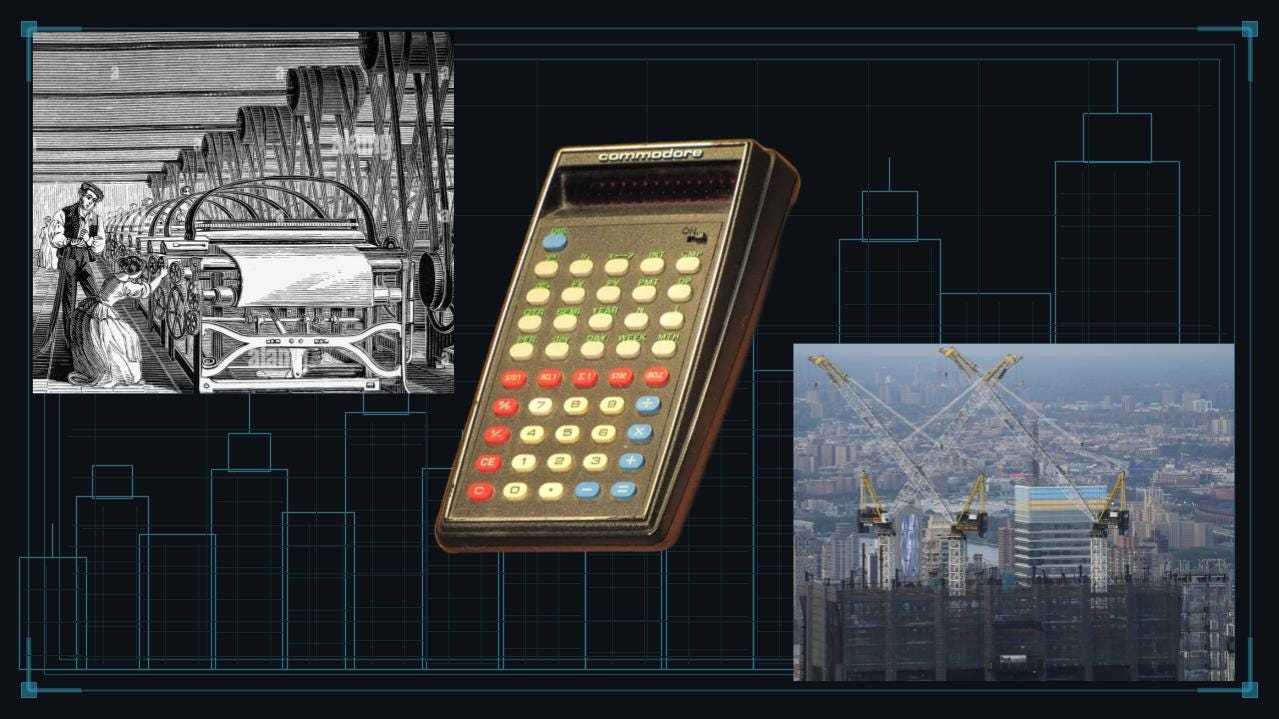
I believe finding cranes needs to be a significant pathway in the liberal arts. The kind of curious exploration, divergent thinking, critical consideration, and shared visions across our domains is needed to develop new kinds of learning for cranes.
We can simultaneously produce cautionary and optimistic tales that help us see the potential before us. Hence, we have the dystopian AI versions such as Skynet, Daleks, or Hal 9000s as ell as the positive AIs such as Star Trek’s computer and Data, or Star War’s R2D2 or Marvel’s character, Vision.
And, we’ve built cranes before.
Think about what we eventually built with the internet. None of it was obvious at first. OER (open educational resources) grew out of a refusal to keep externalizing the cost of learning onto students. Online learning, at its best, showed that real community could exist beyond the four walls of a classroom. For those that leaned into Wikipedia, it became a tool for exploring the archaeology of knowledge production and the chance to publicly and collaboratively write in ways previously not possible. Digital humanities let entire disciplines ask questions they’d never been able to ask.
Each of those emerged because people played, experimented, argued, built, failed, revised and shared. We found dozens of cranes with the internet. We have not yet done that serious, humane, discipline-rich work with AI because on the collective whole, we’ve spent the crane-finding years booing instead.
But before we can build those cranes for education, we need to rethink the current infrastructure.
When cranes arrived, they didn’t simply help builders construct the same buildings more quickly. They made entirely new kinds of buildings possible. But those new buildings demanded new foundations, new structural systems, new engineering principles, and new ways of thinking about the work itself. Practices that had served builders well for centuries such thick load-bearing walls, certain construction sequences, assumptions about height and weight were no longer sufficient. The crane changed what construction had to become.
We have to hold this for education as well.
Generative AI can’t be a tool that helps students write faster or faculty prepare lectures more efficiently. We need to look at it as a tool that can change what learners can do, what counts as difficult, where the intellectual load resides, and therefore, what our educational foundations need to support. We must ask what conditions that once made our practices effective have fundamentally changed.
When cranes made skyscrapers possible, they did more than help builders lift heavier materials. They transformed what builders needed to know and how they approached their work. The accumulated wisdom of masonry remained valuable, but it was no longer enough. Engineers had to understand new forces like wind and sway, coordinate specialized expertise, and design around the unique conditions of each site. A successful skyscraper began not with the building itself, but with a deep understanding of the ground it would stand on.
I think higher education is entering a similar moment. Our disciplinary knowledge remains essential, but it is no longer sufficient on its own. Faculty are increasingly responsible not simply for delivering expertise (in truth, I don’t think they ever were, but that’s another conversation), but for designing learning environments where students connect disciplinary knowledge with their own experiences, communities, questions, and the new capabilities AI brings.
Students, meanwhile, take on greater responsibility for judgment such as deciding what is credible, what matters, what belongs, and how to defend the choices they make.
AI can help lift ideas, but shouldn’t determine where they belong or whether they strengthen the larger structure.
Perhaps the most important lesson from skyscraper construction is that nothing was lifted directly from the ground into its final place. Builders relied on temporary platforms, scaffolding, and carefully sequenced supports to move materials upward safely.
Teaching works much the same way. We cannot expect students to leap from unfamiliar content to disciplinary expertise. Our responsibility is to build bridges from the rich lives they already lead such as their work, families, interests, cultures, and communities to the concepts we hope they will master.
So if I have to name the single biggest move, here it is. And it’s hard. You may not be ready for it by September, and that’s okay.
Start the course where students actually are. And bridge to the course. Spend the first few classes not delivering, but deliberating. You say to your students, more or less:
“Okay. Here we are. You’re in this course. You’re here for a whole range of reasons. So let’s figure this out together. Here are the outcomes we’re responsible for. How do you want to approach them? How do you expect to use or not use AI to get there? How do you want to be assessed? What does it look like to actually engage this material, for you? Where are your stress points, right now, before we even start? What does accountability look like to you?”
And you have them write it down. Document it and sign off on their own plan, and their own accountability. How will you and won’t you use these tools? What does inappropriate use look like in your own words? What’s a fair claim of proof on my end? What happens if the line gets crossed? You build it from the bones up, together.
For some, this will feel like a trap. Sign here so I can catch you later. And it can’t be that. It has to be an honest conversation.
Our students are telling us that this tool is tempting. That it’s everywhere. That a lot of them don’t even want to use it and find themselves using it anyway, pulled by anxiety and time pressure and the fear of being stuck.
So the first-week move can’t just be”declare your AI policy.” It be naming the conditions under which learning is actually going to happen collectively. Name the pressures and what support would make the ethical choice more possible. Only from there, can we build accountability.
Because accountability without support is just surveillance. And support without accountability is just vague permission. The humane space is somewhere in between and its achieved through collaboration and trust-building.
And yes, we do this, all the while knowing that this will be messy and it will not work for all students. But at its core, it is deliberation, self-knowledge, ethical reasoning, interpreting shared goals and making a public commitment to them. In other words, it’s the liberal arts, practiced in the first week of class. This is what it means for students to become the agents of their own assessment.
It will disrupt how we structure a course, how we spend our time, and how we imagine our authority because we’re so used to making students start where we are. Working towards cranes requires us starting at students’ foundations and not our own subject’s foundation. It asks us to start where they are.
I’d rather sit in that discomfort than keep clinging to models that are quietly at war with the world our students actually live in. We are going to have to be guides more than we have ever been before. And I don’t think many of us fully understand yet what being a guide even means: facilitating a thing that’s genuinely happening, building the bridge from where a student is standing into the questions of our discipline. But that’s the job now.
Let me take you back to the hall one last time. The whole danger of that room was never the wrestling. The wrestling was fine. The wrestling was meaningful: artificial and meaningful at once, which was Barthes’ gift to us. The danger was the moment we started chanting. The moment the boo became a reflex. The moment it no longer mattered who was in the ring, because we already knew our line and took the ring for the real world.
Four years ago, a new thing walked into our hall, and a lot of thoughtful, careful, well-meaning people reached for the chant. AI as villain. Students as suspects. And the chant, at full volume, cost us something. It cost us four (soon five) years we could have spent playing, building, and finding the cranes.
It cost some people their claim to another person’s humanity. And most quietly, most expensively, it cost our students the benefit of the doubt.
I’ll end where I started. With three assumptions, except now I hope they land differently.
All exploration is meaningful. Even the artificial. Even the scripted. Even the thing on the low shelf that somebody told you was a waste of time. Especially that.
Everyone is a critical thinker: doubly so for every student who walks through your door. They navigated a complex and often brutal world to get to that seat.
The critical thinking and yes, even the motivation, is already there. Our job was never to install it. Our job is to see it, and to build the bridge from where they are into what we love.
And I categorically reject any discourse that begins from the premise that people are less than they were. Every generation finds its own way into meaning-making, again and again, in its own new and particular context.
Our students are doing it right now, in front of us, with the tools of their moment and too often we’ve called that decline when we should have called it an invitation to teach.
This has to be the work of the liberal arts: to discover the explorations our students are already pursuing. We need to recognize the critical thinking and the creation already happening inside those actions. And we need to remember that every generation finds its way into meaning again, in its own context.
Because if we forget that — if we keep booing — we don’t just mishandle a technology. We commit a deeper failure toward our students. And we go on undermining the very liberal arts education we stand up here claiming to defend.
So here’s what I’ll leave you with: a principle, and then a piece of homework.
Artificial does not mean meaningless, curiosity is needed as much as critique, and our students are not less than we were.
And the homework is this: As you go through today and tomorrow, and when you go back to your departments and campuses to discuss the AI problem; ask yourself if you are a fan in the crowd booing and what would it mean to not boo at that moment.
What would it mean to step out of your role?
Thank you.
Upcoming Sightings & Shenanigans
EDUCAUSE Online Program: Teaching with AI. Virtual. Facilitating sessions: ongoing
Recent Recordings, Resources, & Writings:
Davis, L., & Eaton, L. (May 2026). Expanding OER with GenAI. EDUCAUSE Review.
AI x Higher Ed Podcast with Anand Rao & Stefan Bauschard. Episode: Universities Must Adapt to AI—Here’s How They’re Doing It (May, 2026)
Damm, C., & Eaton, L. (2026, March). From prompt to practice: A framework for transparent GenAI use in higher education. EDUCAUSE Review.
Eaton, L., Nemeroff, A., & Sun, X. (2026). AI-assisted course design and development. In K. S. Ives, M. Cini, & R. Schroeder (Eds.), AI applications in online higher education administration: Strategies for maximizing returns and improving outcomes. Routledge.
Margin of Thought with Priten: Season 1, Episode 5: How Can We Center Pedagogy During the AI Tech Wave? (February 2026)
Online Learning in the Second Half with John Nash and Jason Johnston: EP 39 - The Higher Ed AI Solution: Good Pedagogy (January 2026)
The Peer Review Podcast with Sarah Bunin Benor and Mira Sucharov: Authentic Assessment: Co-Creating AI Policies with Students (December 2025)
David Bachman interviewed me on his Substack, Entropy Bonus (November 2025)
The AI Diatribe Podcast with Jason Low (November): Episode 17: Can Universities Keep Pace With AI?
The Opposite of Cheating Podcast with Dr. Tricia Bertram Gallant (October 2025): Season 2, Episode 31.
The Learning Stack Podcast with Thomas Thompson (August 2025). “(i)nnovations, AI, Pirates, and Access”.
Intentional Teaching Podcast with Derek Bruff (August 2025). Episode 73: Study Hall with Lance Eaton, Michelle D. Miller, and David Nelson.
Dissertation: Elbow Patches To Eye Patches: A Phenomenographic Study Of Scholarly Practices, Research Literature Access, And Academic Piracy
AI Syllabi Policy Repository: 200+ policies (always looking for more- submit your AI syllabus policy here)
Finally, if you are doing interesting things with AI in your higher ed classrooms, consider being interviewed for this Substack or even contributing. Complete this form, and I’ll get back to you soon!
We periodically host small-group workshops and leadership sessions for higher ed teams. You can learn more about our current offerings here.
AI+Edu=Simplified by Lance Eaton is licensed under Attribution-ShareAlike 4.0 International

Comments
Nothing yet. Say the first thing.
Sign in to join the conversation.