
I’m at Oxford this week and next to give the Wilde Lectures. These are not about AI but rather about our capacity to love strangers (a book I am also trying desperately to finish while here!)
But while I am staying at this extraordinary university I can’t help but think about the questions AI is raising for higher education.
A few months ago I heard my friend Alex Hartemink give a lecture explaining the basics of machine learning to a group of university presidents and provosts. Alex and I are both Oxford graduates and US Rhodes Scholars, but we attended at different years. He’s now an eminent computer scientist at Duke and a beloved professor.
At the higher ed event, Alex was asked how he thought universities ought to evolve now that powerful AIs are widely available and much of our reasoning and thought can be augmented through this software. What use do we have for continuing to try to concentrate research and higher education in physical spaces (like Durham or South Bend or Oxford) when AI can make knowledge omnipresent?
Alex offered up the idea that specific universities, to stay relevant, might consider whether they want to be cloisters or spaceships going forward.
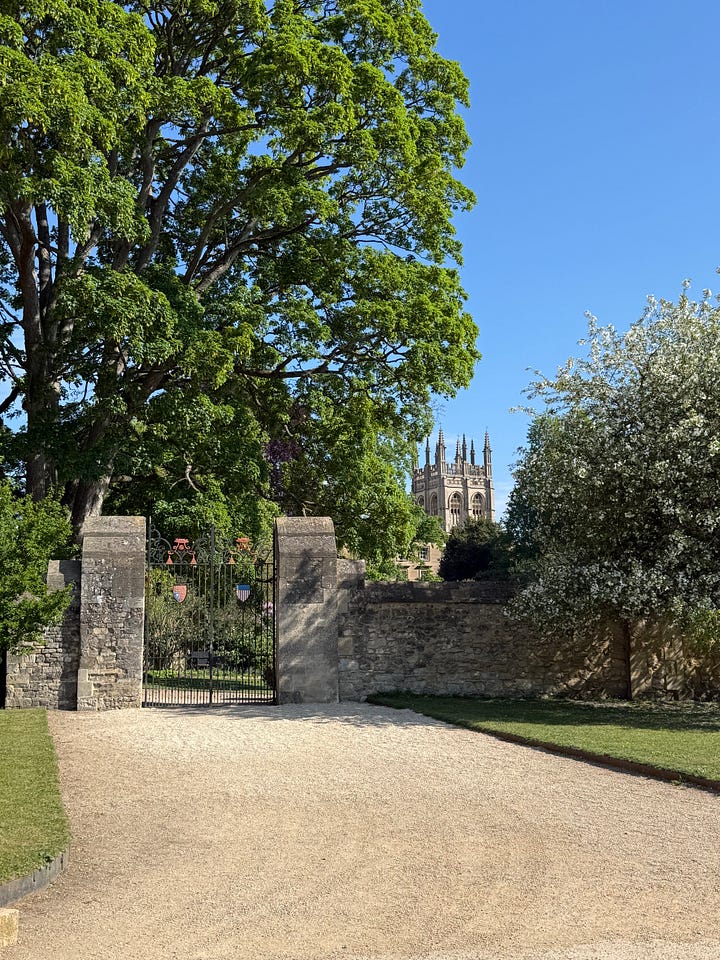
A cloister university is a place where people retreat for a time to strengthen their habits of mind and form their characters, much the way a spiritual seeker might retreat to a monastery. Cloisters separate the learner from distractions like technology, and encourage them to develop their own inner mental and moral life. Universities and religious communities were synonymous with another one thousand years ago. Medieval Oxford students and scholars literally lived, ate, slept, and argued together in college buildings modeled directly on monastery architecture — quadrangles, chapels, and refectories. The line between scholar and monk was genuinely blurry. Fellows of colleges were often required to remain celibate and unmarried, just like clergy. If you wanted to marry, you had to leave the college. (I was reminded of the, uh, medievalness of the rooms staying at Oriel this week; I sorely miss my air conditioning!)
But a university might also choose to become a spaceship. AI enables us to dramatically push forward the frontiers of knowledge. It holds open the possibility of rapid advances in science. A university can determine to become an engine of experimentation and discovery, set on mapping those frontiers. I doubt universities will ever keep pace with the frontier labs when it comes to innovation on building foundation models — they simply don’t have the compute or the economic leverage to hire the best engineers. But this does not mean universities cannot become innovation factories when it comes to the application of these models. All that requires is a trained imagination and time for experimentation, which universities have in spades.
Oxford is a nice example that the best universities can be both cloisters and spaceships at the same time. They can have cloister elements supporting the formation of minds and hearts. Students can live in residential communities, take their meals together, and have one-on-one tutoring from professors. They can have oral exams that require students to prove their mastery of subjects. (I used to sit on a bench outside of New College and cry when I performed badly in one of these intense tutorial sessions. But twenty years later I can still speak at length about the different ways of understanding the de re/de dicto distinction. I will be able to lecture on this topic on my deathbed…)
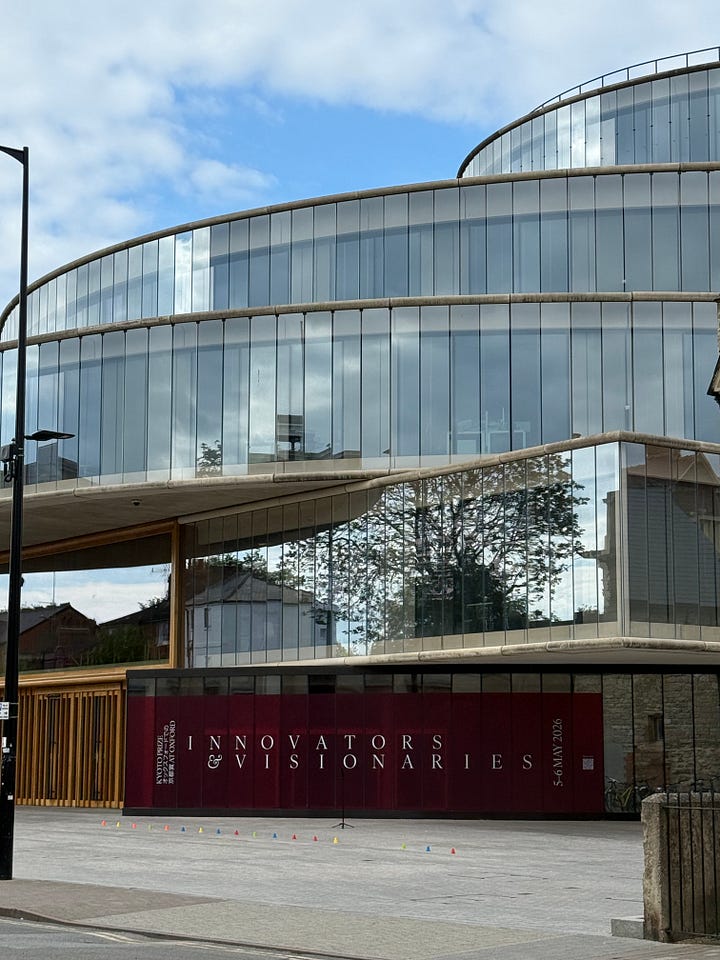
Outside of the Oxford colleges are labs where new vaccines are discovered. The lithium-ion battery was invented here. I have no doubt that scientists drawn to be together in the city of learning will soon unlock some of the most interesting applications of AI. In fact, if there is one lesson from history that should give universities hope it is that geographic concentration of scholars and scientists tends to produce the greatest innovation. Great minds do not necessary think alike, but they think better side-by-side, in community.
Cloisters and spaceships each have their drawbacks too. Cloisters lock people out and spaceships leave people behind. The biggest threat to universities in the dawn of the AI era is also the biggest problem of the past decade -- many universities seem so detached from their surrounding communities that it isn’t obvious anymore why these communities should sacrifice to keep them going. Where’s the broader social benefit? When the monkish students leave the cloister, are they better prepared to love their neighbors? Is the spaceship sending back images that fill us with awe? Are its discoveries alleviating our suffering?
AI won’t destroy the university. Hell, the Black Death and two world wars couldn’t stop Oxford. If anything, I think AI has the capacity to intensify these dual functions of universities. But only if we get serious about renovating our cloisters and spaceships to fulfill these deeper social functions. The biggest threat to universities are increasingly widespread nihilism about moral formation and apathy about discovery.
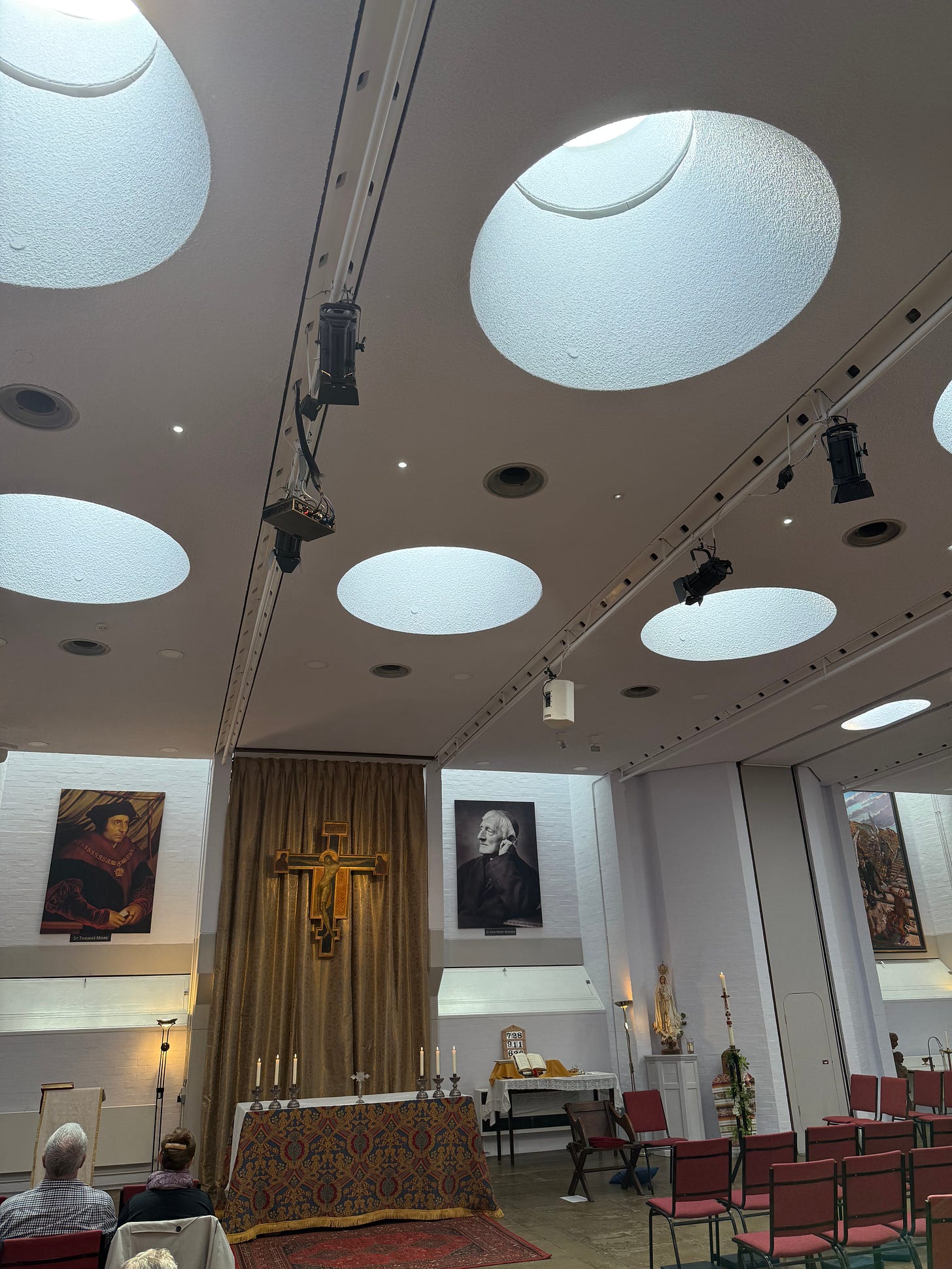
By the way, I went to Mass this morning at the Oxford Catholic Chaplaincy which is a cloister that looks like a spaceship! Seemed like a good idea in the 70s, I guess.
PS: If you are in Oxford this week or next, join us for the Wilde Lectures at the Schwartzman Centre! We’ll be talking through the Loving Strangers book. I may even share a few more stories from my tortured philosophical youth in England…
Comments
Nothing yet. Say the first thing.
Sign in to join the conversation.