
Welcome to the 52nd issue of AI Agents Simplified 🍻
This issue is brought to you by Novu Connect

AI agents are having their definitive “demo magic” moment. You open a browser, connect a model to a handful of tools, write a clean system prompt, and suddenly it feels like you have engineered a fully autonomous digital employee. In a controlled environment, it looks alive. It reads documents, summarizes email threads, searches a database, creates engineering tickets, and orchestrates API calls seamlessly. Everyone in the room smiles, the investors are sold, and the immediate conclusion is that half the company’s workflows can be automated overnight.
However, the moment you put that agent in front of real users, the illusion cracks. The agent begins to lose track of critical constraints, calls entirely wrong tools, updates incorrect database records, and confidently reports that an action succeeded when the backend actually rejected it. It loops endlessly on failed operations and leaks data across user sessions. This exposes an uncomfortable reality in contemporary engineering: agents are easy to demo because underlying large language models are highly impressive, but they are incredibly hard to ship because production environments are entirely unforgiving. The core challenge is not getting an LLM to talk; the real challenge is architecting the controlled backend environment that surrounds it.
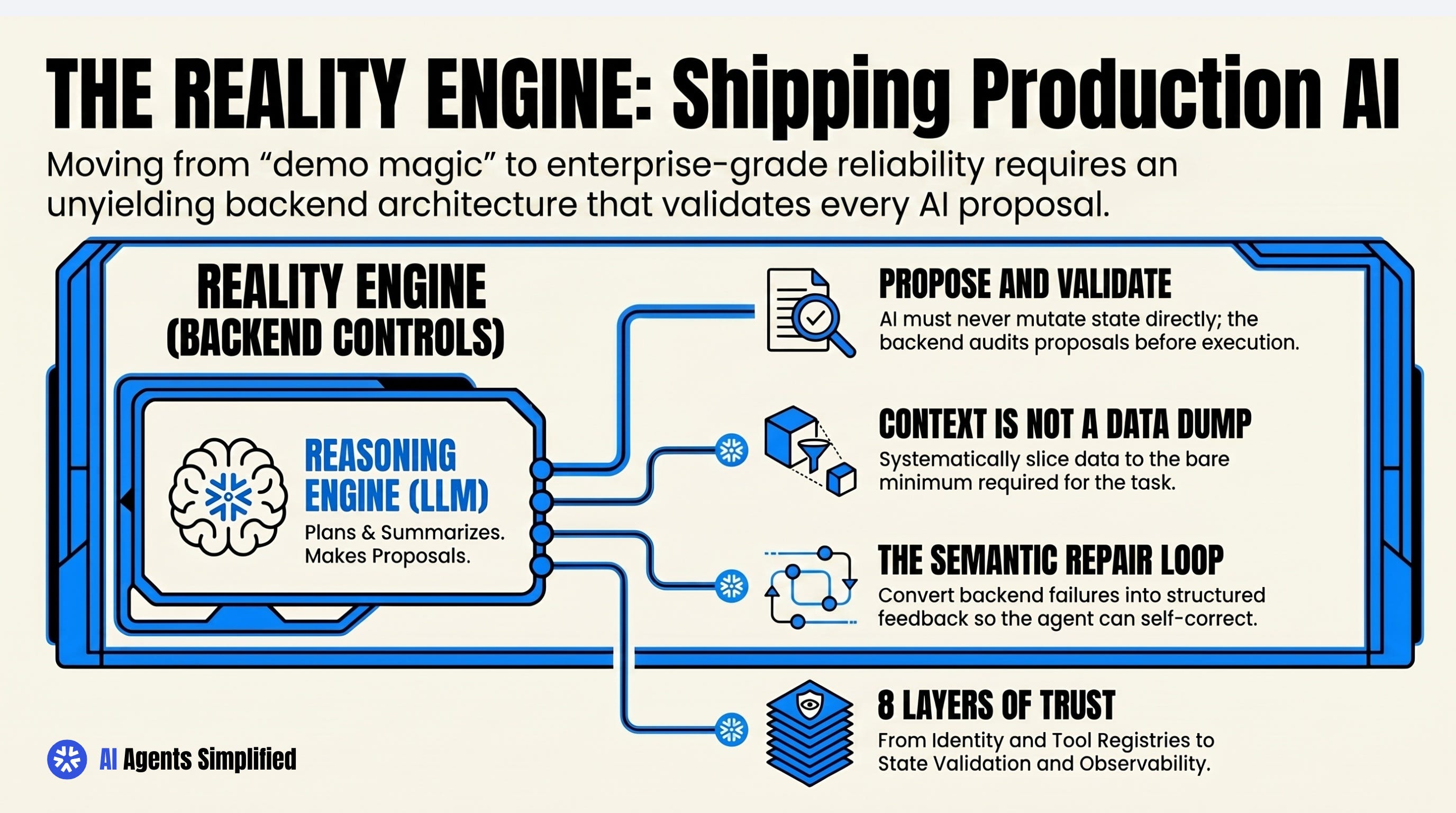
To bridge the gap between a fragile prototype and a robust product, we must establish context discipline. A production-ready AI agent is not a standalone brain; it is an actor inside a heavily restricted ecosystem. While the model serves exclusively as the reasoning engine capable of planning, classifying, and summarizing, the backend serves as the reality engine. The model itself possesses no inherent knowledge of your live database, tenant-level permissions, concurrency locks, or compliance status. It only knows what you deliberately inject into its context window.
When engineering teams treat the context window like an unstructured data dump, throwing in raw chat logs, massive documentation files, and unvalidated tool outputs, they rely on hope rather than architecture. A reliable backend must systematically enforce restrictions before the model ever reasons. The system must algorithmically determine user roles, enforce workspace isolation, slice data down to the bare minimum required for the task, and aggressively hide parameters that the model should never see. A more capable model cannot fix a messy environment; a stronger model inside an undisciplined context window simply generates more expensive, complex errors.
The single most critical architectural pattern for reliable agents dictates that the model must never directly mutate business state. The agent should not directly execute an API call to update a database, refund a transaction, dispatch an email, or alter an enterprise workflow status. Instead, the model proposes an action, a strict backend validation layer audits the proposal, and only then does a boring, predictable execution system run it.
Consider an agent operating within a CRM where a user commands it to follow up with everyone from a recent demo. The model generates proposed actions, such as drafting specific emails, setting individual tasks, and moving deal stages. Before any packets are sent, the backend adult in the room checks for contact ownership, verification records, marketing opt-out status, duplication risks, and whether the operating user holds the necessary authorization. The agent provides the flexible, creative interface, but the backend must remain strictly unyielding.
To achieve this, tool calling must be fundamentally decoupled from direct execution. Tool calling provides a structured schema, but it offers zero guarantees of factual or operational correctness. A model can easily hallucinate IDs, pass incomplete arguments, choose the wrong tool entirely, or repeat a failing operation in an infinite loop. Therefore, the pipeline must transition sequentially from the Model to a Proposed Action, through a dedicated Validator, into the Executor, across the Result layer, through an Agent Feedback mechanism, and finally to the Responded State. The middle validation layer acts as a classic software guard, evaluating strict state machines, rate limits, input formatting, and risk profiles. AI has not removed the need for traditional backend engineering rules; it has made them vastly more important.
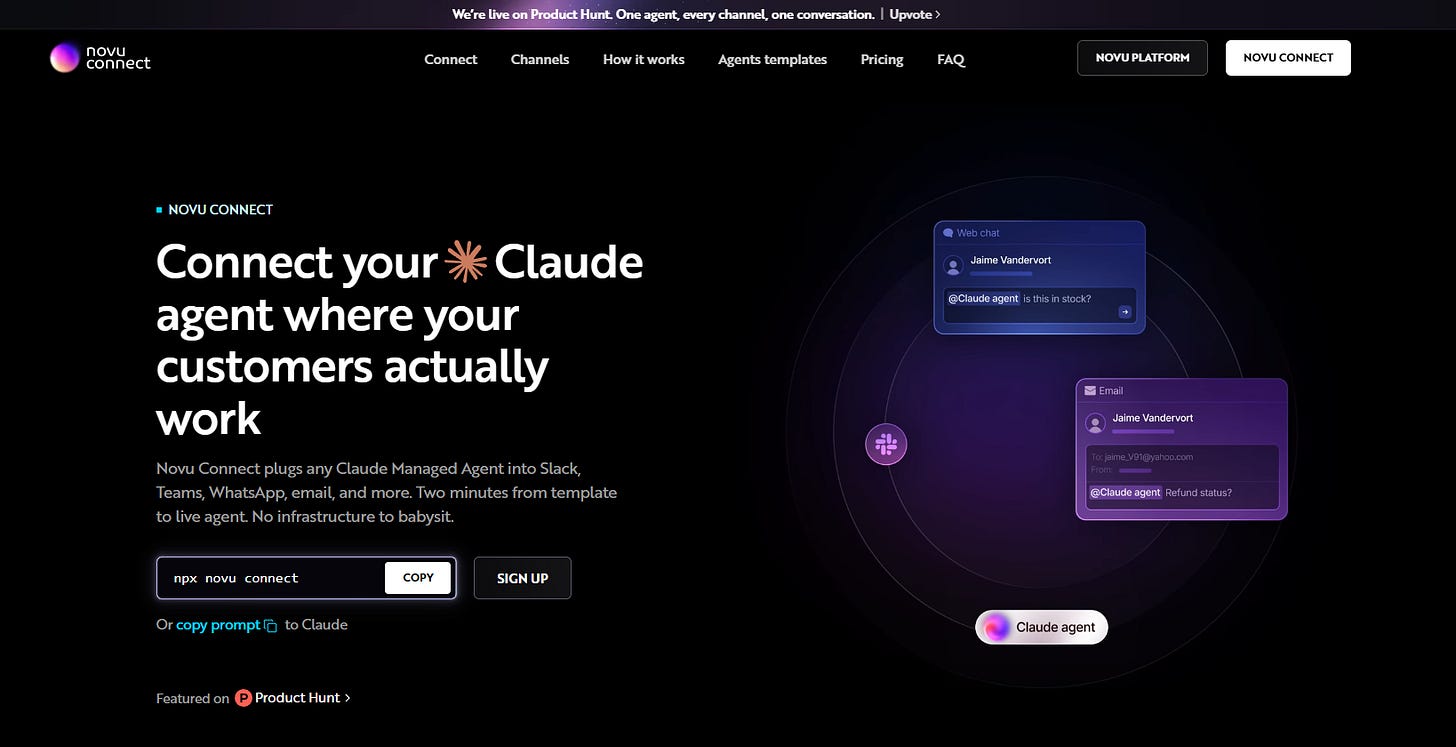
If your Claude agent is trapped inside your app, it’s time to move the conversation to where your customers actually live. Without the headache of maintaining custom infrastructure.
Novu Connect is the new standard in Agent Communication Infrastructure (ACI). It bridges the gap between your AI agents and any messaging platform, including Slack, Teams, WhatsApp, and email. You don’t need to spend weeks building pipelines; just pick a template, connect your tools, and you’re live in under 2 minutes.
No infrastructure to babysit, no custom plumbing to rebuild. Just immediate, two-way conversations with your customers.
Join the challenge: deploy your agent in under 2 minutes and unlock a free month of our Pro tier.
❤️ The best way to keep our mission going - at zero cost to you - is by checking out this free guide from our sponsor.
When errors inevitably occur, traditional software fails loudly by returning explicit exception codes, while agents tend to fail silently by inventing answers or pretending an action succeeded. Brittle systems halt completely when a tool returns an error, but a production-grade agent relies on a continuous repair loop where failures are converted into semantic feedback. If the backend safely blocks an invalid action, it should pass a structured explanation back into the model’s context. By informing the agent that a specific invoice is already locked or a chosen engineer is assigned to another workspace, the model can dynamically recover, apologize, adjust its parameters, or ask the user for clarification.
This disciplined approach must extend to agent memory, which is frequently misunderstood as a magical, infinite cache. Storing every conversational turn and historical variable indefinitely introduces stale context, data privacy violations, and severe latency issues. For business workflows, the relational database or enterprise CRM must remain the immutable source of truth. The agent should possess short-term working memory to maintain current task continuity and high-level summaries for past interactions, but it should never memorize static states. The agent does not need to remember if an invoice was settled or if a user is a workspace administrator; it must explicitly query the backend for those facts on every relevant turn.
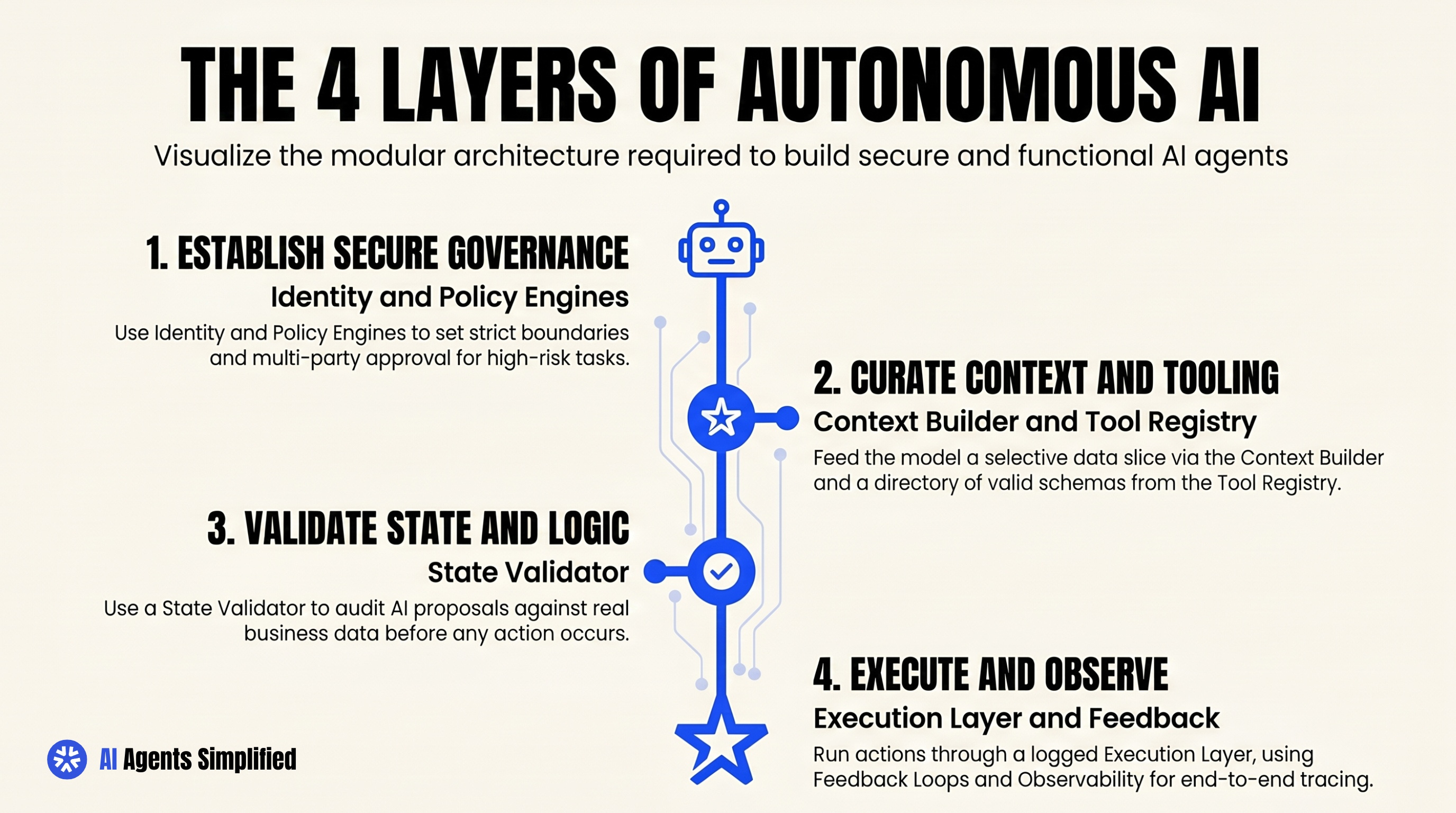
Behind a clean, simple user interface, a dependable agent infrastructure demands eight distinct, decoupled operational layers working synchronously:
The Identity Layer: Establishes precise user authentication, workspace boundaries, role-based access control, and strict data visibility limits.
The Context Builder: Curates a highly selective, relevant, and secure slice of information to feed into the model’s immediate reasoning window.
The Tool Registry: Maintains a strict directory of valid schemas, input expectations, clear descriptions, and pre-calculated risk levels for every accessible action.
The Policy and Permission Engine: Segregates operations by risk, determining which low-impact tasks can run autonomously and which high-impact workflows require multi-party or human approval.
The State Validator: Audits the model’s logical proposals against current business data to ensure compliance with real-world state machines.
The Execution Layer: A heavily logged, entirely predictable system that communicates directly with external APIs, databases, and core infrastructure.
The Feedback Loop: Translates the real-world success, partial failure, or execution constraints back into clear inputs the model can use to plan its final output.
The Observability Layer: Captures deep, end-to-end trace chains tracking the exact user prompt, the injected context, the model’s internal decisions, and the validation logs.
Without comprehensive decision tracing, debugging an agent becomes complete guesswork, and guesswork does not scale in enterprise software. Human approval flows are not a programmatic bottleneck; they are a prerequisite for utility. By separating low-risk actions like drafting and summarizing from high-risk mutations like data deletion and billing updates, you establish controlled autonomy. This allows organizations to gradually earn trust, moving deliberately from supervised assistance to full automation only after verified testing, evaluation runs, and reliable rollback strategies are safely in place. Ultimate industry adoption will not belong to the teams building the most dramatic, conversational personalities, but to the engineers who quietly build the most dependable operating environments around the model.

3 PM hits. Volume picks up. By 3:50, the market's a freight train.
That's when my crew and I strike.
A few wins from recent sessions:
$790 in pure profit
185% on a single position
$1,500 winners closing the bell
We're not predicting tomorrow's headlines. We're not reading tea leaves. We're watching where $55 billion flows in the final hour, and riding it.
It happens today. And tomorrow. And every trading day after.
Tap here to join us. First week is free.
❤️ The best way to keep our mission going - at zero cost to you - is by checking out this free guide from our sponsor.
When engineering agentic pipelines inside your organization, where are you currently facing the steepest bottleneck: getting the model to accurately reason through technical dependencies, or building the backend validation infrastructure necessary to trust it with live operations? Let us know in the comments below!
No posts
Comments
Nothing yet. Say the first thing.
Sign in to join the conversation.