
Fish oil for trauma support?
Well…
For context:
a hummingbird prayer is a reader-supported publication. To receive new posts and support my work, consider becoming a free or paid subscriber.
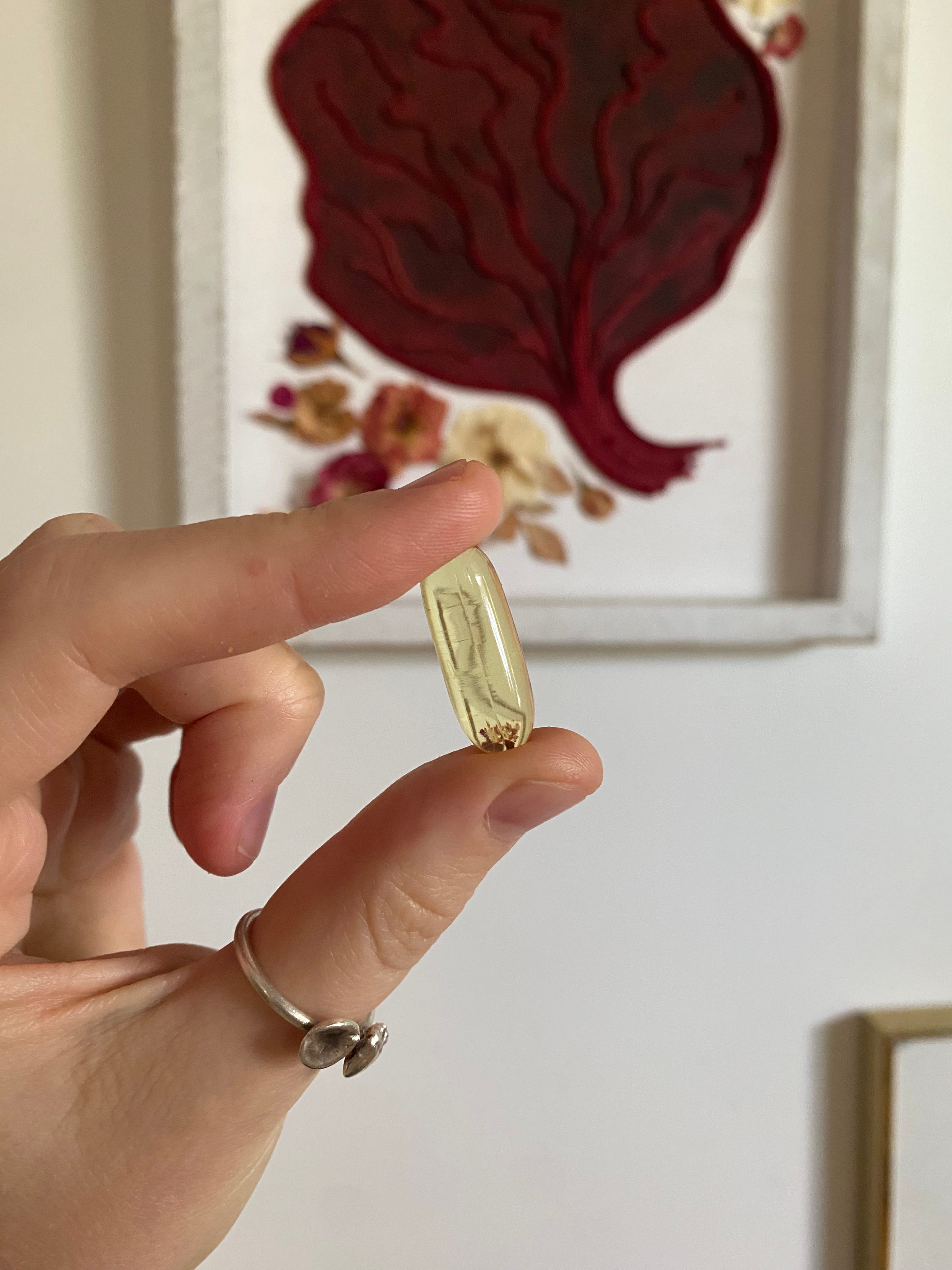
For the last month or so, I’ve been taking Omega 3 Fish Oil supplements and the reason I started was actually for grief support.
As an herbalist and holistic practitioner I am familiar with various plants, remedies, and supplements that can help with wide variety of ways that grief shows up emotionally, mentally, physically.
If I’m being totally honest with you, omega 3’s just were not on my radar as something that could support someone with trauma. I had a whole repertoire and protocol of plants and practices that could be supportive… but fish oil? Not on the list.
Typically people will take Omega 3 Fish Oil supplements to help with…
- Heart Health: lowering blood pressure, stabilizing heart rhythms, support blood vessel functions, and reduce risk of strokes.
- Brain Health: reducing the risk of dementia and brain degeneration, concussion recovery support, memory function
- Mental & Emotional Health: ease and reduce depression & anxiety
- General Inflammation: in joints, digestion, autoimmune diseases
- Joint & Mobility Support: known to reduce overall stiffness and pain with regular supplementation or nutritionally.There are many scientific studies about the known benefits and contraindications.
Fish oil was not something that I would typically consider for clients, friends, or even myself when navigating grief support care and resourcing. It’s not something that first came to mind and yet it is such a pillar for all the ways in which grief shows up in the human body. It was when I connected with a woman in the midst of a holistic consultation I was offering that it dawned on me just how supportive supplementing with Omega 3’s could be for grief support. Not to abruptly change her mood, but to support her in a grounded, humble, and steady way that often times grief is asking of us.
When we look at grief and trauma, we can see it presented in humans as:
- Anxiety and depression
- Memory loss, headaches, and brain degeneration
- Inflammation, stiffness, rigidity, and pain
- Exhaustion & low energy
- Skin irritations like excess dryness or oil, eczema, acne, wrinkles, sagging
- Chest pain & tightness, heart palpitations, irregular heartbeat, and various other cardiovascular issues
- Digestive problems
- Weight loss or weight gain
- Weakened immune system
- Sleep disturbances (too much, too little, nightmares, and disruptions)
- Nerve pain or numbnessThis is just naming a few.
Grief shows up physically just as much as it shows up spiritually, emotionally. or mentally.
Fish oil has long been known as pillar of healing and wellness for all of those symptoms, and for the holistic symptomological picture that grief and trauma may present. It’s not a cure-all by any means; it’s not meant to have flashy results and you don’t even have to supplement it with a capsule or a liquid extract — but it is a pillar for overall human health. A resource.
You can get a good dose of omega 3’s from the food you eat, and truly that should be the primary source. Nutrition, diet, the food we eat is our first medicine cabinet. For myself, I found that eating was challenging when I was in the early days of grief. That first year I lost a lot of weight really quickly, in a very unhealthy way, and so I wasn’t getting the omegas in the food that I was eating.
Even now, sometimes I find food to be challenging. I find my appetite goes away rather quickly and, while I’ve been doing better, I can also see that supplementing with Omega 3 Fish Oils and giving my body a therapeutic dose has been helpful for me at this time.
This is not a flamboyant supplement that’s going to help heal your emotions or grief overnight or give you immediate calming, perhaps even uplifting, results the way things like GABA, L-Theanine, or even Magnesium might. You may not even notice a drastic shift in your mood at all, however you may find your capacity to feel emotions and be present with grief to be expanded. But “heal” it? No. Rather, this is a humble support that can be there for you in the quiet moments. In the mundane day-to-day, step-by-step moments.
If you’ve read my writing, you’ll know that I don’t necessarily agree with the idea that we “heal our grief” so to speak… because really, that’s not the point.
Fish oil isn’t going to magically make your grief go away — and why would you want it to? I’ve heard it said that: we grieve someone as long as we love them… and if we love someone for a lifetime, so too will we grieve them.
Grief is something we learn to be in relationship with; and that relationship changes as we change and evolves as we evolve as time inevitably goes on, whether we want it to or not.
In the long run, Fish Oil is one of those supplements that can support our body through challenging moments of grief and trauma. With somebody, like myself, that has PTSD, living with profound grief, and experiences anxiety/depression, fish oil has been helpful in a myriad of ways. It was not a supplement that was recommended to me… instead, it came to me in a light bulb moment with a woman I’ve been supporting (I share more about this in the context recording at the top of this piece). A realization that I let simmer in my mind, followed by weeks of research while also pulling from my foundation as a holistic practitioner.
While it was not a supplement that I initially thought would have thought would be supportive, here I am (still in the early days mind you) taking high dose Omega 3 capsules daily, specifically looking for a high DHA dose as it is known to help with depression, anxiety, and overall brain function.
Grief shows up in aches and pains, a lowered immune system response, extreme exhaustion, and so many other ways I previously mentioned. It’s not just feeling deep sadness for three weeks, depressed for a year, crying only on the anniversaries and the birthdays and the holidays. It shows up in our inability to get over a cold as quickly, or the chronic inflammation that doesn’t seem to go away no matter how much turmeric we eat, the headaches that linger, or the exhaustion we feel after seeing friends and then being unable to socialize again for months.
Of course, approaching a Fish Oil supplement is not without caution. It’s important to make sure that it will be supportive specifically for you — I want to be clear: it’s not for everyone.
While it is absolutely a supportive supplement, it’s relevant to be aware that there are contraindications to taking it. For example, if you’re on blood thinning medication, you have a seafood allergy, or you’re prepping for surgery, it can be a good idea to hold off and speak with a health professional that you trust AND one that knows your bio-individual health history before taking Fish Oil.
For those that cannot, for whatever reason, take an omega-3 supplement, that’s where you can really focus on your nutritional medicine. Regularly eating chia seeds, flax seed oil, eggs, fatty fish like sardines, salmon, anchovies, and herring for example. Too, bringing healthy fats into your body, which support the nervous system by strengthening the myelin sheath, which can be damaged when we go through intense experiences like trauma, tragedy, death, and loss.
For me, Fish Oil has become a backbone humble pillar that I’ve been feeling consistently supported by. Of everything I have tried, this has been the thing that has me feeling more grounded, not with flashy promises of miracle results, but a humble support showing up for me daily. Over the last month I’ve noticed my skin has been physically softening, less inflamed - my emotions, less ready to explode - my ability to focus in conversations, deepening - my ability to notice when I’m disassociating, quicker. These are small wins, but wins nonetheless.
I’m still sad frequently.
All the time actually.
I’m never not thinking about Floyd.
My capacity to be with these feelings however, has deepened.
I’m a different woman than I was before, but I do feel very supported mentally and physically with this supplement. Of course there are countless other remedies as well, be they herbal or homeopathic supplementation or practices, that can help support us as we walk these challenging seasons of being human.
As time goes on, I will be sharing more about various other remedies, not to “heal grief” or “heal trauma” because I don’t know how realistic that is — but to support our body’s ability to navigate these challenging seasons in various ways. Offering us more nervous system allowance to dedicate the time to integrate our grief. We can look at the symptomology that our body is presenting and say, “let me love you a little bit more today” in whatever way it may be.
Grief and trauma take a toll on the heart, constricting our blood vessels, pushing us into a sympathetic nervous system state of: fight-flight-freeze-fawn. Omega 3’s support the physical and the emotional heart by lubricating our nervous system which can bring more ease. This is a supplement that can be a pillar as you get older too — and if you have a family history of depression or anxiety, stroke, or heart problems, it’s one of those supplements that you might notice supports you in more ways than one over time. You might not notice it right away, but it can be a consistent resource for your body and heart to call upon. Like brushing your teeth everyday or getting quality sleep. It’s regular maintenance.
EPA & DHA
EPA: Anti-inflammatory, mental health support (for things like depression), cardio-vascular health.
DHA: Brain structure & development (for growing babies in utero).
There are many studies that talk about dosing, and my belief truly is that each person is different. That said, typically a 2:1 or 3:1 EPA:DHA ratio is most supportive depending on your health goals. Always check with a trusted health professional that knows your bio-individuality to figure out a ratio that would be most supportive for you.
With herbs, you may drink a cup of a tea or you take a tincture — with homeopathic remedies you may let a tablet dissolve under your tongue or take drops — with physical or spiritual practices you show up to your altar or a mat — and you may notice a shift in your mood or body right away. Some supplements, like Omega 3’s (which you can take as a capsule or in liquid form), build up in your system over time and you notice the benefits later.
For me, I see it in moments when I’m recalling a memory, less skin eruptions when I’m feeling stressed or about to get my bleed. My immune system strengthening with significantly quickened recovery time and lowered cold/flu symptoms.
My emotions too: I’ve observed my parasympathetic system turn on a little sooner after a PTSD episode — that flashbacks don’t take me over as much or for as long; I don’t spiral as deeply and it doesn’t take as long for me to recover.
I do still get exhausted after spending time with friends, but I have found that I can rest a little bit deeper and still maintain (albeit imperfectly) connections and community, which of course is needed when navigating times of grief, sorrow, heartache.
Fish oil and Omega 3 supplements are a cornerstone addition to most recovery protocols, and I wish I thought of it sooner because I have truly felt nourished by it.
Perhaps Fish Oil supplements or just eating more foods rich in Omega-3s will be helpful for you too. Always always always be sure to check with a trusted healthcare professional, someone that knows your bio-uniqueness and bio-individuality - someone that understands the nuances of your story, that knows any other medications or supplements that you’re taking that may indicate that Fish Oil isn’t actually going to be supportive for you because, like I said, it’s not for everyone.
And that’s okay. They don’t have to be for everyone. That’s why there are a wide variety of remedies, herbs, therapies, practices, and supports in the world — there really is something for everyone.
Also I think this goes without saying but incase I was not clear before: Omega 3’s, Fish Oil, and any other supplements do NOT replace therapy or professional help/support. Holistic protocols, supplements, practices etc. are meant to be in addendum to any other forms of care. Please seek support if you feel you need it. Love you.
Fish Oil has been a resource for me, not a cure all, and not a “fix it” remedy — but it has be undoubtably supportive.
You can do your own research and see what you come up with because it might just be that pillar that supports you in the long run.
Omega 3’s for grief support… who knew?
In reverence,
Emma
a hummingbird prayer is a reader-supported publication. To receive new posts and support my work, consider becoming a free or paid subscriber.
Comments
Nothing yet. Say the first thing.
Sign in to join the conversation.