
Every meaningful life contains a hinge. A single instant, disguised as nothing at all, in which a person decides who she is going to be for the next ten years. It rarely wears the costume we expect. No trumpet, no crossroads lit like a stage. It arrives instead as a small, private failure of nerve, usually somewhere near the top of something difficult, and it asks one unglamorous question. Can you keep going, or are you too afraid?
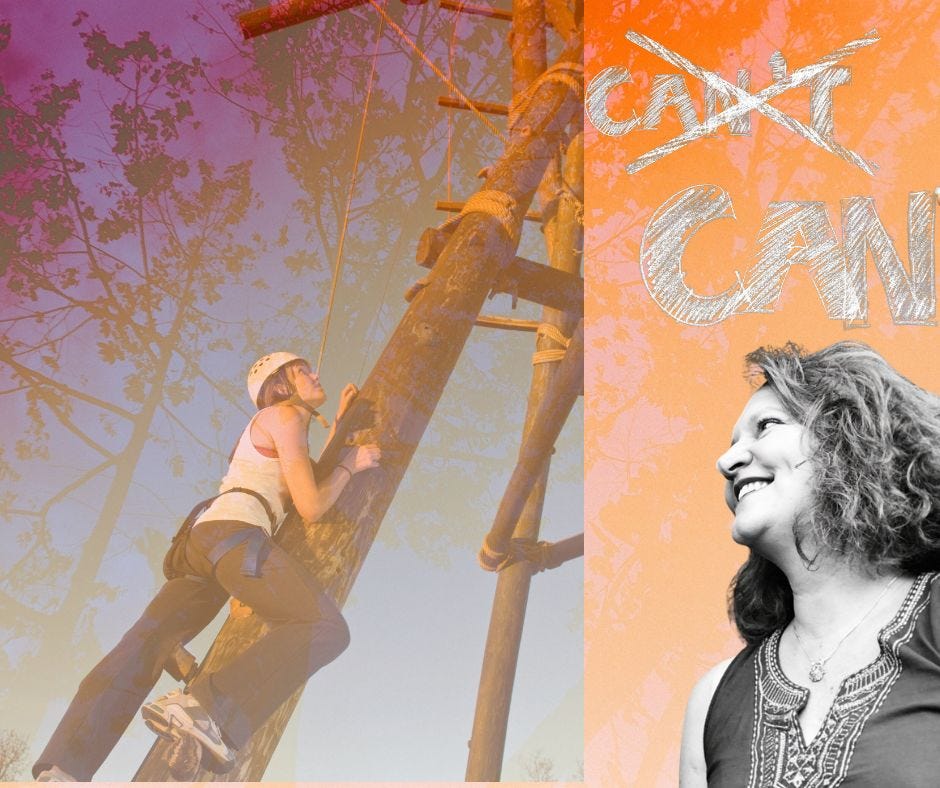
I met mine on a ropes course, thirty feet above the ground, both arms wrapped around a wooden pole while my heart performed something closer to a drumroll than a heartbeat.
Before any of us climbed, the instructor offered a piece of instruction I’ve carried for decades. He said that climbing down a pole we had only partly ascended would prove harder than finishing the climb. Not harder in some abstract, character-building sense. Harder in the plainest physical terms: more strength required, more control, more nerve than simply continuing up and over. He said this the way one might warn a child that the stove is hot, and then he let us begin.
You should know two things: first, I was doing this with my partner and for my child, and second, despite all my various skills, I am not, in any sense of the word, athletic.
Climbing that pole was daunting. I got about two-thirds of the way up before fear closed its hand around my throat. My mind told me that I had overestimated myself, that the wise and sober choice was to descend to the solid, forgiving ground. So I stopped. And exactly as he had promised, the descent undid me. My arms shook. My grip slipped. Each foot I lowered cost more than the four feet I would have needed to reach the top. When my boots finally touched the dirt, I felt no relief, only a private devastation, the unmistakable sense that I had abandoned something that mattered, and that my own body had just delivered the clearest lecture it knew how to give: quitting, this time, had cost more than finishing ever could have.
That experience taught me something I’ve spent thirty years relearning, in different rooms, on different literal and figurative mountains, across continents and over manuscripts and the slow architecture of my life.
It is almost always harder to stop than to continue.
The people who build the lives they actually want, rather than the diminished ones fear negotiates on their behalf, are not people who feel no fear. They are people who understand that fear will accompany them in either direction, up or down, and who choose to keep climbing.
Years later, my husband Mark and I stood before a decision that resembled that same pole, dressed in very different clothes. We were considering leaving behind everything ordinary and familiar- income, routine, the comfort of known walls, our kids and grandkids- for six months of travel through the wide unfamiliar world. We wanted to make sure that our dream trip became a reality while we were young enough to enjoy it. It was a huge risk for us professionally and financially and, after lots of deliberation, we decided to go. More than once during those months, standing in some foreign city with our plans half formed and our courage only partly assembled, we asked each other whether we ought to turn around and come home early.
We did not. We continued, city by uncertain city, and that stretch of time has become, so far, the most consequential season of our shared life. Not because it was easy. It was not. In fact, it was challenging in ways we could never have predicted. Each time we chose to continue rather than head home, we were rehearsing the very same discipline I wish I’d had on that pole decades earlier. We were demonstrating to ourselves, with our actual feet, that we dare to follow our dreams.
I am living the life I once only imagined, not because I stopped being afraid, but because I stopped granting fear the final vote.
I am living the life I once only imagined, not because I stopped being afraid, but because I stopped granting fear the final vote.
In a single moment you decide you can or you can’t. That instant determines everything that follows. The actual moment you hear yourself think you can’t do a thing is more important than almost anything else in determining your success. It’s where the architecture for your future is shaped. Everything built afterward, your next action, your next year, occasionally your next decade, rests on whichever choice you make in that instant. Stop there, and you carry forward the story of fear’s power over you. Continue, and you carry a story of courage awakened.
We’ve mostly been taught to treat that flicker of doubt as data. As a warning light. As proof that we’ve located our actual limit. But doubt, arriving precisely at that height, in that particular moment, is rarely a reliable report on capability. It’s almost always a report on fear. And fear, however useful for keeping us from wandering off literal cliffs, is a poor judge of what we’re capable of once we begin doing something that matters.
Understanding this intellectually is one discipline. Living it, in the actual moment the hands begin to shake, is another altogether. What follows are the instruments I reach for, mental, practical, and mystical, when I feel the old pull toward the ground.
Weigh the cost of stopping, not just the cost of continuing. Fear is skilled at calculating the risk of moving forward. It’s far less skilled at reminding you what it will cost to stop. Before deciding, ask honestly what tomorrow, next month, next year will feel like if you turn back now. Set that cost beside the cost of continuing. It’s often the heavier of the two.
Separate the fear from the forecast. Fear announces, “I can’t.” It seldom offers evidence. When that thought arrives, ask it to show its work. Usually it can’t. It’s a feeling, wearing the borrowed authority of a fact.
Consult your own history as a witness. You have already survived every difficult thing you have ever survived. This is not a comfort so much as a record. When doubt appears, hand it your record.
Shrink the next step, not the destination. You need not leap to the top of the pole. You need only reach the next foothold. Divide the frightening whole into a portion small enough that agreeing to it requires willingness rather than heroism.
Decide before the fear arrives. Make your commitments in calm weather, not in storms. Mark and I had settled on finishing what we started long before we ever felt the particular fear of a foreign city at midnight. When fear finally came, the decision was already standing. We were only carrying it out.
Let the body lead the mind back. Fear inhabits the body before it ever reaches thought. A few slow, deliberate breaths, shoulders lowered, feet planted, can interrupt the spiral long enough for wiser thinking to catch up.
Ask what your future self already knows. Close your eyes and picture yourself a year beyond this decision, having chosen to continue. What does she understand that you do not yet? Let her speak it to you now, before the need is urgent.
Call upon your lineage. Whether that means ancestors, teachers, or simply the women who climbed before you, invite their strength into the moment. You are rarely as unaccompanied on the climb as fear would have you believe.
Regard the fear as a threshold guardian rather than an adversary. In nearly every wisdom tradition, the figure who guards the gate is not there to keep you out forever. It’s there to determine whether you truly want what waits beyond it. Meet it rather than fight it. Ask what it requires of you and then offer that.
I still think of that pole, not with shame any longer, but with something closer to gratitude. It remains the least expensive lesson I ever received, thirty feet of rope and timber teaching me something I might otherwise have had to learn on a mountain from which descent would not have come so cheaply. Every doubt-filled moment since, every foreign city, every daunting chapter, has been an occasion to remember what the instructor told me before I ever touched that pole.
Going down is harder than going up.
So, when you arrive at that hinge, hands trembling, mind negotiating quietly for an ending, I hope you’ll remember that the woman who keeps climbing is not braver for feeling no fear. She is braver for having decided that the view from the top is more reliable than the illusion of relief from an early descent.
Keep Climbing.
Comments
Nothing yet. Say the first thing.
Sign in to join the conversation.