
At heart, I’m a city girl. I grew up in a military family, moving roughly every four years to wherever the orders sent us, and only one of those places happened to sit outside the city limits. Alaska. My family homesteaded eighty acres in Fairbanks for about three years when I was very young.
I have only a few memories from that time, shaped by old photographs, but one of them is my mother’s garden. I couldn’t tell you now what she grew, but three years was long enough for a sizeable crop. Then it was time to move. The inheritance of a military childhood is that you learn how to arrive and settle quickly, and how to leave right around the time a place finally begins to feel like home.
I’ve never lived anywhere with a garden any bigger than that one until now, and for most of my life the closest I came to farming was buying vegetables from the farmer’s market. So, when I moved into my 6-month residency at The Ground, a regenerative farm and hospitality ecosystem in Yamhill County, Oregon, I had no farm background to draw on. What I had was curiosity, a lot of questions for anyone patient enough to answer them, and underneath all of it, an unspoken hope I’d learn to understand what farm life is.
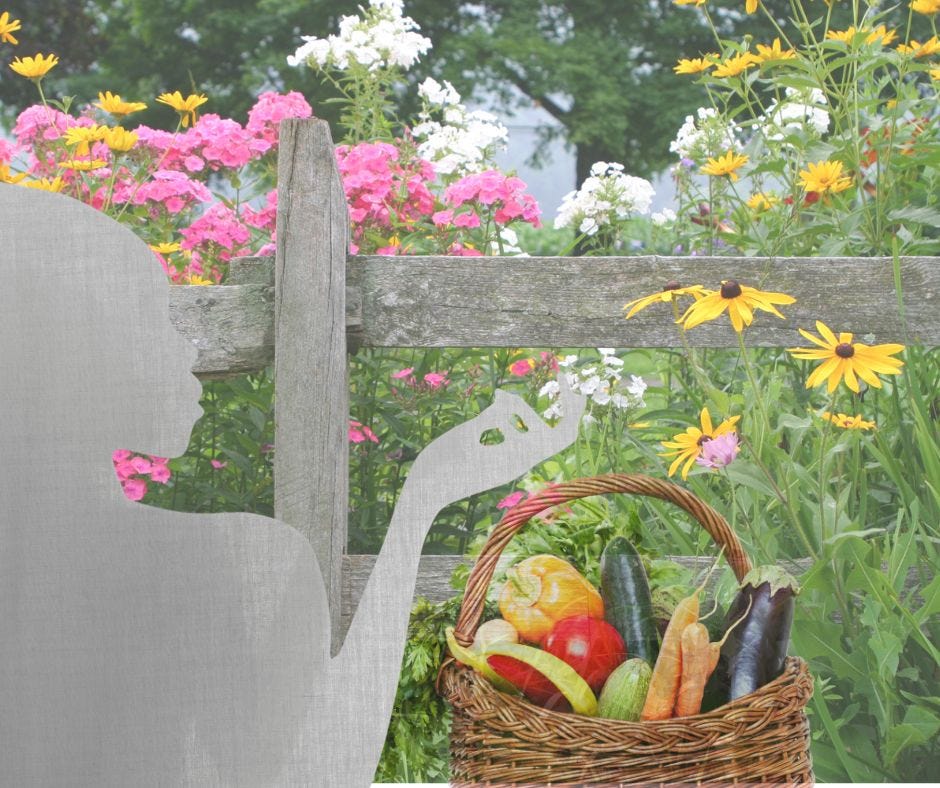
It’s the last week of July as I write this, and I’ve been here since April. Friday I’ll pick up a share of what’s growing in the garden. I’ve been doing that for a couple of months now. I have no idea what’s coming in each share.
I’ve spent my life inside a grocery store’s version of certainty, where I could walk in and decide in advance exactly what I wanted and expect the shelves to have it available. A garden doesn’t take orders. It delivers whatever the rows produce, and my only job is to receive it and figure out what to do with it, and even then, Mark does the cooking, so my decisions are limited. Mostly, I’m fascinated with how things look when they’re fresh and ripe.
It’s remarkable to notice how much this weekly not knowing is teaching me. Most importantly, I’m learning to let myself be surprised, and to eat what arrives instead of what I would normally eat by habit. Some weeks the garden hands me lettuce and armfuls of green, leafy things. Other weeks it provides the best strawberries and carrots I’ve ever eaten in my life, sweet in a way nothing from a store has ever been. A couple times, a never-seen-before item arrived, and I had to figure out what it was.
There are weeks the share is very full and others it’s not. I’ve learned to receive with interest and observation rather than treating the size as a success or failure on the land’s part or mine. My mother must have learned some version of this too, over her time in Alaska, watching her own rows fill and empty on their own schedule. I just never got old enough while we were there to ask her what she noticed before we moved.
Recently, I asked one of the growers here whether she ever knows in advance what a given week will bring. She laughed and said not exactly. I found that oddly comforting. If someone who spends her working life this close to the land still gets surprised by what it offers, then my own not knowing isn’t a gap in my competence. It’s just the honest condition of working with something alive, something that answers to weather and soil and sun and time rather than to my expectations of it.
Each week, someone harvests what is ready. Life is like that. We harvest what is ready when it’s ready and not a moment before. I’m learning to look at the harvest as a life practice rather than something only for the farm.
Harvesting, in our human life, doesn’t follow the tidy story that if you plant carefully in the spring, you’ll reap exactly what you expected by the fall. That story isn’t quite how it works. We plant what we can, we care for it as best we know how, and then the actual return arrives on its own schedule and in its own shape, often nothing like what we pictured when we put the seed in the ground. The skill was never predicting the yield. It was building the capacity to meet whatever yield shows up with enough resourcefulness to make real use of it.
I think, in a way I couldn’t have named as a child following my family from base to base, this is the piece I’ve been circling my whole life. Not the planting. The releasing of expectation, and the willingness to see what can be harvested from a changing life at any given time.
That feels especially true right now, in a world that keeps changing shape faster than any of us planned for. Plenty of what I hoped would be certain by this point, in my work, in my relationships, in the version of my life I imagined when I was planting seeds and making choices, hasn’t arrived in the form I expected. Some of it hasn’t arrived at all.
In past years, I’d have treated that as evidence that I’d planned badly, packed the wrong things, chosen the wrong place to plant myself. I’m starting to understand it differently now, largely because so many glorious things have happened that I could never have predicted and might have missed if it weren’t for what I’ve learned about harvesting life.
The garden doesn’t know what I want each week. It only knows what’s ripe and ready, under moment-to-moment conditions. In the same way, life doesn’t care what I want from it. It delivers what is ripe and ready. If we choose, we can be surprisingly nourished by all we received.
The job is to see what arrives and ask what we can honestly make of it.
That question, what can I make of this, has become a kind of daily practice for me here, and I don’t think it belongs only to people who live on farms. Whatever this last week of July has handed you, whatever surprised you by showing up or by failing to, I’d invite you to ask the same thing before you decide whether it counts as a good week or a bad one. A friendship that changed shape without warning. A plan that fell through and left something unexpected in its place. An opportunity that arrived early, before you felt ready. None of that has to be sorted immediately into success or disappointment.
It can simply be received, the way I’ve learned to receive a share of vegetables, the same way my mother must have harvested hers year after year, knowing all along that on some unexpected day, she would likely be living in a different place and harvesting something different. We can receive life as it is now, without expectation and with curiosity and awe.
There’s something genuinely wonderful in this. Letting go of expectation doesn’t leave you with less. It leaves you with room to be surprised by a life that keeps offering you things you never would have thought to ask for. The version of me that used to walk into a grocery store already certain of what I wanted has started to feel small next to the version learning to meet a garden share of something unexpected and get genuinely excited about it. Not despite the surprise. Because of it.
That’s the invitation underneath all of this. Not to abandon planning, and not to stop desiring certain things. Just to hold what you’re harvesting in your work, your relationships, this whole unrepeatable life, a little more loosely than the tidy story of expectation would have you believe you need to.
I’m learning that creativity shows up strongest right at the edge of not knowing, when you have to look at what life delivers and ask what you can make of it.
I don’t know what’s coming this week, in my garden share or in my life. I’ve stopped needing to know before I decide how I’ll meet it. I’ll receive whatever it is as a bountiful harvest.
Here on this farm, there’s a willingness to take what life delivers, especially in times of great change, and to see how many creative ways we can use our unexpected gifts to make the world better. There’s a small miracle in that.
I’m finding small miracles are a big part of what life on a regenerative farm is all about.
Comments
Nothing yet. Say the first thing.
Sign in to join the conversation.