
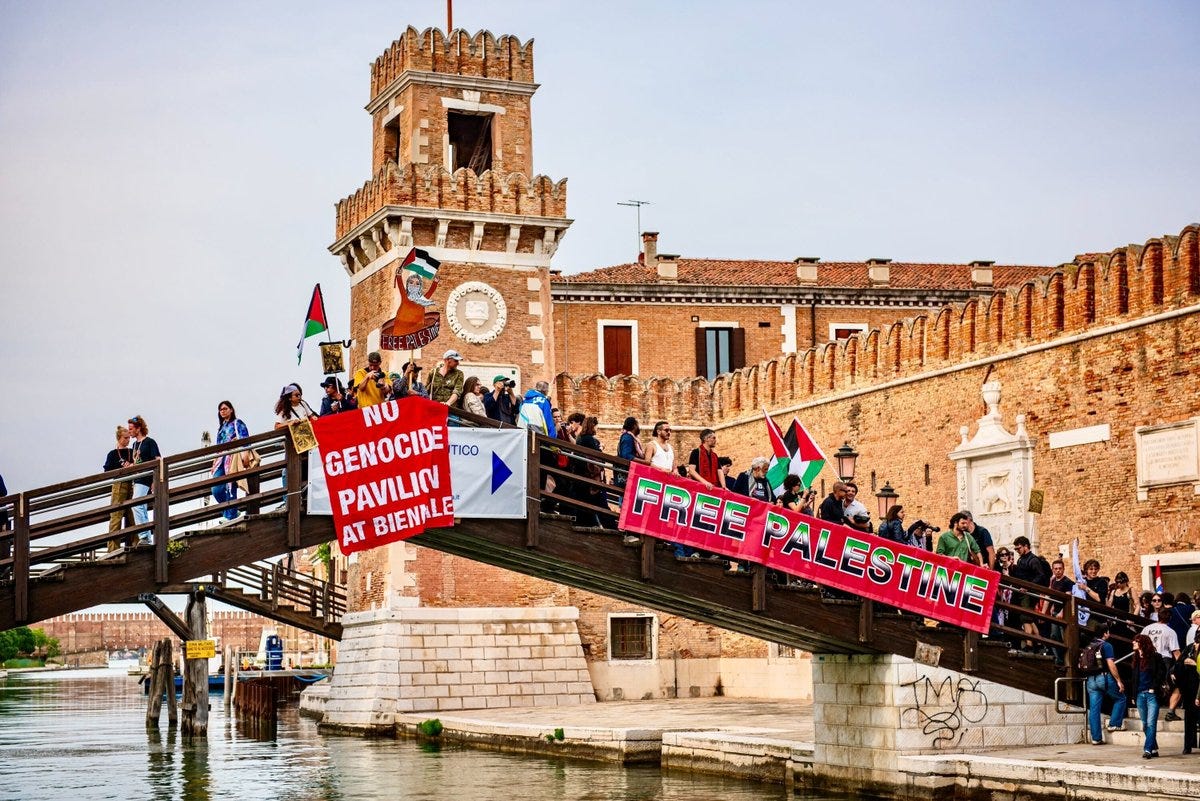
More than 25 national pavilions at the Venice Biennial shut their doors in protest this week, including France, Belgium, Austria, and Italy in an unprecedented revolt over Israel’s continued participation despite it’s ongoing genocide in Gaza.
The crisis is not just an art-world controversy, it has become a referendum on whether major cultural institutions can continue claiming political neutrality while wars, mass civilian killings, and documentation of Israeli genocide continue to unfold in real time.
What began as outrage over Israel and Russia’s participation has spiraled into the deepest institutional rupture the Biennale has faced in decades: the resignation of its entire international jury, coordinated pavilion shutdowns, artist boycotts, protests across the Giardini, and growing questions about whether the national pavilion model itself can survive this political moment.
The immediate trigger was the Biennale’s decision to allow both Israel and Russia to participate despite ongoing wars and international legal scrutiny. The five-member jury resigned after reportedly refusing to judge work from countries whose leaders face international arrest warrants or accusations tied to war crimes and crimes against humanity — a position widely understood to refer to Israel’s war in Gaza and Russia’s invasion of Ukraine.
That unprecedented move shattered one of the Biennale’s central pillars: the authority of the Golden Lion awards. Organizers responded by replacing the traditional jury system with public voting, effectively dismantling the Biennale’s normal adjudication process in the middle of the exhibition.
The fallout spread rapidly.
More than 70 artists withdrew themselves from prize consideration in solidarity with the resigned jury. Days later, over two dozen national pavilions either fully or partially shut down in protest against Israel’s continued inclusion. Participating countries reportedly included Austria, Belgium, France, the Netherlands, Japan, South Korea, Egypt and others.
The protests themselves were unusually direct for an institution long associated with diplomatic caution and elite patronage. Palestinian flags appeared across installations. Demonstrators marched wearing the names of Palestinian artists killed in Gaza. Posters reading “Palestine is the future of the world” and “Stop the Genocide Pavilion” appeared throughout the exhibition grounds.
What makes this moment historically significant is not simply the scale of protest, but what it reveals about the collapsing legitimacy of institutional neutrality inside the global art world.
On May 8, thousands protested in Venice together with Art Not Genocide Alliance (ANGA), against the participation of Israel. Riot police blocked demonstrators near the Israeli pavilion and several other pavilions were temporarily closed by staff in solidarity with the protests (Austria, Poland, Spain, Switzerland, Turkey, Finland, Ireland, Qatar, and the UK, among others).
For decades, museums, biennales and cultural foundations often framed themselves as spaces “above politics,” even while depending on state sponsorships, billionaire donors, weapons-linked philanthropy, or geopolitical soft power. The Venice Biennale — built around national representation — has always functioned partly as a stage for cultural diplomacy. But Gaza appears to have ruptured the credibility of that framework for a large segment of artists, curators and cultural workers.
Many critics now argue that continuing to platform states accused of mass atrocities while insisting on institutional neutrality is itself a political act. The accusation being leveled at institutions is no longer passive silence, but active complicity: that culture is being used to sanitize or normalize violence through prestige, spectacle and international legitimacy.
This is why the protests have spread beyond Israel alone. Russia’s participation became inseparable from the same debate. Increasingly, artists and curators are asking whether international art institutions can continue operating as if geopolitics exist outside the gallery walls.
What is emerging is a broader crisis around the very structure of the Biennale itself. Critics argue that the national pavilion system — created in the age of empires and nation-states — is increasingly incompatible with a globalized art world where artists often reject state representation entirely.
Several curators and artists involved this year openly questioned whether national pavilions now function less as artistic platforms than as instruments of state branding and soft power, similar to accusations made against Eurovision for using the song contest to sanitize and whitewash Israel war crimes and genocide.
The comparison many observers are making is to the upheavals of 1968, when student occupations and political protests forced the Biennale to suspend prizes entirely. But many within the art world believe 2026 goes further because the conflict is no longer external to the institution — it has penetrated the institution’s governing structure itself.
And unlike previous controversies, this one is unfolding during a period when the death toll in Gaza, the destruction of cultural heritage, and the killing of Palestinian journalists, writers and artists are being documented in real time across social media and independent media ecosystems. That immediacy has made it harder for institutions to manage dissent quietly or compartmentalize politics away from culture.
The deeper fear inside the art establishment is that this crisis will not remain isolated to Venice.
Already, museums, universities, film festivals and publishing institutions across Europe and North America are facing growing internal revolts over donor relationships, censorship accusations, sponsorship ties and institutional responses to Gaza. The Venice Biennale may end up remembered not simply as an exhibition disrupted by politics, but as the moment a large part of the cultural sector stopped accepting the premise that art institutions can remain neutral in the face of genocide and ethnic-cleansing.
Comments
Nothing yet. Say the first thing.
Sign in to join the conversation.