
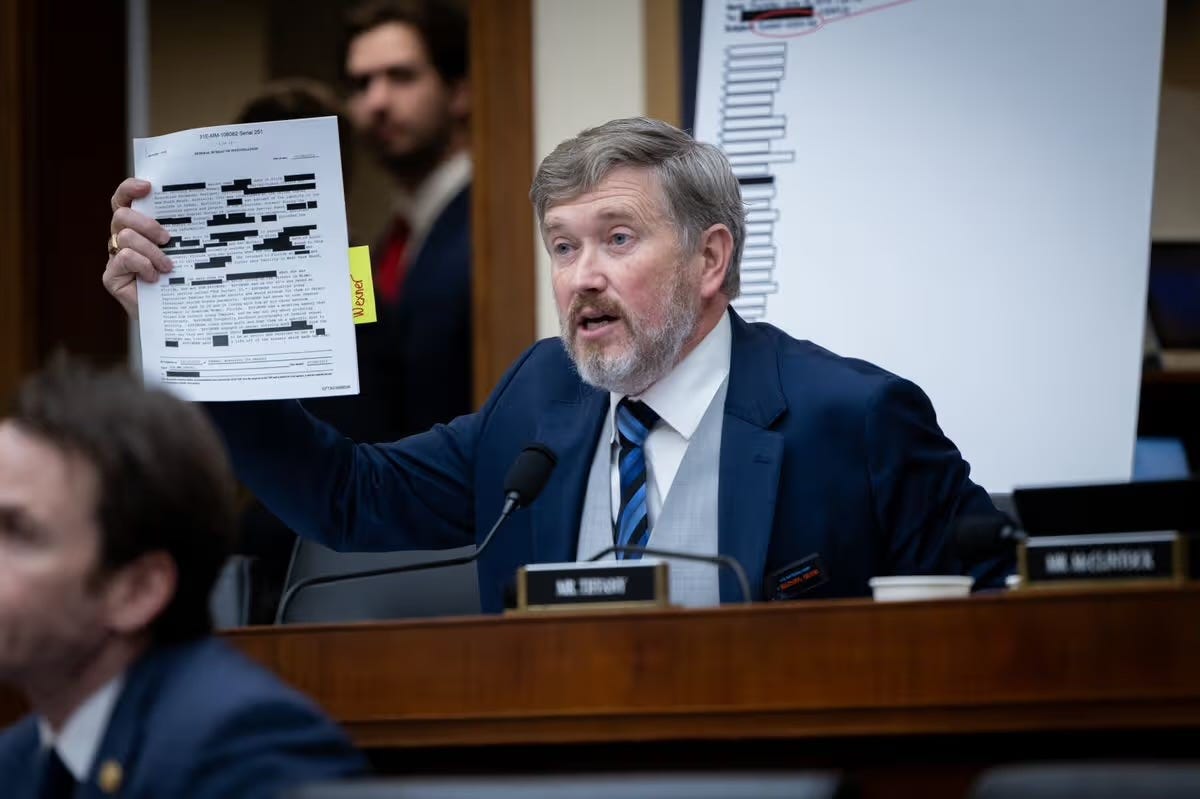
Thirty-four million dollars is the price of silence in American politics. More than double what any house primary race has ever cost. But for all that money, what made Kentucky Congressman Thomas Massie dangerous was never simply one vote on Israel or one speech about Gaza. It was that he crossed an invisible line in American politics and survived long enough to expose that the line existed at all.
For decades, Washington treated unconditional support for Israel as something beyond ordinary democratic debate, enforced not only through ideology, but through fear, donor pressure, party discipline, and political isolation. Massie disrupted that arrangement from inside the Republican Party itself, at a moment when younger Americans across the political spectrum were already questioning wars, foreign aid, lobbying power, and the moral cost of empire in ways previous generations rarely did publicly.
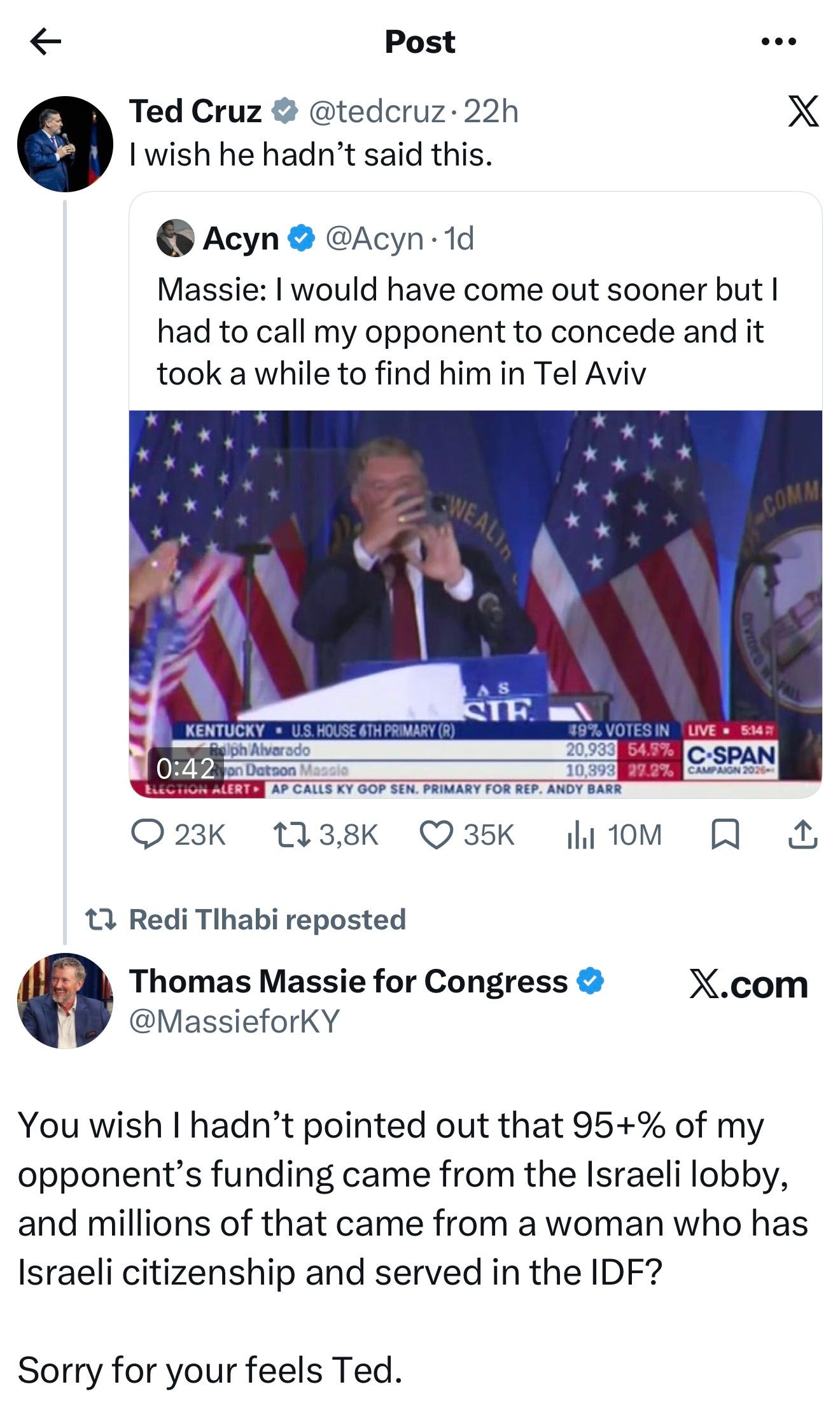
That is why this race became so enormous, so expensive, and so vicious. Not because one congressman could singlehandedly change U.S. foreign policy, but because the establishment understood the symbolic danger of someone proving that criticism of Israel was no longer politically unspeakable. The real threat was not Massie alone. It was the possibility that millions of Americans watching him, especially younger Americans, would begin asking their own questions afterward.
Three moments crystallized why Massie had to be stopped:
First was his vote against Iron Dome funding in 2021. When the House voted unanimously to send $1 billion to Israel’s missile defense system, Massie was the only Republican who said no. “When did the U.S. Congress become a charity for foreign governments?” he asked. That question hung in the air like a challenge to the entire bipartisan consensus that has kept our foreign policy captive to AIPAC for decades.
Second was his willingness to speak the truth about Gaza. While most Republicans fell in behind Trump’s “absolute right to defend itself” rhetoric, Massie looked at the pictures of slaughtered children in Gaza and said what everyone was thinking but no one would say: “Why are we paying for this?” He called it “unacceptable,” “a tragedy,” “a humanitarian disaster”—words that in Washington translate to “enemy of Israel.”
Third was his fight for the Epstein files. This is what really terrifies them. The one that connects the dots between the wealthy donors funding his opposition and the system they’re trying to protect. Massie partnered with Democrat Ro Khanna to force the Justice Department to release 33,000 pages of Jeffrey Epstein-related documents. Because Epstein’s network wasn’t just about rich men with young girls. It was about blackmail. It was about compromising powerful people. It was about a system of corruption that reaches into the highest levels of government.
Donald Trump, who ran his campaign promising to be an America First president, has been on Truth Social calling Massie “weak,” “pathetic,” “a bum,” and “the worst Congressman in the long and storied history of the Republican Party.”
What happened in Kentucky is an auction where the bidders weren’t from Kentucky. They were from Tel Aviv, Manhattan, and Las Vegas—people who’ve never stepped foot in the 4th District, couldn’t find Kentucky on a map, but knew exactly what Massie represented: a threat to the system of political corruption.
Thomas Massie had 1,545 donors from Kentucky. Ed Gallrein had just 70. Among the outsiders funding the attack on Massie was Paul Singer, the hedge fund vulture who made billions betting against American companies. Miriam Adelson, who dumped $106 million into pro-Trump PACs last year alone. And John Paulson, the financial predator who bet against the housing market and profited while millions lost their homes.
Put simply, Massie represents a threat to the new Trump-Adelson alliance that has sold out American interests for Israeli campaign cash.
Pete Hegseth, the Secretary of Defense, traveled to Kentucky to campaign against Massie, in the middle of a war in the Middle East, taking time off from his duties to campaign in a congressional primary against a sitting member of Congress from his own party.
“They’re sending the secretary of war to my district,” Massie said. “That’s why the president’s losing sleep and tweeting about this. That’s why AIPAC has dumped another $3m into my race this weekend.” He’s right. They’re desperate. Because Massie represents something they can’t tolerate: a politician who actually represents his constituents instead of his donors. A politician who puts America first—not as a slogan, but as a principle.
For 14 years, Massie built a reputation in Washington as a Republican willing to vote against his own leadership, on spending, surveillance, foreign aid, and the steady expansion of U.S. military commitments abroad. He did not treat these as peripheral issues, instead he made them central to his critique of Washington power. In his concession speech, Massie framed his defeat not as retreat, but as resistance to pressure he had long refused to yield to.
“For 14 years, those S.O.B.s in Washington tried to buy my vote,” he told supporters. “But they couldn’t buy it.”
What they could buy, and what they did buy, was a political machine capable of overwhelming almost any local electorate. But even that raises a harder question: why this race, and why this level of force?
Glenn Greenwald was right when he said, “Massie is the only one left.” Since Trump returned to power, he has purged his party of dissent. Louisiana Senator Bill Cassidy lost his primary after voting to convict Trump. Georgia’s Marjorie Taylor Greene was called a traitor. Hostettler, Paul, Amash—all gone. Massie is the last Republican standing who dares to question the bipartisan consensus on Israel.
Massie’s loss sends a message to every member of Congress: Cross the Israel lobby and you’re finished. Your career will be over, your name will be mud and you’ll be destroyed by an avalanche of money and media. The most expensive House primary in U.S. history shows just how far they’re willing to go.
But 45 percent of Republicans in Kentucky, in the face of $34 million in outside spending, stood with the congressman who dared to speak truth to power. And in doing so, they proved that democracy still has a pulse. They proved that the people can still beat the money, even when they lose.
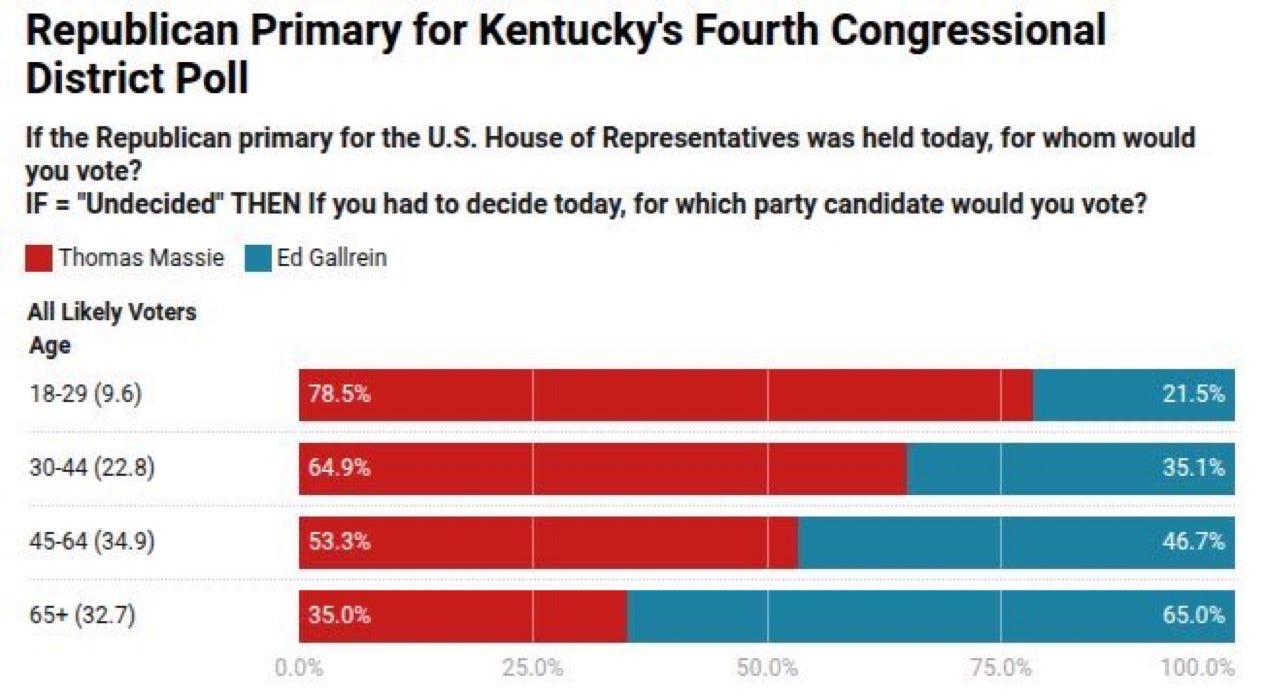
In the background of all this is a quieter shift that neither party fully controls. Younger voters across ideological lines are increasingly skeptical of foreign intervention, more openly critical of military aid abroad, and more willing to question long-standing bipartisan assumptions about U.S. foreign policy—particularly Israel. That shift does not produce a single unified ideology, but it does widen the boundaries of acceptable public debate.
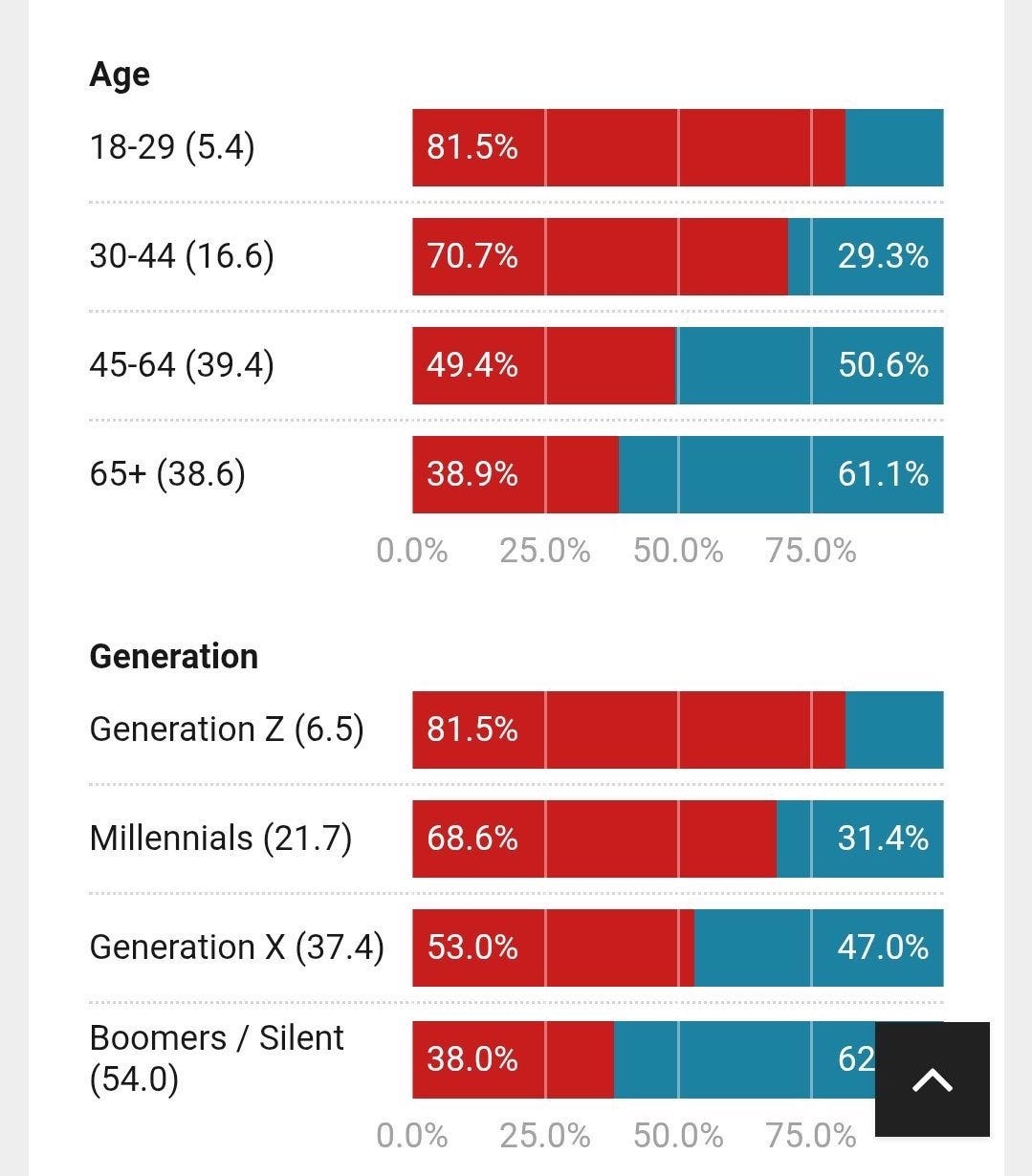
Voters 65 and over were the only age demographic in Kentucky’s 4th Congressional District primary to favor Ed Gallrein over Thomas Massie.
Leaders like Massie, Chris Rabb, and a growing number of younger progressives and anti-interventionist conservatives sit inside a widening space. They are not the origin of the shift, but they are early political expressions of it—and therefore early targets of institutional resistance to it.
For decades, Washington treated unquestioning support for Israel as one of the few issues that existed outside normal democratic scrutiny—insulated by money, party discipline, media caution, and political fear. What people like Massie, Rabb, and a growing number of younger progressives and anti-interventionist conservatives have done is force that consensus into the open, where Americans can finally argue about it publicly instead of pretending it does not exist.
Tens of millions may have been enough to remove one politician, but not enough to stop the question itself from entering mainstream American political life. And once voters begin asking why so much money is required to silence criticism of a foreign government, the old rules become harder and harder to restore.
Thirty-four million dollars was not spent because Thomas Massie was irrelevant; it was spent because he represented a crack in a bipartisan consensus that Washington once considered untouchable. That boundary is now collapsing—not because politicians changed first, but because the public did, especially younger Americans shaped by social media, a life-streamed genocide that continues to unfold, economic decline, and distrust in institutions.
Massie may have lost his seat, but the questions he raised are no longer confined to the margins. And once a political taboo is broken in public, money can punish the messenger, but it cannot force the country to unknow what it has already seen.
Empires always mistake delay for victory. They believe if they spend enough money, remove enough dissidents, and discipline enough politicians, they can restore the old silence. But silence is gone now. A generation of Americans has already seen too much, questioned too much, and inherited too little to return to the political certainties of the past.
Massie may have lost a race. But the consensus that targeted him is losing the country.
Comments
Nothing yet. Say the first thing.
Sign in to join the conversation.