
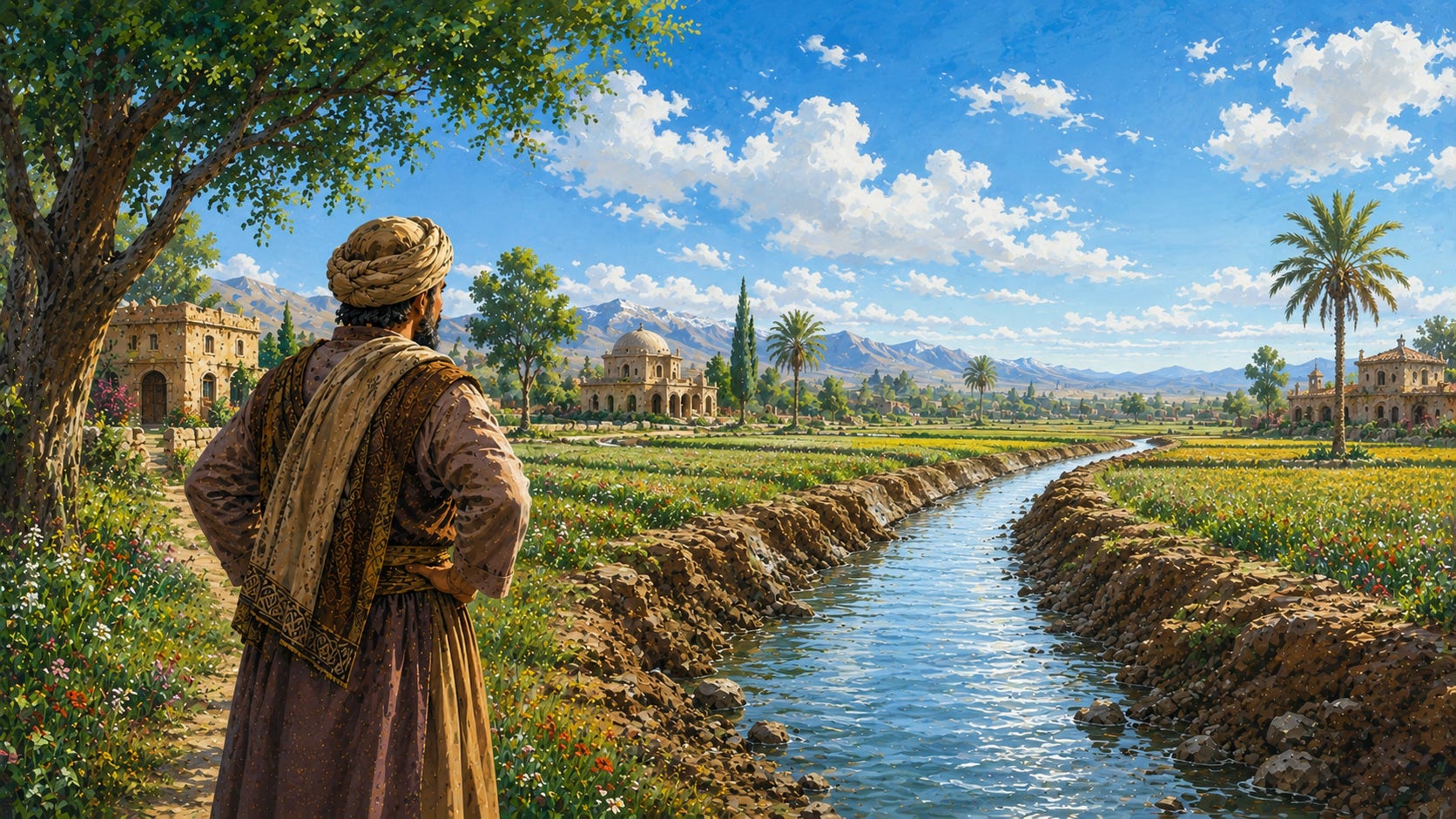
There once were two brothers who were both farmers, and who each owned a big piece of land side by side. After 40 years of being best friends, they had a bitter disagreement that broke both their hearts. They couldn’t reconcile the pain and as a result they stopped speaking to each other.
As time passed, the younger brother’s heart began to harden as his anger led him to bulldoze the meadow between their two lands, causing the water from the ground to rise up and create a creek between their two properties. The older brother was both heartbroken and furious when he saw what happened. He also wanted to retaliate, but didn’t know how.
As he was thinking this over, he heard a knock at the door. He opened the door to find a carpenter with his toolbox in hand. The carpenter asked, “Hello, don’t mean to bother you. Just wondering if you had any work for me around the farm to do?” At that moment, the older brother had a brilliant idea for revenge. He replied to the carpenter, “Yes, I have the perfect job for you. I want you to take the pile of wood from an old barn that fell apart and build up a tall fence alongside the the creek so that I don’t have to see my brother’s farm ever again.”
The carpenter listened to why the older brother wanted this wall built and said, “I think that I can accomplish what you are asking of me.” The older brother gave him all the materials and said, “I am going into town for the week and expect the job to be done upon my return.” The carpenter agreed and got to work.
When the brother came home, he saw a sight that he didn’t expect to see. Not only was there not a wall between his land and his brother’s property, but the carpenter had built a bridge across the creek from his land to his brother’s land with the most beautiful handrail. As the older brother inspected the bridge, he saw his younger brother was walking over the bridge with his hands wide open. The younger brother said with tears in his eyes, “Despite my childishness, despite the way that I retaliated with the bulldozer, you built this bridge and sought to reconcile our hearts!” The younger brother’s words thawed the ice around the older brother’s heart and they embraced with tears.
As the two brothers reconciled their hearts joyfully, the carpenter grabbed his box and started to walk away. The brothers noticed and both turned to him and said, “Don’t leave now, we have so much more work around this farm for you if you’d like to stay.” The carpenter then smiled as he turned to them and said, “I’d love to stay, but I have many more bridges to build.”
This story reminds us how destructive anger can be. People tend to raise their voices when they are angry, not because the other person is physically far, but because the distance between the hearts has widened through misunderstanding. The creek created from the anger of the younger brother is a physical manifestation of the emotional rift between the two brothers. The Qur’an is very adamant about guarding the heart from an anger and resentment that leads to irreversible consequences.
“And do not let the hatred of a people cause you to swerve from justice. Be just; that is nearer to righteousness.”
— Qur’an 5:8
The Qur’an doesn’t say to deny your anger, but to not allow it to be transformed into a rage that burns everything in its path. It’s not easy to forgive those who have hurt us, which is why the reward for doing so is celestially high. The Qur’an says, “The recompense of an evil is an evil like it, but whoever pardons and reconciles, his reward is with Allah.” (42:40). Imagine that, you forgive someone for wronging you and Allah, the Creator of the Universe, intervenes to reward you personally for your act of kindness towards one of His creatures. The verse doesn’t say you forgive them once they apologize or you forgive them when they deserve it. It says, “whoever forgives and reconciles” irregardless of the other person’s level of awareness or self-accountability. The call to forgive and reconcile with those who hurt us doesn’t automatically mean forgetting what happened and being reckless with who we give access to our hearts. Rather, it means we let go of carrying the anger and pain of someone else’s wrongful actions.
Forgiveness is a gift that Allah gives to us, to actually take back the power others took or we gave away and to place it in the safety of His hands. Forgiveness is a bridge that reconnects hearts and removes the veils of separation. This is precisely why the Qur’an and Prophet ﷺ praise those who dedicate time to reconciling and bringing hearts together like the carpenter. After all, it’s no accident that Jesus was a carpenter too!
The Prophet ﷺ said to his companions, “Shall I not tell you of something better in degree than fasting, prayer, and charity?” They said, “Yes.” He said, “Reconciling between people. For discord among people is the shaver.” (Sunan Abi Dawud (4919) and Jamiʿ at-Tirmidhi (2509)
The word the Prophet ﷺ used for shaver is al-haliqah in Arabic which refers to how division and hatred can act like a razor that shaves away the goodness between hearts and the good consequences of someone’s religious and social life. This is perhaps why reconciling hearts carries such a spiritual rank a degree higher than fasting, prayer, and charity. The Prophet ﷺ is highlighting to us that discord doesn’t just separate hearts, it can actually erode the heart, removing the light of goodness from the heart like a shaver removes hair from the body. In a sense, reconciliation is a form of worship like prayer, purification like fasting, and a form of charity through the offering of your time.
“So make peace between your brothers, and be mindful of Allah, so that you may be shown mercy.”
— Qur’an 49:10
The role of the carpenter is the role we are all called to play. To bring peace where there is pain and to become the meeting ground of justice and mercy in the world. The Qur’an doesn’t just say to not retaliate against evil, but to respond with something actually better. “Good and evil are not the same. Repel [evil] with that which is better, and behold, the one between whom and you there was enmity will become as though he were a devoted friend.” (41:34) Like the mystics say, “Be like a date tree, when stones are thrown against you respond with fruits that taste sweet.” In many ways the calling of being a Muslim is to be like earth, to transform what is dead to fertilizer and to grow something beautiful. May we all be gardeners and carpenters on the spiritual path of love.
Oh Allah, please give us the compassion to forgive those who have hurt us. Oh Allah, inspire us to respond to evil with goodness, to harshness with kindness, and to being wronged with mercy. My beloved Lord, help us to overlook the faults of others so that You may overlook our many faults. In Your beautiful and majestic names we pray, Ameen.
In prayers of light upon light,

No posts
Comments
Nothing yet. Say the first thing.
Sign in to join the conversation.