
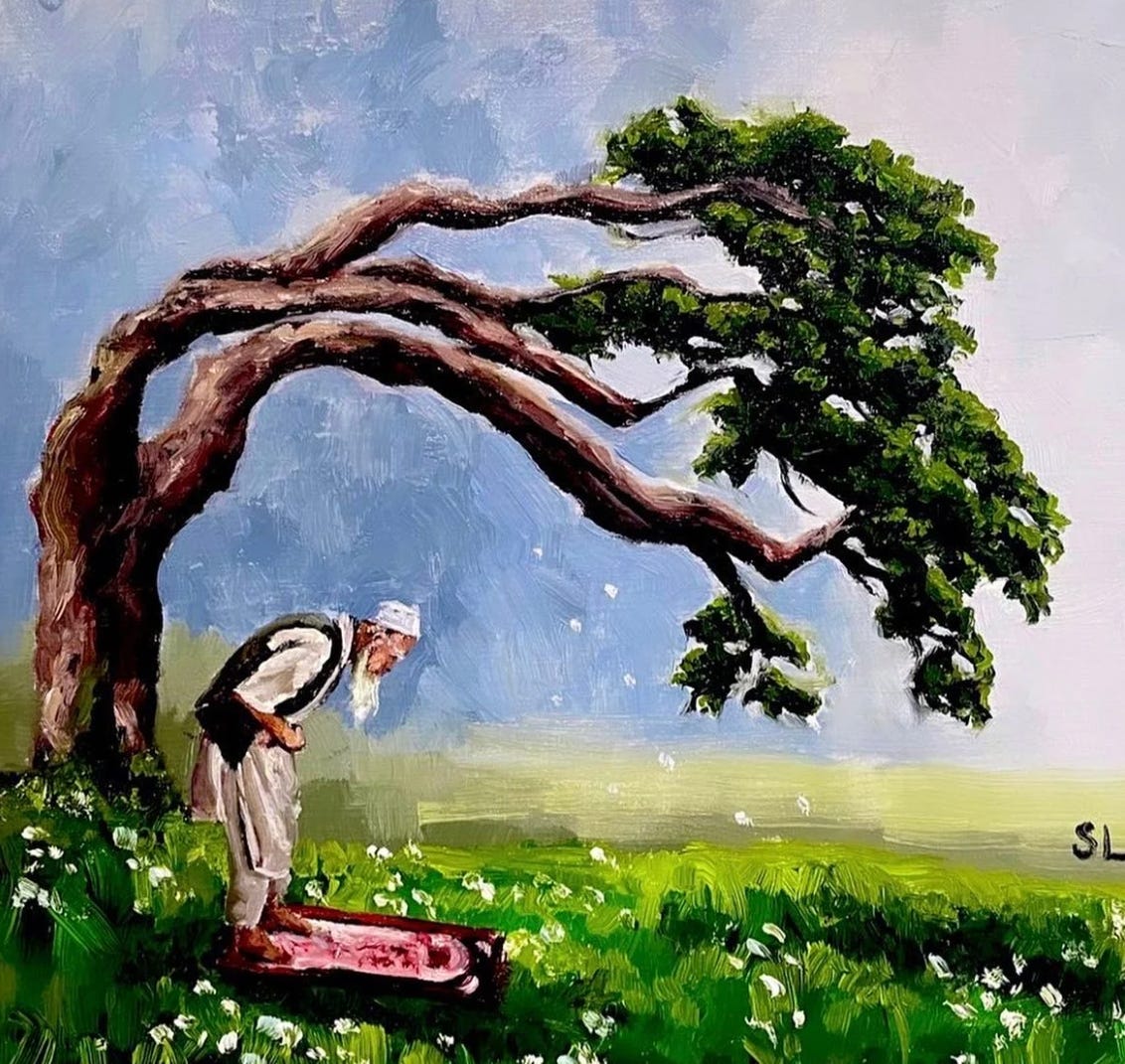
There was a spiritual master from Basra in modern day Iraq who refused to teach. Scholars from all over the world came to him, sat at his feet, asking to be taught and he would always say, “I will not teach you.” Finally a scholar came to him sincerely saying, “My teacher, you must teach us. You have something that no one else has and you must share that with us. Why are you not willing to teach us?” The spiritual master replied, “It is not me who is not willing to teach, it is all those who ask who are not willing to learn.”
The scholar said, “What do you mean? I am here! I am willing to learn.” The master said, “Are you willing to do anything to learn?” The man emphatically said, “Yes! Anything!” The spiritual master went back in his house and came out with a dirty cloth. He said, “Undress yourself of your robes and turbans and wear this dirty cloth.” The scholar gasped as he said, “You want me to walk in this town wearing this dirty cloth?”
The master continued handing the man a wooden bucket filled with little chocolates as he said, “Yes. And I want you to put this bucket around your neck and go to the market place. Every time someone offends you or the little boys throw stones at you, give them one of the candies in the bucket.” The spiritual master continued, “The question is do you want a teaching that you like, that amazes you, that fans the flames of your spiritual ego, or do you want a teaching that will transform your entire life?” As expected, the scholar was unable to wear the dirty cloth and receive the teaching and the master continued to be known as the teacher that doesn’t teach.
Often times we approach God the same way the students approached this teacher. We want to learn lessons that we like, lessons that we can use as preaching material or to uplift our sense of self or meaning. In other words, we don’t necessarily want to know the truth, we want to know a truth that validates our ego’s preferences.
This story is confronting the seekers of knowledge, by asking: How far will you go for the Truth? Because the truth is expensive and the payment is made with your life, your identity, and all that you believe you already know. To learn, in many ways, is more about unlearning and letting go than acquiring something new.
Tazkiyat al-nafs or the “purification of the ego” is vital on the spiritual path, because the path to Allah is not one to a place we have never been, but a remembrance of who we have always been.
“Successful indeed is the one who purifies their soul, and doomed is the one who corrupts it!”
—Qur’an 91:9-10
The Prophet ﷺ talks about a man named Abu Damdam who would accept all curses and humiliation without retaliation as a form of charity to Allah. He would receive every blow against his ego as the necessary friction to polish his soul. This is why the Prophet ﷺ said, “Why can’t you be like Abu Damdam?” The companions asked, “Who is Abu Damdam Oh Prophet of God?” He replied, “Abu Damdam recites the following du’a every morning, ‘Oh Allah! I offer my life and honor to you.’ He would not retaliate or swear at those who swore him, oppressed him or abused him.” (Sunan Abi Dawud) To be like Abu Damdam is to welcome the criticism that purifies the heart of the desire to be validated by creation.
The sincere seeker is the one who prioritizes not what he knows or who he is, but the one who prioritizes the Knower of all knowledge, Al-Alim. When Allah becomes our reference point, the ego is dethroned from king to servant. After all, whatever certainty we carry is in relationship to the limitation of our perception. True certainty is found only in Allah. To say, “I know” is to become rigid, and blind to the ever expanding unfolding of Divine self-disclosure. Allah is Al-Haqq, The Truth, and all else is a mere shadow. The Qur’an reminds us that a thousand lies shatter before the presence of a single truth, the way darkness is dispelled in the presence of light.
“Rather, We hurl the truth against falsehood, and it crushes it, so it vanishes.”
—Qur’an 21:18
To be one who can learn the truth, is to be one who is willing to let all falsehood vanish no matter how beloved it may be to you. It means to let go of all identity, all ideas of oneself, all attachments, and all perceptions of societal expectations. We must be like Ishmail, to lay down our heads upon the stone of decree, and to be fully surrendered before the sword of truth. As the Qur’an says, “Then when the boy reached the age to work with him, Abraham said, “O my dear son! I have seen in a dream that I ˹must˺ sacrifice you. So tell me what you think.” He replied, “O my dear father! Do as you are commanded. Allah willing, you will find me steadfast.” (Qur’an 37:102) This is what it means to be a seeker on the path of truth, to be willing to let everything you have collected go, trusting that the One who gave before will give again.
Oh Allah, help us to purify our hearts and let go of every idea, concept, or perception in the way of knowing You. My beloved Lord, inspire us to seek the Truth regardless of the price. Oh Allah, remind us that all that we know is but a shadow before the light of Your knowing. My Lord, widen our hearts and expand the container of our understanding so that we may be grounded enough to weather the storms of doubt and flexible enough to be moved by Your wisdom. In Your beautiful names we pray, Ameen.
In prayers of light upon light,
No posts
Comments
Nothing yet. Say the first thing.
Sign in to join the conversation.