
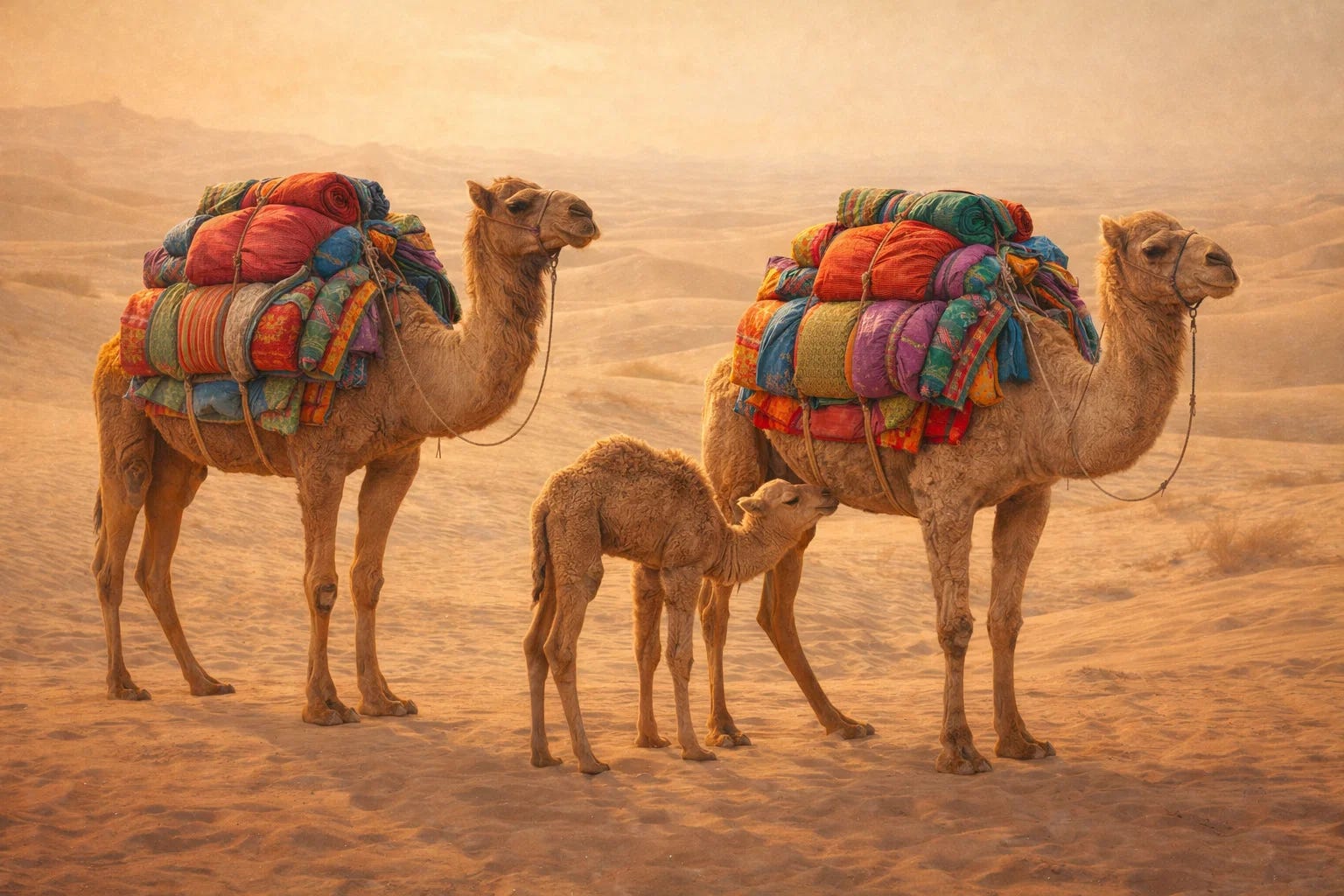
A mystic named Sheikah Sultana was speaking to a male mystic when he joked, “I have a higher station than you, because I am a man.” She replied, “A she-camel can carry the same weight as a male camel, can she not?” The mystic agreed. She then said, “But can’t a she-camel also give milk and have children?” The male mystic bowed to her wisdom and then the two laughed together.
The mystics often use humor as a way to learn and expand their containers and the containers of others. Humor has a way of disarming the ego and confronting us with the limitations in our thinking. Sheikah Sultana uses logic and humor to dismantle the age-old myth of male superiority. The Qur’an very clearly separates spiritual rank from arbitrary categories shaped by the world. Your biological sex gives you no advantage in the face of God. As Allah says in the Qur’an:
“Indeed, the most noble of you before Allah is the most God-conscious of you.”
—Qur’an 49:13
Allah doesn’t say being a man, having power, money, or influence sets you apart, but prioritizes taqwa or God-consciousness as the metric of rank. In the material world our station comes from our power over others, whereas in the spiritual world our value doesn’t come from power, but purification of our ego.
In the first part of the verse in 49:13 Allah says, “Oh humanity! Indeed, We created you from a male and a female, and made you into peoples and tribes so that you may ˹get to˺ know one another.” In other words, Allah is explicitly reminding us that our outward differences were never meant to create subjective interpretations of better or worse, but rather to inspire wonder in the multiplicity of creation. Our differences are not meant to be grounds for comparison, but meant to be diverse ways we come to one another, ourselves, and ultimately Allah as our Creator. The Qur’an is constantly reminding us that it’s not gender, but our virtues that determine our station.
“Whoever does righteous deeds, whether male or female, while being a believer, we shall surely grant them a good life.”
—Qur’an 16:97
Allah continues in this line of wisdom all across the Qur’an connecting men and woman through their virtues, “Indeed, the Muslim men and Muslim women... the believing men and believing women... the truthful men and truthful women...Allah has prepared for all of them forgiveness and a tremendous reward.” (Qur’an 33:35) While men and women have different social roles, these roles do not determine spiritual rank. Even in verses that have historically been used by the patriarchy against women, there is a nuance that dismantles the idea. For example the following verse: “Men are qawwamun over women because Allah has given some more (or differently) than others, and because they spend from their wealth...” (Qur'an 4:34) The word qawwamun does not mean men have a “degree over” women as some incorrectly translate it. Rather the word qawwamun comes from a root that means “to stand up for, uphold, responsibility.” In other words, men are entrusted with woman who are dependent on them, and that trust means they will be held to a higher degree of accountability. This verse is not speaking about spiritual rank or inherent superiority, but rather about a man's additional responsibilities of care, protection, and service toward the women entrusted to him. The distinction described here is not a measure of one soul being closer to Allah than another, but a call to carry a particular trust with humility, mercy, and accountability.
May Allah guide us beyond the surface of His words into their deeper dimensions, and open the eyes of our hearts to receive the Qur’an not merely as a text to analyze, but as a living guidance sent to transform us. May He allow us to understand His verses as He intended, with wisdom, mercy, and surrender to the One who revealed them. May Allah allow us to feel our innate worth as women and to uplift the women in our lives to know their worth as well. May Allah, forgive us in the ways that we have not honored the mercy and love in His message. May He open our hearts and make us mirrors that reflect His qualities upon all of creation. In His beautiful names I pray, Ameen.
In prayers of light upon light,
Listen to a new podcast episode I did this past week!
No posts
Comments
Nothing yet. Say the first thing.
Sign in to join the conversation.