
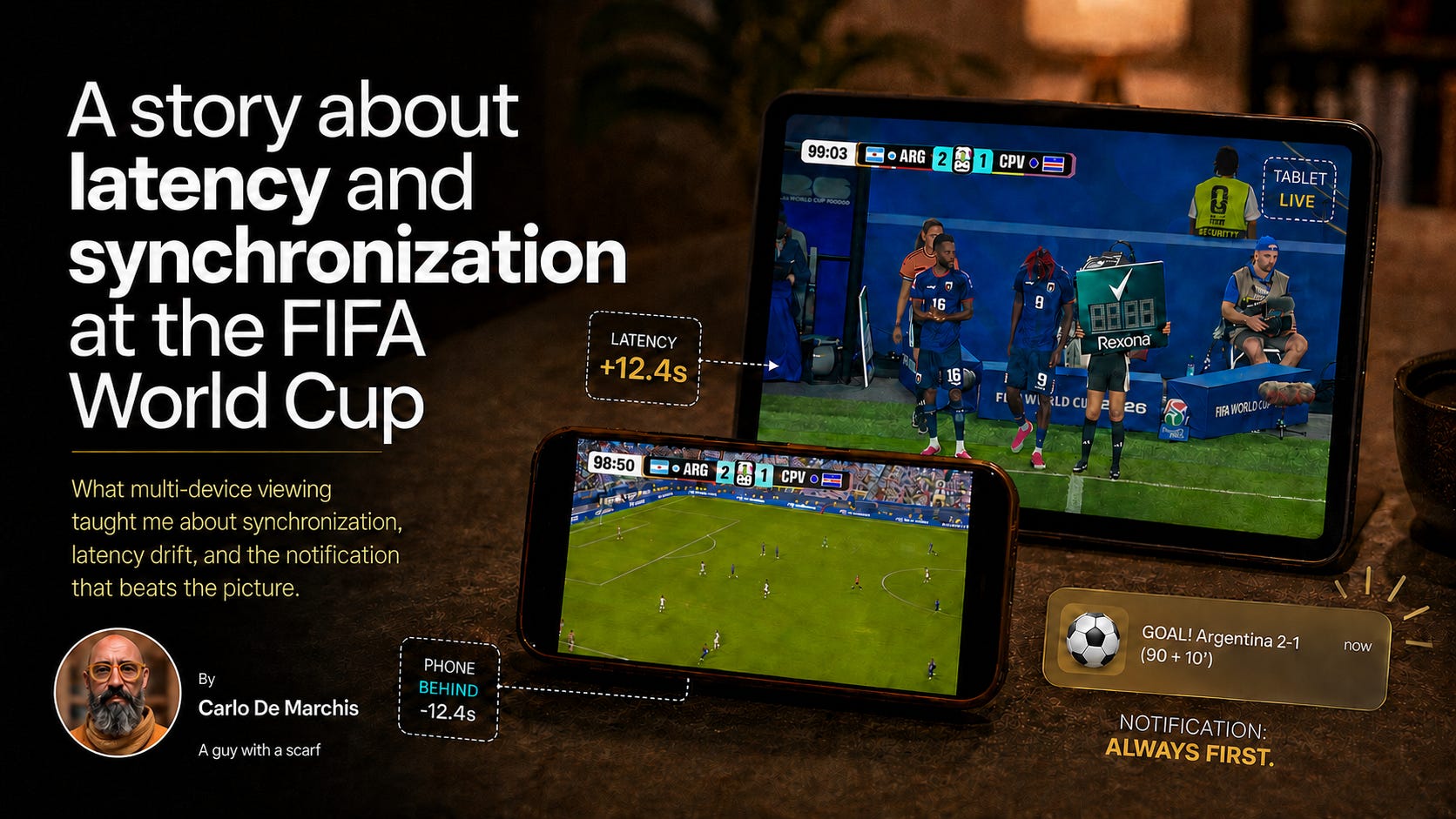
For years the sports streaming debate has run on many tracks. Today I want to stay on two. One is latency, a real conversation we have been having since the first OTT rights deals changed hands. The other is streaming against linear, an argument that has filled millions of words and now feels less interesting than it once did. This World Cup has put a third thing in front of me. Synchronization. An old problem, and we are past the point where we should have solved it.
Here is my position up front. Synchronization is the next problem worth solving properly, and the sharpest edge is the push notification. A notification is addressed to a single device, and a single device is something you can actually control. That makes it fixable. The rest of the pipeline is harder.
The difference is worth stating. Latency measures the gap between my screen and the pitch. Synchronization is a different question. It asks whether everything I am looking at, the screens, the alerts, the second-screen feeds, sits in the same moment.
This only bites if you watch on more than one screen at once. Most of us do. A phone and a big screen is the floor. Add a laptop and a tablet if you are the obsessive type or you grew up with a device in your hand. My house during a World Cup match is a small render farm of slightly disagreeing clocks.
I watched in Italy, on DAZN, across three setups. Important detail: this was the easy version of the problem. Every screen ran the same app, and every alert came from that same app. One company controlled the consumer touchpoints I could see, the video on the television and the push on the phone. When a single operator holds both ends, it has what it needs to line them up. It is a starting point. It is still not solved.
Big screen in the living room. My phone next to me. The kids on a tablet, one of them following his own match while half watching ours. My son plays football and lives on EA Sports FC, so a second screen is his natural state.
The accepted problem showed up first. The streams were not in sync. His tablet ran a few seconds off from the living room, sometimes ahead, sometimes behind. That can come from the device, the network, the app state, when the stream was opened, and how much buffer each player decides it needs. We know this by now, so we manage it. If he is in the same room he does not shout the score, and if he is in another room neither of us tells the other what just happened. Fans have quietly built etiquette around a technical failure.
Working from the studio, laptop for work, the game on my iPhone, stopping every so often to watch and check the two against each other. This is where the stranger problem became obvious. No visible rebuffer, no obvious interruption. The picture simply slid. Over a long session the player eased further from the live edge, a slow drift that nobody announces and no error message flags. By the second half I was clearly behind where I started.
There is a back to live button for when something pulls you away and you rejoin later. That part works. Returning to the true live edge sometimes took more than the button. I had to grab the scrub bar and drag it hard to the right, all the way to the limit, before the stream sat on live again. This is latency drift, the player protecting playback by letting itself fall back from the live edge. On a single screen you barely notice it. Across screens it stacks.
The push notifications started nagging here too, out of step between the laptop and the iPhone, and out of step on the iPhone by itself. I parked the thought. It gets its own section below.
Phone, laptop, tablet, weak connection, me moving between rooms. Every device found its own equilibrium. Three legitimate streams of the same match, three different moments in time, all mine, all correct according to their own buffer. That is the whole problem in one room.
This is the night I stopped being a normal viewer and started testing on purpose. All three screens running, push notifications on for two of them, me poking at the players to see how each one behaved. Late, everything laid out on the kitchen table. At one point the iPhone and the iPad sat a full minute apart on the same match. I still do not know exactly why. Useful to see. It is also the experience of someone who went looking for it. The standard viewer never does this, and the standard viewer is the one who matters most.
Now the part that gets under my skin. I keep the DAZN app on my phone with notifications on. Watching on the big screen, I would feel a buzz or hear the alert seconds before anything happened on the picture. Most of the time it was right. Someone was about to score.
Here is why that happens. The alert fires off the live data feed, the moment the goal goes in for real, and it reaches my phone in a second or two. The television picture is running well behind, delayed by encoding, packaging, the CDN and the buffer on the screen. The drift I hit in the studio only widens that gap as a match goes on. So the notification, tied to the real event, lands before the video catches up. The phone already knows the score the television has not shown yet.
I have worked behind the scenes in sports technology long enough that I do not get angry at this. If anything I feel a small, stupid smugness. I know it is coming and the room does not. For a grown man this is not a good look. I own it.
That smugness is harmless. The real cost lands on everyone who has no idea any of this is happening. They feel the buzz, glance at the alert, and the goal they were seconds from watching is already gone, spoiled by the phone in their own hand. They curse the stream for lagging, never clocking that the stream did nothing wrong and the notification simply got there first.
Here is what I went and checked, because I had spent almost no time on it until now. I also want to correct myself, because this fix is easier to describe than to build.
Push notifications are addressed to individual devices. That is the opening. Because the alert goes to your phone specifically, the platform can hold it back before it fires. The blunt version is simple. Major League Baseball ships a setting called Delayed Gameday Notifications that delays your alerts by around thirty seconds so the buzz does not beat the pitch. It is crude, it works, and many sports platforms still have not done even this much. That part is genuinely cheap. ESPN has gone a step further, letting you open a box score on your phone while the game runs on your TV, reading the on-screen game time so the phone does not give the result away.
The hard version is personalization. A flat thirty second delay helps the average viewer and misses everyone else, because my drift in the studio is not my drift in the country house, and yours is different again. A notification that lands with the goal has to know where your specific stream sits right now, on the device in front of you, and time itself to that. MLB tested exactly this, using the audio signature of your television to align the alert with the stream you are watching. They went back to the flat thirty seconds because it did the job. There is patented work around estimating and confirming each viewer’s delay, including systems that place viewers into delay pools using visual or audio recognition of the broadcast. That patent covers second-screen sync rather than a goal alert. The timing problem underneath is identical. The second screen has to know where the first screen really is. I have not found a mainstream sports platform shipping true per-viewer notification sync at scale. If it exists I want to see it.
The honest version is simple. The blunt delay costs almost nothing and still sits unused on plenty of apps. The prize is the personalized delay that lands with each viewer’s own screen, and nobody I can find has built it at mainstream scale.
The video side is the harder half, and this is where I have more reading to do.
Start with what the platform already holds. When one account streams the same match on three devices, the operator authenticates every one of them and knows the lot in real time: the account, the device, the app version, the stream feeding each screen, the bitrate, the buffer depth, the CDN edge each one pulls from. All of that, live, across your devices at once. That is the vantage point to solve this from.
From there the shape of the fix is clear. Nudge the streams that run ahead and pull up the ones that lag until every screen on the account sits inside a sensible window of the others, so the gap never has to reach the minute I saw on the kitchen table. Once the platform knows where each of your streams actually sits, it can plan the rest of the experience around that same clock, notifications included. The alert then goes to each device timed to that device’s own position, landing with the goal on the screen you are watching.
People at Dolby OptiView focus on synchronized low latency delivery, keeping the gap between platforms and regions inside a tight window so two screens do not disagree by five seconds. Their own research puts numbers on how sore the problem is. More than three quarters of industry professionals name timely, synchronized delivery as a top technical challenge, and around six in ten want latency differences held under five seconds. The ambition is a stream that stays inside a tight timing window, so every screen feels like it is living in the same moment. The drift I watched in my studio is exactly what that work is aimed at.
I need to go deeper on the delivery side, and I will. For now I am confident about the shape of it.
One part of this many platforms have handled well. On-demand highlights come with real spoiler controls now, on the video players and on mobile too. Hidden scores, hidden match length, results blurred until you choose to see them. My son wakes up the morning after a late match, goes straight into the DAZN app, and watches the highlights with nothing given away before he presses play. That experience is clean. The live, multi-screen, real-time case is the one still waiting.
Latency deserves its long debate, and it will keep having it. Synchronization is the problem the multi-device World Cup actually put in front of me, in my living room, my studio, and a country house with a bad connection.
The video pipeline is hard, and companies like Dolby are already addressing it. The notification splits in two. A flat delay is cheap and sitting there unused on plenty of platforms. A delay tuned to each viewer’s real stream position is the actual frontier, and as far as I can tell nobody has shipped it at scale.
If you run a sports platform, do the cheap thing first. Give every fan a delayed-alert option today. Then solve the harder version, where the app knows the real position of the stream in front of that fan. Whoever lands the notification on the goal instead of ahead of it wins a second every fan will feel.
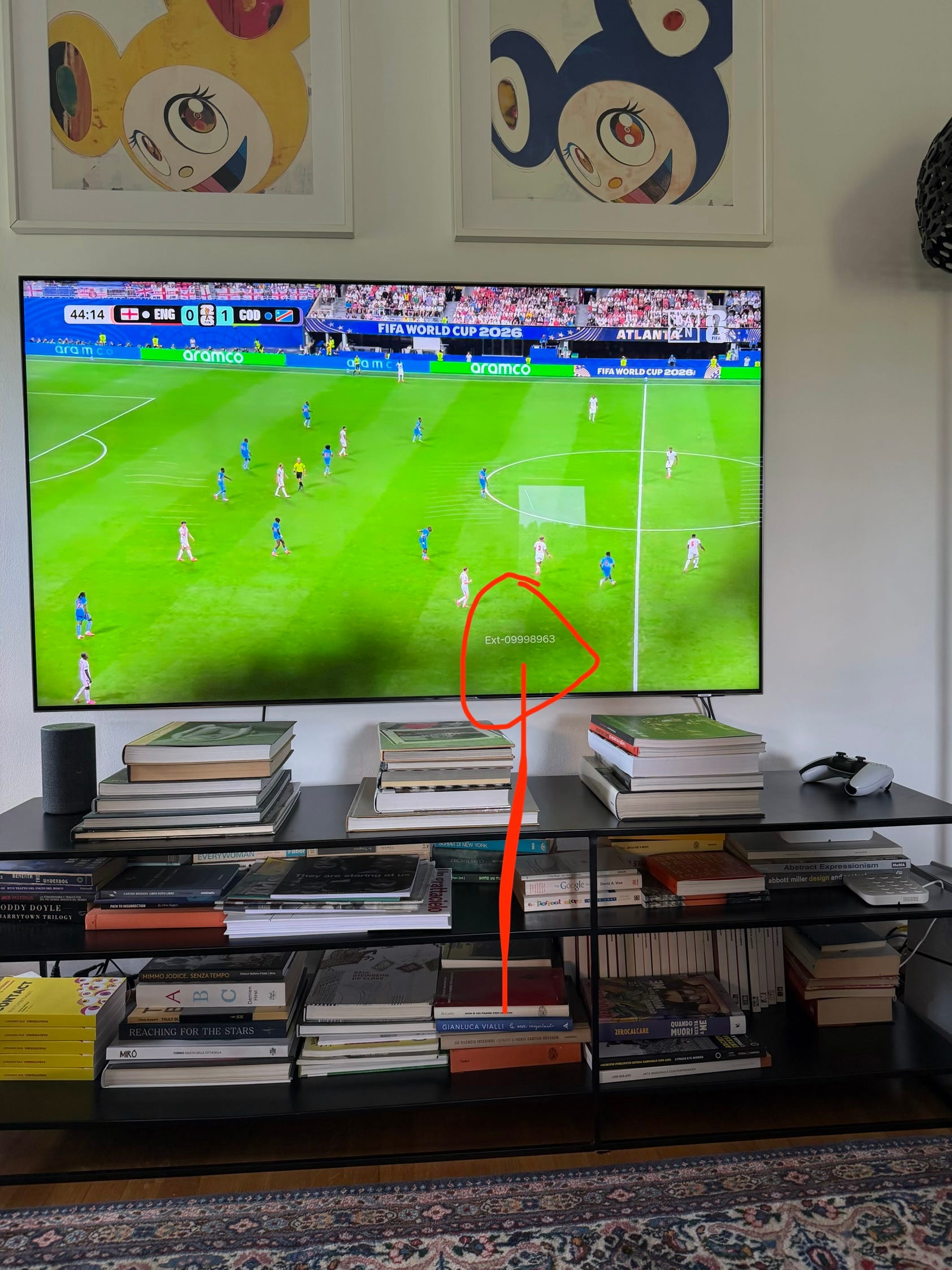
Some of you will have caught a short string of text flashing on the television during a live game, something like ext- followed by a long number, gone in a couple of seconds. In most cases that is likely a visible session watermark. On premium live sports the operator embeds a unique identifier tied to your account and your session, so if the stream gets pirated they can pull that ID out of the leaked feed and trace it back to the account, device, session or distribution path that leaked it. Most of these marks are invisible. Some are overt, dropped onto the picture at semi-random points so they are hard to crop or filter out. It shows on your big screen because that device is rendering your licensed session. As the paying subscriber it costs you nothing and means nothing bad. A World Cup feed is among the highest-value piracy targets in live sport, and it is being tagged accordingly.
A Guy with a Scarf is collaborating with Dolby OptiView - Enabling live sports experiences that engage and captivate fans. #ad
For Sports Fans Seeking Spoiler-Free Refuge, Phones Become Foes, Jacob Feldman, Sportico https://www.sportico.com/business/tech/2026/streaming-mlb-apple-espn-spoiler-notification-settings-1234888192/
Live Sports Streaming That Brings Fans Closer to the Game (synchronized low latency delivery, industry survey figures), Dolby OptiView https://optiview.dolby.com/resources/blog/streaming/live-sports-streaming-that-brings-fans-closer-to-the-game/
Broadcast synchronization with fan engagement platform (patent on estimating and confirming per-viewer broadcast delay), USPTO https://image-ppubs.uspto.gov/dirsearch-public/print/downloadPdf/12010357
What we discovered using forensic watermarking in live sports (per-session identifiers used to trace leaked streams), Friend MTS https://www.friendmts.com/blog/what-we-discovered-using-forensic-watermarking-in-live-sports
I went looking for the sports properties and broadcasters already doing something about synchronization, and the list runs longer than you would expect. It covers the BBC closing the iPlayer gap, Sky’s Real Time feature, Amazon describing fixed and synchronized delivery in its own words, MLB holding its notifications back, and the spoiler controls that Tennis TV, YouTube TV, ESPN and Apple have built into their apps. Below I lay out what each one has shipped, how far along it is, and which moves you can borrow if you run a platform yourself, with the full source list.
The rest of this one is for Substack paying members. Upgrade to read the full rundown.
Comments
Nothing yet. Say the first thing.
Sign in to join the conversation.