
Data from the USDA’s Food Surveys Research Group shows that the most popular foods within American society are leading to nutritional shortfalls against the government’s Dietary Guideline recommendations. This dynamic is no doubt leading to poor health outcomes for U.S. adults and their children. A deeper dive into the data shows that inadequate consumption of fruits and vegetables is worse than expected. Additionally, Americans are over-consuming an eye-popping amount of saturated fats and added sugars when scaled against nutritional guidelines and other food groups. What does all of this mean for regenerative food producers looking to develop markets for their products downstream? For starters, we all need to listen to consumers when they repeatedly report that taste and cost are paramount in their food purchase decisions.
For the better part of 25 years, the Food Surveys Research Group embedded within the United States Department of Agriculture (USDA) has been publishing its Food Patterns Equivalents Database (FPED), breaking down all the foods that Americans actually eat (sandwiches, pizza, burgers, etc.) into their respective Dietary Guideline components (fruits, vegetables, grains, proteins, fats) in an effort to better evaluate and understand food and health trends in the United States. The most recent data from 2017-2020 tells an increasingly well-worn story of nutritional shortfalls and concerning health dynamics within the American population.
Before analyzing the data, let’s first look at what the USDA recommends for daily consumption of food types according to each targeted calorie level…
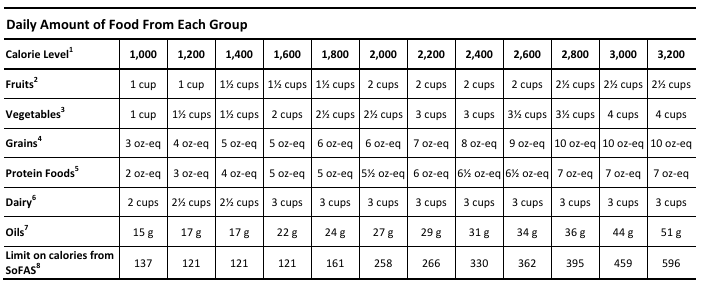
Thus, if you are an adult male trying to manage towards a daily recommended intake of 2,400 calories, it is advised that you consume 2 cups of fruits, 3 cups of vegetables, 8 ounces of grains, 6.5 ounces of protein, and so on. If you are an adult female trying to manage towards a daily recommended intake of 2,200 calories, it is advised that you consume a similar amount of fruits and vegetables to your male counterparts, along with 7 ounces of grains and 6 ounces of protein. For kids trying to manage towards a recommended 1,800 to 2,000 daily calories, advised intake of these foods can be seen in the above table, as well. *We note here that recommended calorie intake depends on a host of variables and can differ from person to person. The term “SoFAS” in the above table refers to solid [saturated] fats and added sugars (to include alcoholic beverages) and is presented as an upper limit on daily calories that should come from these products.
Based on the most recent FPED data, here’s how American men, women, and children are performing against the USDA’s Dietary Guideline recommendations when placed against a 100-index scale…
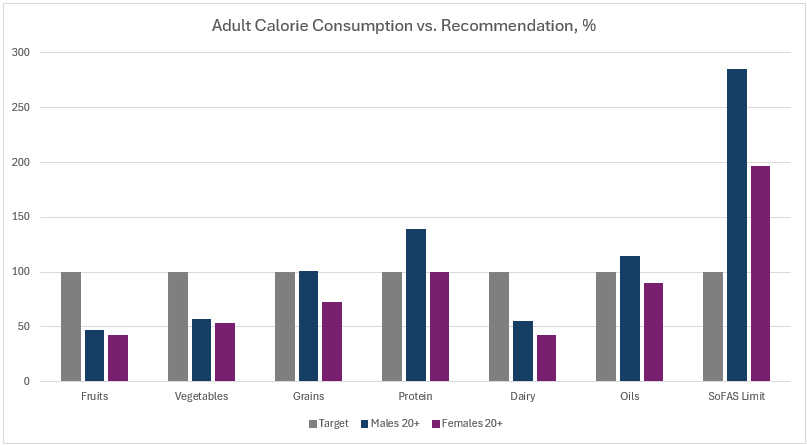
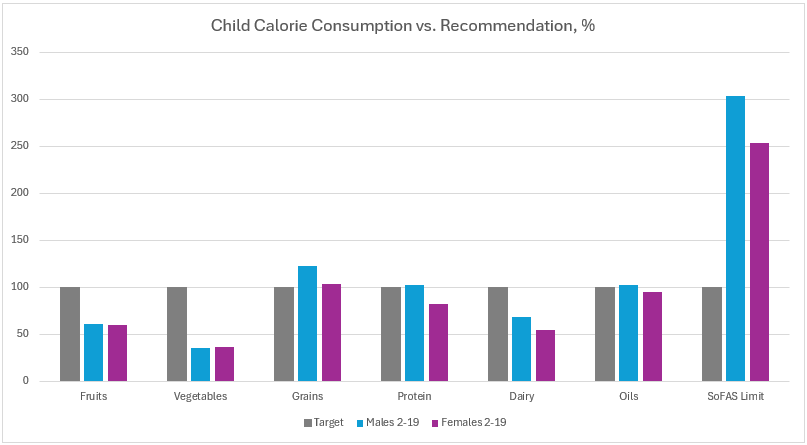
What stands out to you? For us, it is clear that Americans of all ages are falling woefully short on consumption of fruits and vegetables. Men and boys are meeting or exceeding expectations on grain, protein, and oils consumption. Girls are meeting expectations on grains but then falling short once they become adults. Women and girls are mostly getting enough protein; the same can be said of oils. All adults and children are falling short on dairy. Perhaps the most eyepopping visual is all the way to the right of each chart; when it comes to saturated fats and added sugars, the entire American population is way above recommended limits on daily intake. Unfortunately, the news gets worse from here.
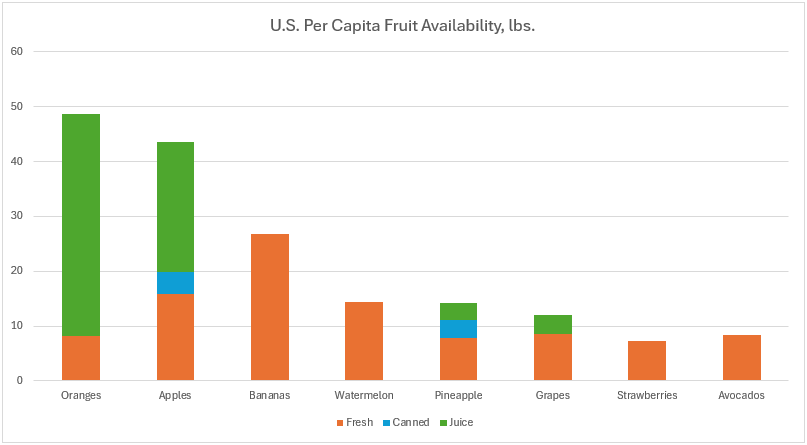
Americans are only consuming about ~50% of the recommended daily intake of fruits and vegetables. Within the fruit category, oranges, apples, and bananas collectively make up around 51% of all fruit items available for consumption, according to data from the USDA. However, check out the composition of fruit items available for sale in the U.S., as shown in the chart below. The vast majority of oranges are consumed as juice, with the same dynamic in place for apples. This strips these fruits of important nutrients for human beings. Only bananas are available - and therefore consumed - in whole form.
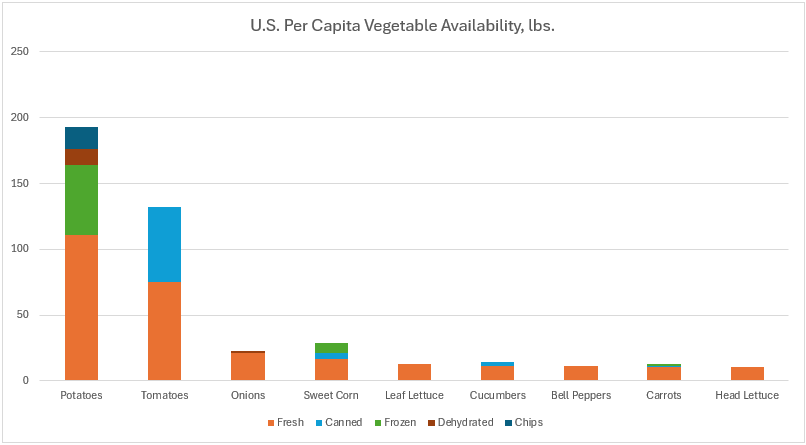
The same dynamic is present in the U.S. vegetable category. Potatoes and tomatoes make up 50% of all vegetable items available for consumption. However, as the chart below shows, a sizable portion of potatoes are sold as frozen fries, dehydrated mashed potatoes, and potato chips. Likewise, a big portion of tomatoes is consumed as canned pasta sauce. Thus, the most recent FPED data showing that Americans are only consuming about 50% of Dietary Guideline recommendations for fruits and vegetables is artificially overinflated itself. As if to hammer the point home, consider that Americans consume more potato chips than they do fresh sweet corn, leaf lettuce, cucumbers, bell peppers, carrots, or head lettuce. Additionally, if French fries were their own vegetable category, they would be the third largest produced and consumed vegetable in the U.S.
What about grains? The FPED data above shows that American children are largely meeting or exceeding grain calorie recommendations, with adult males performing well in this area too. Unfortunately, refined grains make up 89% of total grains consumption for male children and 87% for female children. For adults, the numbers are similar. Refined grains lack key nutrients from heavy processing and are usually commingled with other additives like sugar and chemical derivatives that harm human health otherwise.
Protein is arguably a bright spot within the American diet. Most demographics are meeting Dietary Guideline recommendations on protein consumption when measured by age, gender, and race/ethnicity. However, grain-fed and highly industrialized beef, pork, and poultry products make up a sizable portion (51%) of all protein consumed by American adults and children, when compared against eggs, nuts/seeds, soybean products, and legumes. The largest meat consumers are males aged 40-49, followed by males aged 30-39, and then males over the age of 50. Poultry products are more heavily consumed by males aged 20-29 and then males aged 30-39 thereafter. Across all genders and ages, the consumption of nuts and seeds has been growing over time (0.75 ounces/day as of 2017-2020 compared to 0.6 ounces/day in 2005-2006), however this type of protein remains a small proportion (13%) of overall protein consumed in the U.S.
Of particular note, saturated fats and added sugars remain critically high in the American diet, as evidenced by the FPED charts above and some of the underlying analysis in this report. This point of fact is not surprising, as most of the highly processed foods consumed by Americans are formulated to taste good and cost as little as possible. To be sure, these attributes are the #1 and #2 most important factors to U.S. consumers when evaluating food, according to the Pew Research Center.
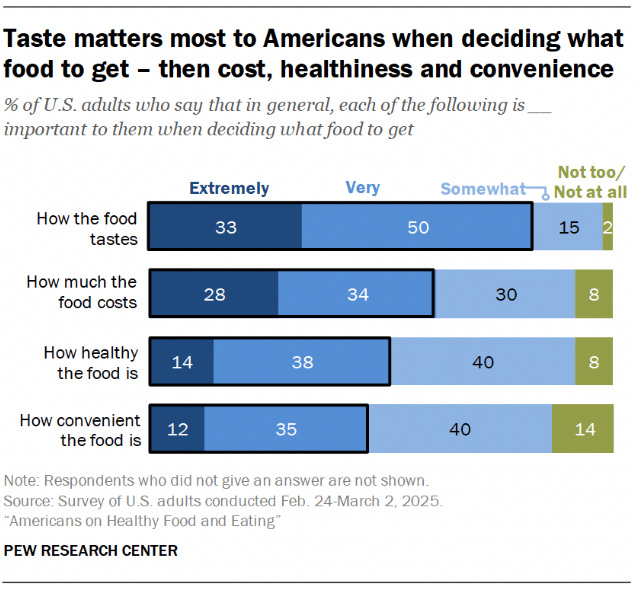
Perhaps more concerning than anything, though, is that a full 80% of U.S. consumers believe that their diets are somewhat or extremely/very healthy. Consumer perception is an incredibly important factor as those of us involved in regenerative agriculture look to heal our lands and deliver more nutritious products out into the marketplace. According to the Consumer Food Insights Dashboard from Purdue University, only 31% of U.S. respondents said that they checked how their food was produced this year. A similar 35% said that they chose local foods over non-local foods. Roughly 40% of respondents said they checked for natural or clean labels. Sustainable…local…clean…these are all words used and marketed by regenerative agriculture adherents. However, the majority of Americans still only want to hear primarily about flavor and cost.
It should not be breaking news that American diets are of poor quality today, falling short of USDA Dietary Guidelines while likely being a primary contributor to worsening human health outcomes in recent decades. That said, a deeper dive into the available data shows that fruits, vegetables, and grains are consumed at even lower rates relative to reported headline quantities (almost half of the tomatoes reported as available for consumption are ultimately consumed as pasta sauce, for instance). For regenerative food producers looking to deliver healthier whole food commodities into the marketplace, this dynamic should serve as a warning that downstream markets for fruits, vegetables, and other products may not be as robust as headline data suggests. Additionally, consumer survey data consistently reports that the nation’s food buyers care most about taste and cost. We should all do well to listen.
Check us out on our homepage or come connect with us on LinkedIn.
We’re an investment fund that raises money from long-term investors to pay farmers and landowners to plant trees on their properties alongside crops and/or animals, returning nutrients to the soil and our food while delivering attractive, uncorrelated returns to investors.
No posts
Comments
Nothing yet. Say the first thing.
Sign in to join the conversation.