
We believe that America’s conventional agriculture system has been built over recent centuries based upon five key factors: 1) land and 2) labor dynamics, 3) market development, 4) technology & productivity gains, and 5) government support. Access to capital doesn’t hurt either. In order for the regenerative agriculture transition to take hold and proliferate in the United States, we expect that it will need to successfully navigate these same five factors, with stakeholders across the private, public, and civil sectors mindful of how future trends might differ from the past. In this report, we review how conventional agriculture came to be in the United States, along with what’s required for a new regenerative era. At the heart of everything lies scale, in our view.
In the United States today, three commodities (corn, soybeans, wheat) make up the vast majority of field crop plantings on American farmland. Public perception usually centers on a belief that farming in the United States was at one point very diverse and that over time the country has become more and more concentrated in the crops that it produces. However, this view is largely misguided. According to research published in 2016, just four field crops (cotton, corn, oats, wheat) dominated the early American farm landscape between 1870 and 1914. Crop diversity did rise into the 1940s, however it declined soon thereafter and receded back towards a present-day focus on corn, soybeans, and wheat. While some crop diversity still exists in pockets around the U.S., it’s important to highlight that this dynamic generally occurs around the edges of the country, outside the main Midwest “Cornbelt” production centers.
To highlight the unrelenting, ascendant rise of American corn, soybean, and wheat production, consider the following: the U.S. farmed more acres of corn in 1900 than it does today. Wheat? Same thing. Only in soybeans has the country meaningfully expanded acreage since the early 20th century, displacing other crops like oats, cotton, and some wheat varieties. Despite the lower acreage numbers for corn and wheat, last year the country produced 14.9 billion bushels of corn (+452% increase relative to early 1900s) and almost 2 billion bushels of wheat (+234%). American farmers also produced 4.4 billion bushels of soybeans, an incredible +87,900% increase relative to the early 1900s. At present, American farmers devote an astounding ~224 million acres to corn, soybeans, and wheat, making up almost 60% of productive farmland area in the U.S.
Why have American farmers largely decided to specialize in a small number of crops since the 1800s? Why couldn’t broader crop diversity gains “hold on” after the 1940s? Why did soybeans grow so rapidly and displace existing crops like oats and cotton? What factors affect farmer decision-making over time? The history, development, and existence of current farm practices hold important lessons for the regenerative agriculture movement and its ability to replace today’s industrialized form of agriculture. The trillion-dollar question then becomes, what factors have allowed conventional, concentrated agriculture to establish itself and scale inside the United States during the past 125 years? We see five main factors responsible for this dynamic, which we name below before going into more detail thereafter.
Land: Availability & Cost
Labor: Availability & Cost
Markets: Customers & Products
Technology/Productivity: Machinery & Equipment; Seed Supply & Genetics; Chemicals; Knowledge Sharing
Government Support: Insurance; Income Subsidies
One of the most important factors for being able to establish any type of agricultural system is of course having the space and ability to conduct operations. As early American farming established itself and looked to feed a growing populace, it needed land. By and large, this wasn’t a problem in the 1800s…it simply meant cutting down trees in many areas. Lots of them.
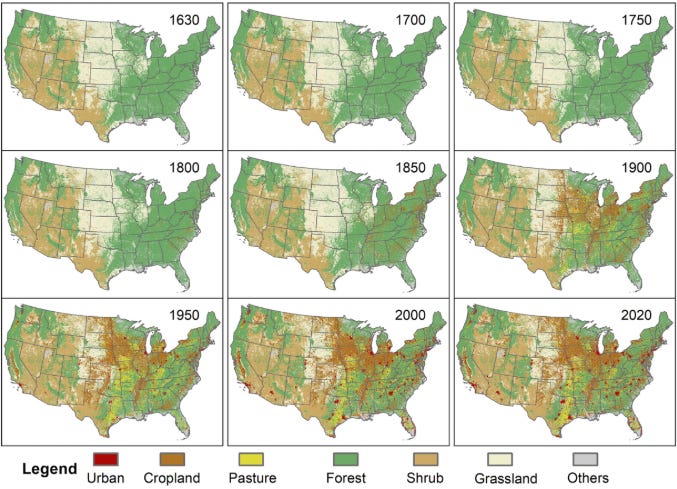
As the above visual shows, the felling of U.S. forests began to pick up pace in 1850, leading to expansive growth in cropland area through 1950 and the turn of the Millennium. In 1862, the Homestead Act was signed into law by President Abraham Lincoln, offering up to 160 acres of public land to those that could live on and farm it for five years (at which point they would receive title to the property). Incredibly, this settlement practice lasted in the lower-48 states until 1976, delivering more than 270 million acres to private citizens. Thus, a considerable amount of farmland moved into the hands of the new U.S. citizenry at virtually no cost into the 20th century. This land has heretofore been passed down through generations of farming families.
Across time, the number of working farms across the landscape has declined as farm enterprises grow in size. As farms have become bigger, the overall cost to acquire them has likewise grown, in part due to ever increasing per-acre market values. The total number of U.S. farms peaked at 6.8 million in 1935, falling to 1.9 million last year. Average farm size now approaches 470 acres compared to ~135 acres in the early 1900s. The current average price to acquire farmland in the U.S. is now $5,586/acre, up from ~$1,700/acre in the late 1990s. The average annual inflation rate for farmland during this time period is roughly 5.5%, outpacing the overall U.S. inflation rate of 2.5%. In the key Midwest Cornbelt area, it is not out of the ordinary to see farmland for sale at over $20,000/acre today.
In the year 1900, roughly 40% of the U.S. labor force participated in farming, equating to ~25 million people involved in the production of agricultural goods at that time. Since then, the number of farmworkers on U.S. farms has steadily declined, reaching roughly 10 million people in 1950, approximately 3 million people in 2000, and now under 1 million people at present day. It makes sense that the total number of farmworkers in the U.S. has been declining over time. In 1900, farmers performed operations by hand together with rudimentary tools and work animals. Thus, a lot more labor was required to plant and harvest one acre of corn relative to the 1950s and present day, whereby increasingly efficient equipment, powerful chemicals, and value chain specialization have enabled the ability to offload much of the on-farm work required of farm laborers previously.
To be sure, labor availability was generally strong for farming enterprises around the early 1900s, led by the participation of direct family members of the landowner managing the property. As a result, the average age of farmworkers skewed young in the late 1800s and early 1900s, with many teens and 20-somethings working on the farm. Ultimately, these same children would end up taking the enterprise over as their parents and other caretakers retired. By 1950, the average age of U.S. farmers had risen up close to 50 years of age. Today, the average is right near 60 years of age, with almost 65% of farm operators over the age of 55. Interestingly, the number of hired farmworkers has stayed relatively consistent since 1950, however the number of family farmworkers has dropped precipitously (in 1950 there were 4 family members to 1 hired worker vs. 2 to 1 today).
As farmworkers get older, the relative cost of farm labor is rising. In the early 1900s, younger family members were seldom paid for their farm labor. Over time, farm wages have steadily risen alongside increases in minimum wage rates. This dynamic ultimately pushed farm enterprises towards the hiring of undocumented foreign workers in the 1990s, with foreign-born unauthorized workers jumping from ~12.5% of all farmworkers in 1991 to ~50% in 2001. The percentage share of these workers has fallen since the early 2000s and now represents ~40% of all U.S. farmworkers (this number has the potential to drop further based on current government immigration policy). Today, average U.S. farm wages now represent roughly 60% of nonfarm wages, up from closer to 45% in 1990.
The existence of markets to which farmers can enter and grow the sale of their crops is critical for the long-term success of farming enterprises. This involves access to both people/places and products. Without consistent access to new people/places and products, agricultural producers run the risk of oversupplying markets and going out of business. In early America, most farmers managed their operations for the sole purposes of feeding their families. Farmers grew oats, barley, and wheat that could be used directly as food; they grew corn, wheat, and oats that could be fed to fatten their animals for meat and dairy production; and they grew cotton as an increasingly valuable textile crop for industrial purposes.
During the 20th century, demand for corn, soybeans, and wheat exploded behind a domestic and international population boom, a ravenous preference for meat/dairy protein, and scientific discoveries that greatly widened the range and versatility of these crops. In the year 1900, there were 1.6 billion people on the planet. By 1950, this number shot up to 2.5 billion. Today, there are over 8.2 billion people around the globe. As population exploded, so too did demand for meat…and lots of it. Why do human beings love meat so much? Some believe there are social and cultural reasons for our obsession with meat. Others point to psychological reasons. Most people simply point to attractive taste, aroma, and texture. No matter the reason, the world now produces over 350 million metric tons (2,205 lbs. per ton) of meat annually, derived from poultry, pigs, cattle, sheep, and other animals. These animals require a significant amount of daily feed, mainly comprised of corn and soybean meal, along with some wheat. Aside from meat production, corn and soy crops are increasingly being used for alternative fuel production, as well (e.g., ethanol and biodiesel). Today, over 40% of the U.S. corn crop is used to feed animals while roughly 45% of the crop is used for ethanol production. Around 70% of the U.S. soybean crop has historically been used to feed animals; we believe that the remainder is split evenly between biodiesel production and other direct food use presently.
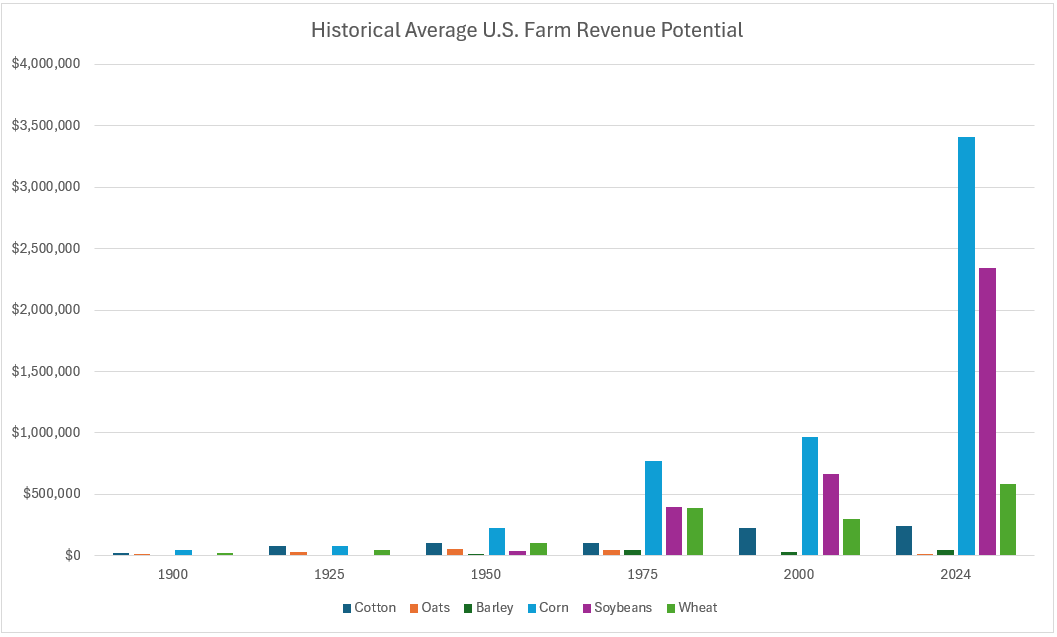
Given the sizable increases in demand for meat products over time, it’s no wonder that U.S. farmers have chosen to plant increasingly concentrated quantities of corn, soybeans, and wheat. The chart below helps put things into further perspective. We have cobbled together historical prices for key commodities produced over the past 125 years in the U.S. alongside their annual production levels (and thus implied demand) at each point in time. From there, we compute a hypothetical market share opportunity for each farm in the U.S., based on the current number of farms in the country. The resulting visual is striking. If you were a farmer, which crops would you choose to plant?!
There is no doubt that technological advancements since the 19th century have led to incredible improvements in farm productivity, driving down costs and allowing U.S. farmers to do more with less. American agriculture requires scale today, based on the need to feed a very large population at affordable prices. This reality has necessitated that U.S. producers drive down their cost profile over time, enabled by advancements in farm machinery and processing equipment; downstream specialization; seed availability and better performing genetic varieties; the development of powerful chemicals; and farm network knowledge sharing.
The 20th century delivered giant leaps in farm equipment capabilities. The invention of combine harvesters and fuel-powered tractors in the early 1900s enabled farmers to grow staple crops on larger quantities of land in quicker periods of time. The introduction of hydraulic systems followed soon thereafter, improving the versatility and efficiency of tractor and harvesting equipment. As the 20th century gave way to the 21st century, computer systems and satellite technology allowed for GPS-guided systems and precision agriculture. Downstream, mechanized grain storage systems started to emerge during the 20th century, with companies evolving to specialize in the storage, processing, and delivery of key commodities and their derivative products. These dedicated systems were built around corn, soy, and wheat, helping to reduce post-harvest losses associated with pests, weather, and spoilage while optimizing the entire value chain for these commodities.
Since the early 1900s, American crop yields have also benefitted from advancements in farm seed and chemical dynamics. In the 1920s, hybrid seeds were developed, whereby two different parent varieties of a commodity were cross-pollinated to create more desirable characteristics (i.e., higher yields or disease resistance) in their offspring. During the Green Revolution of the 1960s, a focus was placed on the creation of high-yielding seed varieties alongside advancements in chemistry that were delivering unending quantities of synthetic forms of fertilizer and pesticides for farmers to apply to their fields. Altogether, these advancements (and further evolution towards genetically modified/engineered seeds in the 1970s+) led to an explosion in American crop yields that remains in place today. Broadly, as technological advancements swept rural America over the years, farmer-led networks began to proliferate as a means for knowledge sharing, supplemented by improved research capabilities at the United States Department of Agriculture (USDA) and the development of the Cooperative Extension System.
The U.S. government has been supporting American farmers both directly and indirectly since the 18th century. Most of its financial support today comes from the U.S. Farm Bill, which we have detailed in previous writings. The first Farm Bill was enacted in 1933, followed by the Federal Crop Insurance Program (FCIP) in 1938 to protect farmers from a wide variety of perils while thus ensuring the continuity of domestic food production across time. In the 1990s and early 2000s, new commodity programs were layered on top of crop insurance coverage to protect farmers from declining commodity prices and overall farm income. Today, the two main commodity programs available to farmers are the Agriculture Risk Coverage (ARC) and Price Loss Coverage (PLC) programs. Administered under the U.S. Farm Bill, FCIP coverage and ARC/PLC payments are deeply embedded in farmer psyches, protecting them from negative weather impacts and declining commodity prices while encouraging the continuous planting of sizable quantities of covered commodities. Almost two-thirds of U.S. farmers use the Federal Crop Insurance Program in addition to almost 30% of American farmland being covered by ARC and PLC programs.
Major field crops like corn, soybeans, and wheat are some of the main crops covered by FCIP and ARC/PLC. Some specialty crops are also covered, however a wholesale move to non-covered crop production can mean that a farmer will permanently forfeit future ARC and PLC payments, even if he returns to major field crop production. Recent FCIP indemnity payments have averaged around $13.5 billion per year while ARC and PLC payments have averaged close to $2 billion. These sums don’t include premium subsidies, program delivery, and underwriting costs associated with administering the Federal Crop Insurance Program, which can cost the government an additional $5 billion+ per year. Today, safety net payments to farmers make up 10%-15% of farm crop and forage receipts in a sector that typically earns 5%-12% net margins. Think about that for a moment. Government support payments are quite literally the difference between farmers making money or losing the farm.
In addition to protecting conventional farmers upstream at the farm level, the U.S. government also protects them downstream by providing food support payments to U.S. consumers. The Food Stamp Act of 1964 was signed into law by President Lyndon B. Johnson, providing money to low-income Americans for food and beverage purchases. The program expanded in the 1970s to include all 50 states. Administered under the U.S. Farm Bill, the food stamp program was rebranded to the Supplemental Nutrition Assistance Program (SNAP) in 2008. Today, SNAP provides roughly $187 per month to individuals and families that qualify for its benefits. The entire program can cost the U.S. government upwards of $100 billion annually, if not more. Most food products are covered for purchase under SNAP; however, the program does prohibit the purchase of alcohol, pet food, hot prepared foods, tobacco products, supplements, and household supplies. The top two purchase categories? Meat/poultry/seafood and sweetened beverages — both heavy industrial users of corn as a raw material. More recently, there have been state-led efforts to further restrict SNAP eligibility away from purchases of soda, candy, and pre-packaged desserts. Additionally, the One Big Beautiful Bill Act passed by Congress earlier this year is anticipated to reduce SNAP eligibility for over 2 million Americans, leading to a government reduction in associated expenditures of roughly $187 billion through 2034.
If the aforementioned factors helped to create our current form of conventional agriculture, where does the United States stand on each of them for the purposes of the regenerative agriculture transition? A very important point of emphasis here is the keyword mentioned at the end of this question: transition. The regenerative agriculture movement in the U.S. is indeed a transition to new products and practices. Although farm products and management techniques have certainly evolved over the past century, they did so based on a foundation that formed according to consumer preference alongside very rapid population growth. The regenerative transition is different in the sense that it is being initially pushed from the land outwards. This requires some additional consideration as to the movement’s ability to scale.
Also worth mentioning is that America’s current form of conventional agriculture is teetering on the edge of disaster because its associated scale relies on a continuous delivery of increasingly high-priced inputs like seeds, fertilizers, and pesticides. The reason that regenerative agriculture could work and thrive at scale within the United States is because of its largely unmitigated avoidance of these products over time and, thus, improved profitability for producers.
Let’s look at the five factors again through a forward regenerative agriculture lens.
As mentioned previously, productive farmland is expensive to acquire today. This dynamic limits opportunities for younger, individual farmers to acquire land or replace older tenant farmers that are retiring from conventional production. In instances where a farm lease is rolled over to a new tenant, landowners themselves also need to “buy in” on the implementation of regenerative practices and products, as well. Less productive land is available in the U.S. at more attractive values, offering opportunities to transform regional landscapes and local economies, but this is fraught with its own challenges.
As legacy conventional farmers and landowners age out of production on large-scale operations, we wonder if more U.S. farms will move into the hands of corporations and investment funds. We see potentially positive network effects from food and agribusiness corporates (backward integration/traceability) and investment funds (ability to quickly raise money and build scale) upping their ownership of farmland, however appropriate farm management will still be required on the ground. Who will supply this expertise? Who will supply this labor?
We do not see a major labor crunch coming as a roadblock for the regenerative agriculture transition. In our opinion, there is good reason for the fact that absolute farmworker numbers are now below 1 million people in the U.S. For all of the technological advancement that has taken place during the past 125 years, farming remains hard work with long associated hours in varying climate conditions (American farmers still work 36-48 hours per week, on average, compared to an average 34 hours per week across the entire private sector). We do not envision a large number of smallholder farmers returning to the U.S. landscape (although we think they will be part of the solution). Instead, we expect big conventional farms to mostly transition to more sustainable, regenerative practices with the help of artificial intelligence (AI) + the buildout of seedstock supplies upstream and specialized processing markets downstream.
Cover crops are one of the leading regenerative agriculture practices being funded and implemented in the U.S. today. Crops like cereal rye, radish, clover, oats, and canola (rapeseed) are being used as offseason ground cover to protect soils and rebuild key nutrients in the ground. However, the relatively niche nature of these crops means that dedicated markets for offtake are still narrow in scope, leading to disappointing persistence rates on cover cropping practices overall. The use of fruit and nut trees in regenerative agroforestry systems on farms is in a similar predicament to cover crops whereby dedicated markets need to be developed downstream to better encourage farmers and landowners to plant trees on their land. This means that dedicated processing assets will need to be stood up from scratch. It also means that greater consumer demand is needed for such products. Thus, we believe that new and existing brands across the consumer packaged goods (CPG) spectrum need to step up and create healthy, flavorful products to foster demand and pull production off the farm.
Given unrelenting consumer demand for meat protein, we see a big near-term opportunity for American farmers to quickly implement regenerative meat production practices like sustainable grazing and mixed tree/animal silvopasture systems. As we discuss ahead, associated feed advancements are beginning to materialize that could help to hasten an overall farm movement towards regenerative meat production in the U.S.
We expect AI to mostly solve for the stark demographic cliff (read: age) currently facing the American farm sector, further reducing the amount of labor required to successfully farm in the United States. Related advancements in seed engineering, equipment, and knowledge-sharing are likely to support a desired move towards regenerative agriculture. Key examples include the nascent market for drones and satellite monitoring, robotics (weeding!), and Advancing Eco Agriculture’s new launch of FieldLark AI, the world’s first AI chatbot for regenerative agronomy.
We see a huge opportunity for American agriculture to move quickly on transitioning to regenerative meat production. As an example of an exciting technology to help hasten this transition, Bio Minerals Technologies and its Omega Balance Natural Meat program has created proprietary fermented forages from grasses and legumes (no grains) that add desired marbling to grass-fed beef (prime grade); deliver a balanced omega 6:3 ratio (believed to reduce inflammation in animals/humans); and bring animals to market faster.
We believe that the private sector can lead the way on an American regenerative agriculture transition. But the government certainly has a role to play, as well. As stated previously, conventional agriculture is heavily subsidized in the U.S., inhibiting any type of meaningful change on the ground. Farmers need to be able to try new things and not be punished for these actions. We would like to see more regulatory flexibility from the federal government, insofar as enabling farmers to trial specialty crop production and regenerative practices without losing access to conventional safety nets. We’d like to see the federal government aggressively expand the scope of its crop insurance program and ARC/PLC coverage, such that farmers can be further incentivized to add more crop diversity on their land.
More federal dollars are now being spent on the Specialty Crops Research Initiative, an area within the USDA that aims to support research and enable solutions to problems encountered by specialty crop producers (includes chestnuts!). This is welcomed news, but we believe that much more in the way of direct federal funding and subsidization is required to move consumers (and thus producers) towards healthier food choices and the crops from which they originate. MAHA is a good start at the consumer level. Perhaps it is also time for the U.S. government to pass a reverse Homestead Act that uses the federal purse to acquire conventional farmland, while then leasing this land to new farmers at below-market rates for the production of specialty crops using regenerative practices. A pathway to ownership might then follow.
Are there any other factors that might have a material impact on the scaling of regenerative agriculture in the U.S., ahead? Access to capital. It’s available in droves to conventional farmers. Not so much to those looking to implement regenerative practices. Financial intermediaries have an important role to play in the regenerative agriculture transition. Their loosening of capital will help U.S. farmers implement and expand regenerative techniques that benefit all of society.
The historical scaling of conventional agriculture in the United States has in part been a function of favorable dynamics that in some respects no longer exist today. Additionally, a transition to regenerative agriculture is presently being farm-led, as opposed to consumer-led. This dynamic itself will partially need to change. But there is much that can be done when it comes to land, labor, markets, technology, and government support to make sure that American agriculture realizes a regenerative future at scale. We expect AI to transform the farm in positive ways. If public-private coalitions can be built around these changes on the farm, fostering updated safety nets, new production/processing capabilities, and positive consumer demand trends, we see an excellent opportunity for U.S. agriculture to evolve into a healthy new era.
Check us out on our homepage or come connect with us on LinkedIn.
We’re an investment fund that raises money from long-term investors to pay farmers and landowners to plant trees on their properties alongside crops and/or animals, returning nutrients to the soil and our food while delivering attractive, uncorrelated returns to investors.
No posts
Comments
Nothing yet. Say the first thing.
Sign in to join the conversation.