
In 1986, hundreds of Catholic sisters from the School Sisters of Notre Dame agreed to do something unusual: they would let scientists give them regular physical and mental evaluations for the rest of their lives, and when those lives ended, they would donate their brains. Led by epidemiologist David Snowdon, what became known as the Nun Study eventually enrolled 678 women between the ages of 75 and 106. They submitted to yearly memory tests, opened their convent archives, and signed away their brains all in the service of understanding whether activities, academics, and past experiences had a role in supporting physical and cognitive health as individuals got older, as well as overall longevity.
The results were surprising. When researchers examined the donated brains, they found something that should have been impossible. A number of sisters who had remained lucid, witty, and engaged until death turned out to have brains riddled with the plaques and tangles of advanced Alzheimer’s disease. By the physical evidence, they should have been profoundly impaired, but they weren’t. Something had protected their functioning even as the physical manifestations of the disease advanced, a buffer that scientists came to call “cognitive reserve.”
One of the building blocks for the cognitive reserve appeared to be related to education and intellect: nuns who had more years of advanced education were much less likely to develop dementia decades later. But there was another thread woven through every life in the nun study: their days were structured around belonging. These women lived inside a dense web of steady and consistent relationships: praying together, eating together, teaching, caring for one another in sickness and old age, rarely if ever truly alone. (1)
A growing body of research now places social connection alongside diet, exercise, and sleep as a genuine determinant of how long and how well we live, and chronic loneliness alongside smoking as a comparable risk to the body. In giving science their minds, the Sisters of Notre Dame helped to establish that the company we keep may be one of the most powerful medicines we have.
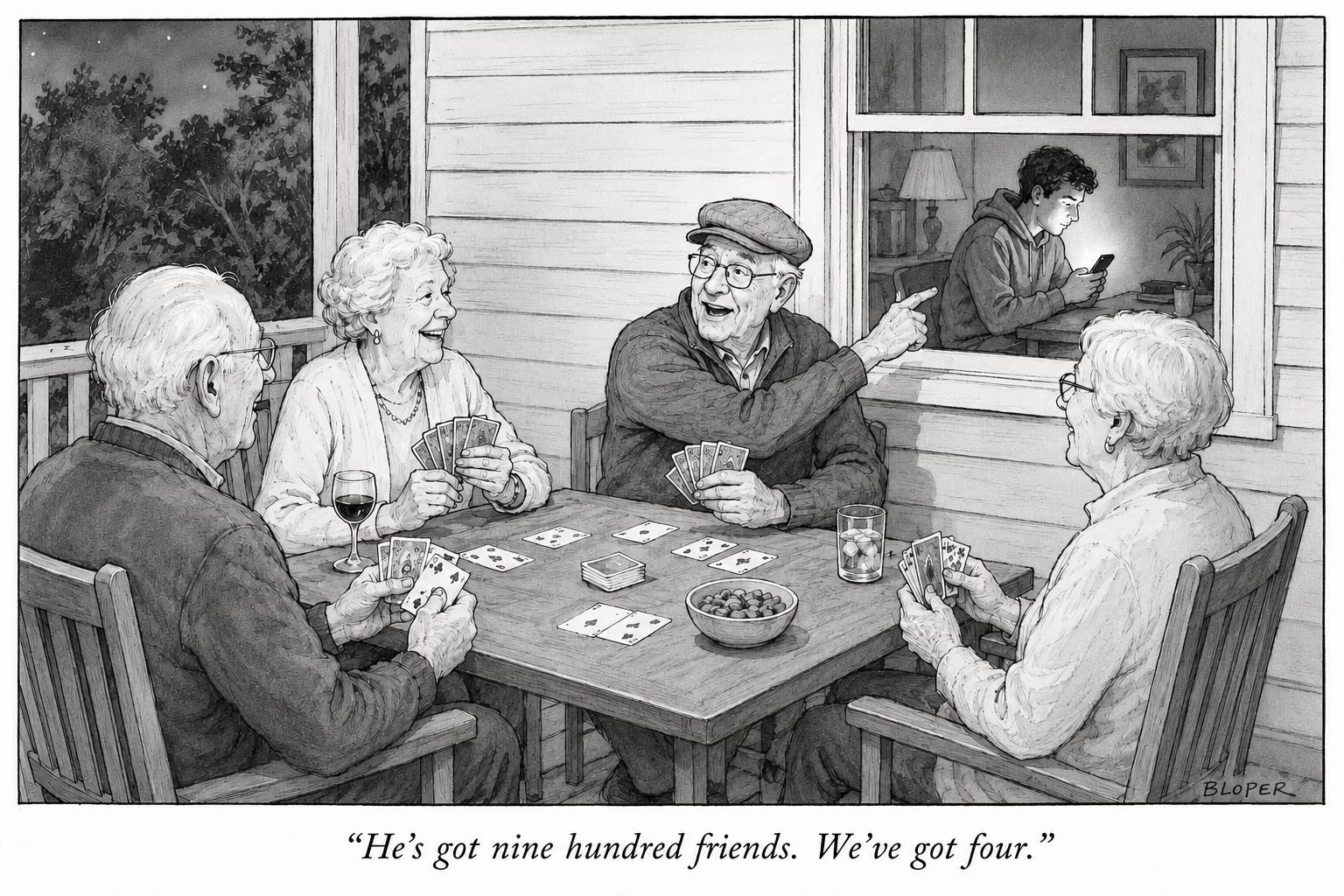
To understand why social connection works on us so powerfully and conversely, why loneliness does such harm, it helps to remember what kind of creatures we are. For nearly all of human history, survival was a group project. Our ancestors hunted, foraged, raised children, and fended off predators in small bands, from which being cast out was effectively a death sentence. Over countless generations, that risk assessment wrote itself into our biology, leaving us with brains and bodies finely tuned to seek the safety of the group. In the framing of the late neuroscientist John Cacioppo, loneliness is one of the body’s alert systems, the social equivalent of hunger, thirst or pain. Much like hunger signals an empty stomach or thirst a parched body, the feeling of loneliness is a physiological warning that something essential is missing, a prod designed by evolution to send us back toward one another. (2)
Loneliness is a psychosocial stress that impacts our physiology through elevated cortisol and inflammation.
In the short term, the drive for connection is meant to be useful, even lifesaving, but when loneliness becomes chronic it can be corrosive. Perceived isolation switches on the body’s stress systems, raising cortisol and producing low-grade inflammation, prompting the immune system to deprioritize antiviral defense. Steven Crane, behavioral sciences researcher at Stanford University says: “Loneliness is a psychosocial stress that impacts our physiology through elevated cortisol and inflammation. This leads to heart disease, it disrupts our sleep, it has mental health impacts, and taken together, these all cascade into disease states that can shorten our lives.”
The mortality risk of weak social ties is roughly comparable to smoking fifteen cigarettes a day.
In the forty years since the Nun Study, the evidence for the importance of social connection has mounted. According to the research of Julianne Holt-Lunstad, professor of psychology and neuroscience at Brigham Young University, the mortality risk of weak social ties is roughly comparable to smoking fifteen cigarettes a day or being an alcoholic, and exceeds the health risks associated with obesity. (3) Holt-Lunstad pooled 70 longitudinal studies of more than 3.4 million people and found that social isolation raised the risk of dying over the study period by almost a third, an effect larger than physical inactivity. (4) In 2023, the US Surgeon General Vivek Murthy released an advisory report warning that poor social connection raises the risk of heart disease by 29 per cent, stroke by 32 per cent, and the risk of dementia in older adults by about half. (5)
Loneliness is not the same as being alone: solitude is the state of being alone, while loneliness is a feeling. The feeling is subjective and determined by the gap between the connection you have and the connection you want. Psychologist Paul Bloom describes loneliness as the felt absence of love, understanding and being needed. You may have all three while alone on a hillside; you may have none while in a crowded family kitchen.
Loneliness is the felt absence of love, understanding and being needed.
Loneliness also comes in a few varieties. Sociologist Robert Weiss argued that loneliness comes in two distinct forms, each arising from a different kind of missing relationship. The first is emotional loneliness, which stems from the absence of a single close, intimate attachment - the kind of bond you have with a spouse, partner, or sometimes a parent or child. The second kind is social loneliness, which comes from the absence of an engaging social network - a community of peers, friends or acquaintances who share your interests and concerns. (7) Building on Weiss’s work, Cacioppo and psychologist Louise Hawkley later described a third kind: collective loneliness - the absence of belonging to a group or social entity larger than the individual, like a faith, a team or a nation. (8) The distinctions are helpful, because each kind of loneliness needs a different kind of repair.
Take Patricia, for example. Patricia is in her late seventies and has advanced Parkinson’s Disease. She is almost entirely home-bound in a small apartment she shares with a sister, with whom she has a strained relationship, and a lodger she rarely sees. A kind home health aide comes for a few hours on weekdays, but the aide speaks only broken English; their exchanges run to small courtesies and simple instructions. Phone calls were once her lifeline; but the tremors and rigidity of her disease now make the handset hard to hold and the touchscreen increasingly difficult to work. She sometimes goes four or five days without a real conversation, so when she receives a visit from a local volunteer organization she lights up for an hour or two. In this framework, a volunteer’s visit briefly assuages Patricia’s social loneliness and leaves the emotional and collective kinds untouched.
Patricia is an acute version of an ordinary problem: about half of all US adults report feeling lonely. The Surgeon General’s 2023 report warned of an “epidemic” of loneliness which was accelerated by the forced isolation of the COVID-19 pandemic. (9) Perhaps surprisingly, however, it is not the old who report the most loneliness but the young: in survey after survey, adults in the Gen Z and Millennial range describe more loneliness than their parents and grandparents, even though they are the most digitally connected generation in history. (10) Among people aged 65 and older the picture is comparatively reassuring: in one large national poll, adults in their late sixties and seventies consistently reported less loneliness and isolation than those aged 50 to 64. (11) But that headline hides the people for whom loneliness may have some of the most serious health consequences. Loneliness tends to climb again past 70, when widowhood, the death of friends, failing health, lost mobility, and fading hearing and sight can strip away relationships, and make new connections harder to form.
If those specific losses can’t always be reversed, new connections can be built. Many older adults have heard advice to join a club or group exercise class, start a new hobby, call a friend, or volunteer, particularly in the years after retirement when social circles can shift dramatically. A growing movement in medicine argues that rebuilding connections is a legitimate job for a doctor, through a practice that has become known as “social prescribing.” The idea is that when what ails a patient is isolation rather than illness, a clinician should be able to prescribe connection itself.
Doctors didn’t simply ask patients what was the matter with them, but what mattered to them.
The approach took root in East London in the late 1990s, where community organizers co-located a doctor’s surgery inside a local community centre so that patients could be referred to help with the social and economic troubles that were making them unwell. The shift was as much philosophical as practical: doctors didn’t simply ask patients what was the matter with them, but what mattered to them. A new kind of staffer, the “link worker,” would then connect a patient to the ordinary stuff of community life: a walking group, an art class, a gardening plot, a weekly befriending visit. The model, tested in other British experiments, proved durable enough that the UK’s National Health Service folded it into national policy (12) and the thinking has since crossed the Atlantic, surfacing in American clinics, senior centers, and nonprofits.
America’s fragmented health system has no National Health Service to plug a link worker into, so the British model has arrived in pieces. Massachusetts launched the first statewide cultural-prescribing pilot, CultureRx, in 2020, letting providers hand patients a slip for free museum admission; a Tufts-led evaluation found patients reported improved wellbeing and providers were glad to have something concrete to offer. (13) Other state initiatives include the Wisconsin Coalition for Social Connection and the Connecticut Collaborative to End Loneliness. Insurers are also experimenting: CareMore’s Togetherness Program, the first to treat loneliness as a diagnosable condition, reported a 57 per cent rise in exercise program participation and a 3.3 per cent fall in emergency department use. There are a host of non-profits developing programs to deliver “doses” of social connection to the lonely, with others developing tools to educate and support clinicians about effective strategies, including Social Prescribing USA, founded in 2022 to coordinate pilots across all 50 states.
Connection can be labor-intensive and expensive to deliver in person, however. There are never enough volunteers, link workers, or visiting hours to go around, and the lonely older adults who need them most — homebound adults like Patricia — are the hardest and costliest to reach. Technology has stepped in with a very different kind of remedy: companionship produced by machine. A new class of AI companions is aimed squarely at the most isolated: seniors already on the caseloads of aging-services agencies, people living alone with little daily contact, people in senior living with difficulty leaving their rooms or interacting with others, and those living with dementia.
The most prominent example in the US is ElliQ, a desk-lamp-sized device with a swiveling “head” and a touchscreen, built by the Israeli firm Intuition Robotics. It initiates conversation rather than waiting to be addressed, suggests activities, remembers what users tell it, leads relaxation and physical-activity exercises, and delivers medication reminders; it also tells jokes, plays music, reads books, and offers virtual tours and trips. One core advantage of these companions is their constant presence and abiding interest in the user: a chatbot never grows impatient waiting for you to finish your story so it can tell its own.
New York’s State Office for the Aging began providing ElliQ free to isolated seniors, and after placing the device with more than 800 older adults it reported a striking 95 per cent reduction in loneliness and very high engagement—with users interacting with it some thirty times a day, six days a week. (14) The same agency also distributes life-like robotic cats and dogs; these animatronic companion pets are credited with cutting self-reported loneliness by about 70 per cent, and such devices are used heavily in dementia care, where conversation is harder and a creature that purrs and responds to touch can soothe and engage. (15)
One caution worth noting is that these numbers come largely from the programs and the companies that make the devices, and independent researchers note there is still very little solid evidence that talking AI companions actually reduce loneliness rather than simply occupying the time. A four-week randomised trial by MIT Media Lab and OpenAI, tracking 981 people across more than 300,000 messages with an AI companion, found that the heaviest users reported higher loneliness, less real-world socialising and greater emotional dependence on the bot. However, participants on average ended up less lonely than they started, and the trial never randomised how much anyone used the chatbot, so whether heavy use deepens isolation or the already-isolated simply lean on it harder remains unsettled. (16)
The advent of AI companions has also brought us to a new frontier of nagging ethical questions, one of which is equality of access - who can get the companions and who cannot, or perhaps more meaningfully, who will get human connection while others get the bots? If a robot is what a strained public system can afford to send its poorest and most isolated elders, while the families who can pay still secure human aides and visits, a device meant to relieve loneliness may harden a two-tier arrangement of who gets people and who gets machines. There are privacy concerns as well, since these are always-listening devices placed in the homes of vulnerable users and operated by private companies with commercial stakes in the intimate data they collect.
But perhaps the most fundamental question concerns honesty. A machine that says “I’ve missed you” has missed nothing; whatever warmth the user feels flows toward a machine that cannot feel it back. Chatbots are also trained by human feedback to please, which makes them sycophantic. Philosophers such as Robert Sparrow have argued that the comfort these devices offer depends on deceiving a person into believing they have a relationship with the device, and that this should not be encouraged. If loneliness is the signal that a bond needs repair, then a sycophantic AI may simply be a painkiller that silences the signal without treating the underlying lack of human connection. Bloom makes a generational exception for these concerns: for a ninety-year-old in an institution, with no living friends and dementia making conversation impossible, a warm AI is a godsend. For someone like Patricia, alone but still capable of real connection, an AI companion that could talk on her schedule could have meaningful benefits, especially if the bot can prompt and facilitate greater human connection.
The overwhelming evidence is that to live a long and healthy life, we should tend our relationships with the same seriousness we should give our diet, sleep and exercise. The longest study of adult life ever conducted began in 1938. Researchers at Harvard began following 724 men (Harvard sophomores alongside boys from the poorest districts of Boston) and later tracked their wives and children, for more than eight decades. They measured income, cholesterol, drinking, exercise and IQ. According to the observational study’s directors George Vaillant and Robert Waldinger, the best predictor of who would stay healthy into old age was none of these; it was the warmth of people’s relationships. Those most satisfied with their relationships at fifty turned out to be the healthiest at eighty, and those ties predicted long life better than social class, genes or cholesterol. (17)
In next week’s Aging Almanac, we’ll meet Paul Rosofsky, who at 91 years young, is a remarkable example of how mindset, faith and purpose can sustain us even in enormous adversity.
Comments
Nothing yet. Say the first thing.
Sign in to join the conversation.