
Dr. Edward Shaw spent 23 years as a practicing oncologist, much of it studying how brain tumours and their treatments affected the cognitive function of people living with brain cancer and long-term survivors. He found a second calling when his wife Rebecca, a sharp-witted speech pathologist with no family history of dementia, was diagnosed with early onset Alzheimer’s Disease at the age of 53. Shaw describes how Rebecca, understandably frightened by the diagnosis and prognosis, wept and asked him to take good care of her. “Of course I promised to do that, yet grief-stricken and afraid myself, I wondered who was going to guide us on this caregiving journey, a journey down a path not chosen.” He was Rebecca’s primary caregiver for nine years.
Nearly 12 million Americans provide care for a loved one living with dementia, some 19 billion hours of it a year, according to Alzheimer’s Association. (1) The role is demanding and time-intensive, and becomes more so as the disease progresses. Few family members recognize their role as caregivers: they see themselves first and foremost as husbands or wives, daughters or sons. But Shaw says that when people do not consider caregiving as a formal role they do not think to train for it, contributing to physical, emotional and mental burnout.
Discouraged by the lack of mentorship and support during Rebecca’s illness, Shaw retrained as a mental-health counselor, moved from the oncology to the geriatrics department at Wake Forest University School of Medicine in North Carolina, and founded a memory counseling program that has since worked with several thousand families. As both a counselor and a caregiver he kept asking care partners a single question — what do you need most? He distilled their answers into a framework that became the basis for a structured counseling and support program at Wake Forest, and a 2019 book for caregivers of people living with dementia. Shaw is now partnering with dementia charity CaringKind, which has developed a structured 10-week support program for caregivers, with plans to seed the program nationally in other organizations and communities.
Looking Ahead: Understanding the Brain in Dementia
Families often feel overwhelmed in the wake of a dementia diagnosis, with fear the dominant emotion. “We naturally fear the unknown,” says Shaw, “and in the caregivers that I see in my counseling practice, people want to know: What’s next? What am I going to face tomorrow?” Education is one of the first central needs of caregivers that Shaw’s program tries to meet: about the brain and cognitive function, the types of conditions that cause dementia, stages of progression, and how each condition can be very different in its early stages before converging at the end.
Teepa Snow, a nationally-recognised occupational therapist and dementia care training specialist working with families and professionals, is careful to correct a common misconception at the start of every training session. Dementia is not a memory problem, but a progressive failure of the brain. Different regions of the brain may fail at different times, even with the same underlying condition, taking specific abilities and sparing others. Understanding which part of the brain is affected and what is still intact can help care partners translate the person’s experience of the world, their behaviour and what they may be trying to communicate.
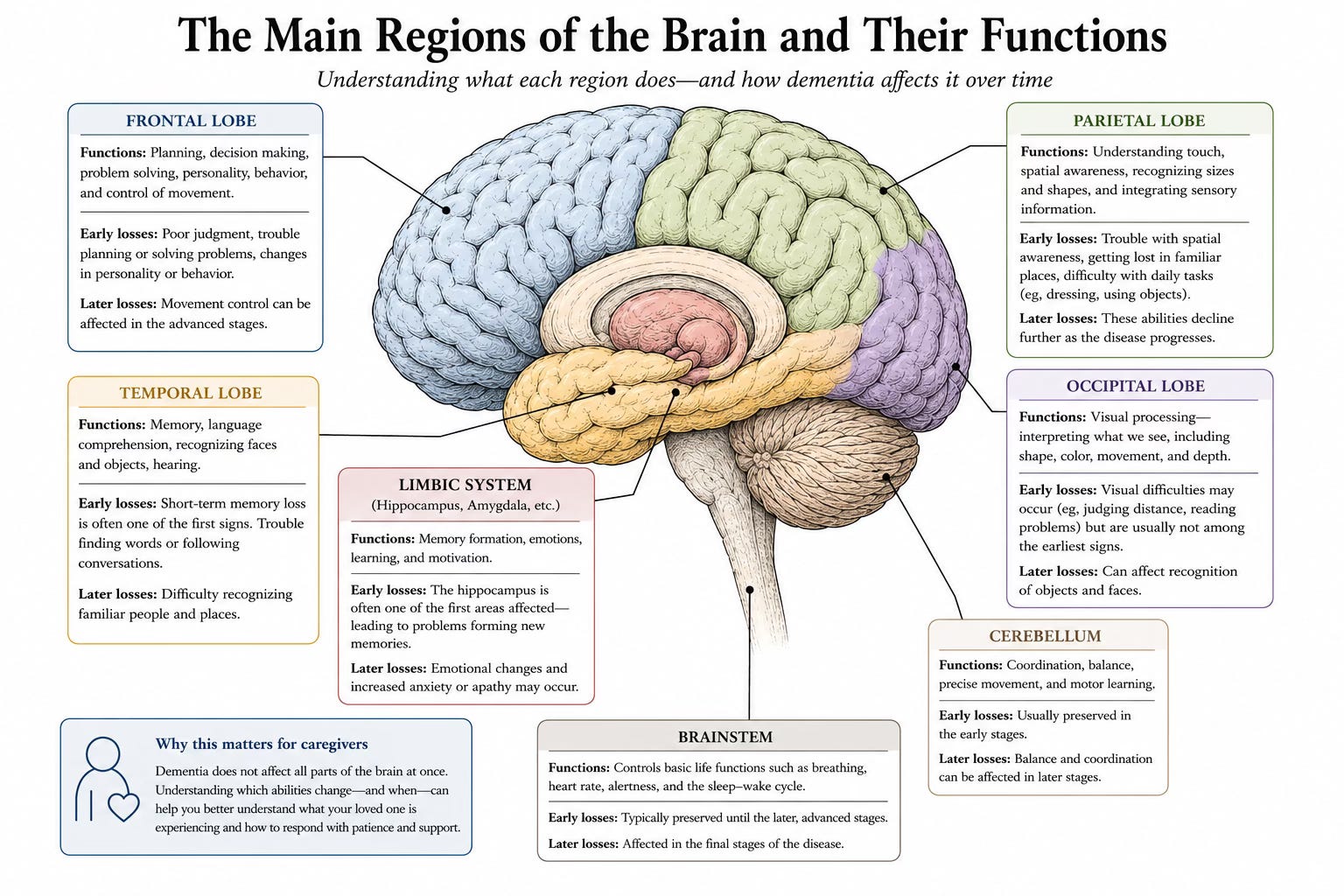
Vision is a helpful example. Peripheral vision narrows steadily as the disease advances; by the middle stages, the usable field can be a tunnel roughly a foot across, as if the person were looking through binoculars. A caregiver may see her husband startle at a touch on the arm, leave food untouched on one side of the plate, or ignore someone standing at his elbow. He is struggling because the visual stimulus is outside the tunnel; approach from the front, and the behaviour disappears. The disease may also affect the person’s ability distinguish shades of colour, or to merge the two pictures from the eyes, resulting in either double vision, or loss of depth perception as the brain selects only one picture. Any of these could make an all-white bathroom a confusing and distressing experience for someone living with dementia.
Understanding the loss of language can offer similar insights, says Snow. Nouns fail first, making it difficult to recall names or everyday objects, and vocabulary slips faster than the comprehension of tone and rhythm. As the disease progresses, an irritated tone or an encouraging one can communicate more than words alone. What survives is just as instructive for caregivers: rhythm and music, long-practised movements, social graces, emotional memory, and “forbidden” language (racist, sexual, or otherwise offensive words). For the caregiver, this knowledge can provide ways to understand, communicate and support their loved one.
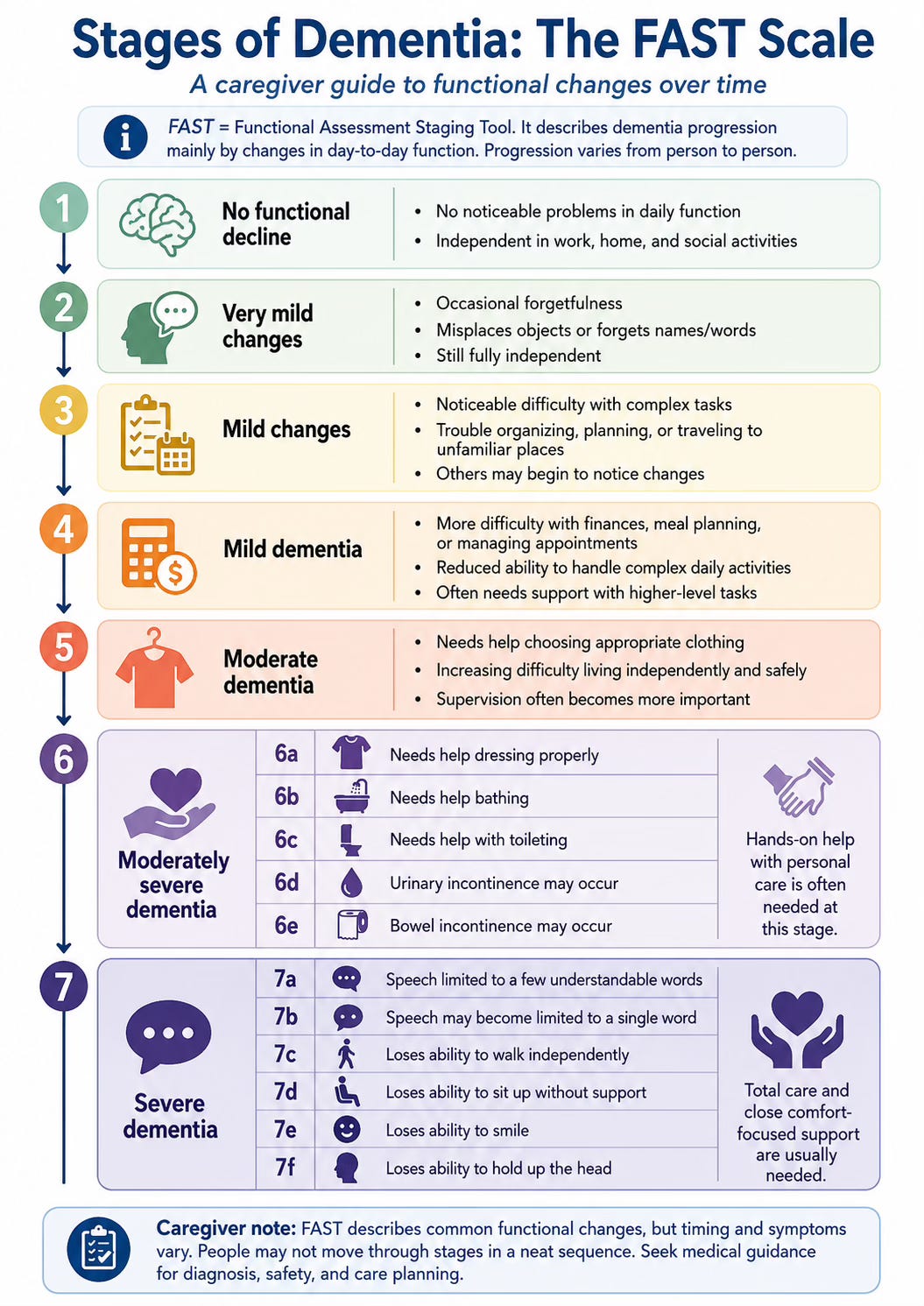
Before the disease progresses too far, Shaw says another central need for caregivers is to prepare legally and financially for what is to come. Average life expectancy after a dementia diagnosis is eight to ten years, and this is lengthening with advances in early diagnosis — but experts urge families not to delay the paperwork. Starting early gives patients the most control over their future, since decision-making capacity is one of the earliest losses. In next week’s Aging Almanac, we talk to Sara E. Meyers, partner in the firm Enea, Scanlan and Sirignano, LLP, about what to prioritize, why a handful of documents are so important, and how families should plan for long-term care. One valuable preparation is often missed: involving the diagnosed person in their own end-of-life decisions while they still can. Shaw’s family did. “This was,” he says, “very much a blessing.”
Caregiving as a Team Sport
A further three of the needs in Shaw’s framework are in the realm of building supportive systems and habits: take care of yourself, ask for and accept help, and adapt to changing relationships.
The default position for most caregivers is self neglect. Family caregivers report feelings of isolation, difficulty taking care of themselves, poor health, and physical and emotional strain, according to surveys from AARP and the National Caregiving Alliance. (2) Shaw’s argument is that caregiving is too often overwhelming as a private act of devotion, and is more manageable as team operation: staffed, scheduled and renegotiated as the disease takes its course. “Caregiving is a marathon, not a sprint,” says Shaw. “You have to be intentional about taking care of yourself.” Shaw’s prescription includes taking scheduled time off: his minimum is one afternoon a week, one overnight a month, one week away a year.

Caregivers also need a support team of family, friends, and paid help if possible. Shaw offers his own household as an example: the Shaws needed seventeen people involved in Rebecca’s care. Shaw asks families to settle, before it becomes urgent, who will tackle different tasks, as each phase of the disease brings its own stress point — at diagnosis there is the sense of vertigo about the future, at the far end, there is the most basic care. He jokes: “Who in the house is going to be the rear admiral when it comes to toileting?” The joke has a serious edge to it: tasks not assigned in advance will fall to one exhausted person by default.
Adapting to changing relationships is perhaps the hardest of all. Dementia changes personality and emotional expression, in addition to the other functional losses. “It upsets the family system apple cart,” says Shaw. Roles migrate from spouse to nurse, from child to guardian, and the division of labor shifts for everyone. This is where professional counseling can do the most good, he says, to help the family adapt to a new system for their new reality.
The Long Goodbye
The remaining needs in Shaw’s framework concern how a caregiver processes his or her experience: tell and retell your story, grieve your losses, explore existential and spiritual issues.
Caregivers need a witness to how hard it is, and someone to care about them as an individual. The listener can be a relative, a friend, a member of a faith community, or a professional. Shaw’s conviction, formed over decades of running support groups, is that a group of fellow caregivers supplies something that the others cannot: peers who need no translation of the experience. Reluctance to join a support group is common, but usually short-lived. “I was hesitant to attend,” said one participant in a CaringKind support group, “but once I got there, I just feel like it was the biggest gift. It made me feel like I belonged.”
The story most often told is one of grief. Shaw repeats a claim from the literature — that the grief of a dementia caregiver may be the longest and hardest a human being can experience. There are the personal losses: the caregiver’s own time, caught in the tension of “I need more time for me, but I need more time for him or her.” For couples, there is the loss of the twosome — the couple’s shared identity, their intimacy, and the future the pair had planned together. One husband in a CaringKind support group described reaching the end of his marriage while his wife was still living: “I realized that I had lost my marriage. The woman I married was no longer there; but we had 37 beautiful years.” And then there is what Shaw calls the most neglected loss, the loss of peace of mind: “You’re always sleeping with one eye open.”
The final need in Shaw’s framework is existential: “Why me? God, how could you allow this?” Some caregivers manage, in time, to find meaning in their experience but there are many more that struggle. The point of asking is not that the answers exist, says Shaw — mostly they do not — but that giving voice to the questions has therapeutic purpose.
Taking it National
CaringKind has built Shaw’s framework into a ten-week program called Partnering Together: it runs roughly 30 workshops a year, feeding 21 ongoing support circles. Participants are surveyed before and after. Of those who finish, 93 per cent report improved knowledge, 83 per cent say they feel better prepared, and 80 per cent say they can talk about their situation more easily than they could in week one. The charity is now working to take the program national, seeding it in other organisations and communities.
As covered in earlier issues of The Aging Almanac, the wider health system is also starting to recognise the caregiver as a second patient with predictable and answerable needs. To meet the specific needs of dementia caregivers, in July 2024 Medicare launched a program called GUIDE — Guiding an Improved Dementia Experience — an eight-year test program that pays care organisations to meet many of the needs in Shaw’s framework: care navigation, a 24-hour support line, caregiver training, and respite care so that the family member can step away. Some 330 organisations have signed on so far. Several health systems, even if they are not yet part of the GUIDE program, have caregiver support programs for families living with dementia. If you are caring for a loved one with dementia, ask what is available in your health system.
For readers who want somewhere to start:
The Alzheimer’s Association runs a 24/7 helpline (1-800-272-3900) that can help with care planning, respite care and finding support groups.
CaringKind runs a 24-hour helpline (1-646-744-2900) and lists its workshops and support groups at www.caringkind.org.
Shaw’s book, “The Dementia Care Partner’s Workbook,” sets out the eight needs in full and is written for families rather than clinicians.
Teepa Snow’s Positive Approach to Care publishes several hundred free training videos on YouTube, most of them short, covering practical questions for caregivers.
Thanks for reading The Aging Almanac! Subscribe for free to receive new posts and support my work.
Comments
Nothing yet. Say the first thing.
Sign in to join the conversation.