

Every major technological transition undergoes a painful period of economic and structural adjustment. When the internet first entered the commercial space, early strategies assumed that simply purchasing web domains and digitizing corporate literature would instantly yield profitability. The subsequent market crash was not a failure of the internet’s core utility; it was the collapse of organizations that mistook a raw technological utility for a complete operating model.
In mid-2026, the technology landscape is navigating an identical phase of structural correction.
On the surface, the market appears to be sending deeply conflicting signals. High-profile executive admissions of messy restructurings and project rollbacks sit directly alongside data showing that corporate software adoption is accelerating rapidly. To the casual observer, this looks like an industry stalling out or falling short of its original promise.
In reality, the underlying repository and macroeconomic telemetry reveals a sharp economic decoupling: the penetration of advanced automation into the enterprise is hitting historic highs, while the legacy human workflows and infrastructure billing frameworks trying to support it are hitting a massive wall.
The transition to an intent-based economy is not a binary switch, but a predictable, four-phase chronological progression driven by the realities of code construction, unit economics, and organizational design.
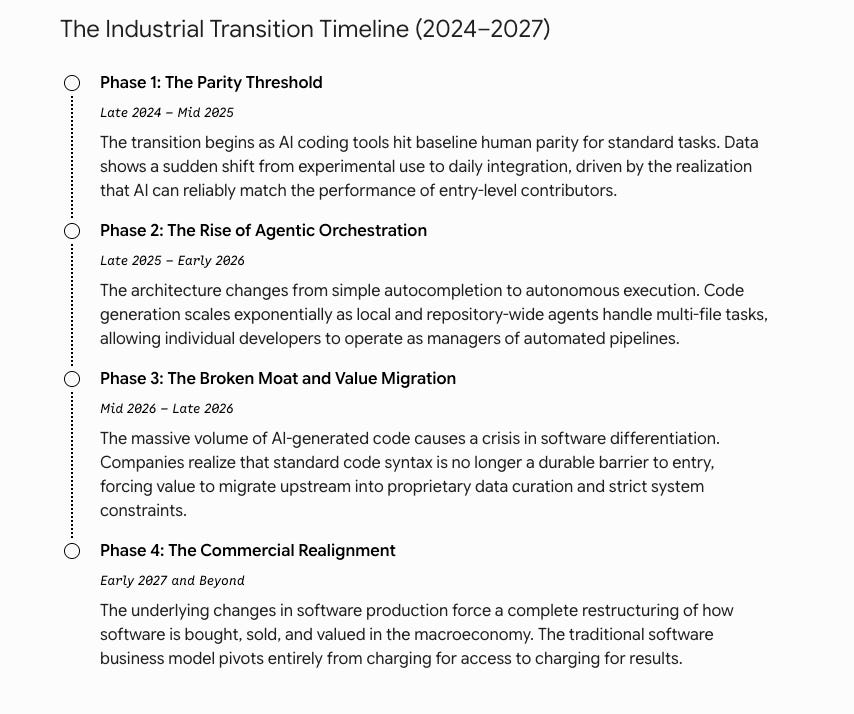
The transition begins as software coding tools hit baseline human parity for standard tasks. Data shows a sudden shift from experimental use to daily integration, driven by the realization that automation can reliably match the task output of entry-level human contributors.
The 2025 Stack Overflow Developer Survey (sampling over 49,000 developers) confirmed that 84% of engineers had integrated AI into their workflows, with 51% using them daily. Microsoft reported that 90% of Fortune 100 companies had actively deployed GitHub Copilot by mid-2025.
This structural shift was further validated by empirical labor tracking from the Stanford Institute for Economic Policy Research (SIEPR) (Mahoney, McEntarfer, and Wahal, 2026). Analyzing IPUMS-CPS labor data, SIEPR documented that rather than triggering widespread senior layoffs, the arrival of baseline technical parity caused concentrated “hiring avoidance” for junior white-collar positions. Corporate buyers began consolidating entry-level roles as automated tools reached performance parity on routine, entry-level task execution.
Three critical shifts marked this era:
The Quality Pivot: A sharp drop in developer sentiment occurred as engineers realized tools were no longer just novelty assistants, but were being used by management to evaluate baseline team capacity.
The Retention Shift: Controlled enterprise studies showed developers retaining 88% of generated code in final production submissions, proving the outputs were no longer throwaway suggestions requiring extensive human rewrites.
The Junior Compression: Enterprise hiring pipelines shifted away from entry-level execution roles, as automated systems absorbed baseline data entry, routine coding, and basic task routing.
The architecture changes from simple line-by-line autocompletion to autonomous execution. Compute generation scales exponentially as local and repository-wide agents handle multi-file operations, allowing individual developers to operate as managers of automated pipelines.
By late 2025, GitHub data revealed developers were merging 43.2 million pull requests per month, a 23% year-over-year explosion heavily driven by autonomous software. Anthropic’s Claude Code achieved an 18% adoption rate by January 2026, demonstrating high client satisfaction due to its ability to handle complex, multi-file repository tasks automatically.
Two critical trends defined this period:
The “Vibe Coding” Era: A move away from manual syntax writing toward objective-validation protocols. In early 2026, coding editor tools like Cursor scaled rapidly, demonstrating that single developers could execute features in minutes that previously required cross-functional teams.
Task Velocity: Cycle times for complex feature deployments dropped by 75%, falling from an average of 9.6 days down to 2.4 days in active engineering repositories.
The massive volume of automatically generated code creates a severe crisis in software differentiation. Companies realize that standard code syntax is no longer a durable barrier to entry, forcing commercial value to migrate upstream into proprietary data curation and strict system constraints.
Gartner’s 2026 predictive research notes that 40% of enterprise applications now include task-specific autonomous agents, up from less than 5% in early 2025. This explosion has shattered traditional technical moats in three distinct ways:
The Commodity Code Wall: Incumbent software companies find their core feature sets replicated by lean startups or single builders within days.
The Shift to Private Data: Venture capital funding pivots away from companies building unique software logic and moves aggressively toward businesses that secure exclusive data partnerships, which represent proprietary context.
The Trust Crisis: Because 46% of developers express distrust in unguided AI accuracy, companies that build advanced validation frameworks start to command a massive market premium over companies that deploy unconstrained agents.
The underlying changes in software production force a complete restructuring of how technology is bought, sold, and valued in the macroeconomy. The traditional software business model pivots entirely from charging for system access (user seats) to charging for verifiable business results.
Enterprise procurement data from Zylo’s 2026 SaaS Management Index shows that while corporate software spend rose 8%, the total number of unique applications remained flat. Companies are spending more on compute, not more on seats. According to pricing benchmarks, 38% of software companies have already been forced to integrate usage-based elements into their contracts.
This phase matures through two key signals:
The Per-Seat Collapse: Enterprise clients demand sweeping contract restructurings, refusing to pay for human user seats when an automated agent is executing the work of a ten-person department.
The Rise of Outcome Billing: Forecasts indicate that as this phase matures into 2027, 70% of B2B buyers will actively reject standard per-user seat models in favor of usage-based or outcome-based billing, officially cementing the transition to the Intent Economy.
To understand the modern horizon, one must look at the “dual tape” of corporate metrics currently playing out across the economy. On one side of the ledger, actual deployment data indicates that automation is no longer an experimental pilot program; it is an industrial standard.
According to mid-2026 macroeconomic telemetry compiled by Goldman Sachs analysts Sarah Dong and Joseph Briggs, AI penetration across American businesses has risen steadily to 20.6%, with a clear line of sight to 24% by the end of the year. Among larger organizations with workforces exceeding 150 people, that adoption rate jumps to 41%.
This macro-trend is further validated by institutional tracking from Guggenheim Securities, whose survey of 150 large-enterprise IT professionals found that 81% of respondents have actively deployed automated agents, with AI consumption now claiming an average of 19% of corporate IT budgets.
Yet, running parallel to this aggressive deployment is the secondary, highly volatile trend: a profound anxiety over runaway infrastructure bills. While the Guggenheim survey notes that IT professionals expect a positive 3.1% lift in operating margins by 2027, it simultaneously captured a sharp, single-digit spike in enterprise concern regarding near-term profitability; a direct indicator that escalating cloud token costs are beginning to outweigh immediate efficiency benefits.
This explains the recent “Token Revolt” across the enterprise landscape. Major industrial buyers are actively revolting against proprietary cloud pricing. With token expenses squeezing margins, enterprises are enforcing strict budget caps, while leading technical directors openly state that cloud API prices must drop by as much as 90% before automation can scale sustainably.
The second critical dimension of this horizon is the collapse of the “labor apocalypse” narrative. For the past two years, headlines predicted that automated code generation and text synthesis would trigger immediate, sweeping corporate layoffs.
The mid-2026 data shows that this apocalyptic view was fundamentally incorrect on a macro level. The Guggenheim survey tracks an average corporate headcount reduction of just 2.5% directly tied to automated systems. As Goldman Sachs’ research and the SIEPR policy brief point out, overall macro unemployment among highly AI-exposed occupations has risen by only 0.77 percentage points since 2022—a trend that closely matches unexposed sectors and reflects a broader labor market softening rather than mass technological displacement.
Instead of mass layoffs, SIEPR’s firm-level data reveals that the true labor market impact is structural: organizations are practicing role consolidation and hiring avoidance at entry levels while maintaining senior headcount.
The real bottleneck is not that machines are taking all the jobs; it’s that human organizations do not know how to handle the volume of work the machines are producing.
Goldman Sachs’ client telemetry shows that while individual tasks see a 23% to 34% productivity uplift, the net organizational return on investment remains constrained. Because companies are embedding high-speed automation loops inside legacy, siloed reporting lines, they are suffering severe technical whiplash.
Telemetry firms tracking actual git repositories have exposed the dark side of zero-marginal-cost software generation:
The Quality Crash: Data from GitClear, which tracks code permanence, showed a major red flag. In a human-only baseline from 2021, the percentage of code thrown away or completely rewritten within two weeks of being written was 3.3%. By 2024, that churn rate jumped to 5.7%. By 2026, it hit an unstable 7.1%.
Acceleration Whiplash: While Faros AI measured clear raw output gains, work completed per developer rose by 66% and overall task throughput rose by 33.7%, the probability of a critical production incident resulting from a merged code change more than tripled.
AI is generating software faster than humans can verify it, resulting in massive, wasteful rewrite loops. The technology is delivering raw speed at the desktop level, but the corporate architecture is trapping that velocity in endless human review queues, bureaucratic alignment meetings, and broken dependencies.
When you strip away the marketing fluff, the hard repository and macroeconomic data prove two things. First, individual human beings are successfully pushing 3 to 8 times more code volume into production via desktop agent orchestration than they were 24 months ago. The bottleneck of manual code construction has collapsed. Second, because the market is flooded with high-volume, high-churn, incident-prone code, the software itself cannot function as a business moat.
The true bottleneck of the modern enterprise is no longer generating lines of code. The real challenge is the human and system architecture: the Intent, Context, and Guardrails needed to keep that code from breaking the business.
The current corporate friction and selective project rollbacks are not proofs that the technology has failed. They are empirical evidence of the “Corporate Gravity Trap”, the realization that trying to run high-velocity intent automation inside a legacy, manual bureaucracy creates a structural breakdown. The horizon belongs exclusively to the leaders who stop buying software seats and start rewriting their internal structure, governance loops, and workflow design from scratch. This is the roadmap we will explore in the rest of this series.
Mahoney, N., McEntarfer, E., & Wahal, K. 2026. What is really happening to jobs? Separating AI hype from reality. SIEPR Policy Brief, Stanford University.
Guggenheim Securities. 2026. Enterprise IT Survey: Agentic Deployment Metrics, Operating Margin Projections, and Token Bill Dynamics.
Goldman Sachs Global Investment Research. 2026. AI Adoption Tracker: Macroeconomic Telemetry, Productivity Gains, and Sector-Specific Labor Impacts. Sarah Dong, Joseph Briggs.
Gartner. 2026. Predicts 2026: AI Potential and Risks Emerge in Software Engineering Technologies.
Faros AI. 2026. The AI Engineering Telemetry Report: Throughput, Churn, and Quality Dynamics.
GitClear. 2025/2026. The Code Quality and Churn Index.
Stack Overflow. 2025. Annual Developer Survey Data.
Zylo. 2026. The 2026 SaaS Management Index: $75B Active Spend Dataset Analysis.
Comments
Nothing yet. Say the first thing.
Sign in to join the conversation.