
As a leader, sponsor, or Product Owner, you often rely on forecasts to make critical business decisions. But you also wonder why the initial timeline your team gives you always seem to change. Is your team being deliberately vague, or are they just viciously deceitful? None of these. The estimates change because of a fundamental reality in project management known as the Cone of Uncertainty.
Imagine an ice cream cone lying side-ways. At the wide end of the cone, when a project is just a vague idea, we have the least knowledge. This is where your estimates are the most uncertain.
Early in a project, your estimates can be off by as much as 25% less to 400% more than the final effort. If your team says a project will take 3 months, the reality could be anywhere from 2 to 12 months. This model provides a neutral, fact-based explanation for why early precision is impossible.
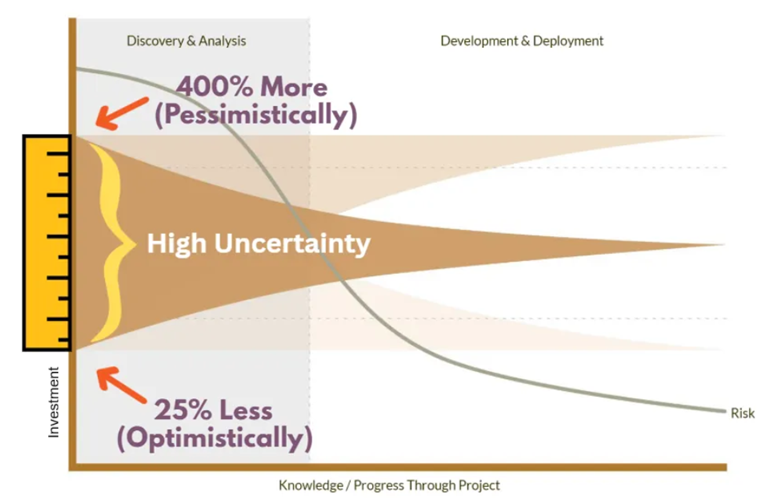
Holding your team accountable to a number at the top of the cone is setting the project up for conflict and disappointment.
The good news is that the Cone of Uncertainty shrinks only through learning and decision-making. As we gather more & more requirements, and gain knowledge through Prototyping, defining the architecture, and finalizing Acceptance Criteria, we get more confident.
Therefore, your initial investment in these early activities, often called Spikes or Discovery Sprints, provides the highest return. They quickly move the project from a huge range of possibilities to a much narrower, more reliable estimate.
The key takeaway for you is: Hold your team accountable for shrinking the cone by prioritizing discovery work first.
By the time the team has completed the final design and learned about the key technical and functional risks, the uncertainty should be down to a manageable ±10%. That’s when a commitment makes sense.

Agile methodologies fundamentally shift how certainty is defined and achieved. Instead of eliminating uncertainty (which is impossible), Agile manages it proactively to deliver predictable outcomes.
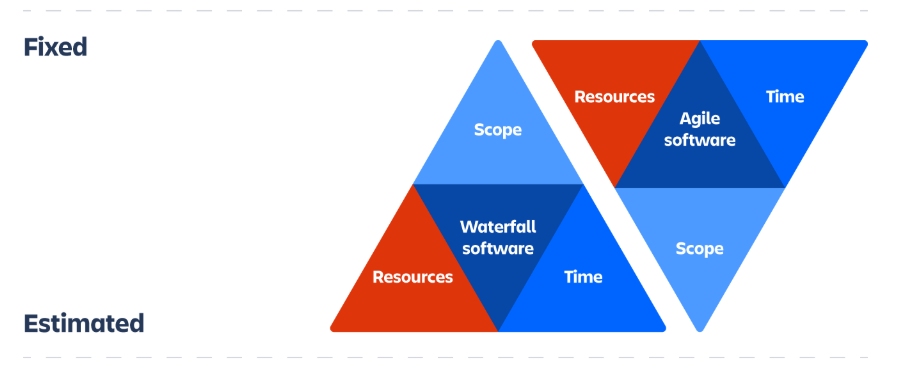
Following are the mechanisms by which this is achieved:
Certainty in Time and Cost: Agile methods achieve certainty by fixing Time (Sprints) and Cost (Team Size or Resources), and then making the Scope flexible. Fixed Timeboxes guarantee that something of value will be delivered or inspected by a certain date, providing certainty in delivery cadence and budget.
Certainty in Value: Focus on frequent feedback (via Sprint Reviews) ensures that the stakeholders inspect the working product often. This provides certainty that the right thing is being built and minimizes waste.
Certainty in Projection: By prioritizing discovery and delivering increments frequently, the team actively works to shrink the Cone of Uncertainty rapidly, leading to greater certainty in future projections.
If you are looking got a more predictable delivery, stop pressurizing your teams for an exact date from Day One. Instead, inspire them to identify the riskiest unknowns, and invest in their learning to close that cone faster.
This is how Agile delivers certainty.
Comments
Nothing yet. Say the first thing.
Sign in to join the conversation.