
Epidemiologist. Security engineer. Former Q-cleared scientist, Sandia National Laboratories. Ph.D. in Environmental Health Science, Emerging Infectious Disease and Epidemiology, DHS Center of Excellence Research Fellow. Former U.S. Army infantryman.
Bottom Line Up Front. Seven judgments, scored 0 to 100 on confidence, with evidence graded known, assessed, or unknown throughout.
1. The prohibition has no enforcement machinery at all. The Biological Weapons Convention has no verification mechanism, no inspections, and no implementing organization. What it has is four people inside a treaty whose entire annual budget, staff and every meeting included, is about $2.2 million. The chemical weapons regime runs on about $95 million with roughly 500 staff. The nuclear regime runs on roughly $490 million with about 2,560 (confidence 95; primary budget documents).
2. Only physical inspection has ever produced verified disarmament. The chemical regime verified the destruction of 72,304 metric tons because inspectors stood in the rooms and watched it burn. The nuclear regime reaches conclusions about 190 states because roughly 275 inspectors visit more than 1,400 facilities. Neither result came from analysis at a distance. Both came from people with badges and the right of entry (confidence 95; OPCW and IAEA reporting).
3. An AI verification system is window dressing, and worse than nothing. A state that controls what data exists controls what the model sees. A system trained on open information scrutinizes the countries that publish and goes blind on the countries that do not. Its real function is to let governments claim assurance without granting access, and to let adversaries claim compliance without admitting an inspector. You cannot tech your way out of this (confidence 95; my analysis, and I own it).
4. Every voluntary transparency mechanism in this field has already failed. No country on earth requires DNA synthesis providers to screen the sequences they are asked to build. Thirty-five states parties have never once filed the treaty’s voluntary declaration in thirty-nine years. Export controls bind 43 jurisdictions out of nearly two hundred. Opt-in systems fail at precisely the moment they are needed (confidence 95; industry protocol text and UN data).
5. Mahley was right in 2001, and he is still right. The American objection was that declarations could not be comprehensive, that biology has no chokepoint comparable to chemical precursors, and that random visits to a random subset deter nobody. All three remain true. The 2001 protocol’s flaw was not that it was too intrusive. It was too weak, and it bound the wrong people (confidence 85; his statement, quoted at length below).
6. The BWC cannot be repaired. It needs a successor. An International Biological Weapons Convention with an implementing organization, declared-facility inspection, challenge inspection on short notice, and a consequence for refusal that does not route through a veto every permanent member holds. Nothing less is worth the paper (confidence 80; my framework, stated plainly so it can be attacked).
7. Until that exists, we tie no hands but the adversary’s. No unilateral restriction on American programs, no freezing of American research, no inspection of American facilities, except under an instrument that binds every relevant state to the same terms with the same enforcement. This is the same test I applied in Part IV: does the rule reach the adversary, or only us (confidence 100; argument, not finding).
Start with the number in the title, because it is not a rhetorical device.
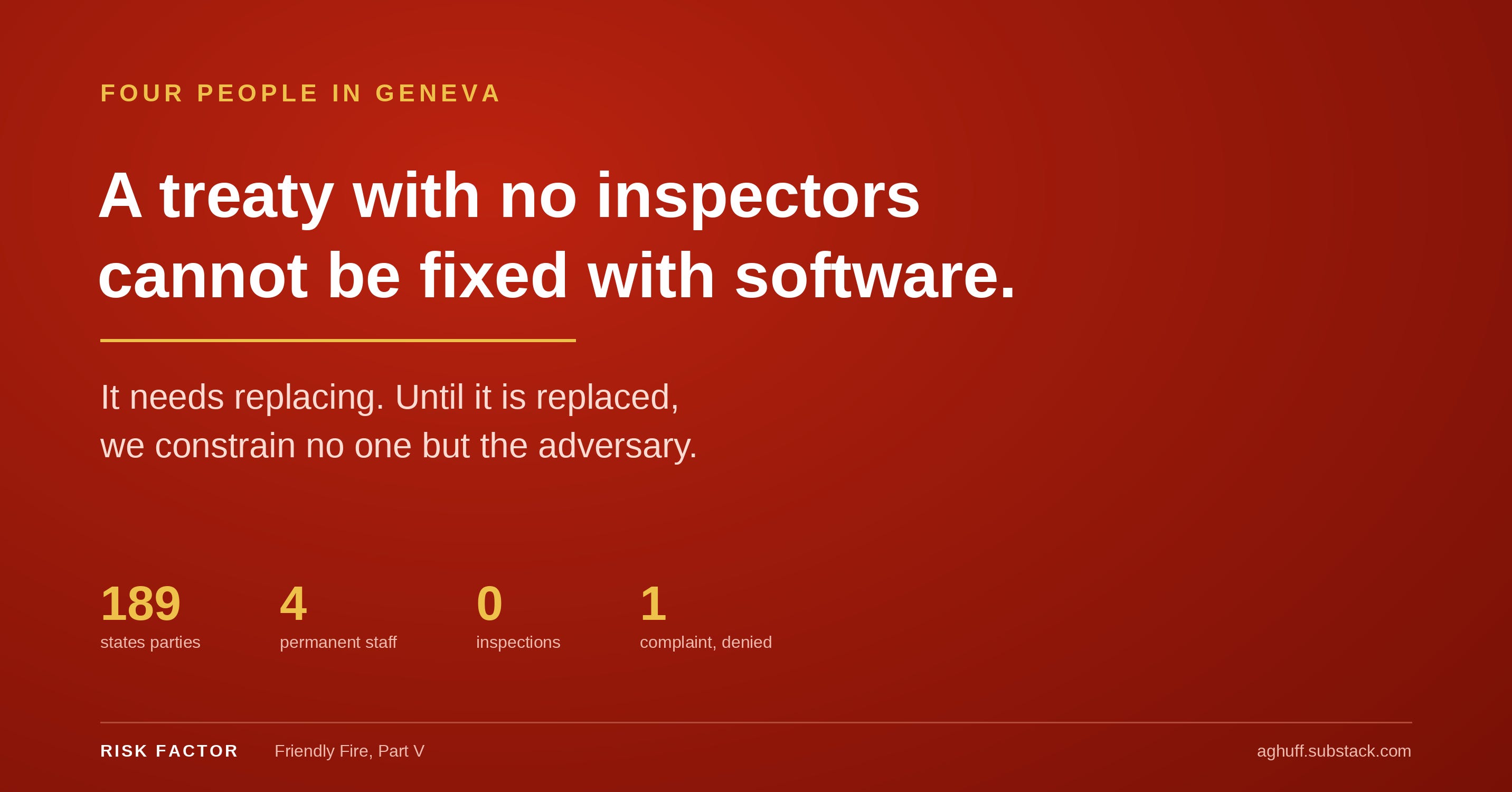
The Biological Weapons Convention entered into force on March 26, 1975. It has 189 states parties, four signatories that never ratified, and four states outside it entirely [1]. It prohibits the development, production, and stockpiling of biological weapons. On its face it is one of the most sweeping disarmament instruments ever written.
Its permanent international staff is four people: one P-5, two P-4, one P-3, housed inside the UN Office for Disarmament Affairs in Geneva, with no inspection and no investigative authority. That unit costs about $1.28 million a year. The Convention’s entire annual budget, the unit and every meeting it services, is about $2.17 million [2].
Now the comparison that should end every conversation about biological risk that begins with the words “but there is a treaty.”
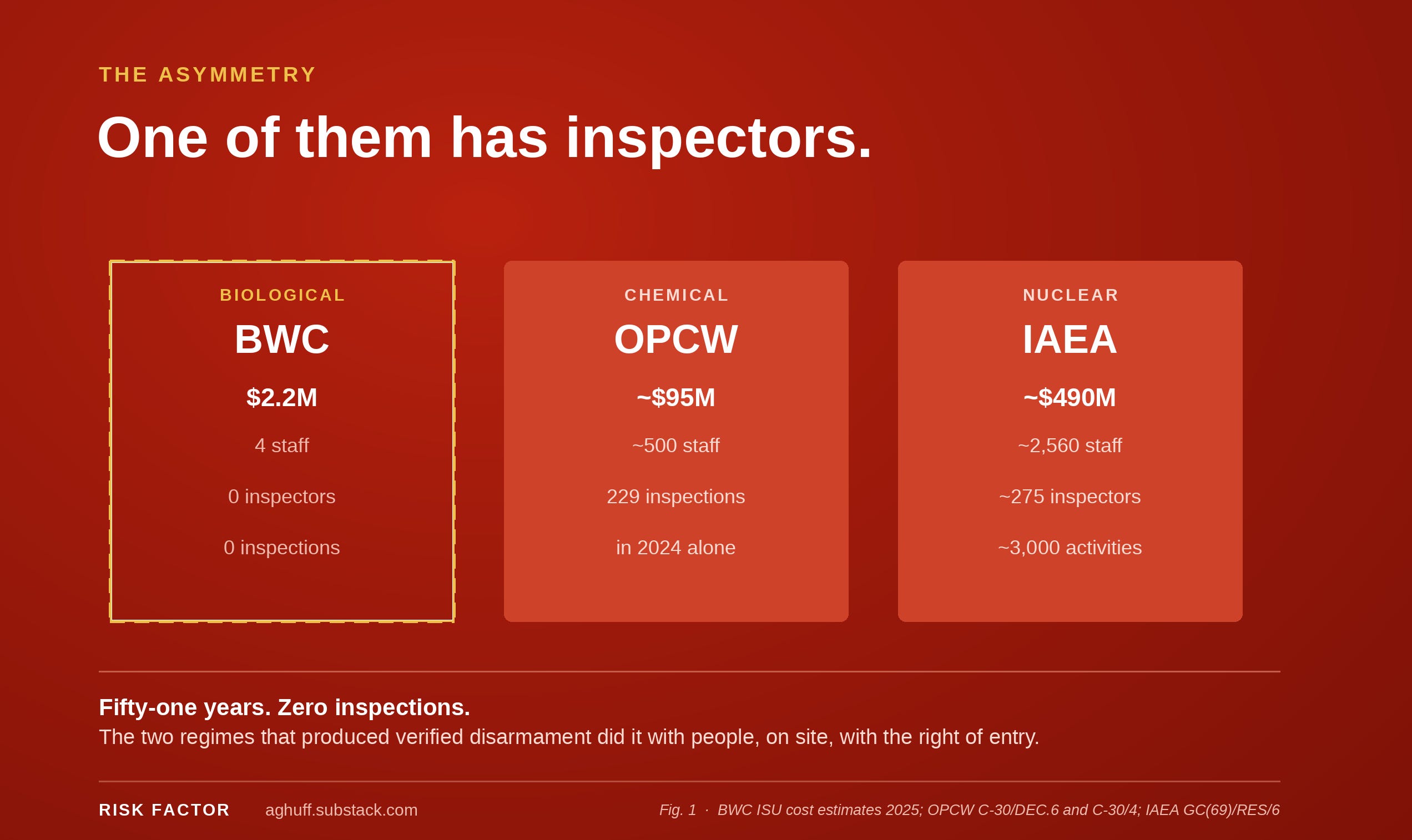
Fig. 1. Three prohibition regimes. One of them has inspectors.
The Organisation for the Prohibition of Chemical Weapons operates on about $95 million for 2026 with roughly 500 staff. In 2024 alone it conducted 229 inspections across 223 sites, consuming 3,530 inspector days, of which 200 were routine industry inspections. It has 5,181 industrial facilities subject to inspection. And it has verified the destruction of 72,304 metric tons of declared chemical weapons, which is 100 percent of what was declared [3].
The International Atomic Energy Agency operates on a 2026 regular budget of roughly $490 million with about 2,560 staff, of whom roughly 870 sat in the Department of Safeguards and about 275 were inspectors deployed for on-site verification, according to the Agency’s most recent published breakdown in 2022. In 2025 it applied safeguards in 190 states and conducted almost 3,000 in-field verification activities at more than 1,400 facilities and locations outside facilities [4].
The Biological Weapons Convention has conducted zero inspections in fifty-one years, because it has no authority to conduct any and nobody to conduct them with.
Hold those three columns in your head, because they contain the entire argument of this article. The two regimes that produced verifiable disarmament did it the same way: inspectors, on site, with the right of entry. The one that produced nothing tried everything except that.
The Convention does contain one transparency instrument, and understanding precisely what it is not is essential to everything that follows.
Confidence-building measures were created by a decision of the Second Review Conference in 1986 and introduced in 1987. They were not created by treaty amendment, because the Convention’s fifteen articles impose no reporting duty of any kind. That is why the operative verb is that states parties “should submit,” not shall. They are politically binding, which is a diplomat’s phrase meaning not binding. There is no consequence for ignoring them and no mechanism to notice that you have [5].
States parties are asked to declare, each April, their research centers and laboratories, their national biological defense programs, disease outbreaks, relevant legislation, past offensive and defensive programs, and vaccine production facilities.
In 2024, 113 states parties filed. That was 60 percent, and it was a record year. Across the thirty-eight years of the regime the average participation rate is about 37 percent. Participation crossed half the membership for the first time in 2021. Thirty-five states parties have never filed a single report in the history of the Convention [5].
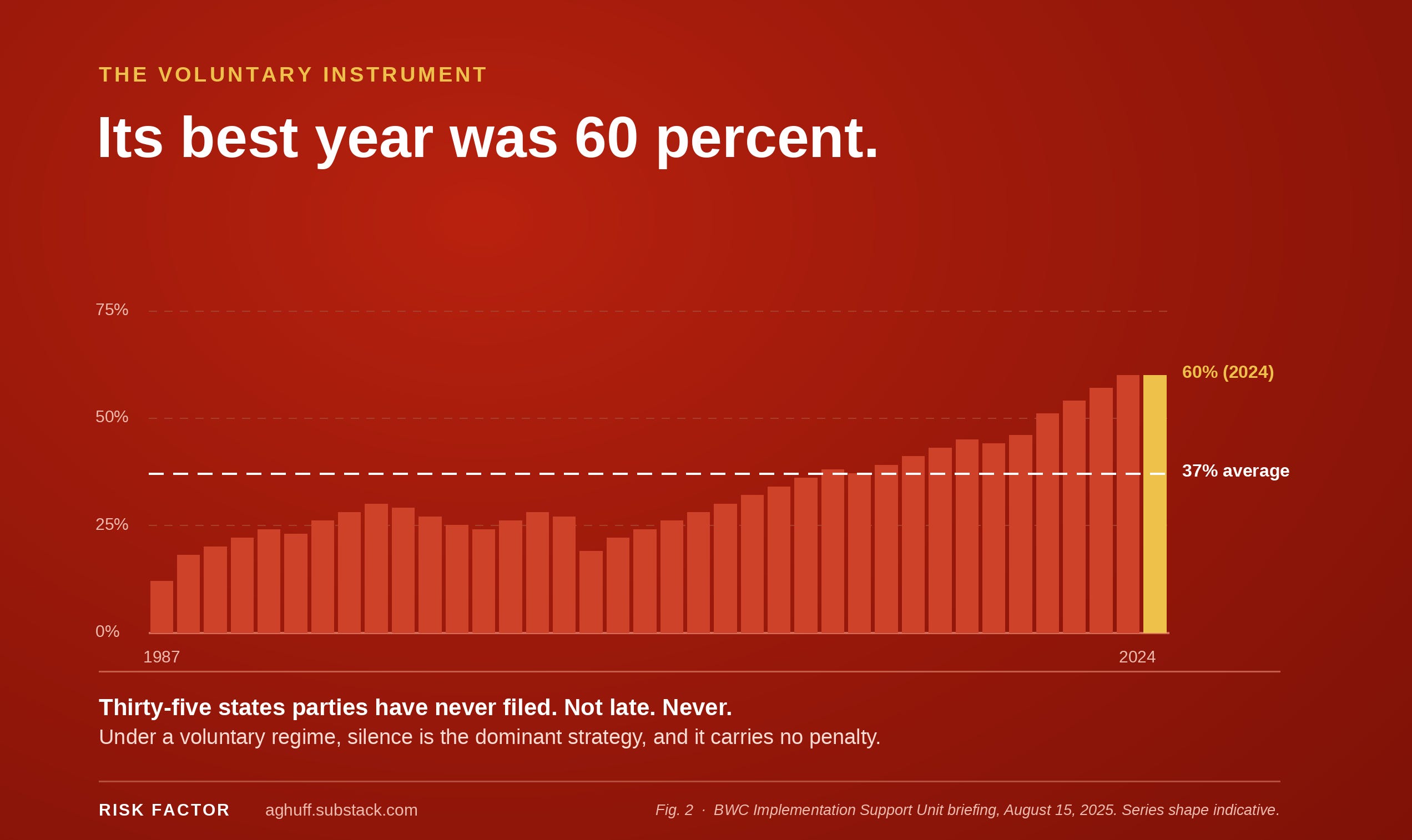
Fig. 2. Thirty-nine years of voluntary declarations. The best year was 60 percent.
Sit with that last number. Thirty-five governments have been party to a treaty banning biological weapons for decades and have never once told anyone what they are doing. Not late, not incompletely. Never.
And even honest filing would not find a weapons program, because the forms do not ask about the things a weapons program generates. Filippa Lentzos and colleagues applied acquisition pathway analysis, a method borrowed from nuclear safeguards, to three biological weapons program scenarios. Depending on the scenario, 60 to 70 percent of the potential warning signs would not be captured at all in a confidence-building measure submission [6].
So the treaty’s only transparency instrument is voluntary, ignored by two fifths of the membership in its best year, never used at all by thirty-five states, and structurally blind to most of what it would need to see even when filed in good faith. That is the baseline. Remember it when someone proposes to improve it with software.
Suppose you believed a state party was building biological weapons. What could you actually do?
Article V provides for consultation. It has been used twice in fifty-one years. Cuba invoked it in 1997 over an alleged American release of Thrips palmi, producing a Formal Consultative Meeting in Geneva that August and a report in December concluding that “it has not proved possible to reach a definitive conclusion.” Russia invoked it in September 2022 over Ukraine, where the vast majority of participating states parties dismissed the allegations as unfounded [7].
Article VI provides for complaint to the UN Security Council. It has been invoked once. In October 2022 Russia lodged a formal Article VI complaint against the United States and Ukraine. On November 2, 2022, at the Council’s 9180th meeting, the Russian draft resolution to establish a commission of inquiry failed: two in favor, three against, ten abstentions [7].
Read that vote carefully, because the lesson is not the one most commentary drew. The lesson is not that the Council rejected a bad-faith Russian claim, though it did. The lesson is that the only enforcement mechanism written into the Biological Weapons Convention is a Security Council vote, and a Security Council vote is subject to five vetoes. Every permanent member is structurally immune to the treaty’s enforcement architecture. That includes China. That includes Russia. That includes us.
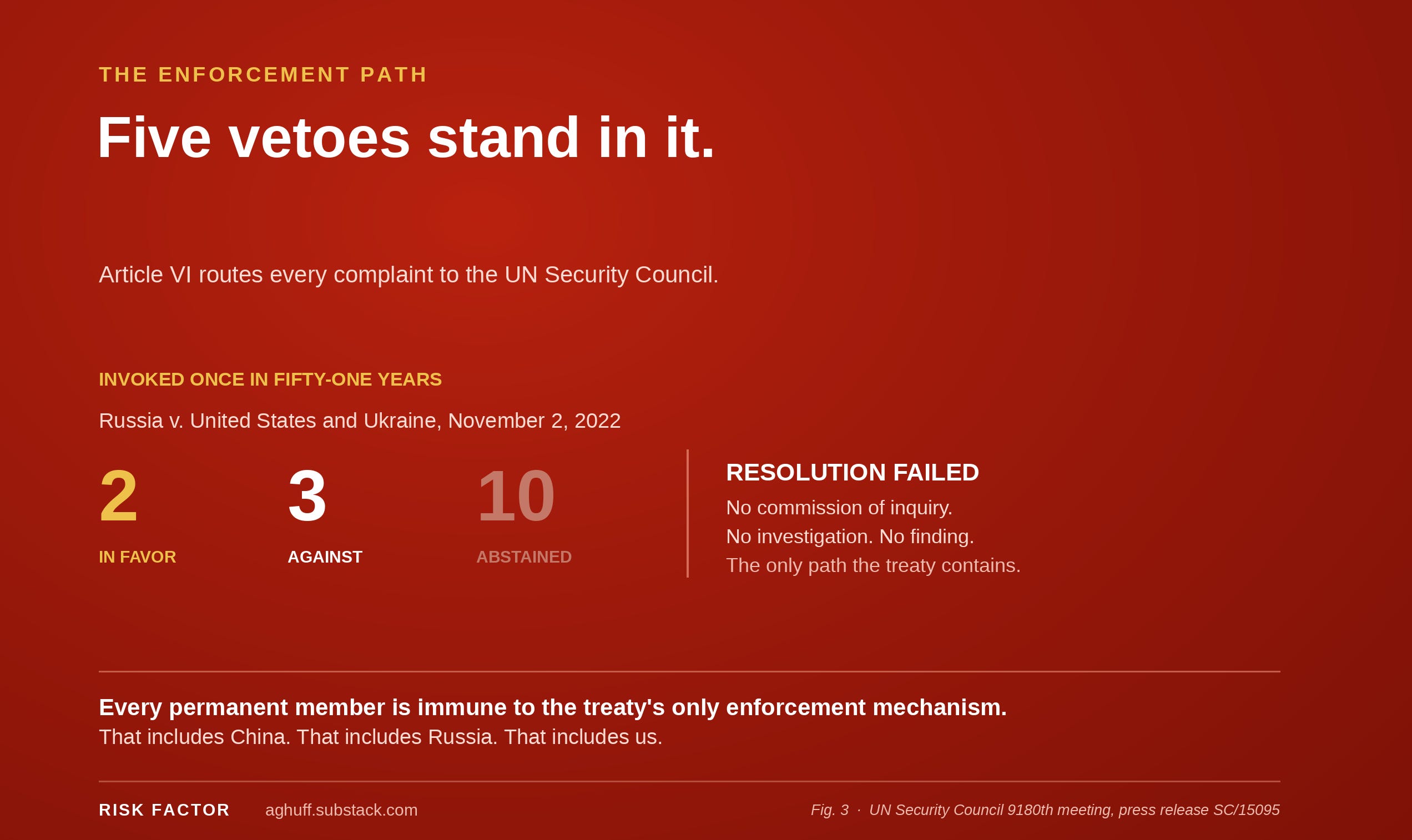
Fig. 3. Article VI in fifty-one years: one invocation, one failed vote, five permanent vetoes.
There is one more mechanism and it does not belong to the treaty. The UN Secretary-General’s Mechanism, established by General Assembly resolution in 1987 and reaffirmed by the Security Council in 1988, can investigate alleged use. UNODA states its own position plainly: for the Biological Weapons Convention “there is no equivalent implementing agency, and thus the UNSGM, which is distinct and independent from the BWC, is the only international mechanism to investigate the alleged use of biological weapons.” It also notes that the mechanism “is not a standing investigative body” [8].
It has been activated three times: Mozambique in 1992, inconclusive; Azerbaijan in 1992, no evidence found; Syria in 2013, concluding chemical weapons were used in four of seven instances investigated. All three were chemical. It has never once been used for a biological allegation [8].
It is in better shape than it was, and I want to give it credit. The roster stood at 649 qualified experts, 139 expert consultants, and 102 analytical laboratories as of July 2026. A ten-day field exercise in Berlin in September 2022, simulating an antimicrobial-resistant Yersinia pestis outbreak with 19 rostered experts from 16 countries, concluded that the mechanism was operationally ready, while flagging gaps in deployment speed against a 48-hour dispatch target, in chain of custody, and in sampling prioritization [8].
But eight years passed between the first capstone exercise and that one, and the training runs entirely on voluntary contributions. The only international capability to investigate the use of a biological weapon depends on whether someone remembers to fund the rehearsal.
From 1995 to 2001 the Ad Hoc Group negotiated a legally binding protocol. The Chairman’s text of March 2001 ran 210 pages, thirty articles, three annexes, nine appendices. It required initial declarations within 180 days covering possession back to 1946 and prior programs for the preceding decade, then annual declarations of containment facilities and national biological defense programs. It provided three kinds of visit, capped at 120 per year worldwide, of which randomly selected transparency visits were to be half to three quarters. It created an Organization for the Prohibition of Biological Weapons with about 250 staff and a 51-member Executive Council [9].
On July 25, 2001, Ambassador Donald Mahley rejected it for the United States. His reasoning was not that verification was undesirable. It was that this protocol would not produce any [10].
On declarations: “Our assessment of the range of facilities potentially relevant to the Convention indicates that they number, at least in the case of the United States, in the thousands, if not the tens of thousands. In addition, their number and locations change on an irregular but frequent basis. Thus, we had no hope that any attempt at a comprehensive declaration inventory would be accurate, timely, or enduringly comprehensive.”
On why the chemical analogy fails, which is the technically serious part: “In chemical manufacturing... the economics of their production dictates making them in a limited number of facilities. Such facilities, because of the toxicity and corrosiveness of the precursors, have recognizable infrastructure requirements... The Ad Hoc Group quickly recognized that no such cataloging was possible with respect to biology... Almost any facility that does biological work of any magnitude possesses the capability, under some parameters, of being diverted to biological weapons work.”
On the deterrent value of random visits, which he called twice-removed randomness: “a regime that contemplates, at best, declaration of an almost randomly-selected set of facilities... among that random sample of facilities, regular on-site activity would take place at only a random sample of even that sub-set... the overwhelming bulk of such activity would take place on the territory of those States Parties least likely to be proliferation candidates... simply does not provide anything remotely resembling a deterrent function on a proliferator.”
And the sentence that has governed the twenty-five years since: the mechanisms “would not achieve their objectives, that no modification of them would allow them to achieve their objectives.”
Here is where I part company with most people who quote Mahley approvingly, and with most people who quote him as a villain. He was right. He is still right. Every one of those claims survives twenty-five years of technological change, because none of them was a claim about technology. They were claims about the structure of biology and the structure of the agreement.
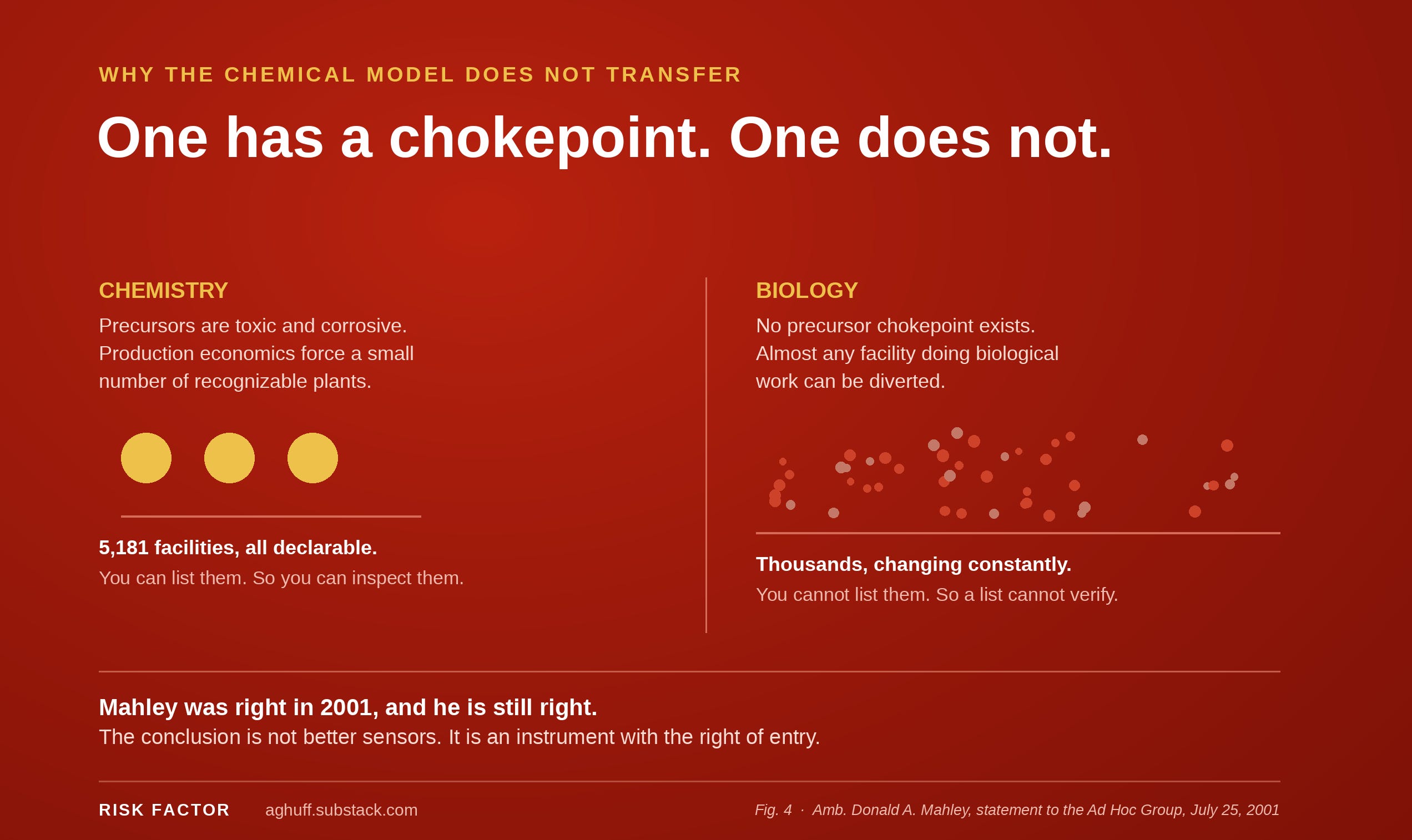
Fig. 4. Why the chemical model does not transfer. A chokepoint versus a capability that is everywhere.
But notice what follows from being right, because the conclusion the United States drew was the wrong one. If a declaration-and-random-visit regime cannot verify biology, and if the bulk of its burden falls on the states least likely to be proliferators, then the protocol was not too intrusive. It was too weak. It asked open societies to accept a cost and asked closed ones for almost nothing, which is the precise failure this series has now documented five times.
The right response in 2001 was not to walk away from verification. It was to demand a harder instrument. We did the first and called it the second, and twenty-five years later there are still four people in Geneva.
Which brings us to the current proposal, and to why I think it is worse than doing nothing.
On September 23, 2025, the President told the UN General Assembly that his administration would “lead [an] international effort to enforce [the] Biological Weapons Convention... by pioneering an AI verification system that everyone can trust” [11].
There is a real argument buried in there. Modern biology does leave more machine-readable exhaust than it did in 2001. Commercial synthesis providers retain the sequence, the vector, and the customer identity for every order for a minimum of eight years. Forty-three jurisdictions license exports of fermenters, spray dryers, and now benchtop nucleic acid synthesizers. Anyone with a credit card can task a satellite at fifty centimeters and have the image in four hours. Machine analysis of that material genuinely works for cueing: a two-year study by the Nuclear Threat Initiative and C4ADS on nuclear procurement data found 50 new leads in more than four million records, identified roughly twice as many high-risk entities as prior manual effort, and saw at least ten entities added to an American export control list during the study [12].
That is useful. It is useful for targeting, for cueing, and for refuting disinformation, which matters more than it sounds given that Russia’s 2022 campaign about Ukrainian biolabs worked partly because no neutral body could adjudicate it. What it is not is verification, and the distinction is not academic.
First, every one of those data streams is opt-in, and opt-in fails exactly when it counts. The gene synthesis industry’s own screening protocol, in its June 2026 edition, states the governing fact in its own text: “At the time of this publication, no country in the world requires Providers or Manufacturers to screen the sequences they are asked to synthesize” [13]. Not one. The American framework is a condition on federal funding, not a law, which means it reaches the people already taking federal money and nobody else. A program that does not wish to be screened orders from one of the several hundred providers outside the consortium, or buys a benchtop synthesizer, which is precisely why that machine sits on the Australia Group control list [14].
Second, the same defect runs through the export control data. Forty-three jurisdictions participate out of nearly two hundred. The control list explicitly exempts information in the public domain and basic scientific research, which for a knowledge-driven program is not a loophole but an open door. Whatever those licensing records show, they show it about the countries that keep licensing records.
Third, and this is the part that should settle it: we already ran the experiment on whether institutions surrender records when disclosure becomes consequential. We ran it on the origins of a pandemic that killed more than a million Americans, and it ran for six years through three levels of court.
In July 2020 the nonprofit US Right to Know asked the University of North Carolina at Chapel Hill for records concerning Professor Ralph Baric and his collaboration with the Wuhan Institute of Virology. The university identified 3.36 gigabytes of responsive material, an estimated 336,000 pages. Most of it was not turned over. US Right to Know sued in April 2022. A Superior Court judge ruled for the university in October 2024. The Court of Appeals affirmed unanimously on January 7, 2026. On June 19, 2026, the North Carolina Supreme Court declined to hear the appeal. The university has produced more than 130,000 pages and withheld 5,205 documents, of which 4,537 are withheld under a single provision of state law [22].
Read the mechanism, because it is the whole point. North Carolina exempts from disclosure “Research data, records, or information of a proprietary nature” held by state universities. The Court of Appeals held that the qualifier “of a proprietary nature” attaches only to the word information, and not to data or records. Under that reading, university research data and records need not be proprietary, or commercially sensitive, or secret in any ordinary sense, to be permanently exempt. US Right to Know argued the interpretation causes the exception to swallow the rule. The courts disagreed, and that reading is now settled law in North Carolina [22].
Notice what did not happen. Nobody defied a court order. The university litigated, and won, and is entitled to the win. That is precisely why the case is instructive. The records stayed sealed not because an institution broke the rules but because the rules, read by three levels of an American court, permitted it. If a domestic public university can lawfully withhold coronavirus research records from an American nonprofit for six years, the proposition that sovereign states will voluntarily surrender synthesis logs and facility declarations to an international body with no inspectors and no enforcement is not optimism. It is a category error about how institutions behave when disclosure becomes costly.
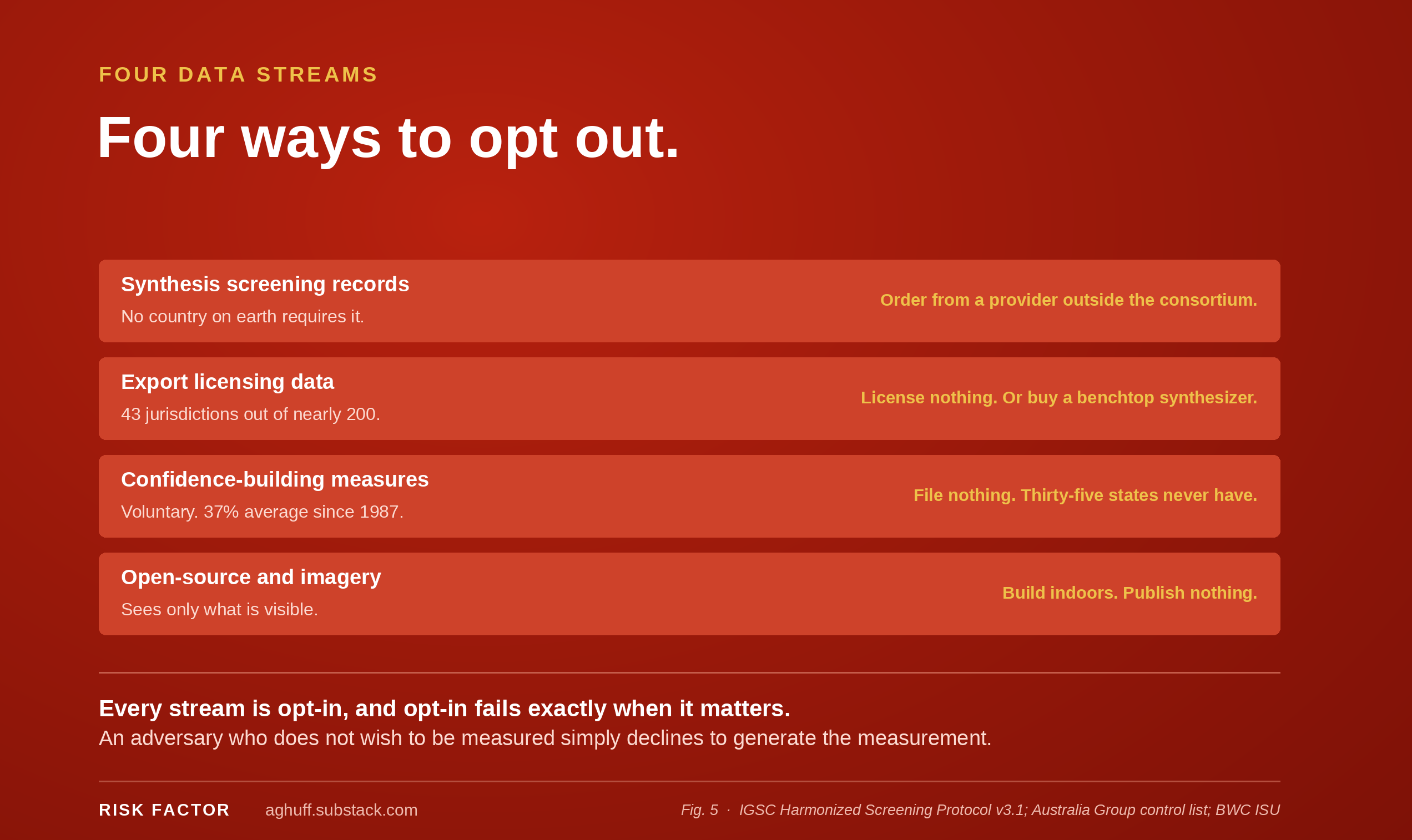
Fig. 5. Four data streams, four ways to opt out.
Fourth, an AI verification system is gameable by construction, and gameable in a direction that hurts us specifically. A model sees what data exists. A state that controls the data controls the model’s conclusions. Train it on open information and it will scrutinize the countries that publish, which is to say ours, and go quiet on the countries that do not, which is to say the ones we are worried about. Kirsten Angeles put the structural problem precisely: such a system “would be effectively blind to the majority of the compliance landscape, disproportionately scrutinizing the minority of states that choose transparency” [15]. We would build a machine that audits America and shrugs at Pyongyang, and then call it a verification regime.
Fifth, the technical community that would have to build it does not believe in it. James Revill of UNIDIR identifies the threshold problem: “Perhaps the most challenging obstacle facing the integration of AI into bioweapons treaty verification would be determining what AI tools should be designed to detect.” And he notes that states “are unlikely to entrust something as sensitive as verification of bioweapons programs to an algorithm that effectively black-boxes decisions,” and that even flagging anomalies “would still require a mechanism for challenge-type inspections to further investigate flagged facilities, and that is no small feat” [16]. Read that last clause twice. The algorithm’s output is a request for an inspection. If you have no inspectors, you have built an expensive way to generate questions nobody can answer.
Which is the real objection. An AI verification system does not fail because the math is bad. It fails because its actual function is political: it lets a government announce that it is solving the problem without asking any state to accept an inspector, and it lets an adversary accept the announcement without accepting anything else. It is a way to look like the chemical weapons regime without being it. Every party gets to claim assurance and nobody has to grant access.
It is worth being precise about the category, because the distinction is legal and not rhetorical. An announcement is a unilateral statement of intent or a political declaration. It expresses a policy position and carries no obligation enforceable at international law. An instrument is a formally negotiated text, a treaty or protocol or verification mechanism, that binds its parties and can be breached. The Biological Weapons Convention is an instrument. What has been offered in its place is an announcement.
This government has made that substitution before, in the adjacent domain. The Political Declaration on Responsible Military Use of Artificial Intelligence and Autonomy, launched by the United States at The Hague in February 2023 and endorsed by more than fifty states, is a serious and thoughtful document. It is also written entirely in the conditional. Every one of its ten measures begins with the words “States should.” Its operative commitment is that endorsing states will “make public their commitment to this Declaration.” Nothing in it can be violated, because nothing in it is an obligation [23].
That is the model now being proposed for biological weapons verification, and it is why the objection is structural rather than technical. A political declaration about artificial intelligence in military affairs costs a government nothing and binds it to nothing. A declaration that an algorithm will verify the Biological Weapons Convention costs the same and binds the same. Neither one puts a person inside a building.
There is no substitute for the badge and the right of entry. The chemical regime destroyed 72,304 metric tons because inspectors watched it happen, not because an analyst inferred it from trade data. The nuclear regime can say something meaningful about 190 states because roughly 275 people go to more than 1,400 buildings. When we wanted to know what Iraq had actually built, we did not model it. UNSCOM went and looked.
So specify the instrument. Not the 2001 protocol with better software. A successor convention, and I will call it what it would be: an International Biological Weapons Convention.
It needs five things, and the first four are borrowed from regimes that already work.
An implementing organization with inspectors. Not a four-person support unit. A technical secretariat on the order of the OPCW’s, with a standing inspectorate, its own laboratories, and a budget in the hundreds of millions rather than the low millions. The chemical regime’s roughly $95 million and five hundred people are the floor, not the ceiling, because biology has more facilities than chemistry does.
Mandatory declarations with a penalty for silence. The current regime treats non-filing as an absence of information. The successor must treat it as a finding. A state that declares nothing should face the consequences of a state that declared something suspicious, because under any voluntary system silence is the dominant strategy and thirty-five governments have been playing it for thirty-nine years.
Challenge inspection on short notice, with no veto over access. The chemical convention has this and it is the provision that makes the rest credible. Note that the OPCW has never conducted a challenge inspection, which critics cite as proof the tool is useless. It is proof of the opposite. The tool works by existing.
Managed access that protects trade secrets without conferring a veto. This objection killed the 2001 protocol and it has been solved in ratified treaty text since 1997. The IAEA Additional Protocol requires arrangements to protect “proprietary or commercially sensitive information” and then specifies that such arrangements “shall not preclude the Agency from conducting activities necessary to provide credible assurance” [17]. More than a hundred and forty states have lived under that language for a generation. Biology’s commercial-secrecy problem is not novel and does not require a novel answer.
And an enforcement path that does not run through the Security Council. This is the hard one and the non-negotiable one. As long as the consequence for a finding of non-compliance is a Council vote, the five permanent members are exempt, and a treaty that exempts the states with the largest programs is a treaty about everyone else. Whatever the mechanism, it cannot be one that any single major power can switch off.
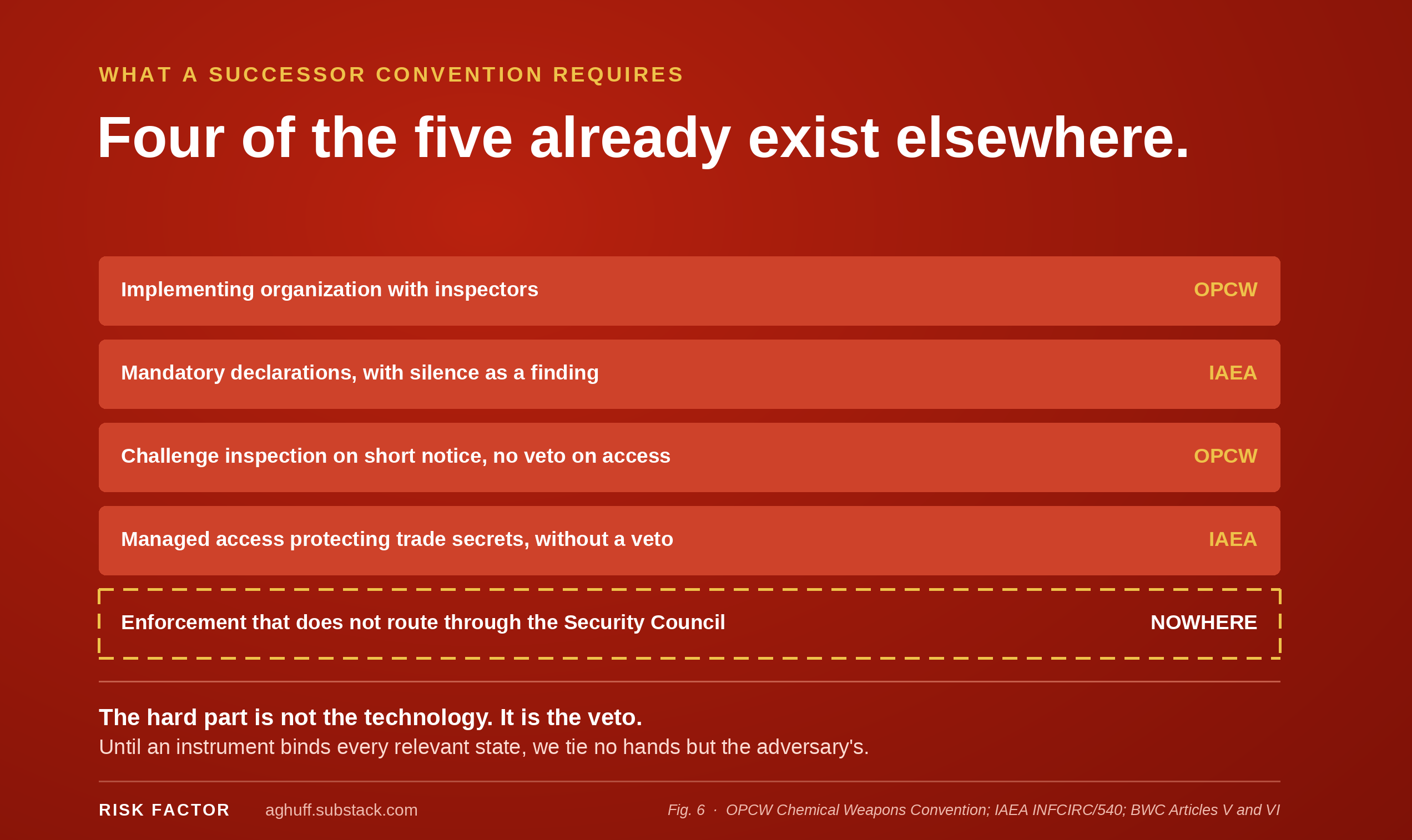
Fig. 6. What a successor convention requires, and which existing regime already does it.
Now the hard line, and it is the reason this article exists.
Until that instrument is in force and binding every relevant state, the United States accepts no unilateral constraint on its own biological programs. No freezing of American research. No inspection of American facilities. No accepting a limit whose only reliable effect is to reduce American capability while every adversary continues at full speed.
This is not obstruction. It is the test I set in Part IV and I intend to apply it consistently: does the rule reach the adversary, or only us? A screening mandate as a condition of market access reaches every supplier who wants to sell here, including foreign ones, so I support it. A research suspension reaches only the people we pay, so I oppose it. An inspection regime that binds all relevant states reaches adversaries, so I support it, and I would accept inspectors in American facilities as the price. An AI verification system that scrutinizes whoever publishes the most reaches us and nobody else, so I oppose it, and so should you.
Lead, then bind. Build the strongest biodefense enterprise in the world, and accept constraints when everyone is bound by them and somebody can actually check.
A word about credibility, because a government’s claim to verify the world rests on how it runs its own house.
The same administration proposing to verify global compliance by algorithm has not managed to run a functioning oversight process for research it directly funds. I documented this in Part IV, and the record has not improved. Executive Order 14292 wrote an exceptions route in Section 3(b); the agency announced it would accept no exceptions [18]. The order gave ninety days to revise the framework governing the commercial step where a dangerous sequence becomes physical DNA; that deadline passed 385 days ago and the federal page still says the replacement is coming [19]. Forty projects were suspended, at least twenty-two of them tuberculosis research on a pathogen that killed 1.23 million people in 2024, while the virology the order was written to catch went unlisted according to the policy’s own most prominent scientific advocate [20].
The review body that could hear an appeal does not exist. Its deadline is October 18, 2026, and the policy does not say who appoints its members or what standards they will apply. The relevant scientific society called the central definition “ambiguous as written” while noting that “the penalty for violation is high” [21].
So, the current architecture is a rule nobody can interpret, enforced with penalties nobody can appeal, administered by a body that has not been created, alongside a screening framework that expired more than a year ago and was never replaced. That is the domestic program of a government that proposes to audit the planet’s laboratories with software.
Fix the thing you control. An oversight process with definitions a competent researcher can apply, an appeal route with a clock, and a screening mandate with the force of law rather than the force of a funding condition. Then go to Geneva and ask other people for access.
“You are demanding an instrument that will never be negotiated, which is a sophisticated way of demanding nothing.” The strongest objection, and I feel its force. Russia and China will not accept challenge inspection soon, and a successor convention is a decade’s work at best. My answer is that the alternative on offer is not incremental progress but simulated progress, and simulated progress is worse than an honest deadlock because it removes the pressure that produces real agreements. The 2001 protocol failed and the response was twenty-five years of working groups. I would rather hold an empty table than sign at a rigged one.
“Refusing all unilateral constraint until a perfect treaty exists means never accepting any constraint.” Not all constraint, and the distinction is in Section VI. I support biosafety rules, containment engineering, select-agent controls, and incident reporting, because those prevent accidents and accidents require no adversary’s cooperation. I support screening mandates as market-access conditions, because they bind foreign suppliers too. What I oppose is a constraint whose only reliable effect is to lower American capability. If a critic can show that an inspection regime binding all relevant states falls in that category, I will revise in print.
“You dismiss AI verification while admitting machine analysis found real proliferation leads.” Both are true and the difference is what the output does. Cueing produces a question for a human to answer, and the nuclear case worked because there was an inspectorate and an export control apparatus to answer it. Verification produces an official finding of compliance. I support the first and oppose calling it the second. Build the analytic capability, use it to target inspections, and never let it substitute for them.
“Physical inspection cannot verify biology either. Mahley proved that, and you agreed with him.” The sharpest objection in the set, and it deserves a direct answer rather than a dodge. Mahley proved that routine random visits to declared facilities cannot verify biology. He did not prove that short-notice challenge inspection with no right of refusal cannot, and he was not asked to, because the 2001 protocol did not offer it. I concede this openly: an inspection regime for biology will be less conclusive than one for fissile material, because there is no biological equivalent of an isotopic signature and a twenty-liter fermenter is a twenty-liter fermenter. What inspection provides is not certainty. It is the cost of concealment, the risk of discovery, and a factual record that survives contact with a hostile information environment. Analysis at a distance provides none of those.
“Naming the pandemic-origins record is a partisan move that will cost you credibility with the people you need to persuade.” It may. I include it because it is the most instructive available test of whether institutions disclose when disclosure is costly, and because it requires no theory whatsoever about what happened in Wuhan. It requires only the docket. A public university, an American nonprofit, six years, three courts, 4,537 documents still withheld, and a statutory reading that makes research records exempt whether or not anything about them is proprietary. Nobody broke a law. That is the finding. If someone can show me a case where high-stakes biological records came out promptly and voluntarily, I will weigh it against this one.d
“You were Vice President at EcoHealth Alliance. You are the last person who should be demanding inspectors.” I am among the first, and for the obvious reason. I served there from 2014 to 2016, objected to the gain of function research at executive meetings, became a whistleblower about what I saw, and the organization’s later debarment is part of the record any reader should weigh. What that experience taught me is exactly what this article argues: self-reporting fails, voluntary compliance fails, and the only thing that reliably produces truth about a laboratory is somebody with authority standing in it. If I wanted to protect work like the work I once helped oversee, I would be advocating an algorithm.
Five parts have now documented the same failure in five domains. Part I showed the disease surveillance being switched off. Part II showed the medicines we chose not to onshore. Part III showed the best-evidenced cause of chronic disease waved off because acting on it meant defending vaccines. Part IV showed forty research projects frozen while the gate where dangerous DNA is bought and sold went unguarded. Part V shows a treaty with four people, no inspectors, and an enforcement path five countries can veto.
In every case the warning existed. In every case the fix existed. In every case the money and the attention did not, and the control we imposed landed on the people already following the rules.
Part VI asks who is accountable, and it will not be comfortable for anyone. It examines what happened when a movement built on the claim that American health had been captured by institutions took charge of those institutions, and what has been dismantled since. It asks a question with a checkable answer: who, by name and office, is responsible for coordinating the federal response to the next pandemic, and does that position currently have an occupant? And it returns to the pattern this series has traced five times to ask whether it is five failures or one.
The last five parts described a house with the smoke detectors removed. The next one asks who took them down, and who is standing in the hallway now.
Dr. Andrew G. Huff is an epidemiologist, security engineer, and former combat infantryman. He served as Vice President at EcoHealth Alliance from 2014 to 2016 and later became a whistleblower. He is the author of The Truth About Wuhan and lead author of the 2017 systematic review of global biosurveillance systems.
Competing interests: none. Funding: none. Risk Factor is funded entirely by its readers.
Corrections policy: if I have a material fact wrong, bring evidence and I will correct it in this post, visibly.
A note on scope: this article describes gaps in treaty verification architecture at a level already published in open policy literature. It contains no operational detail of use to anyone seeking to misuse biology.
Currency note: budget figures originally denominated in euros are converted to US dollars in the text at approximately 1.15 dollars per euro; the original euro figures appear in the endnotes. Conversions are mine.
Research verification and document production were AI-assisted under the author’s direction; all claims and citations were verified against primary sources on August 23, 2026.
1. UN Office for Disarmament Affairs, Biological Weapons Convention universality (https://disarmament.unoda.org/en/our-work/weapons-mass-destruction/biological-weapons/universality): 189 States Parties, 4 signatory states that have not ratified, 4 states that have neither signed nor acceded. Entry into force March 26, 1975. Comoros acceded February 14, 2025; Kiribati May 20, 2025.
2. BWC Implementation Support Unit, established at the Sixth Review Conference in 2006, housed in the UNODA Geneva Branch, with no verification, inspection, or investigative authority (https://disarmament.unoda.org/en/our-work/weapons-mass-destruction/biological-weapons/implementation-support-unit). Four fixed-term posts since 2023, one P-5, two P-4, one P-3, at roughly $1.28 million annually. The ISU overall cost estimates paper of August 20, 2025 lists the Convention’s Average Current Budget, covering the ISU and all BWC meetings, as $2,170,200 (https://docs-library.unoda.org/Biological_Weapons_Convention_-Working_Group_on_the_strengthening_of_the_ConventionSixth_session_(2025)/2025-0820_Overall_Cost_Estimates.pdf). These are UN figures already denominated in dollars.
3. OPCW decision C-30/DEC.6, November 25, 2025 (https://www.opcw.org/sites/default/files/documents/2025/11/c30dec06%28e%29.pdf), appropriating EUR 82,935,524 for 2026, which is approximately $95 million. Staffing of about 500 from more than 80 member states (https://www.opcw.org/about/technical-secretariat). Inspection figures from Report of the OPCW on the Implementation of the Convention in 2024, C-30/4, November 27, 2025 (https://www.opcw.org/sites/default/files/documents/2025/11/c3004%28e%29.pdf), paragraph 1.1 and Table 1: 229 inspections across 223 sites and 3,530 inspector days, of which 13 percent were CW-related and 200 were Article VI industry inspections; no challenge inspections and no investigations of alleged use in 2024. Destruction and facility totals from OPCW by the Numbers as of December 31, 2025 (https://www.opcw.org/media-centre/opcw-numbers): 72,304 metric tons declared and 72,304 destroyed; 5,181 industrial facilities subject to inspection; 193 States Parties.
4. IAEA 2026 regular budget of EUR 432,973,201 operational, expressed as EUR 371,914,263 plus $61,058,938, plus EUR 6,000,000 capital, appropriated under GC(69)/RES/6 at the 69th General Conference, September 2025 (https://www.iaea.org/sites/default/files/gc/gc69resdec-2025.pdf); approximately $490 million converted. Secretariat of some 2,560 staff (https://www.iaea.org/about/staff). Department of Safeguards of around 870 staff including about 275 deployed inspectors, per Director General Grossi, IAEA Bulletin 63-3, October 2022 (https://www.iaea.org/bulletin/iaea-safeguards-for-international-peace-and-security); this is the most recent published breakdown located and is four years old. 2025 activity from the Safeguards Implementation Report for 2025 (https://www.iaea.org/sites/default/files/sir-2025.pdf).
5. BWC Implementation Support Unit information briefing, Confidence-Building Measures under the Biological Weapons Convention, Daniel Feakes, Chief of the ISU, delivered August 15, 2025 to the Sixth Working Group session (https://docs-library.unoda.org/Biological_Weapons_Convention_-Working_Group_on_the_strengthening_of_the_ConventionSixth_session_(2025)/2025-0815_ISU_ppt_on_CBMs.pdf): 113 CBM reports in 2024, 60 percent of States Parties; 102 submissions as of August 15, 2025; 35 States Parties have never submitted, down from 62 in early 2020; more than 2,300 CBMs submitted since 1987. Mean participation across 1987 to 2024 is approximately 37 percent, derived from the ISU’s own printed series. Categories, the April 15 deadline, the deletion of category D by the Seventh Review Conference in 2011, and the should-submit formulation from UNODA (https://disarmament.unoda.org/en/our-work/weapons-mass-destruction/biological-weapons/confidence-building-measures). A separately reported figure of 117 submissions in 2025 appears in the Nonproliferation Review (doi 10.1080/10736700.2025.2591572) and is not a UN figure; the 2024 UN figure is used here.
6. Filippa Lentzos, Scott Wingo, Jez Littlewood and Asha Muti, “How new technology could make it easier to identify covert bioweapons programs,” Bulletin of the Atomic Scientists, September 15, 2025 (https://thebulletin.org/2025/09/how-new-technology-could-make-it-easier-to-identify-covert-bioweapons-programs/): applying acquisition pathway analysis to three program scenarios, “Depending on the scenario, 60 to 70 percent of potential warning signs of a bioweapons program would not be captured at all in submissions.”
7. UN Security Council, 9180th meeting, November 2, 2022, press release SC/15095 (https://reliefweb.int/report/ukraine/security-council-rejects-text-investigate-complaint-concerning-non-compliance-biological-weapons-convention-ukraine-united-states): the Russian draft resolution to establish a commission of inquiry under BWC Article VI, arising from its complaint against the United States and Ukraine circulated October 24, 2022, failed with 2 in favor (China, Russian Federation), 3 against (France, United Kingdom, United States), and 10 abstentions. On Article V: the 1997 Cuban Thrips palmi allegation proceeded as a Formal Consultative Meeting in Geneva, August 25 to 27, 1997, reporting December 15, 1997 that “it has not proved possible to reach a definitive conclusion”; Russia convened a Formal Consultative Meeting in September 2022 at which the vast majority of participating States Parties dismissed its allegations.
8. UN Secretary-General’s Mechanism (https://disarmament.unoda.org/en/our-work/weapons-mass-destruction/unsgm): established by General Assembly resolution A/42/37 C in 1987, reaffirmed by Security Council resolution 620 in 1988, operating under Guidelines and Procedures in A/44/561 endorsed by A/RES/45/57 C in 1990. UNODA states that for the BWC “there is no equivalent implementing agency, and thus the UNSGM... is the only international mechanism to investigate the alleged use of biological weapons,” and that it “is not a standing investigative body.” Three activations, all chemical: Mozambique 1992, Azerbaijan 1992, Syria 2013; see Brackmann et al., “Assessing Readiness of International Investigations into Alleged Biological Weapons Use,” Emerging Infectious Diseases 31(7), July 2025 (https://wwwnc.cdc.gov/eid/article/31/7/24-0841_article), also the source for the September 2022 Berlin capstone exercise, the 48-hour dispatch target, and the eight-year gap between capstone exercises. Roster figures as of July 2026, 649 qualified experts, 139 expert consultants, 102 analytical laboratories, from UNSGM Newsletter Issue 12 (https://media-publications.unoda.org/public/2026-08/UNSGM-issue12.pdf).
9. Arms Control Association, “Executive Summary of the Chairman’s Text,” May 2001 (https://www.armscontrol.org/act/2001-05/features/executive-summary-chairmans-text): the Chairman’s text of March 30, 2001, 210 pages, 30 articles, three annexes, nine appendices; Article 4 declarations; three visit types capped at 120 per year with randomly selected transparency visits at 50 to 75 percent of the total; Article 9 investigations; Article 16 establishing an Organization for the Prohibition of Biological Weapons of about 250 staff with a 51-member Executive Council. The July 2001 Composite Text, CRP.8, ran 218 pages, derived from a 343-page bracketed rolling text.
10. Ambassador Donald A. Mahley, statement to the Ad Hoc Group, Geneva, July 25, 2001, US Department of State Washington File EPF314 (https://usinfo.org/wf-archive/2001/010725/epf314.htm). All quotations in Section IV are verbatim from this text. The widely repeated claim that a US interagency review identified 37 serious problems does not appear in this statement and is not used here.
11. The President’s remarks to the UN General Assembly, September 23, 2025, quoted as rendered by the Carnegie Endowment, Lucas Fluegel, December 4, 2025 (https://carnegieendowment.org/posts/2025/12/biological-weapons-trump-united-nations-strengthen-treaty). Verify verbatim against the official UNGA transcript before publication. On the follow-through, see United States National Statement, BWC Meeting of States Parties, Under Secretary of State for Arms Control and International Security Thomas DiNanno, December 15, 2025 (https://geneva.usmission.gov/2025/12/15/united-states-national-statement-bwc-meeting-of-states-parties/), calling on “every State Party to join us in our efforts to seek ways in which AI and other tools can help us verify BWC compliance” and warning that “Inactivity or a failure to complete this important work would threaten to consign the BWC forum to oblivion.”
12. Erin Dumbacher and Page Stoutland with Jason Arterburn, “Signals in the Noise: Preventing Nuclear Proliferation with Machine Learning and Publicly Available Information,” Nuclear Threat Initiative, January 12, 2021 (https://www.nti.org/analysis/articles/signals-in-the-noise-preventing-nuclear-proliferation-with-machine-learning-publicly-available-information/): a two-year study finding that automated data preparation “could save hundreds of analyst hours and help identify twice as many potentially high-risk entities as previous manual efforts,” that applied to a baseline of more than four million records machine learning “could identify 50 new leads for further review,” and that “During the two-year study, at least ten entities identified through these approaches were added to a U.S. government export control list.” Imagery capability from Planet Labs high-resolution products (https://www.planet.com/products/high-resolution-satellite-imagery/): approximately 15 SkySat satellites at 50 cm with sub-daily tasking and delivery in under four hours.
13. International Gene Synthesis Consortium, Harmonized Screening Protocol v3.1, June 1, 2026 (https://genesynthesisconsortium.org/wp-content/uploads/IGSC-Harmonized-Screening-Protocol-V3.1.pdf), section 4: “At the time of this publication, no country in the world requires Providers or Manufacturers to screen the sequences they are asked to synthesize.” Sections 7.1 through 7.4: eight-year retention of sequence, vector, and recipient identity and shipping address; eight-year retention of screening results; screening of all orders at or above 200 base pairs, transitioning to 50 base pairs by October 24, 2026 to conform to the US framework. IGSC states its members “represent a majority of global commercial gene-length nucleic acid synthesis capacity”; the widely cited 80 percent figure originates with the Nuclear Threat Initiative, not IGSC, and has no published methodology. For scale, the IBBIS Global DNA Synthesis Map launched December 2025 (https://globalsynthesismap.bio/) identifies more than 700 providers across 81 countries.
14. Australia Group, Control List of Dual-use Biological Equipment and Related Technology and Software, dated November 30, 2022 (https://www.dfat.gov.au/publications/minisite/theaustraliagroupnet/site/en/dual_biological.html). Item 10 controls “Nucleic acid assemblers and synthesizers, which are partly or entirely automated, and designed to generate continuous nucleic acids greater than 1.5 kilobases in length with error rates less than 5% in a single run,” together with the software that designs functional genetic elements from digital sequence data. Participation of 43, being 42 countries plus the European Union, with adherents Kazakhstan in 2015 and Albania and Montenegro in 2025 (https://www.dfat.gov.au/publications/minisite/theaustraliagroupnet/site/en/participants.html). The related-technology provisions explicitly exclude information in the public domain and basic scientific research.
15. Kirsten Angeles, “How would an AI verification system work in the Biological Weapons Convention?,” Georgetown Security Studies Review, January 19, 2026 (https://gssr.georgetown.edu/the-forum/topics/biosec/how-would-an-ai-verification-system-work-in-the-biological-weapons-convention/), warning that a system trained only on public data “would be effectively blind to the majority of the compliance landscape, disproportionately scrutinizing the minority of states that choose transparency.”
16. James Revill, “How AI can (and cannot) improve verification of the Biological Weapons Convention,” Bulletin of the Atomic Scientists, October 6, 2025 (https://thebulletin.org/2025/10/how-ai-can-and-cannot-improve-verification-of-the-biological-weapons-convention/). Revill heads the WMD and Space Security Programmes at UNIDIR. See also UNIDIR, “Possible Models of BWC Verification,” November 2024 (https://unidir.org/wp-content/uploads/2024/11/UNIDIR_PossibleModelsOfBWCVerification_Report_web.pdf).
17. Model Additional Protocol, INFCIRC/540 (Corrected), approved by the IAEA Board of Governors May 15, 1997 (https://www.iaea.org/sites/default/files/infcirc540.pdf), Article 7 on managed access to protect proprietary or commercially sensitive information, which “shall not preclude the Agency from conducting activities necessary to provide credible assurance.” See also Article 4.a, “The Agency shall not mechanistically or systematically seek to verify the information referred to in Article 2,” and Article 5.c on access to Agency-specified locations for environmental sampling. Additional Protocols were in force with 141 states and Euratom as of March 31, 2023 per the IAEA (https://www.iaea.org/topics/additional-protocol) and 142 plus Euratom as of September 2024 per the Arms Control Association (https://www.armscontrol.org/factsheets/iaea-safeguards-agreements-glance).
18. Executive Order 14292, “Improving the Safety and Security of Biological Research,” signed May 5, 2025, 90 FR 19611 (https://www.govinfo.gov/content/pkg/FR-2025-05-08/html/2025-08266.htm), Section 3(b): “Heads of agencies shall report any exception to a suspension to the Director of OSTP for review in consultation with the APNSA and the heads of relevant agencies.” NIH Guide Notice NOT-OD-25-127, June 18, 2025 (https://grants.nih.gov/grants/guide/notice-files/NOT-OD-25-127.html): NIH “will not be accepting requests for exceptions to terminations or suspensions if deemed to meet the Executive Order’s definition of dangerous gain-of-function research.”
19. HHS ASPR, 2024 OSTP Framework for Nucleic Acid Synthesis Screening (https://www.aspr.gov/readiness-response/medical-countermeasures-biodefense/s3/synthetic-nucleic-acid-screening/ostp-framework-nucleic-acid-synthesis-screening), verified August 23, 2026 and still carrying the notice that agencies “will revise or replace” the framework and that the page “will be updated once the new framework is available.” The Section 4(b) deadline expired August 3, 2025; elapsed time is 385 days as of August 23, 2026.
20. Approximately 40 NIH awards suspended by mid-July 2025. Treatment Action Group statement, July 24, 2025, opposing “the suspension of at least 22 TB research awards” (https://www.treatmentactiongroup.org/statement/treatment-action-group-statement-on-suspension-of-tb-funding-over-white-house-gain-of-function-fictions/). Tuberculosis mortality of 1.23 million in 2024 from WHO, Global Tuberculosis Report 2025 (https://www.who.int/teams/global-programme-on-tuberculosis-and-lung-health/tb-reports/global-tuberculosis-report-2025). Richard Ebright, quoted in Reason, September 18, 2025 (https://reason.com/2025/09/18/the-trump-administration-misses-key-deadlines-for-imposing-restrictions-on-gain-of-function-research/): “What clearly happened was that the program officers assigned to virology simply nullified the executive order... Even the most glaringly obvious projects were not included on the list.” Ebright praised the order at signing as a major step.
21. United States Government Policy for Stopping High-Risk Life Sciences Research, dated July 20, 2026 and released July 28, 2026, and NIH Guide Notice NOT-OD-26-101 (https://grants.nih.gov/grants/guide/notice-files/NOT-OD-26-101.html), establishing 120 days for agency implementation guidance and 90 days to establish a single independent third-party review body, with suspensions remaining in place until both exist. Measured from the July 20 issue date those deadlines fall on November 17 and October 18, 2026. As of August 23, 2026 the review body has not been established. American Society for Microbiology, July 29, 2026 (https://asm.org/press-releases/2026/july/asm-statement-on-usg-high-risk-life-sciences-resea): “The differentiation between DGOF and Potential DGOF is ambiguous as written,” and separately, “The definitions are broad, the penalty for violation is high, and the resulting ban on swaths of research will inhibit national preparedness to combat infectious disease threats.”
22. US Right to Know v. University of North Carolina at Chapel Hill. The North Carolina Supreme Court denied discretionary review on June 19, 2026 (https://www.carolinajournal.com/nc-supreme-court-will-not-take-unc-records-case-tied-to-covids-origin/). The unanimous Court of Appeals decision of January 7, 2026, authored by Judge Jefferson Griffin, upheld Superior Court Judge Alyson Adams Grine’s October 2024 order accepting the university’s interpretation (https://appellate.nccourts.org/opinions/?c=2&pdf=45134; see also https://www.carolinajournal.com/judges-reject-public-records-case-linked-to-unc-and-covid-19s-origins/ and https://dailytarheel.com/314020/university/university-unc-records-case-covid-origin-denied/). The exemption is N.C. Gen. Stat. section 116-43.17: “Research data, records, or information of a proprietary nature, produced or collected by or for state institutions of higher learning in the conduct of commercial, scientific, or technical research where the data, records, or information has not been patented, published, or copyrighted are not public records as defined by G.S. 132-1.” The Court of Appeals held that “the phrase ‘of a proprietary nature’ in section 116-43.17 solely modifies ‘information,’” so research data and records are exempt without regard to proprietary character. Document counts, the 3.36 gigabyte and 336,000 page estimate from the July 2020 request, and the April 2022 filing date are from UNC’s February 2026 filing opposing review (https://www.ncappellatecourts.org/show-file.php?document_id=397066) and US Right to Know’s January 29, 2026 petition (https://www.ncappellatecourts.org/show-file.php?document_id=395963). The university’s position, stated in its filing: “The University has already made considerable disclosures concerning its coronavirus research, limiting public interest in this case.”
23. Political Declaration on Responsible Military Use of Artificial Intelligence and Autonomy, US Department of State (https://www.state.gov/bureau-of-arms-control-deterrence-and-stability/political-declaration-on-responsible-military-use-of-artificial-intelligence-and-autonomy). Launched at the Responsible AI in the Military Domain summit in The Hague in February 2023; Vice President Harris announced 32 endorsing states on November 1, 2023, and the list has since exceeded fifty. All ten measures are framed as what “States should” do, and the operative undertakings include that endorsing states will “make public their commitment to this Declaration.” On its status as a non-binding political commitment rather than a source of legal obligation, see the American Journal of International Law contemporary practice note (https://www.cambridge.org/core/journals/american-journal-of-international-law/article/united-states-unveils-political-declaration-on-responsible-military-use-of-artificial-intelligence-and-autonomy/6778323C139D0EAF91AA9CE49F50E808). The declaration is cited here as an example of the announcement category, not as a criticism of its content.
Figures current as of publication. Elapsed time since the August 3, 2025 screening deadline is 385 days. Currency conversions are at approximately 1.15 dollars per euro; original euro figures appear in the endnotes.
Two claims rest on an absence of evidence and are stated as such. First, no United States working paper specifying an artificial-intelligence verification system has been located in the UN Office for Disarmament Affairs document library for the 2025 or 2026 sessions, and the phrase artificial intelligence does not appear in the negotiated text of BWC/WG/8/CRP.1/Rev.1. Second, no United States national statement to the ninth session of the Working Group was located. Both are searches that returned nothing rather than confirmations that nothing exists. If either document is produced, this piece will be corrected visibly under the corrections policy above.
The President’s remarks to the UN General Assembly of September 23, 2025 are quoted as rendered by the Carnegie Endowment rather than from the official transcript, and are attributed accordingly in endnote 11.
The ninth session of the Working Group closed on August 21, 2026. Its formal report had not been issued at the time of writing; nothing in this article depends on it. Text status is quoted from BWC/WG/9/CRP.1/Rev.4 of August 19, 2026, and proceedings from contemporaneous daily reporting.
No posts
Comments
Nothing yet. Say the first thing.
Sign in to join the conversation.